|
 |
Costa Rica Your daily |
 |
|
|
|
|
|||||||||||||||||||
 |
||||||||||||||||||||
|
|
|||||||||||||||||||
 |
|
|
|
|
|
|
|
|
| What we published this week: | Monday | Tuesday | Wednesday | Thursday | Friday | Earlier |
|
|
 |
 |
 |
||||||||
| A.M. Costa Rica's Second newspage | |||||||||
| Home |
Tourism |
Calendar |
Classifieds |
Entertainment |
Real
estate |
Rentals |
Sports |
About
us |
|
| San José, Costa Rica, Tuesday, Aug. 31, 2010, Vol. 10, No. 171 | |||||||||
 |
| Costa Rica Expertise Ltd http://crexpertise.com E-mail info@crexpertise.com Tel:506-256-8585 Fax:506-256-7575 |
 |
 |
|
Go to Page 5 HERE! Go to Page 6 HERE! Sports is HERE! |
NEXT PAGE |
|
get bid invitation today By the A.M. Costa Rica staff
The La Gaceta government newspaper is supposed to be carrying this morning the invitation to bid for cell telephone concessions. The Superintendencia de Telecomunicaciones said that the long awaited invitation instructs potential bidders to obtain the 200-page document that outlines the requirements and procedures for bidding. At stake are three sets of frequencies that will allow the development of a cell telephone service. The requirements are strict. A bidder must show annual income of $450 million and 1.8 million telephone subscribers elsewhere. The firm also has to have five years experience in operating such a system and has to have experience in setting up a new system. There are about a half dozen companies that fill the bill. They have 45 days to prepare the bid and submit it. A company may only win rights to one frequency set. Casa Presidencial characterized what follows as a long and complex process. The Superintendencia has to evaluate the offers and any eventual contracts must be reviewed by the Contraloría de la República. Casa Presidencial said the executive branch was counting on the good disposition of the Instituto Costarricense de Electricidad, which now operates the telephones. Any new arrival will be a direct competitor, and the former telecom monopoly fought hard to make the auctioning of the spectrum as long and difficult as possible. There also is the possibility of prolonged court battles. The Superintendencia is acting after the Sala IV constitutional court said that it must resolve the matter quickly. In early August the high court gave public officials three months to award concessions for the frequencies. Specifically the Sala IV ordered the Ministerio de Ambiente, Energía y Telecomunicaciones, the Superintendencia de Telecomunicaciones and the Instituto Costarricense de Electricidad to coordinate their efforts so that the award of cell telephone concessions would take place in three months. Companies will bid on one of three packages of spectrum. Concessions one and two each consist of 15 MHz in the 1800 MHz frequency and 15 MHz in the 1.9/2.1 GHz range, with uplink and downlink for a total of 60 MHz. Concession three has three frequency bands, with 5 MHz in the 850 MHz range, 15 MHz in the 1800 MHz spectrum, and 10 MHz of 1.9/2.1. The concession decisions will be the end of a long road that began in 1995 when the U.S.-based Millicom was forced to end cellular telephone service. The Sala IV determined that the new innovation infringed on the monopoly that was guaranteed to the Instituto Costarricense de Electricidad. Millicom had been offering the cell service here since 1989. It took the government monopoly more than a year to resume the cell service. Once before the government tried to open up the telephone industry to private companies. Riots ensued and the idea was abandoned. The current opening is due to the free trade treaty with the United States. Having lost its monopoly service, the government-owned Instituto Costarricense de Electricidad fears a loss of income. The fears are well grounded because local telephone service, including cell service, is offered at less than cost. The government telecom company has been dogged by complaints of poor coverage, overloaded systems and other flaws, not to mention less than stellar customer service. Nancy Grace show notes case of missing U.S. citizen By the A.M. Costa Rica staff
CNN's Nancy Grace is publicizing the case of David Gimelfarb who disappeared a year ago after hiking in Parque Nacional Rincón de la Vieja. A story about the case is on the CNN Web site. There is no indication if the story will make the television show. There are no new leads in the case. CNN noted that two other men vanished in Guanacaste last year. Gimelfarb is from the Chicago, Illinois, area, and his parents have not given up. Periodically there are reports that an individual resembling him has been seen. Michael Dixon, a British tourist, and Craig Snell, an expat from Ostional, are the other two missing men. Snell vanished under suspicious circumstances from somewhere near his home in March 2009. Dixon vanished in Tamarindo last Oct. 18. His family, too, has been aggressive in keeping his name in the news. Another U.S. citizen, Roger Peter Biennvennu, 64, has been missing since early July, according to the Judicial Investigating Organization. He lived in Barrio Quebradas, San Isidro de Peréz Zeledón. 3,000 volunteers to help clean up By the A.M. Costa Rica staff
Some 3,000 volunteers will clean up 50 locations during September as part of a national campaign run by the Asociación Terra Nostra with support form the Instituto Costarricense de Turismo and private companies. The campaign is designed to raise consciousness among Costa Ricans about cleanups and conservation. Volunteers will be working along many of the rivers, in San Carlos, in Guanacaste, in Heredia, the Osa peninsula and in Manuel Antonio. This is the second such national cleanup event. The first was last September with about 2,500 volunteers who picked up nearly 26,000 kilos of trash, some 57,200 pounds.
|
|||||||||||||||||||||||||||||||||||||||||||||||||||
 |
||||||||||||||||||||||||||||||||||||||||||||||||||||
| Home |
Tourism |
Place
classified ad |
Classifieds |
Entertainment |
Real
estate |
Rentals |
Sports |
About
us |
|
| What we published this week: | Monday | Tuesday | Wednesday | Thursday | Friday | Earlier |
| The contents of this page and this Web site are copyrighted by Consultantes Río Colorado 2001, 2002, 2003, 2004, 2005, 2006, 2007 and 2008 and may not be reproduced anywhere without permission. Abstracts and fair use are permitted. Check HERE for details | ||||||
 |
| A.M. Costa Rica third newspage |
 |
||||||||
| Home |
Tourism |
Calendar |
Classifieds |
Entertainment |
Real
estate |
Rentals |
Sports |
About
us |
|
| San José, Costa Rica, Tuesday, Aug. 31, 2010, Vol. 10, No. 171 | |||||||||
 |
| Page One is HERE! Page 2 is HERE! Page 4 is HERE! | NEXT PAGE |
| Bumper rice crop overwhelms storage and drying facilities |
|
|
By Dennis
Rogers
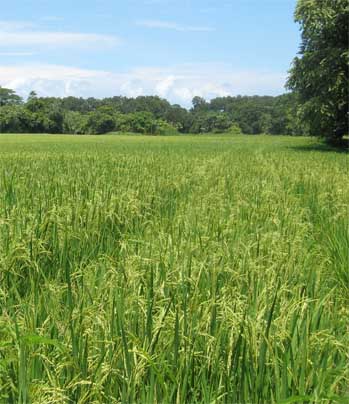
Special to A.M. Costa Rica Increases in the Costa Rican rice crop, largely the result of government efforts to stimulate production, have run up against available capacity to dry and store the grain. Reaction to price spikes related to the economic crisis of 2008 led the central government to embark on a program to increase self-sufficiency in the production of basic grains. The Plan Nacional de Alimentos was the result. Given the proportion of the population that subsists mainly on rice and beans, the price of those staples has important social implications. Costa Ricans each year eat more than 50 kilograms (110 pounds) of rice per capita, accounting for 22 percent of total calories, according to the United Nations Food and Agriculture Organization. In the Americas, only Surinam, Haiti, and Panamá get significantly more calories from rice. For some Southeast Asian countries, rice makes up 70 percent of calorific intake or more. Recent years have seen national rice production at about 50 percent of consumption, with the remainder made up by imports, according to figures from the Corporación Arrocera Nacional. The plan’s goal is to have that figure at 80 percent. Conarroz describes itself as a “public, non-governmental agency.” Since 2009 was a drought year and production was poor, increases in production as a result of the plan’s stimulus programs were not so notable. Government price supports have resulted in considerable land converted from cattle ranching to rice, according to Minor Barboza, chief of operations for Conarroz. Climatic conditions have been good. Depending on the area planted during the second cycle that runs from January to June, the harvest should be about 270,000 tons for the year that runs from July 2010 to June 2011, Barboza said. As recently as 2007 production was at 155,000 tons, down from 266,000 in 2001. The 270,000 tons figure will be roughly the 80 percent of consumption sought by the government plan. At present there is a 35 percent duty on imported rice until the local supply is exhausted, when it drops. The harvest is mostly in around the southern part of the country, underway in the far north, and just about to start in the Caribbean zones where rice is grown. The bottleneck has been with drying the grain, not |
 A.M. Costa Rica/Dennis Rogers
This field near Quepos is nearly ready for harvest.storage. Barboza said Conarroz and the industry have been taking measures to avoid “heating” and spoilage. To some extent rice can be aerated still in the truck while waiting at the processing plant. Also there is some risk farmers will try to harvest early and get their rice into the processing queue, which means greener and wetter grain. Spoiled grain will end up as animal feed, said Barboza. The national plan for rice foresaw that processing capacity was inadequate for the 80 percent level, and recommended the rehabilitation of old driers and silos belonging to the Consejo Nacional de Producción. This did not happen in time for the quick increase in production, with private investment also inadequate. Most processing capacity in the country is in private hands. The Consejo traditionally was a crop and marketing support agency to help small farmers. Its profile has fallen in recent years with the introduction of other agencies. Its funding is largely from the Fábrica Nacional de Licores, makers of the Cacique brand aguadiente. However sales of Cacique have fallen of late and the heavily overstaffed agency has seen salaries rise to as much as 90 percent of its budget, allowing no investment in other areas. Along with a recent scandal where allegedly ineligible farmers had been given loans that were subsequently forgiven, that has lead to efforts to close the Consejo and distribute its functions among other agencies. The employees’ union has blocked these efforts so far. |
| Magistrates involve themselves in school discipline case |
|
|
By the A.M. Costa Rica staff
If a child in public school is punished by a teacher, a parent always can carry the issue to the Sala IV constitutional court. That is what happened this year. In a decision released Monday the constitutional court set aside punishment leveled on a student at Escuela Carlos Luis Valverde Vega in Cartago. |
The violation that resulted in the
punishment was not made clear, but a
teacher deducted 33 points from the child's grades and required the
student to give a talk to classmates. For this, the mother filed
a
request for the court to intervene. The mother said that the punishment lacked due process and that no defense was permitted. She added that the child was not allowed to speak in defense in the company of a parent or tutor. |
 |
| You need to see Costa Rican tourism information HERE! |
| Home |
Tourism |
Place
classified ad |
Classifieds |
Entertainment |
Real
estate |
Rentals |
Sports |
About
us |
|
| What we published this week: | Monday | Tuesday | Wednesday | Thursday | Friday | Earlier |
| The contents of this page and this Web site are copyrighted by Consultantes Río Colorado 2001, 2002, 2003, 2004, 2005, 2006, 2007 and 2008 and may not be reproduced anywhere without permission. Abstracts and fair use are permitted. Check HERE for details | ||||||
| A.M. Costa Rica fourth news page |
 |
||||||||
| Home |
Tourism |
Calendar |
Classifieds |
Entertainment |
Real
estate |
Rentals |
Sports |
About
us |
|
| San José, Costa Rica, Tuesday, Aug. 31, 2010, Vol. 10, No. 171 | |||||||||
| Page One is HERE!
Page Two is HERE!
Page
Three is HERE! Page Five is HERE! Page Six is HERE! The sports page is HERE! |
Next Page |
| Voters abroad urged to balance out the
irrational in U.S. |
||
|
By the A.M. Costa Rica staff
Overseas Democrats are being urged to vote because they are less given to irrationality and could tip the balance in many close races, according to the former executive director of Democrats Abroad. The former director, Tom Fina, sent a letter over the weekend to overseas Democrats to urge them to register and vote. He writes periodically for the organization. "Unless there is a sharp turn-around, the November elections will be decided not by Democrats, Republicans or Independents but by irrationals," Fina said. The combination of an angry right and an angry left threatens the Democratic majority in both houses of Congress and the public policy changes on which Barack Obama campaigned and for which he was elected, he said, adding: " . . . voters are also justified in their frustration about the continued casualties and bleak outlook in Afghanistan, the perception that despite the billions of dollars given the Government of Pakistan to fight the Taliban, it is protecting it. Nor, is there any confidence in the Afghan Government which is failing its own people as well as the United States and other countries that are fighting the Taliban. And, while Obama has removed combat troops from Iraq ahead of schedule, the prolonged failure of the Iraqi parties to form a functioning government adds to |
public despair
that we have just been spinning our wheels. Fina said the most insidious attack was the claim that Obama is a Muslim and not born in the United States. He cited an Aug. 19 Pew Research poll that said that even less than half of the registered Democrats think Obama is a Christian. Fina noted that traditional Republicans have problems with anti-establishment candidates winning in seven state party primary elections. "Will these right wing irrationalists deliver winning votes to Republican candidates or will they scare the bejesus out of moderate Republicans, Independents and diffident Democrats to defeat them," he asked. In the long run these Republican positions in total opposition to the Obama Administration and in support of right wing racial and religious intolerance will be costly, Fina said, adding that congressional elections are short run and Republican leaders are willing to sell their souls for the short run. Fina said he hoped Obama's speech tonight contains pivotal statements about wars in Iraq and Afghanistan and about his economic policy. "Both issues cry for bold leadership that could influence the November outcome," he said. Both Democrats and Republicans are trying to get out the oversea vote. Most expats vote in the state and district in which they last lived before they moved overseas. |
|
| San Carlos will be setting for
concert-rodeo doubleheader |
||
|
By the A.M. Costa Rica staff
Mexican actress and singer Ninel Conde will be the main attraction at a San Carlos concert the same night of what is being described as an American-style rodeo on Oct. 2. Productora de Eventos Masivos Bleak Producciones S.A. is the producer of both events. The rodeo event is one of several that are planned for the same month. The location will be the Cámara de Ganaderos en Platanar in San |
Carlos, and the
time is 7 p.m. A team called Súper Bull Riders will
participate, organizers said. In addition, Ms. Conde will be accompanied by the Costa Rican group Charlie XX-27. Ticket holders will be able to attend both events, the organizers said in a release. Ms. Conde is a Latin Grammy award winner who also has had key roles on soap operas or novelas, as they are called in Spanish. |
|
| Home |
Tourism |
Place
classified ad |
Classifieds |
Entertainment |
Real
estate |
Rentals |
Sports |
About
us |
|
| What we published this week: | Monday | Tuesday | Wednesday | Thursday | Friday | Earlier |
| The contents of this page and this Web site are copyrighted by Consultantes Río Colorado 2001, 2002, 2003, 2004, 2005, 2006, 2007 and 2008 and may not be reproduced anywhere without permission. Abstracts and fair use are permitted. Check HERE for details | ||||||
| A.M. Costa Rica fifth news page |
|
|||||||||
| Home |
Tourism |
Calendar |
Classifieds |
Entertainment |
Real
estate |
Rentals |
Sports |
About
us |
||
| San José, Costa Rica, Tuesday, Aug. 31, 2010, Vol. 10, No. 171 | ||||||||||
 |
| Page One is HERE!
Page 2 is HERE! Page Three is HERE! Page Four is HERE! Page Six is HERE! Sports page is HERE! |
NEXT Page! |
| U.N. official condemns murder of radio journalist Special to A.M. Costa Rica
The recent murder of a radio journalist in Honduras brings to nine the number of media professionals killed there so far this year, and prompted a senior United Nations official to call for urgent action to stem the rise in violence against members of the press. Irina Bokova, the director-general of the U.N. Educational, Scientific and Cultural Organization condemned the murder of Israel Zelaya Diaz, a reporter for Radio Internacional in San Pedro Sula, the country’s second largest city. The 62-year-old radio journalist, known as Zagatay, reported on a variety of local topics, including politics and crime. He was found shot to death on the edge of a sugarcane field near the city Wednesday He is the ninth journalist killed in Honduras this year, according to Reporters Without Borders and the International Press Institute. “It is vital that this crime be investigated thoroughly, just as every effort should be made to end the violence and intimidation targeting journalists in Honduras,” Ms. Bokova stated in a news release. “It is the duty of the authorities to see that the basic human right of freedom of expression is recognized.” Ms. Bokova has also condemned the Aug. 11 murder of Magomedvagif Sultanmagomedov, the editor-in-chief of the television station Makhachkala-TV in the Russian republic of Dagestan. Sultanmagomedov, who had escaped a previous attempt on his life in 2008, died of gunshot wounds after the car he was travelling in came under submachine-gun fire in central Makhachkala. “The killing of a journalist constitutes an attack against freedom of expression, a fundamental human right. Furthermore, it is an attack on our freedom as citizens to be informed and to participate in the democratic process. “I call on authorities to do their utmost to ensure that the ongoing investigation solves this crime,” said Ms. Bokova. Caribbean author pens book on daily life there Special to A.M. Costa Rica
"Time Flies Like Cow" by Geoffroy Birtz is a collection of philosophical introspection packaged in clever narrative, according to a news release on the book. The author lives in Gandoca on the southern Caribbean coast. He is Canadian and a former computer consultant. The release described the book this way: Influenced by everyday observations, Birtz pens his thoughts as his observations provoke him. "Time Flies Like Cow" follows the narrator for a day as he drives around completing errands. As the narrator travels in his community, he ponders many subjects. From economics to education and quantum physics to social behavior, "Time Flies Like Cow" offers insight on a variety of concepts. Birtz intends for Time Flies Like Cow to be a social commentary and reflective treatise presented with humorous prose. The book touches on many aspects of current events and hopes to relate to a broad range of readers. Time Flies Like Cow is available online at Amazon.com and other retail channels. Some chapters are online at the author's Web site. |
|
 |
| Home |
Tourism |
Place
classified ad |
Classifieds |
Entertainment |
Real
estate |
Rentals |
Sports |
About
us |
|
| What we published this week: | Monday | Tuesday | Wednesday | Thursday | Friday | Earlier |
| The contents of this page and this Web site are copyrighted by Consultantes Río Colorado 2001, 2002, 2003, 2004, 2005, 2006, 2007 and 2008 and may not be reproduced anywhere without permission. Abstracts and fair use are permitted. Check HERE for details | ||||||
| A.M. Costa
Rica sixth news page |
|||||||||
| Home |
Tourism |
Calendar |
Classifieds |
Entertainment |
Real estate |
Rentals |
Sports |
About us |
|
|
|
|||||||||
| Page One is HERE!
Page 2 is HERE! Page Three is HERE! Page Four is HERE! Page Five is HERE! Sports page is HERE! |
Calendar is here! |
| Food & Entertainment |
| The
cookie knows all about the activities of the computer user |
|
|
By the A.M. Costa Rica wire services
It's called behavioral marketing, but it might just as well be called virtual profiling. Web sites, search engines, advertising agencies and Internet data collectors — they're all using relatively basic technology to record what you're looking at, how much you like it, and most importantly, what you might want to buy online. "Advertisers are building large, complex profiles on customers," says Ginger McCall with the Electronic Privacy Information Center. Profiles she says contain all sorts of information about you, where you live, what you do, who your friends are, and what your preferences may be. All that information is focused into one purpose, says Susan Grant with the Consumer Federation of America: "To serve them with ads that are more directly targeted to things they are interested in." Depending on your perspective, it's either a great idea, or just a little bit creepy. Here's how behavioral marketing works. Web sites drop what are called "cookies" into a visitor's computer. This cookie is really the technology that tracks visitors as they click around within a Web site and as they move from site to site. This detailed information is blended into customer profiles and used mostly by Internet advertising networks to target consumers. |
"You have thousands of Web sites that consumers go to," says Mike Zaneis of the Interactive Advertising Bureau. "You have thousands of marketers that want to reach those consumers. An ad network is the middle-man." While some firms try to keep these data profiles as anonymous as possible, Susan Grant notes that even that amount of privacy is ebbing away, thanks to increasingly sophisticated computer tracking. "It's relatively easy to match certain information such as zip codes and financial information and figure out who somebody is," she says. All this has some, like Ginger McCall, raising alarms about our eroding privacy online. "Facebook had transformed their service so that now they're putting a cookie with the user and that cookie can track the user across the Internet. When you sign up with Facebook, you have to give that service your real name so, absolutely, the tracking information is being connected with your actual identity." It isn't just networking sites like Facebook, or retailers like Amazon. Cookie-generated data is also gathered by data collection companies. That information is packaged into millions of customer profiles that are then grouped, bundled and sold to advertising networks. Consumer advocates like Ed Mierzwinski of the non-profit US Pirg are not amused. "These companies have a goal of collecting information, keeping it forever and selling it to as many different kinds of companies that want to buy it," he warns. Adding to the concerns are a new generation of computer algorithms that amass known information about a user, then draw predictions about what they might be like in their public, and their private lives. "They can also make assumptions about you in terms of your sexual preferences, your race, your ethnicity or your finances," says Grant. "The information can be accessed and used by somebody for purposes that you never dreamed of." For example, says Ed Mierzwinski, "You might eventually have that piece of information about your surfing habits somehow collected by an insurance company that would harm you by charging you more." Advertising networks and websites say they voluntarily follow regulations that prohibit the sharing of private information, especially data on your health or your finances. And says Mike Zaneis, an evolving self-regulatory program will allow Web surfers a choice. "We're talking about a single icon that consumers can easily understand and discover that is delivered in and around targeted ads. 'Click here' if you would like to opt out of all this third party data tracking." But instead of opting out, critics say, Web users should have the choice to opt in. "If you're the sort of person that likes to have targeted advertising, says Ginger McCall, "then you should be able to opt in to that service. It shouldn't be that you are inherently opted in by default." "Do I have to opt out of every Web site that I go to?" asks Mierzwinski. "Why shouldn't the Web sites that I go to ask me a question? 'Hi Ed, how are you? Do you want to opt in to us collecting information about you so we can offer you what we think are better deals?' Why doesn't it work that way?" Opt in or opt out — it may not matter because individuals already have the power to control their cookies, just by adjusting their brower's privacy settings. Not enough, say privacy advocates who argue there are cookies, and then there are cookies: things such as "flash cookies" and "super cookies" that can get around a user's browser controls. For the time being, when it comes to privacy, Internet users are pretty much on their own. |
Latin American news Please reload page if feed does not appear promptly |
|
| |
|
| Home |
Tourism |
Place
classified ad |
Classifieds |
Entertainment |
Real
estate |
Rentals |
Sports |
About
us |
|
| What we published this week: | Monday | Tuesday | Wednesday | Thursday | Friday | Earlier |
| The contents of this page and this Web site are copyrighted by Consultantes Río Colorado 2001, 2002, 2003, 2004, 2005, 2006, 2007 and 2008 and may not be reproduced anywhere without permission. Abstracts and fair use are permitted. Check HERE for details | ||||||