|
|
A.M.
Costa Rica
Your daily English-language news source Monday through Friday |
 |
| (506) 2223-1327 |
Published
Monday,
May 1,
2017, Vol. 17,
No. 85
|
Email us |
|
|
|||||||||||||||||||||
|
||||||||||||||||||||||
|
|
| Page Two is HERE!
Page Three is HERE!
Page Four is HERE! Page Five is HERE! Page Six is HERE! and Page 7 is HERE! Classifieds are HERE! Real estate is HERE! Useful Links! |
Next
Page |
| What we published this week: | Monday | Tuesday | Wednesday | Thursday | Friday | Earlier |
|
|
|
|
|
|
|
Food |
|
|
Abstracts and fair use are permitted. Check HERE for more details |
| A.M. Costa Rica's Second news page |
|
Published Monday,
May 1, 2017,
Vol. 17, No.
85
|
|
|
|
|
|
|
Food |
|
|
Go to Page 5 HERE! Go to Page 6 HERE! Sports is HERE! Opinion is HERE! Classifieds are HERE! Plus useful links |
NEXT PAGE |
|
Rainy
season returns to affect air travel
By the A.M.
Costa Rica staff
The advent of the rainy season interjects another variable into air travel. Tourists arriving and leaving have been surprised by delays cause by volcano eruptions. Turrialba ash has halted flight operations at Juan Santamaría airport several times over the past two years. The dust from the Poás volcano that has just begun erupting generally goes to the west, but a change in winds could cause problems at the international airport, too. Flight operations were halted Saturday for about 20 minutes at Juan Santamaría when a thunderstorm cell passed overhead. Members of the ground crew took shelter under roofs, and the departure of three aircraft were delayed. A lightning strike can fry the electronics of an aircraft, and thunderstorms also generate freak winds. Some Atlanta, Georgia-bound tourists faced problems with the delay because they were connecting with flights to New Orleans, Louisiana, and Boston, Massachusetts. In addition to the airport delay, the tourists faced crowds at U.S. immigration and customs in Atlanta. Rain is normal every day of the rainy season, usually after noon. Saturday at 1 p.m. Atlanta flight left on time, but the lightning delayed a 2:15 p.m. flight because the storm swept in just as the ground crew was about to push back the aircraft. Aircraft storm radar is useless on the ground because the signals are blocked by the terminal buildings. So pilots have to rely on information provided by other sources to determine the size of the storm and for how long it will be overhead and a danger. The normal path for storms coming from the west is over the Alajuela airport and along the southern part of the capital, mainly the Hatillos. Commercial jets can fly and land in rain as long as the storm does not generate lightning. Man caught with $41,500 undeclared cash By the A.M.
Costa Rica staff
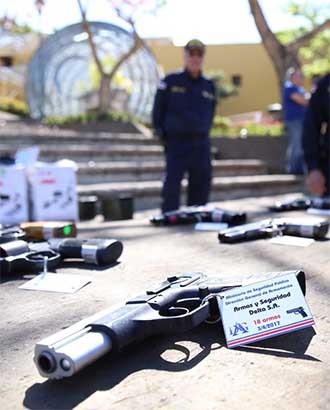
A 22-year old Mexican national was arrested Saturday at Juan Santamaría airport when he attempted to bring in $41,500 of undeclared money into the country. According to a report, officers of the airport police and Policía de Control de Drogas apparently noticed the suspect was obviously nervous when approaching security scanners. He was pulled aside and his luggage searched. Within one of the suitcases police said that they had found an enormous find of cash. The Mexican citizen was apparently supposed to return to his country next Tuesday, police said. The Ministerio de Seguridad Pública claims that the suspect in custody has refused to give the reason why he had attempted to smuggle the cash through along with its origins. 162 artifacts seized in Guanacaste raid By the A.M.
Costa Rica staff
Authorities with the Judicial Investigating Organization seized over 162 archaeological pieces believed to be of pre-Columbian origins from a suspect’s house in Santa Cruz Friday morning. The judiciary established an investigation that apparently included surveillance and a raid on the home of a 50-year old man where the objects were found, according to a report. Investigators believe that the suspect intended to sell these pieces, which have been valued by the judiciary’s experts as being worth more than 3.5 million colons, or $6,283. Photos of the objects released by the judicial agents show mainly stone pieces with legs and flat top resembling miniature foot rests. The suspect remains in custody.  A.M. Costa
Rica/Google Earth
map
Glenn Klima
proposes a separate crossing using old rail
line.
Our
reader's opinion
Paso Canoas needs separate crossings Dear A.M. Costa Rica: I have a suggestion regarding the border crossing in Canoas! It would involve a bit of cooperation with Panamà and most of the land involved is old United Fruit railroad right of way, which the government likely controls in one way or another. I can elaborate further. My suggestion involves the creation of a separate crossing for all commercial cargo vehicles, thereby allowing the existing crossing and Aduana to remain as is for human crossing. Simply by removing the commercial trucks from the present traffic congestion would be a permanent and efficient solution to the insanity of the present border crossing congestion. The red line would be a road built by Costa Rica, and it is all old railroad right-of-way, which some national entity likely owns. The green area would be a fenced compound purchased and constructed by Costa Rica, large enough to park say 100 trucks. This would be complete with the agricultural spray and livestock quarantine. In other words: a modern facility. The blue line would be a road created by Panamá, as well as a marshaling yard to process vehicles. This would ease the traffic congestion at the existing crossing and only personal vehicles and buses would cross and use the existing Aduana I choose the railroad route for several reasons, but primarily because of the likely ownership of this would be some agency within the national government. Also, the railroad was designed and constructed to accommodate steam locomotives so the ballast, or basic foundation for a two-lane roadway is already in existence. Another plus is that it is very straight for about 11 miles. The marshaling or processing compound would have to be acquired from the present owners. And of course Panamá would have to agree and build similar facilities on their side of the border! Glenn Klima
Golfito
|
||||||||||||||||||||||||||||||||||||||||||||||||
|
Go to Page 5 HERE! Go to Page 6 HERE! Sports is HERE! Opinion is HERE! Classifieds are HERE! Plus useful links |
NEXT PAGE |
|
|
|
|
|
|
|
Food |
|
| What we published this week: | Monday | Tuesday | Wednesday | Thursday | Friday | Earlier |
| The contents of this Web site are copyrighted by Consultantes Ro Colorado S.A 2017 and may not be reproduced anywhere without permission. Abstracts and fair use are permitted. Check HERE for details | ||||||
A.M. Costa Rica Third News Page |
 |
|
Published Monday,
May 1, 2017,
Vol. 17, No.
85
|
||||||
|
|
|
|
|
|
Food |
|
| Page One is HERE! Page 2 is HERE! Page 4 is HERE! | NEXT PAGE |
| Love
of cycling and cocoa creates unique chocolate-making
process |
|
|
By Rommel Téllez
of the A.M. Costa Rica staff What started as a love for cycling and cocoa ended up as a hobby. That hobby became a full time activity and a way of living for Andrés Ulate, an entrepreneur who founded Bicichocolate. The Costa Rican-based business is a chocolate processing company that relies on leg-generated power machines known as bicimáquinas. This Heredia-based company toasts and grinds raw cocoa seeds by using modified bicycles that take the need of electricity away. The special bicycles are also used to mix the resulting chocolate paste, which will become tablets or chocolate drink powder. “My family owns a small property in Sarapiquí and every time I went there I would come back with a few cocoa seeds to sell,” Ulate said. “One day, a friend told me I would not get much from selling them alone and that I should look to provide added value by processing them a bit more.” “By then, I got acquainted with the works of Carlos Marroquín, a Mayan native who created bicycle-based machines for different purposes and the idea was born,”added Ulate. In Guatemala, Carlos Marroquín teaches to anyone interested how to adapt a bicycle to fulfill a specific need. He has created machines to pump water, launder clothing or shake fruit smoothies. In the case of Ulate, he started his business with three of these machines. The first one is a toaster machine with a special plate that spins at a regular speed. That’s where the seeds are placed while heated by a gas device. His second machine is a grinder that helps him create black pure slick chocolate paste much faster than using a regular machine. Finally, Ulate also relies on a bici-shaker, which he uses to prepare cocoa-based drinks. |
 Bicichocolate photo
Founder Andrés
Ulate examines some cocoa beans.
“Most of my products I
sell at small craftsmanship fairs or special events
where I am invited to show my idea however Heredia
is still my best market,” he said.
“In my own ideal scenario I see my business growing by a combination of more machines and also the use of alternative power sources,” Ulate explained. “Sustainability is part of our identity and we need to keep that up.” So far, Bicichocolate is engaged with obtaining more funding to expand its business, but they are not seeking partners. Ulate’s wish is to keep the operation within family control, in order to maintain the charm of his brand. “Well, I do eat my own chocolates every day. I’m not tired of it. I just love it,” he said. “I feel very proud of chocolate’s indigenous origins and its health benefits for the heart, mind and humor.” |
 |
| |
 |
| |
 |
| |
 |
| |
 |
| |
 |
| |
 |
| Page One is HERE! Page 2 is HERE! Page 4 is HERE! | NEXT PAGE |
|
|
|
|
|
|
|
Food |
|
| What we published this week: | Monday | Tuesday | Wednesday | Thursday | Friday | Earlier |
| The contents of this Web site
are copyrighted by Consultantes Río Colorado S.A.
2017 and may not be reproduced anywhere without
permission. Abstracts and fair use are permitted. Check HERE for details |
||||||
A.M. Costa Rica's Fourth News page |
|
Published Monday,
May 1, 2017,
Vol. 17, No.
85
|
||||||
|
|
|
|
|
|
Food |
|
| Page 1 is HERE! Page 2 is
HERE! Page 3 is HERE! Page 5 is HERE! Page 6 is HERE! The sports page is HERE! Opinion is HERE! Classifieds are HERE! Plus useful links |
Next Page |
| Study in Osa Peninsula gives new look at
tropical forest carbon cycle |
|
|
By the University of
Colorado Boulder press staff
Tropical rainforests are often described as the lungs of the earth, able to essentially inhale carbon dioxide from the atmosphere and exhale oxygen in return. The faster they grow, the more they mitigate climate change by absorbing carbon dioxide. This role has made them a hot research topic, as scientists question what will happen to this vital carbon sink long-term as temperatures rise and rainfall increases. Our findings fundamentally change a view of the tropical forest carbon cycle that has been published in textbooks and incorporated into models of future climate change for years. Conventional wisdom has held that forest growth will dramatically slow with high levels of rainfall. But Boulder researchers this month turned that assumption on its head with an unprecedented review of data from 150 forests that concluded just the opposite. “Our data suggest that, as large-scale climate patterns shift in the tropics, and some places get wetter and warmer, forests will accelerate their growth, which is good for taking carbon out of the atmosphere,” said Philip Taylor, a research associate with the Institute of Arctic and Alpine Research. “In some ways, this is a good-news story, because we can expect greater CO2 uptake in tropical regions where rainfall is expected to increase. But there are a lot of caveats.” Ecologists have long thought that forest growth follows a hump-shaped curve when it comes to precipitation: To a point, more rainfall leads to more growth. But after about 8 feet per year, it was assumed too much water can waterlog the ecosystem and slow the growth rate of forests. While working in the Osa Peninsula of Costa Rica, Taylor began to question this assumption. “Here we were in a place that got 16 feet of rain per year, and it was one of the most productive and carbon-rich forests on Earth. It clearly broke from the traditional line of thinking,” he said. Intrigued, Taylor spent four years synthesizing data on temperature, rainfall, tree growth and soil composition from rainforests in 42 countries, compiling what he believes is the largest pan-tropical database to date. The study, published recently in the journal “Ecology Letters,” found that cooler forests below 68 degrees Fahrenheit on average, which make up only about 5 percent of the tropical forest biome, seemed to follow the expected hump-shaped curve. But warmer forests, which are in the majority, did not. “The old model was formed with a lack of data from warm tropical forests,” said Taylor, who describes such remote, often uninhabited forests as the final frontiers of scientific exploration. “It turns out that in the big tropical forests that do the vast majority of the breathing the situation is flipped. Instead of water slowing growth down, it accelerates it." |
 University of Colorado
photo
Phillip Taylor, lead
author, climbs tree in Osa Peninsula.
Taylor
cautioned this does not mean climate change won’t
negatively impact tropical forests at all.
In the short term, research has shown, droughts in the Amazon Basin have already led to widespread plant death and a 30 percent decrease in carbon accumulation in the past decade. “A lot of climate change is happening at a pace far quicker than what our study speaks to,” he says. “Our study speaks to what we can expect forests to do over hundreds of years.” Because the carbon cycle is complex, with forests also releasing carbon into the atmosphere as plants die, it’s still impossible to say what the net impact of a wetter climate might mean for the forest’s ability to sequester carbon, said senior author Alan Townsend, a professor of environmental studies. “The implications of the change still need to be worked out, but what we can say is that the forest responds to changes in rainfall quite differently than what has been a common assumption for a long time,” said Townsend. Going forward, the authors hope the findings will set the record straight for educators and scientists. “Our findings fundamentally change a view of the tropical forest carbon cycle that has been published in textbooks and incorporated into models of future climate change for years,” said Taylor. |
Here's reasonable
medical care
Costa Rica's world class medical specialists are at your command. Get the top care for much less than U.S. prices. It is really a great way to spend a vacation. See our list of recommended professionals HERE!amcr-prom
|
|
|||||||||||||||||||||||||||||||||||||||
|
|
| Page 1 is HERE! Page 2 is
HERE! Page 3 is HERE! Page 5 is HERE! Page 6 is HERE! The sports page is HERE! Opinion is HERE! Classifieds are HERE! Plus useful links |
Next Page |
|
|
|
|
|
|
|
Food |
|
| What we published this week: | Monday | Tuesday | Wednesday | Thursday | Friday | Earlier |
| The
contents
of
this
Web
site
are copyrighted by Consultantes Río Colorado S.A. 2016
and may not be reproduced anywhere without
permission. Abstracts and fair use are permitted. Check HERE for details |
||||||
|
A.M. Costa Rica's Fifth news page |
 |
|
|
Published Monday,
May 1, 2017,
Vol. 17, No.
85
|
|||||||
|
|
|
|
|
|
Food |
|
|
|
U.S. warns
vaccine supply
for yellow fever will run out By the A.M. Costa
Rica wire services
U.S. health officials said the United States will run out of the vaccine for yellow fever as early as next month, and travelers who need a shot might have to wait. Officials say a manufacturing problem has created a shortage of the only version of the vaccine licensed in the United States. The vaccine is recommended for travelers to certain parts of South America and Africa, with more than a dozen countries requiring proof of vaccination in order to enter. The disease was eradicated in the United States more than 100 years ago, and the vaccine is not a part of routine inoculations. Officials with the Centers for Disease Control and Prevention say they are bringing in another vaccine that is used in other countries to try to lessen the shortage. However, they say it will only be available in about 250 of the 4,000 U.S. clinics that administer the shot. Health officials are urging travelers to plan ahead, saying it will likely take longer to get the vaccine and people might need to travel farther to get it. Yellow fever can cause jaundice, abdominal pain, vomiting, internal bleeding and organ failure. Most people improve after more mild symptoms of fever and chills, however, about 15 percent of infected people become seriously ill. The virus is spread by the same mosquito that transmits the zika virus and other tropical diseases. Officials say there has recently been a global shortage of the vaccine.  Voice of America
photo
Fernando
Villavicencio speaking on YouTube.
Ecuadorian
journalist faces
tough sentence for defaming By the A.M. Costa
Rica wire services
Fernando Villavicencio knows all too well the risks confronting journalists who expose information that others want to suppress. The Ecuadoran journalist, convicted of defaming President Rafael Correa under the country’s harsh communications law, has spent parts of the past few years in hiding rather than submit to prison. He already has paid nearly $50,000 in fines. He faces current charges, and a pretrial detention order, for allegedly disseminating private emails of Correa and another official. He and his family have faced long separations, as well as threats of physical harm. “The government cannot afford to let my voice be free,” he said last month, speaking from an undisclosed location via a Skype audio connection. Last week, the 52-year-old author and founder of the FOCUS Ecuador news website applied for political asylum in Lima, Peru, fearing he would not get a fair trial in the current case. His website was suspended last month. The fact that Villavicencio is seeking asylum is a clear reflection of Ecuador’s systematic persecution of critics, Carlos Lauría, the Committee to Protect Journalists’ senior program coordinator for the Americas, said in a statement last week. The committee encouraged Perú to grant the pending request and urged “Ecuadoran authorities to drop all charges against Villavicencio immediately and allow him to return home without fear for his freedom to work as a journalist.” Press freedom in Ecuador has been eroding, according to reports released this week by the committee and another watchdog group, Reporters Without Borders. The group scored Ecuador a 105 in declining order among 180 countries. Freedom House, a U.S. government-subsidized non-government organization that monitors human rights records, last year bluntly described Ecuador’s media environment as not free. Its new report is due out Friday. Since Correa took office in 2007, Ecuador has experienced practically a decade of incessant persecution of police, media, judicial and even economic, Villavicencio said. Ecuadoran authorities did not respond to several requests for comment on Villavicencio’s case. Soon after Correa became president, the U.S.-educated economist and former Ecuadoran finance minister labeled much of his country’s foreign debt as illegitimate. The OPEC country defaulted on its loans in 2008, setting the stage for later financial dependence on and oil deals with China. Correa also increased public spending, reducing poverty levels from 38 percent in 2006 to below 23 percent in 2014, according to the World Bank report. But, as the BBC noted in a profile, the socialist castigated independent media as his greatest enemy and an impediment to his reforms. Villavicencio first tangled with Correa in 2010 while serving as an aide to an opposition legislator, the Committee to Protect Journalists explained in a 2014 profile. The president, detained at a police hospital during a police revolt, summoned army troops who killed at least five people. Villavicencio and the lawmaker demanded investigating Correa for perpetrating crimes against humanity. No probe took place. But Correa filed a defamation suit that eventually yielded prison terms and fines for Correa, the lawmaker and a third man. Villavicencio was given 18 months and ordered to pay $47,000. His wife, Ms. Sárauz, said she raised $10,000 of the amount through crowdsourcing, then borrowed the rest from friends. Meanwhile, Villavicencio went on the run, hiding out with an Amazon tribe before shifting among a series of safe houses to elude authorities. And he wrote. Villavicencio, who once worked for the national oil firm EP Petroecuador, used his insider knowledge to investigate corruption and environmental degradation linked to the industry. That was the focus of “Ecuador: Made in China,” a 2013 book. In 2013, the country adopted a communications law that is one of the most regressive that has been promulgated not only in Ecuador but in the Americas in the last decade, Lauría said. As the Committee explained, Villavicencio then riled up authorities over an article he co-wrote criticizing the government’s legal wrangling with the U.S.-based oil company Chevron. The writers were accused of illegally obtaining and disseminating government officials’ personal emails. Villavicencio traveled to Washington in 2014 to get a protective order from the Inter-American Commission on Human Rights. Ecuador’s government said it would not recognize the measure. The latest of Villavicencio’s nine books, called “The Oil Holiday,” published in March, contends that intermediaries in Venezuela’s oil deals with China profit at the public’s expense. Villavicencio, who had considered running for an assembly seat last fall, left Ecuador for Perú shortly after the election. He sees Ecuador headed down the same dangerous path as Venezuela, said his homeland struggles with corruption, debt and a lack of government transparency. This week, Ecuador’s government said it would fine seven news organizations for not reprinting an Argentine story that accused Lasso of tax evasion, which is a charge he denied. The government later backed off imposing fines. Last-minute cancellation maroons concert attendees By the A.M. Costa
Rica wire services
Promoters of a planned exclusive music festival on a small island in the Bahamas cancelled the event at the last minute Friday after many attendees had already arrived and paid thousands of dollars for tickets. “Due to circumstances out of our control, the physical infrastructure was not in place on time and we are unable to fulfill on that vision safely and enjoyably for our guests,” said a statement announcing the event’s cancellation. Organizers of the Fyre Festival promoted it as a once-in-a-lifetime musical event on a remote island once owned by Pablo Escobar, the infamous Colombian drug lord. Revelers paid between $450 and $12,000 for tickets to the two-weekend festival and were expecting to arrive and find sun and luxury. When the first guests reached the island Thursday, though, they found a festival site in disarray and none of the things that were promised. Social media posts from people on the island showed the luxury accommodations they paid for were actually small tents, some of which were still in boxes. The gourmet catering promised by organizers turned out to be literally bread, cheese, and salad with dressing, one person wrote. In a statement released Friday, the Bahamas Ministry of Tourism said it was extremely disappointed at the way organizers handled the event and said it had representatives at the festival site assisting people as they try and get home. Organizers said they were trying to arrange charter flights to Miami for people that had already arrived on the island and officials in the Bahamas cancelled all inbound flights to the island. Environmental groups march on hundreds of U.S. cities By the A.M. Costa
Rica wire services
Thousands of environmental activists marched in the U.S. capital Saturday, and in about 300 other cities across the country, to try to draw support for climate-related causes. The People's Climate March was meant to coincide with President Donald Trump's 100th day in office, according to its organizers, who have condemned what they see as the administration's lack of concern for environmental issues. They said they objected to Trump's rollback of restrictions on mining, oil drilling and greenhouse gas emissions at coal-fired power plants, among other things. "The Trump administration's policies are a catastrophe for our climate and communities, especially low-income and communities of color, who are on the front lines of this crisis," the People's Climate Movement, a collection of about 50 liberal activist groups, said in a statement. Protesters marched from the Capitol to the White House, where they held a rally. About 300 sister marches or rallies were held in cities from Seattle to Boston. In Washington, marchers braved temperatures in the 90s, while in Denver, it snowed on several hundred activists who had gathered. The partner organizations that made up the event's steering committee consisted mainly of environmental groups but included several trade unions and anti-war and minority advocacy groups. The presence of so many non-climate-related sponsoring organizations was reflected in the group's platform, which listed issues the activists said they found important but didn't feel were being adequately addressed by the Trump administration. The platform blended the problems organizers said were created by climate change with economic and social justice issues, and it called for such changes as increasing the national minimum wage to $15 an hour and fighting the corporate trade-induced global race to the bottom. A similar event last weekend saw thousands of activists show up in the nation's capital for the March for Science to protest what they said were denials of scientific truths by the Trump administration. About 600 rallies were held around the world as well. The national demonstrations on Saturday occurred a day after the Environmental Protection Agency announced it was updating its website to reflect the views of the Trump administration. It then removed several pages from former President Barack Obama's administration that explained the science behind climate change. The vast majority of scientists who study the climate say the planet is unequivocally warming, and that it is extremely likely the change is predominantly caused by humans. Trump White House defends invite to Rodrigo Duterte By the A.M. Costa
Rica wire services
The White House on Sunday defended President Donald Trump's invitation to his Philippine counterpart to visit Washington, saying the need to fortify an Asian alliance against North Korea's growing military threat outweighed concerns about President Rodrigo Duterte's deadly domestic crackdown on drug trafficking. “Whether they're good folks or bad folks, people we wish would do better in their country, doesn't matter. We've got to be on the same page," said White House chief of staff Reince Priebus in an interview with ABC news. Priebus' comments came a day after the White House announced the invitation, and just hours after a Philippine presidential spokesman said Trump told Duterte by phone that he was interested in developing a warm, working relationship. A White House statement called Saturday's call between the two leaders very friendly. It made no mention of the international controversy around Duterte's widely condemned war on drug trafficking, a violent initiative that has drawn the ire of the United Nations and most Western heads of state. Last year, then-U.N. chief Ban Ki-moon strongly condemned Duterte's support for the extra-judicial killings, calling them a breach of fundamental human rights and freedoms. Since taking office last year, analysts say Duterte's drug war has led to more than 6,000 deaths, about one-third of them in police raids and the remaining by vigilantes. At one point late last year, Duterte boasted to British media that he had personally killed three suspects while he was mayor of the southern city of Davao. Saturday's presidential phone call also coincided with another North Korean ballistic missile test north of Pyongyang. U.S. and South Korean analysts say the test failed, with the missile falling, without causing harm, into the Sea of Japan. Washington has responded to recent North Korean missile activity by ordering the deployment of a sophisticated anti-missile system to ally South Korea. President Trump also has ordered the deployment of a flotilla of warships. Pyongyang conducted two unauthorized nuclear test explosions last year and about two dozen rocket launches in a years-long push to expand its nuclear weapons and ballistic missile programs.
|
|
||||||||||||||||||||||||||||||||||||||||||||||||||
|
|
| Page One is HERE! Page 2 is HERE! Page 3 HERE! Page 4 is HERE! |
NEXT PAGE |
|
|
|
|
|
|
|
Food |
|
| What we published this week: | Monday | Tuesday | Wednesday | Thursday | Friday | Earlier |
| The
contents
of
this
Web
site are copyrighted by Consultantes Río Colorado S.A.
2017 and may not be reproduced anywhere without
permission. Abstracts and fair use are permitted. Check HERE for details |
||||||
| A.M. Costa Rica sixth news page |
|
Published Monday,
May 1, 2017,
Vol. 17, No.
85
|
|||||||||
| Calendar |
Opinion |
Classifieds |
Real estate |
|
Food |
|
|||
| Page 1 is HERE! Page 2 is HERE! Page 3 is HERE! Page 4 is HERE! Page 5 is HERE! Page 7 is HERE! Sports is HERE! Opinion is HERE! Classifieds are HERE! Plus useful links |
Next Page |
Calendar is |
| Food |
||
| Lifestyle |
|
Follow the trimming
trucks to get ready-to-use top dressing Here’s a tip for all you gardeners. Follow those ICE branch trimming trucks! Back in the States, getting top dressing and soil amendments was as easy as heading to the local Home Depot or Lowes garden section, grabbing a cart, and loading up bags of whatever you needed. Not so in Costa Rica. We do have a local macadamia nut farm and they occasionally have bagged nut shells for sale to use as a top dressing. We also have places to buy rice husks although the closest is almost an hour away and they are great to amend heavy soils.
I was helping a friend with measurements on her new home when I wandered out into the driveway. That’s when I spotted it: a pile of wood chips! And not just one pile, there were several. Alright, you have to be hungry for mulch and top dressing to start waxing poetic about a pile of chips, but I was starving. ICE, it turns out, doesn’t just trim trees back from its poles and wires, it brings in great big chippers to turn them from branches to chips. And then what? Then it just dumps the chips on the ground. Oh the waste. Gardeners all over the country hungry for wood chips and ICE just dumps them. It’s embarrassing, that’s what it is. Evidently, no one in management has heard of “waste not, want not” and I am not going to tell them because then I would have nothing for my yard. Remember, I have a big yard and big gardens. So far, I estimate that my gardener and I have loaded and brought home four cubic meters of wood chips. Enough for all the vegetable gardens and a start on the zig-zag garden. With those chips and some nice cow manure, we will make short work of those gardens and the rainbow gardens as well. Then I think we will stockpile the rest of the chips and let them mature. Nothing like mature well-rotted wood chips to mix with some lime and nasty dirt. Just you wait until we are finished with it all. Ahhhhh. So, I found my secret stash just by accident. As for you, my fellow gardener, you are going to have to follow those ICE trucks around. Maybe, if you are really lucky, they will be putting them in a dump truck instead of just dumping them on the ground. Then you can just shout: “Follow me!” and can get them to dump them on your driveway.
Plant for the Week
Makes the mouth water just looking at the pitanga or Surinam Cherry. The deep red ones are fully ripe and ready to pick. This is a lovely tree of about 6 to 8 meters that makes a fine addition to the orchard. The fruit is eaten raw, although it is a bit sour, or pitted and cooked with sugar to serve over desserts. Plant it full sun and enjoy the harvest. |
|||||||
| Costa Rican News |
AMCostaRicaArchives.com |
Retire NOW
in Costa Rica |
CostaRicaReport.com |
| Fine Dining
in Costa Rica |
The CAFTA Report |
Fish
fabulous Costa Rica |
|
|
| Page
1 is HERE!
Page 2 is HERE!
Page 3 is HERE! Page 4 is HERE! Page 5 is HERE! Page 7 is HERE! Sports page is HERE! Opinion is HERE! Classifieds are HERE! Plus useful links |
Next Page |
Calendar is here! |
| Food |
||
| Lifestyle |
|
|
|
|
|
|
|
Food |
|
| What we published this week: | Monday | Tuesday | Wednesday | Thursday | Friday | Earlier |
| The contents of this Web site are
copyrighted by Consultantes Río Colorado S.A. 2017 and
may not be reproduced anywhere without permission. Abstracts and fair use are permitted. Check HERE for details |
||||||
| From page 7: Collected waste gains $1.6 million for ICE By the A.M. Costa Rica staff The waste collected from scrapped copper, cable, batteries, metal and other electronic parts yielded about $1.6 million in colons this past year to the Costa Rican electricity institute. According to officials from the Instituto Costarricense de Electricidad, these materials are what is left of the works and projects carried out by the group. The institute has eight scrap centers where the inventory of pitched material is auctioned off. Environmental sustainability and responsible management of what the organization defines as corporate waste are the ideas in mind for the project. This year, the institute’s scrap centers plan to carry out four auctions through the Sistema Integrado de Compras Pública Mer-link. There are centers in Libera, Coco, Paraíso, Siquirres, and Río Seco de Parrita among others. More information can be found on the institute’s website. |