|
 |
Costa Rica Your daily |
 |
|
|
|
|
|||||||||||||||||||||||||
 |
||||||||||||||||||||||||||
|
|
|||||||||||||||||||||||||
|
|
|
|
|
|
|
|
| What we published this week: | Monday | Tuesday | Wednesday | Thursday | Friday | Earlier |
|
|
 |
 |
 |
||||||||
| A.M. Costa Rica's Second newspage | |||||||||
| Home |
Tourism |
Calendar |
Classifieds |
Entertainment |
Real
estate |
Rentals |
Sports |
About
us |
|
|
|
|||||||||
 |
| Costa Rica Expertise Ltd http://crexpertise.com E-mail info@crexpertise.com Tel:506-256-8585 Fax:506-256-7575 |
 |
 |
|
 A.M. Costa Rica photo
As the rainy season continues more and more residents aremarking new giant potholes with whatever is handy, including this old tire. India seen as big market for Caribbean and Latins Special to A.M. Costa Rica
India could become a fast-growing market for Latin American and Caribbean commodities but governments in this region must foster closer ties with the South Asian giant and reduce trade costs to tap into that opportunity, according to a new study by the Inter-American Development Bank. With 1.1 billion people and a scarcity of natural resources, relative to other continent-size nations, India has the potential to be a large buyer of agricultural and mineral goods, Latin America’s main exports, according to the study. Currently, India represents just 0.8 percent of this region’s overall trade, compared with China’s 7.7 percent share. The book “India: Latin America’s Next Big Thing?,” published by the development bank's Integration and Trade Department, looks into recent development and economic trends in India and their possible impact for Latin America and the Caribbean. The study argues that India has the potential to mirror the recent economic performance of China, which has become a major market for Latin American and Caribbean exports but also poses a challenge for the region’s manufacturing sector. “The region and India are increasingly together at the table when major decisions are taken,” said Luis Alberto Moreno, development bank president. “We are starting to see greater integration among them and there is a tremendous opportunity for more trade and cooperation. Latin America and the Caribbean are poised to advance confidently into a promising future and India is increasingly interested in being an active partner in that process.” In order to boost trade, both India and Latin America must lower tariffs and trade barriers, the study concludes. India’s average tariff on Latin American agricultural goods is 65 percent, more than five times China’s 12.5 percent tariff. Even though Latin American tariffs on Indian goods are not as high — reaching 9.8 percent in the case of manufactured products — they are well above the 4 percent to 6 percent range, the study said. A 10 percent reduction in average tariffs imposed on Indian products, for example, would likely increase imports of Indian goods by 36 percent in Chile and Argentina. The 4 to 6 perent range is urged by the Organization of Economic Co-operation and Development. India and Latin America must reduce transport costs, the study said. Currently, India, unlike China, has no direct shipping services to this region. Goods have to be shipped first to Singapore or Europe, which increases both freight rates and shipping times. In the case of Brazil, for instance, shipping a product from Santos directly to Mumbai would take an estimated 27 days and 15 hours. Shipping via Singapore would take approximately 36 days and 18 hours — almost nine days longer, the study concluded. The book estimates that a 10 percent reduction in freight rates would likely boost imports of Indian goods by as much as 46 percent and 47 percent in Chile and Argentina, respectively. Currently, high trade costs are preventing Latin America from reaping full benefits from its current trade with India and undermining the flow of investments between the two regions, the study said. Today a 1 percent growth in China’s gross domestic product generates a 2.4 percent increase in this region’s exports to China. Meanwhile, a 1 percent rise in India’s GDP yields just a 1.3 percent growth in the region’s sales to the country. The study also calls for the two regions, which have signed numerous cooperation agreements covering 21 economic sectors in the past decade, to increase opportunities to exchange valuable development and economic lessons. For example, India can provide important lessons based on its success in creating dynamic information technology services, burgeoning aerospace, microfinance and pharmaceutical industries and top-notch universities to train its leaders, just to name a few areas, said the study. Latin America, on the other hand, can provide success stories in agriculture, mining, aeronautics, biofuels, private pension schemes and poverty alleviation programs, all of which could help India address some of its economic growth constraints, it added. The study also identifies areas in which India could represent a competitive challenge for Latin America. Given the large size of India’s population and the political pressure to reduce poverty, the study argues that the country will likely specialize in labor-intensive manufacturing goods like China. India has now just a fraction of China’s level of participation in U.S. imports with a market share of 1.7 percent against China’s 22.3 percent in 2008. Emergency commission gets criticism from Contraloría By the A.M. Costa Rica staff
The Contraloría de la República said it has found weaknesses in the coordination, supervision and control of the Comisión Nacional de Prevención de Riesgos y Atención de Emergencias, better known as the national emergency commission. The criticism related to rehabilitation and reconstruction after emergencies, the Contraloría said. The agency, which is the budgetary watchdog, said, in effect, that there were no controls that guaranteed supervision of projects and that some files of projects lacked relevant information. The emergency commission coordinates the work of hundreds of local committees, but the major reconstruction projects are handled at the national level Power outage along autopista By the A.M. Costa Rica staff
The Compañía Nacional de Fuerza y Luz said it will cut off power to part of Escazú and part of Santa Ana today from 7:30 a.m. to 4:30 p.m. for maintenance. The blackout will include Villa Real and Hacienda del Sol but not the Río Oro development. Also included will be commercial outlets along the Autopista del Sol such as Pequeño Mundo and Restaurant Machu Picchu.
|
||||||||||||||||||||||||||||||||||||||||||||||||
 |
|||||||||||||||||||||||||||||||||||||||||||||||||
| Home |
Tourism |
Place
classified ad |
Classifieds |
Entertainment |
Real
estate |
Rentals |
Sports |
About
us |
|
| What we published this week: | Monday | Tuesday | Wednesday | Thursday | Friday | Earlier |
| The contents of this page and this Web site are copyrighted by Consultantes Río Colorado 2001, 2002, 2003, 2004, 2005, 2006, 2007 and 2008 and may not be reproduced anywhere without permission. Abstracts and fair use are permitted. Check HERE for details | ||||||
 |
| A.M. Costa Rica third newspage |
 |
||||||||
| Home |
Tourism |
Calendar |
Classifieds |
Entertainment |
Real
estate |
Rentals |
Sports |
About
us |
|
| San José, Costa Rica, Tuesday, Aug. 3, 2010, Vol. 10, No. 151 | |||||||||
 |
 |
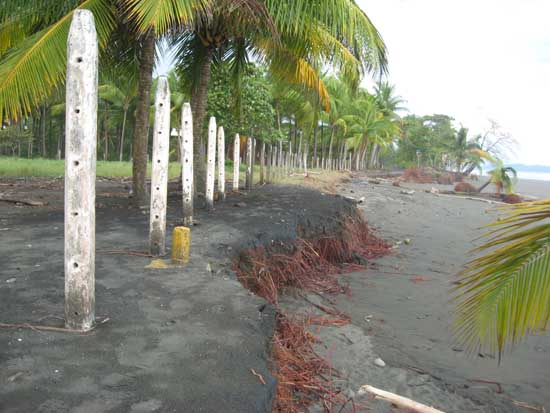
| When someone built this fence
it marked the end of the 50-meter zone. A yellow official marker
attests to that fact. Now the fence line is nearly in the sea at high
tide. |
 A.M. Costa Rica/Dennis Rogers
|
| Ocean does not heed boundary markers put up by humans |
|
|
By Dennis Rogers
Special to A.M. Costa Rica Recent months have seen the outer shore of Isla Palo Seco near Parrita eroded to the point where waves are lapping at the fences of beach properties. In places the water has eliminated three rows of coconut palms to reach the mojones which mark the limits between the 50 meters of public beach and land that can theoretically be leased from local government. These markers were set as recently as 2000, according to inscriptions on them. Isla Palo Seco is a narrow barrier island with an estuary and some mangroves behind it. Much is empty lots and abandoned beach houses, though there are occupied houses and several operating hotels. Many of the lots don’t have concession status, and in the narrowest parts of the island the distance between the mojones indicating 50 meters from the ocean and those indicating the protected zone for the estuary are only 15 to 20 meters. Most of the road is along the beach within the 50-meter zone, and has been rendered impassable for stretches, resulting in tracks across lots in various states of occupation. Universidad Nacional oceanographer Alejandro Gutiérrez said that conditions on these sand islands are transient and they have their own natural dynamic. Any specific case would involve a combination of factors. Climate change and accompanying increases in water temperature can produce the swells that attack the beaches. Some of these swells travel great distances to come ashore in Costa Rica, he said. The few millimeters increase in water levels by |
itself is not enough to affect this
and other beaches that have seen similar erosion as Island Palo Seco. What he called anthropomorphic factors have been crucial in another nearby case where Isla Damas near Quepos broke into several pieces and was cut off from the mainland. Gutiérrez attributed the change in the channel, which could be crossed on foot at low tide, to cutting of mangroves behind the island. The Palo Seco access road is well-maintained by the Parrita municipality, but workers are unable to confront the encroaching sea. Esperanza Gallego, who owns a hotel near the worst section, said she was told ahead of time the mayor wouldn’t discuss the road. When a meeting was arranged and she brought it up anyway, he was displeased, she said. Material for the miles of riprap it would take to stabilize the beach shore would have to come from far away, and would be impossible for a poor municipality like Parrita to manage or finance a project that large. Potentially the national Comisión Nacional de Emergencia could be involved, but its resources don’t tend to be spent on disasters impacting people who live at the beach. One dump truck load of large rocks did come in, according to local resident Christine Bartoldus, but made a trivial difference. During a recent visit to the island, a backhoe was working illegally on the beach as some property owner dredged material for a barrier. Municipal workers have reportedly just stabilized and filled the worst areas where the road was impassable. |
| Mining opponents issue new broadside with big names |
|
|
By the A.M. Costa Rica staff
Opponents of an open pit gold mine in northern Costa Rica have discounted an estimate that the country would have to pay $1.7 billion in compensation if it canceled the project. The petition came to news outlets Monday from Preserve Planet, an organization in opposition to the Las Crucitas project. The petition also bore the names of former president Abel Pacheco Espriella and former environmental minister Carlos Manuel Rodríguez. Also on the petition were the names of former presidential candidates Ottón Solís and Rolando Araya, as well as the name of Mariano Figueres Olsen, son of the former president. Also there were the names of 12 sitting legislative deputies and five former deputies. Other signers included a host of names from some well-known and some-not-well-known environmental organizations. The petition argued in technical details that the country would not be vulnerable for a monumental international arbitration award if President Laura Chinchilla rescinded a decree that Óscar Arias Sánchez signed that said the mining venture by Industrias Infinito was in the public interest. |
Casa Presidencial released the
financial estimate after experts in the Chinchilla government
studied a Sala IV decision that said the mining project was legally
constituted. The president says that she opposes open pit mining in general and will not permit another one. The petition argues that a decree by Pacheco was in force when the Arias government awarded the concession, so the concession is void. Pacheco issued a decree against open pit mining ventures as one of his first acts as president. But later the Sala IV constitutional court ruled the decree unconstitutional involving projects already in development. The petition also said that Costa Rica will only receive a 3 percent cut of the 700,000 estimated ounces of gold that would be mined. That would be about $21 million at today's prices. The Arias government was counting on the project to bring jobs and economic revival to the northern zone. The project, operated by a subsidiary of a Canadian firm, has generated fierce opposition, in part because of the foreign ownership and because cyanide would be used to leach the gold from crushed rock. The petition appears to set the stage for another court challenge. The company still is in a lower court over many of the same allegations on which the Sala IV issued a ruling. |
 |
| Home |
Tourism |
Place
classified ad |
Classifieds |
Entertainment |
Real
estate |
Rentals |
Sports |
About
us |
|
| What we published this week: | Monday | Tuesday | Wednesday | Thursday | Friday | Earlier |
| The contents of this page and this Web site are copyrighted by Consultantes Río Colorado 2001, 2002, 2003, 2004, 2005, 2006, 2007 and 2008 and may not be reproduced anywhere without permission. Abstracts and fair use are permitted. Check HERE for details | ||||||
| A.M. Costa Rica fourth news page |
 |
||||||||
| Home |
Tourism |
Calendar |
Classifieds |
Entertainment |
Real
estate |
Rentals |
Sports |
About
us |
|
| San José, Costa Rica, Tuesday, Aug. 3, 2010, Vol. 10, No. 151 | |||||||||
| Climate chief Christina Figueres warns
future is at stake |
||
|
Special to A.M. Costa Rica
With the future of humanity at stake, governments must continue building common ground to further progress on climate change, the new United Nations chief on the issue said in the latest round of international negotiations which kicked off in Bonn Monday. “Whether we succumb to the storms of climate change or work together to reach the far shore is up to us to decide,” said Christiana Figueres. She is a Costa Rican and executive secretary of the U.N. Framework Convention on Climate Change. She was invoking the journey made by Christopher Columbus more than five centuries ago. This was her first address to U.N. climate change talks as head of the convention since taking over from Yvo de Boer last month. “As individuals, as governments, as a global community, we must all exceed our own expectations, simply because nothing less will do,” Ms. Figueres told delegates. Science, she said, has shown when and by how much greenhouse gas emissions must drop to avert climate change’s worst impacts. “Time is not on our side,” Ms. Figueres stated. “Decisions need to be taken, perhaps in an incremental manner, but most certainly with firm steps and unwavering resolve.” The week-long talks under way in Bonn are the third round of U.N. climate change negotiations so far this year, ahead of the next conference of parties to the convention in Cancun in November. At that gathering in the Mexican city, Ms. Figueres told delegates Monday, “you have both the responsibility and the opportunity to take the next essential step: to turn the politically possible into the politically irreversible.” Speaking to reporters, she said that governments can build on progress made so far in five main areas. First, the public pledges made by all industrialized countries to slash emissions by 2020 and the plans put |
forward by more
than one third of developing nations to limit their
emissions growth must be captured in an internationally-agreed form,
she said. Secondly, governments must forge ahead with efforts to agree on ways to allow developing countries to take action in areas including adapting to climate change, limiting emissions growth, providing adequate finance and enhancing the use of clean energy. In another key area, “industrialized nations can turn their pledges of funding into reality,” she said. Last year, these countries promised to provide $30 billion in fast-track financing for developing countries to adapt and mitigate climate change through 2012, with pledges having been made to raise $100 billion annually by 2020. “Developing nations see the allocation of this money as a critical signal that industrialized nations are committed to progress in the broader negotiations,” Ms. Figueres said. Further, “countries want to see that what they agree with each other is measured, reported and verified in a transparent and accountable way,” she pointed out. “Countries want to be confident that what they see is what they get.” Finally, the convention chief said, while governments agree that pledges must be captured in a binding manner, “they need to decide how to do it.” Governments, she added, “need to deliver this combination of accountability and binding action so that civil society and business can be confident that clean, green strategies will be rewarded globally, as well as locally.” More than 3,000 people — including government delegates and representatives of the private sector, environmental groups and research institutions — are attending the Bonn gathering this week. The next round of talks is slated to take place in Tianjin, China, in early October, weeks before the start of the Cancun conference. |
|
| Home |
Tourism |
Place
classified ad |
Classifieds |
Entertainment |
Real
estate |
Rentals |
Sports |
About
us |
|
| What we published this week: | Monday | Tuesday | Wednesday | Thursday | Friday | Earlier |
| The contents of this page and this Web site are copyrighted by Consultantes Río Colorado 2001, 2002, 2003, 2004, 2005, 2006, 2007 and 2008 and may not be reproduced anywhere without permission. Abstracts and fair use are permitted. Check HERE for details | ||||||
| A.M. Costa Rica fifth news page |
|||||||||
| Home |
Tourism |
Calendar |
Classifieds |
Entertainment |
Real
estate |
Rentals |
Sports |
About
us |
|
| San José, Costa Rica, Tuesday, Aug. 3, 2010, Vol. 10, No. 151 | |||||||||
 |
 |
| Home |
Tourism |
Place
classified ad |
Classifieds |
Entertainment |
Real
estate |
Rentals |
Sports |
About
us |
|
| What we published this week: | Monday | Tuesday | Wednesday | Thursday | Friday | Earlier |
| The contents of this page and this Web site are copyrighted by Consultantes Río Colorado 2001, 2002, 2003, 2004, 2005, 2006, 2007 and 2008 and may not be reproduced anywhere without permission. Abstracts and fair use are permitted. Check HERE for details | ||||||
| A.M. Costa
Rica sixth news page |
|||||||||
| Home |
Tourism |
Calendar |
Classifieds |
Entertainment |
Real estate |
Rentals |
Sports |
About us |
|
|
|
|||||||||
Latin American news Please reload page if feed does not appear promptly |
to favor Cuban capitalism By the A.M. Costa Rica wire services
Cuba's leader Raúl Castro says his government will scale back its involvement in the nation's economy and allow more Cubans to operate their own businesses and hire workers. Castro said Sunday the aim is to create jobs for nearly 1 million workers currently employed by the government who will be laid off. Ninety-five percent of all Cubans work for the government. The Cuban leader made the remarks at the twice-yearly session of the national assembly. He did not say how many business licenses would be issued. Earlier, economy minister Marino Murillo said the deputies will discuss changing Cuba's economic model, but that the changes should not be called reforms. He cited the example of small barber shops that have been turned over to employees who can set their own prices while paying rent to the state. Although he has made several public appearances in recent weeks, former Cuban leader Fidel Castro was not at the meeting. His chair has been empty since he turned power over to his brother, Raul, four years ago. Court halts tree cutting over failure to consult By the A.M. Costa Rica staff
The Sala IV constitutional court suspended tree cutting, in part because the native residents in the area were not consulted beforehand. The tree cutting is in the Quitirrizí de Mora and Zapatón de Puriscal reserves. The court also said that environmental officials have not verified if any environmental damage has taken place. The case was appealed by a representative of the Huetares in Quitirrisí and Zapatón peoples. There are laws that require notification and consultation with native peoples. The court also heard that the tree cutting might endanger a water source. |
Lastin American news feeds are disabled on
archived pages.
|
|
| Home |
Tourism |
Place
classified ad |
Classifieds |
Entertainment |
Real
estate |
Rentals |
Sports |
About
us |
|
| What we published this week: | Monday | Tuesday | Wednesday | Thursday | Friday | Earlier |
| The contents of this page and this Web site are copyrighted by Consultantes Río Colorado 2001, 2002, 2003, 2004, 2005, 2006, 2007 and 2008 and may not be reproduced anywhere without permission. Abstracts and fair use are permitted. Check HERE for details | ||||||