|
 |
Costa Rica Your daily |
 |
|
|
|
|
||||||||||||||||||||||||||||||||||||||||||||||||||||
 |
|||||||||||||||||||||||||||||||||||||||||||||||||||||
|
|
||||||||||||||||||||||||||||||||||||||||||||||||||||
 |
|
|
|
|
|
|
|
|
| What we published this week: | Monday | Tuesday | Wednesday | Thursday | Friday | Earlier |
|
|
 |
| A.M. Costa Rica Second newspage |
 |
||||||||
| Home |
Tourism |
Calendar |
Classifieds |
Entertainment |
Real
estate |
Rentals |
Sports |
About
us |
|
| San José, Costa Rica, Thursday, June 24, 2010, Vol. 10, No. 123 | |||||||||
 |
| Costa Rica Expertise Ltd http://crexpertise.com E-mail info@crexpertise.com Tel:506-256-8585 Fax:506-256-7575 |
 |
 Click HERE for
great
hotel discounts
|
|
Pre-school credit
cards
offered starting today By the A.M. Costa Rica staff
Banco Nacional said Wednesday that it would be issuing debit cards or similar to youngsters from newborn to 6 years. The bank has created a Cool Plus Master Card for youngsters between 4 and 6 years and a Cool Club ID card for children up to 3 years. The bank said it was trying to get youngsters to have an incentive to save money. The cards will be launched today with a clown show at the auditorium of Banco Nacional. Women's rights group, founded here, is honored Special to A.M. Costa Rica
The Peter and Patricia Gruber Foundation Wednesday announced that it will award the 2010 Women’s Rights Prize to an organization founded in Costa Rica and one other. The organizations have contributed significantly to advancing women’s reproductive health and rights in many countries, said the announcement. The organization that was founded in 1987 in Costa Rica is Comité de América Latina y El Caribe para la Defensa de los Derechos de la Mujer. This regional organization in Latin America and the Caribbean says it promotes, monitors and defends women’s rights as human rights and contributes to the construction of real democracies in which women can fully exercise their human rights and participate at all levels of society with freedom from violence. The organization was founded two years after the United Nations Third World Conference on Women in Nairobi, Kenya, at which female lawyers gathered to discuss the need for judicial and political reform to defend women’s rights. Currently, about 200 individual and organizational associates in 14 countries are affiliated with Comité de América Latina y El Caribe, which is based now in Lima, Perú. The other organization that is being honored is the Center for Reproductive Rights which says it is dedicated to winning for all women the right to decide whether and when to have children, the freedom to exercise that right, and access to the best reproductive healthcare available. The New York-based foundation said that both were being recognized extending and defending the rights of women through litigation, law reform, and education. The two organizations will share a $500,000 prize. In addition to the cash award, both organizations will receive a gold medal. Seven downtown families evicted by morning blaze By the A.M.. Costa Rica staff
A fire believed started by a scented candle heavily damaged the second floor of a downtown building Wednesday morning and evicted the seven families living there. The blaze was at Avenida 5 at Calle 6. Firemen said they got the call at 9:09 a.m. The initial investigation showed that the blaze started in the mattress of a child's bed. Firemen from four stations responded and managed to keep the flames from spreading. The structure has stores on the first level. Key route reopened but not this morning By the A.M. Costa Rica staff
The on-again, off-again Ruta 32 is on again. Highway officials opened the road early Wednesday even though they announced they were closing it the day before. A slide covered the highway about 1:30 p.m. Tuesday and blocked traffic in both directions. Dirt was up to six feet deep. The road will be closed today from 5:30 a.m. to 11 a.m. because engineers from Spain are surveying the slipping hillsides with sensitive instruments. Closings are scheduled for the same time Saturday and Sunday, too. Decree sought to protect children from mistreatment By the A.M. Costa Rica staff
The Defensoría de los Habitantes is promoting an executive decree designed to protect children from violence. The Defensora, Ofelia Taitelbaum, was scheduled to meet with President Laura Chinchilla Wednesday afternoon to promote the idea. She said that an average of 2.48 cases of mistreated children a day come in to the Hospital Nacional de Niños. Although the true number of mistreated children is hidden, she said indications are that such cases are increasing. She said she has been working on the proposal for three months to develop an integrated strategy to prevent, detect and promote the rights of children. A decree issued by the president has the force of law without going through the legislature.
|
|||||||||||||||||||||||||||||||||||||||||||||||||||
 |
||||||||||||||||||||||||||||||||||||||||||||||||||||
| Home |
Tourism |
Place
classified ad |
Classifieds |
Entertainment |
Real
estate |
Rentals |
Sports |
About
us |
|
| What we published this week: | Monday | Tuesday | Wednesday | Thursday | Friday | Earlier |
| The contents of this page and this Web site are copyrighted by Consultantes Río Colorado 2001, 2002, 2003, 2004, 2005, 2006, 2007 and 2008 and may not be reproduced anywhere without permission. Abstracts and fair use are permitted. Check HERE for details | ||||||
 |
| A.M. Costa Rica third newspage |
 |
||||||||
| Home |
Tourism |
Calendar |
Classifieds |
Entertainment |
Real
estate |
Rentals |
Sports |
About
us |
|
| San José, Costa Rica, Thursday, June 24, 2010, Vol. 10, No. 123 | |||||||||
 |
 |
| Arbitration ruling hinged on legality of Villalobos deals |
|
|
By the A.M. Costa Rica staff
An attempt by Canadians to get back money lost in the Villalobos Brothers high interest scheme failed mainly because an international arbitration panel did not think the case involved legal investments. The long-running case pitted 137 Canadians against the government of Costa Rica. The Canadians argued that Costa Rica had failed to provide adequate protection for their investments and that the country forced the failure of the Villalobos enterprise with a police raid. A.M. Costa Rica reported the ruling in May, but the written ruling only recently became available online. The three-arbitrator panel ruled that it did not have jurisdiction because the money given to the Villalobos brothers was not an investment as defined in a Costa Rican-Canadian treaty for the protection of investments which came into force in 1999 Instead, the panel, formed by the International Centre for Settlement of Investment Disputes, said: "By actively seeking and accepting deposits from the Claimants and several thousand other persons, the Villalobos brothers were engaged in financial intermediation without authorization by the Central Bank or any other government body as required by law. The courts of Costa Rica after a lengthy and extensive legal process determined that Osvaldo Villalobos, because of his involvement in the scheme, committed aggravated fraud and illegal financial intermediation. In securing investments from the Claimants, the Villalobos brothers were thus clearly not acting in accordance with the laws of Costa Rica. The entire transaction between the Villalobos brothers and each Claimant was illegal because it violated the Organic Law of the Central Bank." The panel also said that evidence on the record shows that deposits with the Villalobos brothers were structured as personal loans to Luis Enrique Villalobos. "Drawn by the high interest rates and the confidential nature of the scheme, more than 6,200 persons deposited a total of approximately US$405 million with the Villalobos brothers over the years of the scheme’s operation" the panel noted. The Villalobos operation paid up to 39 percent a year on moneys rolled over and slightly less if interest was withdrawn monthly. A key point in the decision to dismiss the case was that Canadians did not control their investment, which is one of the requirements listed in the investment protection treaty. In fact, the panel described at length the curious way that Luis Enrique Villalobos documented the money that came in from those who loaned him money. The panel noted that Villalobos gave depositors so-called guarantee checks from a Banco Nacional account. At the same time Villalobos or an aide told the depositor that the check could not be cashed because there was not sufficient money in the account. Costa Rican judicial employees had told the panel in an August hearing that particular bank account remained inactive with very little money since 1997. Villalobos workers sometimes would outline the terms of the borrowing agreement on the back of the check, the panel said, adding that if a depositor wished to withdraw principal, he or she would present the guarantee check when requesting payment and surrender it upon payment. |
 A.M. Costa Rica file photo
Costa Rican woman investor reads the bad news on the Ofinter
S.A. front door Oct. 14, 2002. The woman was in tears and said her
family lost a large amount of money."Many of the depositors, like the claimants in this case, were foreign nationals," the panel said. "They often deposited significant sums of money with what appears to be relatively little investigation and research, relying instead on the recommendations of friends and acquaintances who had previously deposited funds with the brothers and attested to the fact that the Villalobos brothers had regularly paid them the high interest rates promised. The Villalobos brothers provided minimal documentation to the persons depositing funds with them, and thereafter issued no periodic reports on the status of the funds received or the enterprises in which the funds were purportedly invested. Moreover, the Villalobos brothers made no reports to the tax or other governmental authorities of Costa Rica or any other government on their operations or on the income earned by depositors in the scheme." The panel said that based on the evidence presented, it is clear that the claimants did not exercise the kind of due diligence that reasonable investors would have undertaken to assure themselves that their deposits with the Villalobos scheme were in accordance with the laws of Costa Rica. Sandra Morelli Rico of Colombia was president of the panel, which also included two professors, Jeswald W. Salacuse of the United States and Raúl E. Vinuesa of Argentina. The panel cited a total investment of approximately $405 million over the years of the scheme’s operation. A.M. Costa Rica has said more than $1 billion was lost when Luis Enrique Villalobos closed down his operation Oct. 14, 2002. However that amount included accrued interest. The panel also said that the subsequent conviction of Oswaldo appeared to justify the police raid on the Villalobos operation and the Ofinter S.A. money exchange houses related to the brothers. Despite the panel ruling, A.M. Costa Rica has reported that Costa Rican officials knew for a long time the nature of the Villalobos operation and failed to take steps to stop it. Had the panel accepted the case for an arbitration decision instead of dismissing it on technical grounds, the Canadians were believed to be ready to provide evidence of the involvement of highly placed Costa Ricans as silent partners of the Villalobos brothers. |
 A.M. Costa Rica/Google Maps graphic
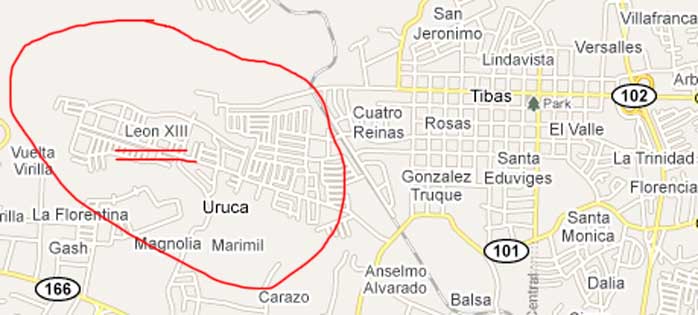
León XIII is west of Tibás and one of those
areas the central government wants to improve. |
|
| Wireless Internet might be a solution for service in slums |
|
|
By Dennis Rogers
Special to A.M. Costa Rica The Instituto Costarricence de Electricidad finds itself in a bind after the Sala IV constitutional court ordered it to supply Internet access to a claimant, after the agency told her it wouldn’t because “technicians can’t enter the area.” Leon XIII in Tibás, where the woman lives, is one of the rougher parts of northern San Jose. The magistrates said ICE’s actions “violate the affected party’s fundamental rights to communication and information, as a public service.” ICE is a government agency, even though its monopoly is broken, and is subject to the court’s jurisdiction the way a private company might not. As yet there is no legal precedent on the question. So far the only other broadband internet providers are cable television companies, who will not enter the poorest parts of the city for economic reasons, and are far from universal coverage in many better-off zones. ICE in a plaintive press release cited unspecified “technical reasons” it couldn’t provide the service to Leon XIII. It is a “socially responsible entity, which attends to clients in all parts of the country…in spite of the technical and geographical limitations it faces.” The administration was quick to add that it would be looking for a solution, since “various telephone lines meet in the area.” Failure to comply with Sala IV orders is a serious matter for government officials. Last year the mayor of Liberia was hauled off in handcuffs in front of television cameras for not fixing drainage problems in a poor neighborhood there. Leon XIII resident Blanca Manazares says telephone coverage and other public services are well distributed there, though as it’s a “conflictive zone,” ICE’s telephone repairmen usually come with a police escort. Ambulances and taxis normally enter as well. The court apparently found the technical arguments unconvincing, while the six months it took ICE to provide a negative answer can’t have helped. Authorities in general are used to poor people in Costa Rica who feel and act powerless against unresponsive bureaucratic machinery, but this individual’s success with the court could push ICE in a direction that will help it compete with new arrivals. |
Wireless technology around the world
has proven revolutionary in many
poor societies, with the usual examples the farmer in Bangladesh who
can pay for a call to check on market prices for his crops instead of
suffering from the predations of middlemen, or the fisherman offshore
who can see who is offering the best prices for his catch before
heading in. One less-noted area where wireless coverage can be a lifesaver is literally, if phone technicians are indeed at physical risk in working in what is euphemistically referred to in Costa Rica as “marginal areas.” While slums here are relatively tame compared to Río or Kingston, meter readers and repairmen are regularly robbed and threatened with harm in these zones. Cell systems are also less at risk of copper theft, though one tower in Desamparados has been stripped multiple times, according to news reports. Wireless options for the Leon XIII resident do exist, and the court ordered ICE to provide service, “be it the ADSL or wireless data card, according to the convenience and choice of the plaintiff.” The 3G system rolled out in December has a data-only option, at slightly cheaper rates than the Acelera fixed service for supposedly the same transfer speeds, but has been excoriated in blogger forums for its slow speeds and unreliability. ICE subsidiary Radiográfíca S. also has a WiMax service in the immediate urban area. Towers are still somewhat scattered and the system is limited to line-of-sight. The window antenna offered for a mere $6 per month rent (“while supplies last”) probably wouldn’t work in densely-populated areas. Including the decoder the price is $35/month for the cheapest package, nearly twice the ADSL from ICE. The $100 installation fee would likely be too much for any slum dweller. In the poorest parts of the metropolitan area, a roof antenna to get at a WiMax signal might be an unwanted signal that there is computer equipment within the house. To attempt to provide common infrastructure such as Wi-Fi would run up against known problems, as with the public phones which are always out of order in Leon XIII because, as Manazares puts it, “people tear them apart.” |
| You need to see Costa Rican tourism information HERE! |
| Home |
Tourism |
Place
classified ad |
Classifieds |
Entertainment |
Real
estate |
Rentals |
Sports |
About
us |
|
| What we published this week: | Monday | Tuesday | Wednesday | Thursday | Friday | Earlier |
| The contents of this page and this Web site are copyrighted by Consultantes Río Colorado 2001, 2002, 2003, 2004, 2005, 2006, 2007 and 2008 and may not be reproduced anywhere without permission. Abstracts and fair use are permitted. Check HERE for details | ||||||
| A.M. Costa Rica fourth news page |
|
||||||||
| Home |
Tourism |
Calendar |
Classifieds |
Entertainment |
Real
estate |
Rentals |
Sports |
About
us |
|
| San José, Costa Rica, Thursday, June 24, 2010, Vol. 10, No. 123 | |||||||||
 |
xx |
 |
| Page One is HERE!
Page Two is HERE!
Page
Three is HERE! Page Five is HERE! Page Six is HERE! The sports page is HERE! |
Next Page |
 Observatorio Vulcanológico y
Sismológico de Costa Rica photo
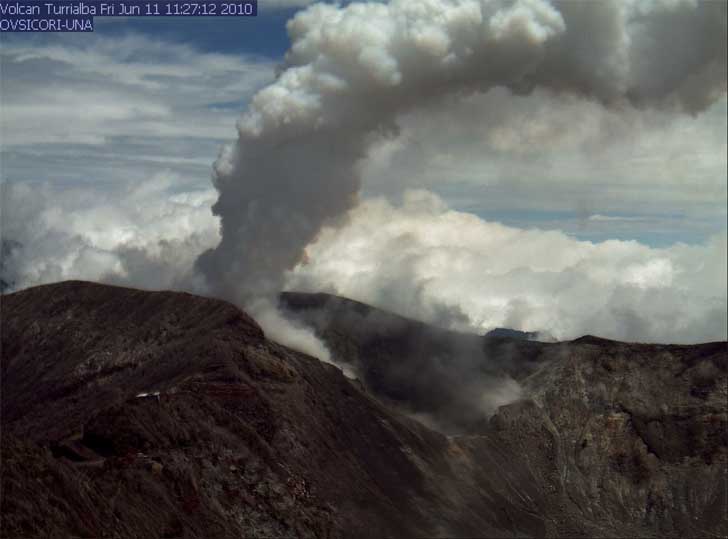
Gas pours from the crater without
obstruction, scientists say
|
||
| Towering columns at Turrialba are just
gas, scientist says |
||
|
By the A.M. Costa Rica staff
Although the Volcán Turrialba is putting on a great show with tall columns of gas coming form the peak, there is no indication that the gas is carrying ash, according to a report this week from the Observatorio Vulcanológico y Sismológico de Costa Rica. Javier Francisco Pacheco, who prepared the report along with Floribeth Vega and Federico Chavarria, said the Heredia-based observatory has received a number of calls reporting ash falling some distance from the volcano. Pacheco dismissed these accounts and said that the gas may just be carrying fine dust a long distance. |
He said that the
gas release accompanied by continuous tremors within
the mountain shows that there is little obstruction to the gas flow. If
rocks, magma or some other obstruction were present, the mountain would
have a different signature on the recording devices, he said. Pacheco said that the gas columns are as much as 4 to 6 kms (2.5 to 3.75 miles) into the sky and frequently are seen by airline pilots flying over northern Costa Rica. The column of gas tends to hang together. The presence of ash would suggest the presence of magma and a possibility of an eruption. |
|
| Autistic child guaranteed schooling by
Sala IV decision |
||
|
By the A.M. Costa Rica staff
An autistic child has the right to go to school, the Sala IV constitutional court said in a decision released Wednesday. The child's parents sought to enroll him in a Hatillo 2 school, but teachers there said they did not have the resources to handle the child. |
The court said the
child had been attending a school in the Hospital
Nacional de Niños in 2009, but health experts there suggested
the child
was ready for a regular school, said the decision. The decision is against the Ministerio de Educación Pública, which now must provide the resources for the child's education. |
|
| Home |
Tourism |
Place
classified ad |
Classifieds |
Entertainment |
Real
estate |
Rentals |
Sports |
About
us |
|
| What we published this week: | Monday | Tuesday | Wednesday | Thursday | Friday | Earlier |
| The contents of this page and this Web site are copyrighted by Consultantes Río Colorado 2001, 2002, 2003, 2004, 2005, 2006, 2007 and 2008 and may not be reproduced anywhere without permission. Abstracts and fair use are permitted. Check HERE for details | ||||||
| A.M. Costa Rica fifth news page |
|
|||||||||
| Home |
Tourism |
Calendar |
Classifieds |
Entertainment |
Real
estate |
Rentals |
Sports |
About
us |
||
|
|
||||||||||
 |
 |
| Home |
Tourism |
Place
classified ad |
Classifieds |
Entertainment |
Real
estate |
Rentals |
Sports |
About
us |
|
| What we published this week: | Monday | Tuesday | Wednesday | Thursday | Friday | Earlier |
| The contents of this page and this Web site are copyrighted by Consultantes Río Colorado 2001, 2002, 2003, 2004, 2005, 2006, 2007 and 2008 and may not be reproduced anywhere without permission. Abstracts and fair use are permitted. Check HERE for details | ||||||
| A.M. Costa
Rica sixth news page |
|||||||||
| Home |
Tourism |
Calendar |
Classifieds |
Entertainment |
Real estate |
Rentals |
Sports |
About us |
|
|
|
|||||||||
Latin American news Please reload page if feed does not appear promptly |
slain Tijuana newsman Special to A.M. Costa Rica
In an emotional ceremony held Tuesday the Inter American Press Association honored the memory of journalist Francisco Ortiz Franco six years after his murder. The organization took advantage of the occasion to express outrage at the lack of justice surrounding this crime and announced that it will submit the case to the Inter-American Commission on Human Rights in the next few days. The decision to petition the international institution is based on legal proceedings tainted since the murder occurred on June 22, 2004, total silence by federal officials on how the investigations are proceeding, and the clear violation of reasonable time limits for solution of the case. The ceremony in Tijuana, Baja California, was organized by the Inter American Press Association and the local weekly newspaper Zeta, where Ortiz Franco was joint editor. His widow, Gabriela Ramírez, his two sons, Francisco and Héctor, and his daughter, Andrea, were present for the screening of the documentary “El crujir de las palabras” (word crunching) which narrates the life and death of the murdered newsman and puts the spotlight on the need to combat the impunity and spiraling violence plaguing the Mexican press. At the ceremony’s close Ms. Ramírez accepted a plaque in recognition of the human and journalistic qualities that Ortiz Franco had brought to his work, stating: “We are still waiting for justice, for the perpetrators and masterminds to be punished — not the justice that serves only to embellish the speeches of those in power and in fact does not exist if the impunity continues.” Ortiz Franco was killed in front of two of his children as he was about to get into his car. A masked man, believed to be from the Arellano Félix cartel, shot him four times at point-blank range. Since then, despite the initial mobilization of justice authorities and the public prosecutor’s office, the case has suffered numerous irregularities, the association said. Ortiz Franco worked alongside Jesús Blancornelas and members of the association some weeks before his death, when a committee working with state and federal government officials was reviewing the case file regarding the murder of “Gato” Félix, also a Zeta co-founder who was killed in 1988. The case also remains partially unpunished. The unsolved murder of Félix was the first of 26 cases that the association has submitted to the Commission on Human Rights since it initiated its Anti-Impunity Project in 1995. Blancornelas also was gunned down in a separate incident but survived. Zeta routinely publishes investigatory articles about the drug cartels and local politicians. |
| Latin American news feeds are disabled on
archvied pages.
|
|
| Home |
Tourism |
Place
classified ad |
Classifieds |
Entertainment |
Real
estate |
Rentals |
Sports |
About
us |
|
| What we published this week: | Monday | Tuesday | Wednesday | Thursday | Friday | Earlier |
| The contents of this page and this Web site are copyrighted by Consultantes Río Colorado 2001, 2002, 2003, 2004, 2005, 2006, 2007 and 2008 and may not be reproduced anywhere without permission. Abstracts and fair use are permitted. Check HERE for details | ||||||