|
||
|
A.M. Costa Rica
Your daily English-language news source Monday through Friday |
||
 |
 |
 |
|
|
 |
||||||||||||||||||||||||||
|

|
|||||||||||||||||||||||||
 |
||||||||||||||||||||||||||
|
|
|||||||||||||||||||||||||
 |
 |
| What we published this week: | Monday | Tuesday | Wednesday | Thursday | Friday | Earlier |
|
|
|
|
|
|
|
Food |
|
Jo
Stuart |
|
|
| A.M. Costa Rica's Second news page | |||||||||
| San José, Costa Rica, Monday, June 18, 2012, Vol. 12, No. 120 | |||||||||
|
|
|
|
|
|
|
Food |
|
Jo
Stuart |
 |
 |
 |
|
Riteve gets 10 more years
to inspect nation's vehicles By
the A.M. Costa Rica staff
The transport ministry had renewed the contract of Riteve SyC S.A., the firm that provides the vehicle inspections. The Ministerio de Obras Públicas y Transportes said that the firm has not had a single complaint for failing to fulfill its contract. In addition, the state will take over the company's$25 million in property and machinery at the end of the 10-year extension. There have been calls to allow other firms offer the same services. But the transport ministry said that not having an interruption in inspections was in the country's best interest. In addition, it said some 500 families depend on a member having a job with Riteve. The company will allow its rates to be fixed by the country's regulating agency instead of by the ministry. The company had complained that it was not getting sufficient return. Some motorists claimed their vehicles were being rejected initially so that Riteve could collect a reinspection fee. The company also agreed to build permanent facilities in some of the areas where motorists are now serviced by a mobil inspection facility. By
the A.M. Costa Rica staff
The Central Valley experienced several waves of rainstorms Sunday night and early Monday, but the weather institute said that conditions in the beginning of the week would be highly local. The Instituto Metorológico Nacional said Monday would be another hot day giving way with isolated showers over the national territory and the south Pacific On the other hand, Monday has an 80 percent chance of rain with 60 percent Tuesday and Wednesday, according to Weather Underground, Inc., which provides the forecast for A.M. Costa Rica.
|
||||||||||||||||||||||||||||||||||
 |
|||||||||||||||||||||||||||||||||||
|
|
|
|
|
|
|
Food |
|
Jo
Stuart |
| What we published this week: | Monday | Tuesday | Wednesday | Thursday | Friday | Earlier |
| The contents of this page and this Web site are copyrighted by Consultantes Río Colorado 2012 and may not be reproduced anywhere without permission. Abstracts and fair use are permitted. Check HERE for details | ||||||
 |
 |
| A.M. Costa Rica Third
News Page |
|
| San José, Costa Rica, Monday, June 18, 2012, Vol. 12, No. 120 | |
|
|
|
|
|
|
|
Food |
|
Jo Stuart |
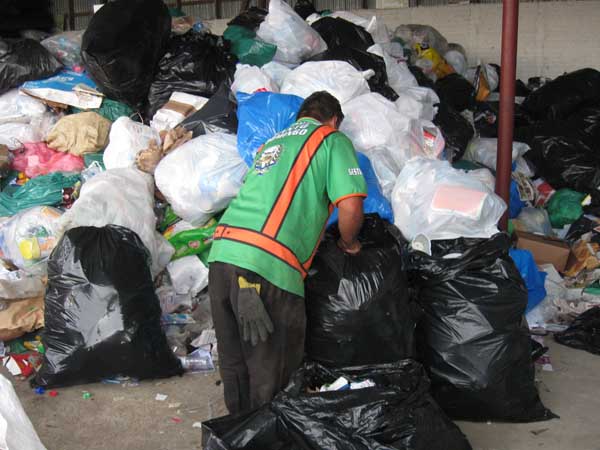
A Santo Domingo municipal employee works at the Asociacion Domingeña de Gestion Ambiental where recycling is a profitable venture. |
 A.M. Costa Rica/Dennis Rogers
|
| Santo Domingo recycling program scores a
limited success |
|
|
By
Dennis Rogers
Special to A.M. Costa Rica A voluntary recycling project where residents can drop their cans, bottles, and paper products is running in Santo Domingo de Heredia and is capturing a substantial share of the recyclables in the municipality’s solid waste. For the month of May, 35 tons of material were removed from the waste stream, according to figures provided by project coordinator Guillermo Umaña. The total value of the materials sold on to various middlemen and larger recycling projects was 1.9 million colons, roughly enough to cover the salaries of the five people working to sort the recyclables. This also saves the municipality about one day’s worth of tipping fees at the La Carpio landfill. At 8,000 colons per ton, that would be another 280,000 colons per month. Some fuel to truck that garbage can also be subtracted from overall costs. A study in 2005 found that organics make up the majority of Santo Domingo’s domestic waste at 69 percent by weight. Other non-recyclables total about 17 percent, then white paper, newspaper, boxboard, and corrugated cardboard about 2 percent each. Recyclable categories including steel, HDPE plastic, PET plastic, glass, and tetra/waxed cardboard registered 1 percent each. Small amounts of aluminum complete the useful component. This was for strictly residential waste. Commercial pickup includes more white paper and corrugated, according to studies elsewhere The total amount of recyclables in Santo Domingo’s waste flow would be about 14 percent. At 35 tons of waste collected each work day, that is about 100-110 tons of recyclables per month. Five tons of the total collected at the center in May was unrecyclable plastic which is taken away by the cement company Holcim for fuel in its kiln in Cartago with no compensation. Thirty tons still means 25 to 30 percent of the total recyclables produced in Santo Domingo are captured by the project. This is a large amount considering that recycling is a new concept to most Costa Ricans. The Paseo de las Flores mall in Heredia also has set up a recycling program consisting of pairs of labeled bins |
 A.M. Costa Rica/Dennis Rogers
Mall
trash bins are not very clear.
throughout the mall and in the
food court. Operations manager Gustavo
Ugalde indicated that cooperation on the part of visitors is very low,
and ordinary trash ends up in both sides. In the case of the areas away
from restaurants, this is a minor problem as the recyclable bottles,
cans, and cups can be quickly sorted.
Where food scraps are a major part of the waste flow, the situation is more complicated. In the food court (17 locations) a relatively small number of customers actually bus their tables, so the cleaning staff can sort the recyclables. Since most paper gets wet or contaminated by food, the main criteria for usable recyclables is that it be “uncontaminated” as a sign on the bins states. This is not too clear. “Customers don’t even look” said cleaning manager Carlos Núñez, as a teenager dumped a tray of hamburger wrappers into the recycling bin. Ultimately, the staff separates waxed cups, plastic bottles, and a small number of aluminum cans which become a source of income for the mall’s waste disposal contractor, along with used cooking oil for biodiesel. Other businesses produce some paper. Cardboard recycling was done previous to this arrangement as a fund-raiser for the mall employees’ solidarity association. Overall, the mall produces about seven tons of waste per day not counting the cardboard, with the food court producing about 60 percent of that, said Ugalde. The Mas x Menos supermarket at the mall has its own pickup service, which would also include cardboard recycling. Removal of recyclables as per the present system reduces the total garbage output of the mall very little. |
| Ruta 32 reopened after 1,600 tons of rock
and dirt removed |
|
|
By
the A.M. Costa Rica staff
Highway workers managed to reopen Ruta 32 Friday morning at the point where 1,600 tons of rock and dirt fall onto the two-lane roadway. The slide happened early Wednesday, The route is a key one because it connects the Central Valley to the northern zone and the Caribbean coast. The section still represents a danger. Some of the rocks that fell were the size of automobiles. So the Consejo Nacional de Vialidad said it will continue to monitor the site. This is the first time there was a slide in this area. Much of the section of the highway through Parque Nacional Braulio Carrillo is on a shelf road with towering cliffs to one side and a steep drop off to the other. Rain makes driving there dangerous |
 Consejo Nacional de Vialidad photo
Workman views the reopened
section of the highway. |
 |
| You need to see Costa Rican tourism information HERE! |
|
|
|
|
|
|
|
Food |
|
Jo
Stuart |
| What we published this week: | Monday | Tuesday | Wednesday | Thursday | Friday | Earlier |
| The contents of this page and this Web site are copyrighted by Consultantes Río Colorado 2012 and may not be reproduced anywhere without permission. Abstracts and fair use are permitted. Check HERE for details | ||||||
 |
|
||||
| A.M. Costa Rica's Fourth News page | |||||
| San José, Costa Rica, Monday, June 18, 2012, Vol. 12, No. 120 | |||||
|
|
|
|
|
|
|
Food |
|
Jo
Stuart |
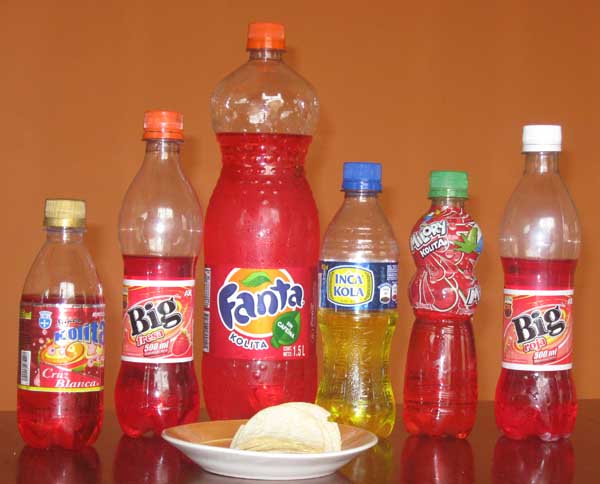
The bottles are Cruz Blanca, Big Cola, Fanta, Inca Cola, Milory and another version of Big Cola. The chips in front are plain Pringles to clean the Pallet of taste testers. |
 A.M. Costa Rica/Dennis Rogers
|
| New entry Inca Cola fairs well in
evaluation by young experts |
|
|
By
Dennis Rogers
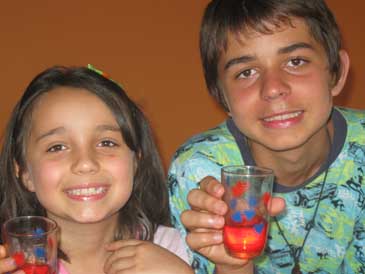
Special to A.M. Costa Rica With the arrival of Inca Cola to the Costa Rican soft drink market, A.M. Costa Rica has compared it to the existing competitors so readers don’t have to. A team of experts subjected the products to careful scrutiny and passed judgment on the four main competitors in the kolita class. Inca Cola is “the pride of Peru,” preferred by many there to regular colas, like the one in the hourglass bottle, on a nationalistic basis. It isn’t actually a cola in taste, but instead a sweet drink originally flavored with jamaica or hibiscus flowers. It is now available in Supermercados Unidos outlets like Mas X Menos and Walmart, imported in bottled form. The equivalent locally produced kolita beverages are products sold alongside orange or grape flavored sodas in most any supermarket or neighborhood pulpería. The Coca Cola product is called Fanta and is sold mostly in bottles. The company which is widely considered the most valuable brand in the world doesn’t need much introduction. Pepsi for this line is represented by Florida Ice & Farm, the monopoly brewer in Costa Rica. The kolita product is called Milory. Also from Peru originally is Big Cola, which broke into the Costa Rican market in 2004 despite considerable resistance from the established multinationals, who were eventually accused before Costa Rica’s competition commission of using spurious environmental complaints against the new entrant. Big Cola made its mark with large bottles aimed at the lower socio-economic strata, with minimal amounts of syrup and bottles about as thin as is possible by blow molding PET plastic. These were sold at small neighborhood stores until the company eventually reached all the supermarket chains. Once established in the market, an additional bottling line allowed Big Cola to add other presentations of different bottle sizes. Representatives of Big Cola claimed they are the reason other companies have changed to 3-liter sizes and also the return of the smurf bottle from Coke, according to news reports. Big Cola’s different sized bottles have different descriptions, with some saying strawberry, some jamaica, and some just red. Jamaica wasn’t located for the study. An additional market participant is Cruz Blanca, with a carbonated version of the cola syrup that can be purchased to make refrescos. The taste-testers’ grandmother has been known to subject chan, a seed that looks like frogs’ eggs when soaked in water, to this treatment producing a savagely sweet refresco. Cola syrup is also the red fluid that is often put on shaved-ice copos. Cruz Blanca’s pop seems only to be available in Periféricos supermarkets in a small bottle. The Euromonitor market research company has overall consumption of carbonated soft drinks in Costa Rica at just under $500 million, with Coca Cola at 70 percent, Pepsi at 18 percent, and Big Cola most of the remainder. These figures are from 2010. Test subjects were a Costa Rican/U.S. duel national male, 12 years old, and another female aged 8. Both have a known |
 A.M. Costa Rica/Dennis Rogers
The panel of cola expertspenchant for sweets. They
tasted each brand and were asked leading questions about its aroma,
sweetness and strength, bouquet, and amount of carbonation. The palate
was cleansed with plain Pringles between samples. Expectoration was not
allowed. The
experts considered the appearance in a glass and the presentation of
the product itself.
All six samples were chilled overnight. Service was in a small water glass. Fanta was essentially the benchmark to which others were compared. It scored intermediate in the important factors, being sweet with moderate carbonation and orangey color. Milory is stronger and sweeter, mostly due to less carbonation and is less brightly colored also. One tester described the taste as “rotten strawberry.” Inca was scored high on flavor and carbonation with a much fruitier bouquet, evoking lemon or banana. Inca Cola has a bright yellow color which some might associate with dehydration after a long hike in the Peruvian coastal deserts, as opposed to the red of the other brands. This could have been a cause of bias. The Cruz Blanca product was considered little more than a watered down version of the syrup with hardly any carbonation. One tester described it as “weird” and both noted a slight salty or bitter taste. Two different presentations of Big Cola were tried, strawberry and just red. Nobody detected any hint of strawberry in either. Both experts said the red had little taste. Red has some more carbonation while the strawberry has “little, little, little” gas. Big Cola is the regional partner of the Barcelona football team, with some players on the labels. Uniforms show the old Unicef promotion before the team sold out to a Qatari consortium as part of the conspiracy to have the 2020 World Cup there. The two presentations don’t show the same players however, as red has Villa, Puyols, former coach Pep Guardiola, Messi, and Iniesta, while fresa has Villa, Puyols, Messi, Pedro, and goalkeeper Valdez. Adults present detected a slightly bitter aftertaste to both Big Cola products but found them barely distinguishable. With Inka the most palatable, adults generally find all of the tested products to taste like bubblegum. |
|
|
|
|
|
|
|
Food |
|
Jo
Stuart |
| What we published this week: | Monday | Tuesday | Wednesday | Thursday | Friday | Earlier |
| The contents of this page and this Web site are copyrighted by Consultantes Río Colorado 2012 and may not be reproduced anywhere without permission. Abstracts and fair use are permitted. Check HERE for details | ||||||
| A.M.
Costa Rica's Fifth news page |
 |
||||||||
| San José, Costa Rica, Monday, June 18, 2012, Vol. 12, No. 120 | |||||||||
|
|
|
|
|
|
|
Food |
|
Jo
Stuart |
 |
| Haiti
making headway, prime minister reports By
the A.M. Costa Rica wire services
Haitian Prime Minister Laurent Lamothe says his country is making headway two-and-a-half years after an earthquake claimed the lives of 300,000 people and left 1.5 million others homeless. In a recent interview, Lamothe said that the government has moved 250,000 people out of tents they had been living in and relocated them to homes, but he admits more still needs to be done. The magnitude 7.0 quake on Jan. 12, 2010 reduced dozens of government and private buildings to rubble within 25 kilometers of Port-au-Prince, Haiti's capital. In two weeks, the government will begin construction on a new building for the ministry of interior and the ministry of commerce. The prime minister explained that the commerce ministry was chosen because the government wants the world to know Haiti is open for business. Haiti is getting help from the United States to build 5,000 homes and develop an industrial park that is expected to generate 40,000 jobs. The country has also begun infrastructure improvements to replace more than 40 percent of the roads. Lamonthe says the government has waived tuition for more than 1 million schoolchildren as part of a poverty reduction program that will also assist parents. Haiti has received 48 percent of its pledges from international donors. The Haitian prime minister says the government is working with donors on remaining pledges. The country is also working aggressively to eradicate corruption. Lamothe said more than 43 people have been arrested in the first three weeks of the latest anti-corruption initiative. Haiti has also struggled to control cholera outbreaks, but Prime Minister Lamothe said the most recent outbreak is under control and work is ongoing to completely stamp it out. Argentina's president seeks talks on fate of the Falklands By
the A.M. Costa Rica wire services
President Cristina Fernández of Argentina used the 30th anniversary of the end of the Falkland Islands conflict to demand that Britain begin formal talks with her country on the fate of the disputed archipelago. Ms. Fernández made the demand Thursday during an appearance at the United Nations Decolonization Committee. She accused Britain of abusing its position as a permanent member of the U.N. Security Council, but insisted Argentina did not want any more wars over the islands, which are referred to in Argentina as the Malvinas. "We are just asking to talk," Ms. Fernández said. "We are not asking to be said that we are right, told we are right. We are just asking to talk. We are not asking for anyone to say 'yes, the Malvinas are Argentina's.' We are asking for no more no less than to sit down at a table and talk." But two legislators from the Falklands attending the meeting accused Ms. Fernández of using bullying tactics to win control of the archipelago, and said the island would determine its own fate through a referendum it plans to hold next year. The Falkland lawmakers attempted to present a letter to Ms. Fernández offering to hold talks with her, but no one in her large delegation would accept it. Britain says it will not discuss the Falklands's future with Argentina, saying it is up to the island's residents to determine their future. Argentina and Britain engaged in a 74-day war after Argentina invaded the remote South Atlantic islands, which ended with Argentina withdrawing from the islands. About 650 Argentinean and 255 British military personnel died in the conflict. The Falklands have been a self-governing British territory since the 1982 war. Africa becomes a player in world's drug trade By
the A.M. Costa Rica wire services
Officials at the U.S. Drug Enforcement Administration say Mexican drug cartels are playing an increasing role in trafficking illicit drugs in Africa. Anti-drug officials say the cartels increasingly use Africa as a conduit for illegal drugs. U.S. Drug Enforcement Administration officials say their investigations indicate a growing number of chemicals used to produce illegal drugs for cartels in Mexico have been coming from African traffickers. They say Mexican drug cartels now have documented links to criminal groups in Mozambique, the Democratic Republic of the Congo, Ghana, and Nigeria. Jeff Breeden, the chief of the drug agency's Africa section, says he has witnessed the growing trend himself. “We haven’t identified specific cartel activity in Africa. We’ve identified Mexicans in Africa, and we know they are affiliated with cartels. We just haven’t put it together,” Breeden said. In the past, Mexican and South American drug operations extended as far across the Atlantic as West Africa, which served as a staging point for drugs smuggled north to Europe. But a growing number of joint DEA and local police operations in recent years have shown drug trafficking operations reaching farther east across sub-Saharan Africa. In a DEA report presented to the U.S. Senate in May, officials in Pretoria, South Africa, say police intercepted a shipment of chemicals used to make illegal drugs destined for a group of Mexican nationals operating out of Maputo, Mozambique. Further investigation led to the arrest of three Mexicans and one Nigerian operating out of a Mozambique residence. DEA officials said they believe nine of the largest drug trafficking organizations in South America and Mexico have operations in Africa. Breeden says the concern among drug enforcement agents is that Africa may grow into a central transit point for the cartels. “There were several large seizures. One in Kenya, and one in the DRC, where a Mexican was identified at the time. The pseudoephedrine was transiting and being repackaged in Africa, and then forwarded to Mexico or Central America for processing into methamphetamine, and ended up on the streets in the U.S,” Breeden said. Using initials for the Democratic Republic of the Congo. The growing number of illegal drug operations in Africa forced the DEA to increase its efforts, opening multiple offices across sub-Saharan Africa. In January the agency opened an office in Nairobi, with plans to open one in Senegal and a few other locations within several years. Breeden says the DEA is reacting to a threat in Africa that is coming from all over the world. “We’ve seen in the past several years heroin coming from Afghanistan, transiting both East Africa, South Africa, and West Africa, and a lot of that is destined to the United States," Breeden said. Breeden says Africa’s porous borders, under-trained law enforcement and corruption problem create prime ground for illegal organizations to operate freely. |
|
||||
|
|
|
|
|
|
|
Food |
|
Jo
Stuart |
| What we published this week: | Monday | Tuesday | Wednesday | Thursday | Friday | Earlier |
| The contents of this page and this Web site are copyrighted by Consultantes Río Colorado 2012 and may not be reproduced anywhere without permission. Abstracts and fair use are permitted. Check HERE for details | ||||||
| A.M.
Costa
Rica's sixth news page |
|
|||||||||
| San José, Costa Rica, Monday, June 18, 2012, Vol. 12, No. 120 | ||||||||||
|
|
|
|
|
|
|
Food |
|
Jo
Stuart |
 |
Latin America news |
Quakes within 6
minutes
had different origins By
the A.M. Costa Rica staff
Two quakes within six minutes of each other came from difference sources, said geological experts. The first was at 12:21 p.m. Sunday about 22 kilometers (14 miles) south of Jacó and 52 kilometers (32 miles) west of Parque Nacional Manuel Antonio. The intensity was strongest in Jacó. The estimated epicenter was in the Pacific ocean. The Red Sismológica Nacional attributed this quake to the subduction of the Coco tectonic plate under the lighter Caribbean plate on which Costa Rica rides. The magnitude was estimated at 3.8. The second quake was at 12:27 p.m. had an epicenter estimated to be some 5 kilometers northeast of San Isidro de Coronado. The cause, according to the Red Sismológica Nacional, was a local fault. The magnitude was 3.8, said the Red. Red Sismológica Nacional said that it is common for quakes form various sources to take place on the same day. The country averages 18 quakes a day but most are not felt by humans, the Red said. Grecia expats planning independence event Special
to A.M. Costa Rica
Grecia hosts its second annual Independence Day Fiesta for Sunday, July 8, from 10 a.m. to 4 p.m. Th event is organized by a group of expats and their Costa Rican neighbors who said the purpose is to celebrate U.S. independence with American foods, live music and dance, and much more, and to give back to the community. The event again will be at the Quinta Real recreation center in San Francisco de San Isidro de Grecia. Everyone is invited, no passports needed for entry. The day's activities include swimming, fútbol, raffles, silent auction, along with vendors of everything from local art to baked goods to hot coffee, said organizers. Besides all-American hot dogs and hamburgers with all the trimmings and sides, the menu also includes ice cold soft drinks and beer, they said. All foods and beverages are reasonably priced. Ample free parking is provided. The U.S. Embassy is hosting a voter registration drive. Those who seek to register to vote will need their U.S. passport, the organizers said. Admission at the gate is 1,500 colons ($3) or 500 colons ($1) for children 12 and younger. All profits benefit the Fundación de Amigos Griegos Hoy por Ti (Friends of Grecia Foundation – For You Today!), whose goal is to assist members of the Grecia community who have fallen through the cracks and need a helping hand, said organizers. For more information, those interested can call 2444-7861 or email azbelle72@gmail.com, or visit the Facebook page. |
|
Latin
American news feeds are disabled on archived pages.
|
|
| Costa Rican News |
AMCostaRicaArchives.com |
Retire NOW in Costa Rica |
CostaRicaReport.com |
|
|
|
|
|
|
|
Food |
|
Jo
Stuart |
| What we published this week: | Monday | Tuesday | Wednesday | Thursday | Friday | Earlier |
| The contents of this page and this Web site are copyrighted by Consultantes Río Colorado 2012 and may not be reproduced anywhere without permission. Abstracts and fair use are permitted. Check HERE for details | ||||||