|
 |
Your daily |
 |
|
|
|
|
|
|
|
|
|
|
|
|
|||||||||||||
|
|
|||||||||||||
 |
 |
| A.M. Costa Rica Second newspage |
 |
||||||||
| Home |
Tourism |
Calendar |
Classifieds |
Entertainment |
Real
estate |
Rentals |
Sports |
About us |
|
|
|
|||||||||
 |
| Costa Rica Expertise Ltd http://crexpertise.com E-mail info@crexpertise.com Tel:506-256-8585 Fax:506-256-7575 |
 |
|
Go to Page 4 HERE! Go to Page 5 HERE! Sports is HERE! |
|
Our readers' opinions
Country must stop playingblame game on criminals Dear A.M. Costa Rica: The A.M. Costa Rica story concerning "Investigators check up on guards" and reader opinion on "Labor rulings" are related in that they each highlight the need to promote and enforce an improved moral state in this country if we are to control crime and prosper as a nation. "The investigator [of the Sección de Delitos Varios] said he did not blame the guards for the situation" ... [because] "most security companies pay very little." That is a horrible implication and I don't believe it is appropriate for those in positions of authority to excuse a crime perpetrated by an individual and to put the "blame" for the crime on an innocent party (the employer guard "companies"). That is akin to saying "you're not to blame for killing someone because you're not paid very much/It's okay to be a thief because you're poor/We won't punish you because "Society" is to blame." In the same vein, an individual who, without force or duress, willingly signs a private contract to provide a guard service (a service contract which fulfills all the moral and legal criteria of a contractor relationship vs an employee/employer relationship) with full intention of using the "system." Before court day, the retired couple approached the plaintiff to try to effect a "reasonable" settlement only to avoid the stress of the process, only to be rejected because the plaintiff wanted "everything" (even though the final judgment did not award him "everything" — but enough to make the experience extremely costly in duress and money for the retired foreigners). There is a saying "thieves are never rogues among themselves" Matteaux (1712) Quixote — but one does not look for such rogues among statesmen or those in power or authority (as in any justice system in any country). If an individual (whether he killed, robbed, failed to respect a binding agreement, etc.) does not accept responsibility for his actions — although it would be the honorable thing to do — it is incumbent upon those in power or in judgment to immediately cease excusing their actions; to cease providing protection/immunity and to cease casting aspersions on innocent parties (guard employers who may or may not pay sufficiently; employers who don't word reprimands to employees in the exact terminology defined by labor judges; foreigners who believe in the inviolability of a binding contract signed without extortion in mind). If a country wants to reduce crime, it has to stop misappropriating the blame — from the bottom up. "No me culpa" cannot be accepted from the very lowest form (I didn't drop it; it fell/I didn't break it; it woke up broken/I didn't know I wasn't to drink the employer's booze; the employer didn't say not to/I don't accept contrition; my letters of warning were not in the right form). It may be a stretch to see how these little acts relate to greater crimes — but they all stem from someone in power expressing or condoning a lack of moral obligation to take responsibility. If there is no self-control, then we must have forced control. If forced control to do the moral, honorable, legal thing is not effective, we have disorder. I hope that Costa Ricans care enough about crime — moral and judicial — to see the dangers of a "no me culpa" mentality and for labor judges to stop mollycoddling employees — instead, start treating them like responsible adults. If adults are always treated like little children who need a custodian, that's what they will always be. Personally, I'd prefer to see adults in any society move forward to be responsible members of society with acceptance of the moral obligations that go hand-in-hand with responsibility for self. (Any comment or suggestion that I endorse blatant abuse of employees/people is misinterpreted — I do not condone acts of abuse and believe they should be dealt with severely in courts in any country in which they occur.) Mary Jay
Alajuela Requiring foreign passport would bar locals at casinos Dear A.M. Costa Rica:
I remember when I was in London, and they had an interesting casino law. It was illegal for British Citizens to gamble, but if you could show a foreign passport, you could gamble. This law seemed to satisfy the casino interested in providing gambling to tourists who were only there for a short time as well as protecting the local residents from developing a gambling addiction, which could ruin their families. I am very surprised that Oscar Arias passed this law so rapidly without really thinking it through. This precedent, I am sure, will make many other businesses nervous about their investments here, if the government is able to decree unfair laws at their whim. Not good for encouraging badly needed investment in Costa Rica. Laws that are decreed without being debated or well thought out can lead to instability in any economy. Edward Bridges
Desamparados Where will labor courts draw line on employees? Dear A.M. Costa Rica: I was going to thank you for the excellent news coverage and commend the police officer for actually doing his job in sending a clear message to thieves. Now the TV station wants to say, "oh the poor boy who was shot was only trying to feed his family." It appears the police officer clearly acted in the line of duty to protect the public and apprehend a criminal in the act of committing the crime. Ahaha, but will the three witnesses still be around when it is time to go to court? Without three witnesses AND the evidence, let's guess the final outcome. The revolving door on crime IS the No. 1 challenge facing Costa Rica. Not the bad road. From the article about the cuidacarro and the homeowner's contract with the guard company, it is incomprehensible that the courts would declared employee rights for these "contract laborers." Dean Barbour has a valid point. No Tico will have job security past 80 days if the judges continue to declare every one an employee. I guess I better not get my nails manicured every week. Will Lady Lee become my employee if she comes to my house every week, and I tell her what color polish I want? How about an attorney or CPA on retainer? If they work for me regularly or do my books monthly, are all professionals now going to sue as employees? Where will the labor court system draw the line? Ed Rogers
Central Pacific
|
 |
 |
 |
| A.M. Costa Rica third newspage |
 |
||||||||
| Home |
Tourism |
Calendar |
Classifieds |
Entertainment |
Real
estate |
Rentals |
Sports |
About us |
|
|
|
|||||||||
 |
 |
 |
| Search
on for California man who had 12-year-old girlfriend |
|
|
Special to A.M. Costa Rica
U.S. law enforcement officials are seeking help in locating a 61-year-old California man who appears to have had a long-running sexual relationship with a Costa Rican child. The U.S. Immigration and Customs Enforcement is appealing for the public's help in locating the man who fled after an investigation led to him being charged with child sex tourism and possession of child pornography. The man has made some 40 recorded visits to Costa Rica. He is Leonard B. Auerbach of Orinda, California. He was added to Custom Enforcement's list of most wanted fugitives. The action comes after Auerbach failed to appear for his arraignment in federal court here April 9. The charges against Auerbach stem from an Immigration and Customs Enforcement probe that began almost two years ago, said the agency. Search warrants, including one executed at his Orinda residence, showed that Auerbach traveled to Costa Rica approximately 40 times between 2003 and 2007, they said. According to court documents filed in the case, during those searches, Immigration and Customs Enforcement agents discovered computers and thumb drives containing images of Auerbach with a minor female in various stages of undress as well as close-up photographs of the girl's private parts. Data embedded in those digital images indicated they were taken as early as September 2004, when the child was only 12 years old. The case affidavit also includes excerpts from conversations that were secretly recorded in July 2007 in which Auerbach refers to his "girlfriend," acknowledging her age and having sex with her, said the agency. In those conversations, Auerbach also comments on pictures he took of the girl when "her clothes are off or half on," the agency said. "This case is yet another reminder that pedophiles mistakenly believe they can evade detection and prosecution by committing sex crimes outside the United States," said Mark Wollman, special agent in charge for the Immigration and Customs Enforcement Office of Investigations in San Francisco. "We're hoping that |
 U.S. Immigration and Customs
Enforcement photo
The U.S. Immigration and Customs Enforcement released this
photo of Leonard B. Auerbach. He may be in Costa Rica.publicizing this case will enable us to capture this defendant and return him to the Bay Area to face justice." Auerbach, a mortgage finance expert, is charged with one count of engaging in illicit sexual conduct in foreign places and one count of possession of child pornography. The sex tourism charge carries a maximum penalty of 30 years in prison and a $250,000 fine. The maximum penalty for possession of child pornography is 10 years in prison and a $250,000 fine. He also faces a charge of transporting child ponography, according to the U.S. Attorney's office in San Francisco. In March 2005, Auerbach was named to the board of directors of Luminent, an East Coast real estate investment trust. According to the news release issued by Luminent announcing that appointment, Auerbach formerly served on the faculty of the Haas School of Business at the University of California, Berkeley. This investigation into Auerbach's activities is part of Operation Predator, an initiative targeting those who sexually exploit children. U.S. Immigration and Customs Enforcement encourages anyone with information about Auerbach's whereabouts, to call its 24-hour toll-free tip line at 1-866-DHS-2ICE. |
| Would-be
judicial investigators face lots of qualifying tests |
|
|
By Elise Sonray
of the A.M. Costa Rica staff It is illegal for businesses to require prospective employees to take lie detector tests in Costa Rica. But authorities have ways of weeding out a fibber in the search for the perfect investigator, said the sub-director of the Judicial Investigation Organization Wednesday. By the end of the month, the legislature will approve the budget for 500 new judicial investigators, said Francisco Segura Montero, the sub-director. “We are already interviewing and sorting out those in line,” said Segura. The judicial organization already has 2,000 applications from hopeful investigators, but not all of the 500 will be chosen from that group said Segura. The various exams and background checks will weed out hundreds of unqualified individuals, he said. “In reality were looking for the perfect person,” said the sub-director. The agency works under the courts and does most of the criminal investigations in the country. In January the government approved the request from Jorge Rojas Vargas, organization director, for 500 new investigators. He had threatened to quit unless he obtained more resources. Although the only real requirement to be an investigator is a high school diploma and a driver's license, said Segura, the complex exams and investigations will discern the best of the bunch. The first process is to see if the perspective employee is “a bad or good person,” said Segura. A criminal background check is done on the individual and their entire family. “They should come from a decent family who doesn't have problems with the law,” said Segura. Later officials look at high school records and any hint of criminal problems the individual may have had in school. A specific group of investigators interviews the applicant's family members, high school teachers and acquaintances throughout the country to verify the facts. “They ask questions to find out if the applicant told us any lies,” said Segura. Lie detector tests in the United States are legal for prospective employees only if the job entails regularly handling of drugs or if it relates to the security business, such as armed guards, according to the the Employee Polygraph Protection Act. That's not the case in Costa Rica however, so employers, even public ones like the |
 A.M. Costa Rica/Elise Sonray
Francisco Segura Montero, agency
sub-director
Judicial Investigation Organization, have ways of getting around the law. After the background checks, applicants must pass a series of examinations. A number of psychological exams are given, said Segura. “We want very calm people,” said Segura, “We're not interested in the aggressive type.” Next doctors perform a series of medical examinations, including drug tests from urine and blood samples, said Segura. Applicants also take written exams usually focusing on a topic they studied in school, he said. Segura was not sure how many investigators currently speak English in the judicial organization. He did say high schools now require a second language, so he imagines the amount is increasing. Each year the Federal Bureau of Investigation gives a scholarship to one English-speaking investigator to train in Virginia for three months, said Segura. After an applicant passes all the tests, he or she is enrolled in basic training, which lasts four and a half months, said Segura. New employees are placed in various units, depending on the current needs of the judicial organization and the specific talents of the investigator, said Segura. “Our doors are wide open,” said Segura, who started as an investigator himself. Pay starts at $800 a month, which is $200 more than the law requires for college graduates, but increases as the investigator gains experience. Segura who climbed his way to the second-to-the-top spot after 28 years, said he owes everything he has to the judicial organization. |
 |
Please
contact
about this space |
||
 |
 |
||
| You need to see Costa Rican tourism information HERE! |
| A.M. Costa Rica fourth news page |
|||||||||
| Home |
Tourism |
Calendar |
Classifieds |
Entertainment |
Real
estate |
Rentals |
Sports |
About us |
|
|
|
|||||||||
|
Opposition lawmakers target
immigration ID card contract
|
|
|
By the A.M. Costa Rica staff
Lawmakers from the Partido Acción Ciudadana are critical of the head of immigration because he authorized a direct contract with a company that was involved in imperfect work in the past. The lawmakers said that the company, Lasercard Corp., jeopardized the security of the nation. This is the company whose local representative was in a consortium that was providing immigration identification cards at the start of 2006. Users quickly complained that the printing was rubbing off the plastic cards. Lasercard also supplies the U.S. government with what becomes green cards when issued for legal residents. The lawmakers, Elizabeth Fonseca, Francisco Molina and Alberto Salom Echeverría, said that Mario Zamora Cordero, director general of Migración y Extranjería, should have picked the Swiss firm, NagraID, for the 962 million-colon ($1.9-million) deal. However, Ms. Fonseca revealed in the legislature Wednesday that Zamora told her that Lasercard had paid $875,000 to clear its name. The immigration department had sought money from the company when the identification cards began to fail. The plastic cards replaced paper documents including the unwieldy booklet carried by permanent residents. They resemble the cédulas carried by Costa Rican citizens. |
The
original agreement in 2003 was with GTK Corp. and Tarjetas de
Memoria Láser de Costa Rica TML. It was for $2.6 million
and awarded after public bidding, That is the contract under which the
printing began to fail. Immigration officials stopped the contract
after $500,000 had been spent. The new contract was awarded directly, which means there was no bidding. The agreement anticipates 150,000 identity cards. When the agreement was announced in December, the amount was set at $1.7 million. Salom said he wanted a complete report from Zamora on the contracts. However none of the lawmakers explained if there were other faults beside the non-permanent printing. The lawmakers held a press conference Wednesday afternoon. The card’s optical memory stores cardholder information, including high resolution color facial image, fingerprint images and templates (for automatic one-to-one identity verification), digitized signature and biographic data, said the company. In addition, the optical stripe will also secure identification. LaserCard is based in Mountain View, California. The company also produces the computerized machines that process the data and produce the plastic cards. The immigration department has been in chaos for the last three years because workers were unable to issue or renew residency documents fast enough. Zamora extended the validity of residency documents for a year twice to avoid a flood of applications. |
|
Child welfare agency plans
boost in tutoring, therapy and psychological care
|
|
|
By the A.M. Costa Rica staff
The national children's institute announced Wednesday that it will invest 225 million colones (about $460,000) in tutoring, therapy, psychological care, and toys for children in government homes. The measure will improve conditions in children's homes and orphanages around the country and benefit 2,500 children, said a spokesperson from the agency, the Patronato Nacional de la Infancia. The money will be invested during the next eight months, said the spokesperson. The measure was approved by the |
Contraloría
General de la República, which authorized the children's
institute to
hire its employees directly for a period of three years. The Contraloría ruled that the case of the children's institute was special because in order to hire tutors and caregivers, the situation of each individual child must be considered fully. In 2007 only 31 million colons (about $63,000) were alloted to the institution for the same type of child care. The increase will provide better conditions and quality of life for children and adolescents under the institutional protection, said the spokesperson of the children's institute. |
| News from
the BBC up to the minute |
BBC sports news up to the minute |
| BBC news and sports feeds are disabled on archvied pages. |
|
| A.M. Costa Rica fifth news page |
Are
you
still
spending 70 percent You need to fill this space ASAP! |
||||||||
| Home |
Tourism |
Calendar |
Classifieds |
Entertainment |
Real
estate |
Rentals |
Sports |
About us |
|
|
|
|||||||||
 |
 |
|
Receving stolen
property allegations face pair By the A.M. Costa Rica staff
After months of investigations, judicial agents arrested two suspects accused of possessing items stolen from homes in Escazú, said a spokeswoman Wednesday. Agents from the Judicial Investigation Organization found numerous items in three separate locations, including 24 paintings by renowned Costa Rican artists, cell phones, two firearms, watches including a Rolex, jewelry, three computers, and a set of skis, they said. Agents raided three locations: a house in Escazú, a business in San José, and a house in Patarrá, Desamparados, said a spokesperson from the public prosecutor's office. Agents arrested Hernan Madrigal Abarca, 35 and Douglas Soto Monge, 35, said the spokeswoman from the judicial organization. Investigators suspect the two men used a parking lot as a center of operations, where they would receive the stolen goods, said the spokeswoman. Madrigal and Soto both have previous robbery and burglary charges on their records, said the spokeswoman. Officials will return all of the items to their appropriate owners according to filed complaints, said the spokeswoman. One month ago investigators found 25 paintings in the same parking lot, all from house robberies in Urbanización Trejos Montealegre in Escazú, added the spokeswoman. Some of the items dated back from a robbery in 2006, said the spokesperson for the public prosecutor. Still no signs of woman, 86, who vanished from home By the A.M. Costa Rica staff
There is still no sign of the 86-year-old woman who disappeared in the darkness Thursday morning, said a neighbor. “We haven't had any news or word from her since she vanished,” said Grettel Sánchez Arrieta, a neighbor who helped care for the elderly woman in the wooden wheelchair. The woman who disappeared, Luisa Venegas Torres, lived near Calle Fallas in Desamparados. It has been a week, and no investigators or police officers have questioned Ms. Sánchez or other neighbors in the area, she said Wednesday. “I haven't seen anyone from the Judicial Investigation Organization, the police or anywhere,” said Ms. Sánchez. Ms. Venegas is thought to have disappeared between 1 a.m. and 3 a.m. Thursday morning after two women missionaries held a prayer meeting at her house. The caretaker for Ms. Venegas said she was sleeping and heard nothing that night. Also missing was a television, a small stove, a coffee maker, and a radio, said the caretaker. Thursday morning Ms. Venegas was scheduled to pick up a new wheelchair. |
| A.M. Costa Rica Sports news local and from the wires |
 |
|
|
|
|
|
|
|
|
|
|
||||||
|
||||
|
Food, festivals, arts, entertainment, poker |
|
|
|
|
|
|
|
|
|
|
|
National bands and artists
make for a "massive" festival
|
|
|
By
the A.M. Costa Rica staff
A day of live music exhibiting some of Costa Rica's up-and-coming pop and rock groups will take place in the Centro Nacional de la Cultura Saturday. Ten bands, including Parque en el Espacio, which takes a lot of its influence from English group Radiohead, will be playing from midday until 8 p.m. in the building that borders Parque España in downtown San José. This is the first Festival Arte Masivo, and will also incorporate a show of works by 30 artists, and health demonstrations in disciplines such as yoga, belly dance, reiki, and massages. Unusual food stalls will serve cheeses, coffees, juice, tea and pastries in an Azerbaijani style, said an announcement. The 2,000 colon ($4) entrance fee will go towards the project Voluntad al Servicio de los Sueños run by the |
Fundación
Acción Joven, whose work
intends to limit the amount of children from poor backgrounds who leave
school early or become absentees. The private foundation is directed by young people from universities who take part in the Trabajo Comunal Universitario program, which requires them to volunteer for 150 hours before they can graduate. The work is mainly carried out in public colleges in poorer areas, giving the children advice about how they can act in their own communities to affect change. The other bands that will play during the course of the day are La Escafandra, whose music ranges from jazz to hard rock, Parlour, el proyecto Nois Nois, Polaroid, Los Acetatos, The Movement in Codes, Exnobia, Sensor Trifulcador and Poper. More information is available at 8883-1850. |
| Interrogating your oponent with table talk |
|
|
Table talk is a part of
the game, and frankly, it’s the part of the game that I enjoy
most. How players react to questions that you ask can give
definitive information as to the strength of their hand. Even an
opponent who says nothing at all might be sending a silent
signal. A mere shrug, an awkward smile, or even a frozen stare
can be meaningful. To begin your interrogation, make sure that your line of questioning makes sense. And be prepared to use different approaches because not all opponents will respond in the same manner. One approach is to try to catch your opponent off guard, hoping to get him to relax and give a genuine reaction. Try asking a question that is non-confrontational. Here’s one that I like: “From the way you’re playing this hand, you must be from Sweden. Swedish players are nuts and so is this hand! You didn’t take lessons from Gus Hansen, did you?” You see, Gus Hansen is known for his wild and aggressive style of play, but more apropos to your question, he’s actually from Denmark, not Sweden. If your opponent knows this, his reaction may give up some information as to the strength of his hand. He may answer, “Gus is not Swedish, he’s Danish”, and follow that up with a chuckle. He might say, “Swedish players are even crazier than Danish players!” The ease in which he responds, and of course, what he actually says, will help you gauge his comfort level. The more comfortable he appears, the more likely he’s got a strong hand. The less comfortable he seems, the more likely he’s bluffing. It’s really that simple. The key point is that your questioning doesn’t need to have much to do with poker; it’s just about a guy named Gus who’s from Denmark, not from Sweden. You can also recite a short spiel designed to elicit a telling response from your opponent. For example, after an opponent bets, say something like, “I’m such an idiot. Why in the world did I bet the flop if I couldn’t call a raise? Man, I do this so often (while laughing out loud) it’s not even funny. I must really be a terrible player.” |
 This kind of table talk takes the focus off your opponent and places it squarely back on you. Your goal is to get your opponent to lower his guard so you can gauge his reaction to your self-mocking tirade. By making it seem as though you aren’t the least bit interested in him, he might relax, loosen his shoulders, or laugh out loud. But if he’s bluffing, he may not move a muscle. Remember, every player reacts differently. It’s your job to figure out the meaning behind his reaction or lack thereof. You can also try asking a specific question looking for a specific response. For example, there’s always the classic, “If I fold will you show me your hand?” Once you ask this question, concentrate on how your opponent answers. Does his response indicate that he’s enticing you to fold? Does he seem completely disinterested in what you do? Believe me, if he is indeed bluffing, he’ll certainly be interested in what you do. If he has a monster hand, however, he’ll probably show less interest in whatever decision you make. These are just a couple of the tricks you’ve seen me use on television. I’ve got a few more in my repertoire but I can’t give away all my secrets! Go ahead and create some of your own trickery. Visit www.cardsharkmedia.com/book.html for information about Daniel Negreanu’s new book, "Hold’em Wisdom for All Players." © 2008 Card Shark
Media. All rights reserved.
|
| Food... |
|||
Mini-mall comes to the rescue of the not-rich-but-hungry  For those in the know, there is a clean, affordable, relatively quiet gastronomic surprise off the pedestrian mall in downtown San Jose. Between Arenas clothing store and the Patio Restaurant, behind a perfume counter and a Pops Ice Cream sits a food court without a McDonald's, Wendy's, Subway or Church's Chicken in sight. Tropical Food is a counter selling relatively healthy food. While their batidos aren't as delicious as the ones found at FrutiLand in Mall San Pedro, the water-or-milk- blended-with-fruit drink is a refreshing treat to carry during your walk along Avenida Central. A batido with the fruit of your choice mixed with water costs 650 colons, with milk, 750 colons. That's from $1.30 to $1.50. Adding honey or granola takes you up to a still-reasonable 900 colons ($1.80). The store also peddles fruit salads, ranging from 700 to 1.600 colons ($1.40 to $3.20). Marisqueria produces delicious looking and smelling seafood dishes. A customer-friendly hanging chalkboard lists their menu and respective prices. A small corvina ceviche will set you back 1,950 colons ($3.90). Get a small rice with shrimp for 2.150 colons ($4.30), 2,800 ($5.60) for a larger serving. Or try one of the fish filets prepared several different ways, the cheapest being with oil and garlic for 2,600 ($5.20) colons, the priciest fish filet dish is 3,600 colons ($7.20) for relleno with ham and cheese. Click here to read more |
Festive season proves troublesome even for established restaurant  Being a chef in a
busy kitchen must be a pretty stressful job, but
around Christmas stress is something any successful restaurant should
factor in as inevitable. Being a chef in a
busy kitchen must be a pretty stressful job, but
around Christmas stress is something any successful restaurant should
factor in as inevitable. On a second visit to well-reputed French restaurant Le Chandelier, it soon became obvious that the staff were poorly equipped for the onslaught of Christmas party diners on a Tuesday night, leaving the usually decent food to deteriorate into a procession of almost inedible starters and bland entrees. Set in an old San Pedro house with brick ceilings and wooden beams that was converted into a restaurant around 15 years ago by Swiss owner Claude Dubuis, Le Chandelier purports to offer French cuisine that has been developed over generations of experience. Click here to read the full review A great meal is not all in the presentation 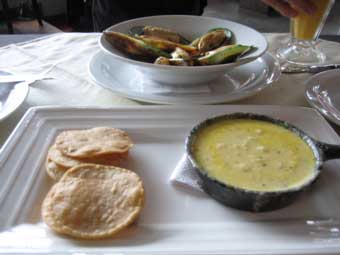 With a vaulted
glass ceiling, palm trees lining the pathway and posh lighting, one
would not expect Saga restaurant to be settled behind a dull parking
lot in Escazú. With a vaulted
glass ceiling, palm trees lining the pathway and posh lighting, one
would not expect Saga restaurant to be settled behind a dull parking
lot in Escazú. Although this restaurant may look out of place, it doesn't deviate much from the norm in Escazú, an area many would classify as suburban sprawl. The majority of the cuisine at Saga seems to fit with the setting: classy presentation, yet lacking any profound flavors. Although the restaurant boasts itself as an “international food restaurant” on its Web site, much of the inspired cuisine is lacking the depth which would be found in authentic dishes. Click here to read the full review |
||
| Film and Dramatic Arts ... |
|||
National violinist plays third Orquest Sinfonica concert It is the turn of the violin this weekend, as the Orquesta Sinfonica Nacional holds its third concert of the season in the Teatro Nacional. Costa Rican soloist María Lourdes Lobo currently plays violin with the Cuarteto Alma, which is made up of four women and regularly performs in various culture centers around San José. In this weekend's concert she will be interpreting German composer Max Bruch's popular "Concerto for Violin and Orchestra." She will also play English composer Frederick Delius' "Preludio a Irmelin," which was premiered 19 years after the composers death in 1934, and Shostakovich's "Symphony Number 10, according to the alterations made by Jacques Sagot at the event of Stalin's death." Read more - click here |
Costa Rica's cinematic heritage shared with all at public libraries All over the country, film lovers are being given the chance to learn a bit more about Costa Rica through cinema screenings in public libraries. Viewers will probably be surprised to find out there are so many Costa Rican films in circulation, and although none is famous, they deal with issues close to the country's history. Subjects range from the nation's love of guaro and documentaries on influential figures such as Francisco Amighetti and Juan Santamaría, to racial issues, lighter animated films, and even how to fish shrimp responsibly. Margarita Rojas, director of the Sistema Nacional de Bibliotecas, initiated the project, making copies of the works that she considers essential to Costa Rican cinema to send around the country. Read more - click here |
||
| Festivals ... |
|||
Semana U fills campus with cultural events The campus of the Universidad de Costa Rica is buzzing more than usual this week, as students fill their time with cultural events instead of exams. Although classes continue, students often choose not to attend, as the attraction of concerts, sports, theater and art overpowers their studious side. La Semana U is a tradition that has been going on for much longer than most of the current students can remember. Individual faculties work with the Federacion de Estudiantes to organize the participation of a wide variety of acts and to secure enough money from the university to hold the week of fun and games. |
“A few years ago, the faculties would sell beer to the students in order to earn some money,” said Mauricio Arayas Santana, an ex-student. “They would spend it on useful things like more computers. Now they've banned beer because too many students were getting drunk and falling asleep on the lawn.” Instead, the week focuses around more wholesome activities, but as the events do not charge an entrance fee, the faculties do not earn any money. The week lasts until Friday. Read more - click here |
||
| Books ... |
|||
Land use in Costa Rica documented by Fulbright scholar Forty years of living in the jungle, moving between secluded forestry stations and research labs, has led Louisiana resident and NASA veteran
Click here to read more |
New book dwells on the social aspects of food Food is not just a selfish pleasure or a way to stifle hunger, but is central to the evolution of art, according to a new book published by Museos del Banco Central. Artworks by Costa Rican painters are the main content of the hardback book, “Imagenes para Comer,” which follows the representation of food in art since still life painting became popular in the Renaissance. Full-color pictures of both traditional and modern works are far more common than recipes, as the author Marjorie Ross only provides seven recipes within the book. All are traditional Costa Rican dishes showing influences from different sections of the community, such as corn fritters, white beans and chorizo and fruit salad. The book focuses on the meanings that food has within society, and how these are portrayed by art. Click here to read more |
||
|
|
|
|
|
|
|
|
|
|
|
|
| What we published this week: | Monday | Tuesday | Wednesday | Thursday | Friday | Earlier |
|
|