|
 |
Your daily |
 |
|
|
|
|
|
|
|
|
|
|
|
|
|||||||||||||
|
|
|||||||||||||
|
|
|
|
|
|
|
|
| What we published this week: | Monday | Tuesday | Wednesday | Thursday | Friday | Earlier |
|
|
 |
| A.M. Costa Rica Second newspage |
 |
||||||||
| Home |
Tourism |
Calendar |
Classifieds |
Entertainment |
Real
estate |
Rentals |
Sports |
About us |
|
|
|
|||||||||
 |
| Costa Rica Expertise Ltd http://crexpertise.com E-mail info@crexpertise.com Tel:506-256-8585 Fax:506-256-7575 |
 |

Click HERE for
great
hotel discounts
|
|
in Sarapiquí and Parrita By the A.M. Costa Rica staff
The anti-dengue clean up moves to Sarapiquí and Parrita this Sunday as an expected 400 volunteers will be out picking up trash and any kind of receptacles that could hold mosquito larva. This is the 10th and 11th sweep this season run by Asociación Terra Nostra Terra under the sponsorship of Cervercería Costa Rica, the beer company. The Sarapiquí sweep will be in Finca Seis Centro, Finca Once and La Victoria Centro, said the association. In the Canton de Parrita the sweep will be in Pueblo Nuevo, Parrita Centro, Sitradique and Los Sueños. In Sarapiquí the volunteers expect to visit some 1,249 homes. The goal off the program is not only cleanup but education, sponsors noted. In Parrita about 1,175 homes will see volunteers. The sweeps start at 7 a.m. Snake attacks police officer near Nicaraguan border By the A.M. Costa Rica staff
A decorated Fuerza Pública officer ran into a deadly fer-de-lance snake while he was searching for a marijuana plantation near the border with Nicaragua in Los Chiles Thursday. The officer, identified as Wilford Roblero Hernández, was struck several times, said the Ministerio de Gobernación, Policía y Seguridad Pública. The fer-de-lance, known as a terciopelo in Spanish, is an aggressive, highly venomous pit viper. Roblero Hernández has worked as a police officer for six years and was awarded a prize last year for his work by the U.N. Educational, Cultural and Scientific Organization. He also is known as the moderator of a local radio show on police work. He was taken to a local clinic where he was prepared for transportation to the hospital in Ciudad Quesada, San Carlos, officials said. Our readers' opinions
Wealthy people pay little,and workers pick up cost Dear A.M. Costa Rica: I think Sally has some of it right. Anything at all that has to do with banking should be extremely private and guarded. But since so many wealthy people have decided that they do not want to pay taxes we now have a problem. Legislature in the U.S. has been customized to cater to the wealthy so that they can make maximum profits and pay little import and or duty taxes on products that they now have made in Chinese prisons. It's as if they want it all. First of all they have managed to influence everyone in Washington to rally to their needs. In doing so, they have managed to run the ball around the end and amass a fortune. They are so greedy with their profits that they refuse to pay at least some taxes. All tax dollars are needed and especially from the wealthy. The lower and middle class are once again stuck with the task of bailing out the big boys on wall street, AIG, and every dam bank in the nation. Its time to pound the wealthy into the ground and give the blue collar workers a break. Am i dreaming or what? As for regulating the drugs? That will never happen. You cannot let people on the streets have or purchase freely any amount of opium-based drug or cocaine. They will find a way to abuse this in a heartbeat, too. The need for drugs and guns are a horrible disease that we must find a solution to and real quick. I'm like Sally. I don't have all the facts, but i do know that what i see is horrible. The decisions our president makes will be much better than those made by either President Bush. President Bush Sr. managed to prop up a dictator in Panamá, then turn and hide his head in the sand, then invade the country and create one of the worst atrocities ever in Panama's history with a mass grave that is still trying to be resolved. His son alike who fell in love with the Iraqi war, to the point that all other problems were ignored until we have what you now see as a recession. I tip my hat to Obama for his latest effort to mend fences with Fidel despite the fact that Fidel has imprisoned and killed many innocent people, but the urgent need for help in that country takes priority so I will bite my tongue and tell my Cuban neighbors to please let the wounds heal so we can do something good for the island of Cuba. Bruce Simpson
Hone Creek Social cost of drug war is 2.4 million jailed youth Dear A.M. Costa Rica: Clearly, Ms. Sally O'Boyle's opinions are full of insight and plain facts. The "war on drugs" has been a disastrous and tragic replication of Prohibition, only with much deeper and far ranging consequences. The political cowardice and exploitation of popular fear and ignorance has not only cost countless lives, but has created the most shameful and monstrous American gulag the world has ever known. It is no exaggeration to say in size, duration, and draconian purpose, these eclipse even those of World War II. The only differences are state-sponsored executions and deliberate starvation. With 2.4 million American youths incarcerated [most non-violent drug offenders] one must ask when rational thought will displace inhumane notions of justice and outright stupidity. Could all of the actors and architects of this failing approach to drug usage/trafficking have failed to read history? Do they give a damn about the destruction of youthful lives & potential? H. Franz Santa Ana and Las Vegas, Nevada
|
|||||||||||||||||||||||||||||||||||||||
| Home |
Tourism |
Place
classified ad |
Classifieds |
Entertainment |
Real estate |
Rentals |
Sports |
About us |
|
| What we published this week: | Monday | Tuesday | Wednesday | Thursday | Friday | Earlier |
| The contents of this page and this Web site are copyrighted by Consultantes Río Colorado 2001, 2002, 2003, 2004, 2005, 2006, 2007 and 2008 and may not be reproduced anywhere without permission. Abstracts and fair use are permitted. Check HERE for details | ||||||
 |
| A.M. Costa Rica third newspage |
 |
||||||||
| Home |
Tourism |
Calendar |
Classifieds |
Entertainment |
Real
estate |
Rentals |
Sports |
About us |
|
| San José, Costa Rica, Friday, April 17, 2009, Vol. 9, No. 75 | |||||||||
 xxxx
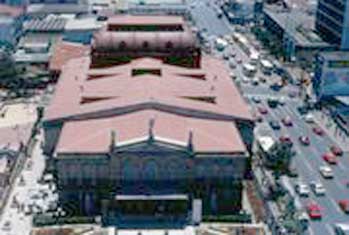
Theater roof will be returned to original red color |
 Ministerio de Cultura, Juventud y
Deportes photo
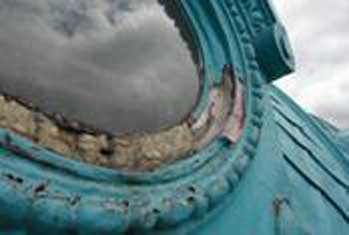
Cupola shows the signs of disrepair
|
|
Teatro Nacional roof will get
a restoration makeover
|
|
|
By the A.M. Costa Rica staff
The job will not be the most visible restoration project in San José, but the culture ministry is giving the go ahead for a major restoration of the cupola of the Teatro Nacional. This is the section on the roof of the theater that is 26.8 meters (88 feet) square and 18.15 meters (60 feet) high. This is more than a roof. The cupola contains all the machinery used to change and manage the scenery inside the theater. And the job is more than just repair. Experts have been examining the downtown structure for a year. The restoration will begin in a few weeks. Officials blame the pigeons and the acid their waste creates for corroding the metal of the roof. In addition there is bug damage to the wood and leaks. The frames of oval windows in the cupola are rotting. |
Workmen first will use
high-pressure hoses to rid the roof of the green
metal paint put on in 1997. Then they will attack the rusting metal and
make replacement parts for the wood. There also are some decorative elements that need to be restored. Finally the restored roof will get a red paint job to bring it back to its original color. The job is being financed by grants from the government of Spain and Germany with additional funds from the local firm Holcim Costa Rica S.A. The cost is about 107 million colons or about $190,000. The theater, built in 1897, is the architectural crown jewel of Costa Rica. It also is home to hundreds of pigeons. Officials did not say how they would handle that problem. |
| Tiny fly can cause a whole lot of trouble long after a bite |
|||
| More
than 20 years ago I was staying in a very nice hotel in Mexico City
after having returned from a few days in Acapulco. I awoke in the
middle of the night on fire with itching and burning around my
waist. I jumped out of bed and discovered what seemed like a
dozen red dots circling my waist like a belt. Frantically, I called the front desk and declared my bed was full of bedbugs. After denying their hotel had any such thing, a person from housekeeping came up and we went through my room, tearing my bed apart and examining even the walls. No bugs, no mosquitoes, nothing. As I recall, they kindly put me in another room. It was some time later that I realized that I had probably been bitten by sand flies that were on the beach in Acapulco. I haven’t thought about bedbugs or sand flies. I seldom get to the beach, and I think of bed bugs as having disappeared with Victorian slums and TB (although TB is making a comeback). Then just recently I read about the bedbugs making their re-appearance in the beds of hospitals, nursing homes and even hotels in the States and probably elsewhere. So far they do not seem to be a problem in Costa Rica. However, it is a different story with sand flies. Many tropical and subtropical beaches have those almost invisible pests, also known as biting midges. The bites of some of them can carry a number of diseases, including the potentially devastating leishmaniasis. I knew nothing about this until recently. A dear friend, after months of costly doctors’ visits, antibiotics and pain in Spain and the United States, was finally diagnosed with leishmaniasis panamensis. The two festering wounds she had were the result of the bite (and saliva) from a type of sand fly. In spite of the name, she was bitten when she was on the Caribbean coast of Costa Rica. Leishmaniasis panamensis is called papalomoyo in Costa Rica, but it has other names in other locales where it exists, such as the Mediterranean, the Middle East, other Latin American countries and Asia, as well as southern Texas. The problem is you don’t know right away that you have been bitten, and if you are traveling (as she was), the medical professions in more temperate countries often haven’t a clue and are prone to treat the sores that can erupt with antibiotics, which don’t help. |
Hosts can be dogs, rodents, foxes, sloths and marsupials, as
well as
humans. More humans are at risk because of the many
environmental
changes that are taking place around and near beaches, including
deforestation and the increase of human populations who now live in the
former habitats of animals. In Costa Rica the BriBri Indians, as well
as people who visit their villages and the beaches nearby are now more
at risk. The flies are most apt to appear between dusk and dawn. |
||
 |
 |
| Home |
Tourism |
Place
classified ad |
Classifieds |
Entertainment |
Real estate |
Rentals |
Sports |
About us |
|
| What we published this week: | Monday | Tuesday | Wednesday | Thursday | Friday | Earlier |
| The contents of this page and this Web site are copyrighted by Consultantes Río Colorado 2001, 2002, 2003, 2004, 2005, 2006, 2007 and 2008 and may not be reproduced anywhere without permission. Abstracts and fair use are permitted. Check HERE for details | ||||||
| A.M. Costa Rica fourth news page |
 |
||||||||
| Home |
Tourism |
Calendar |
Classifieds |
Entertainment |
Real
estate |
Rentals |
Sports |
About us |
|
| San José, Costa Rica, Friday, April 17, 2009, Vol. 9, No. 75 | |||||||||
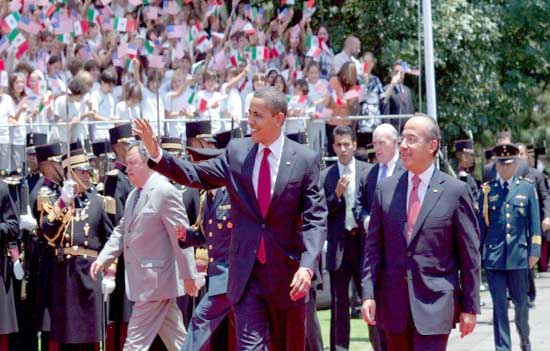
| School children cheer Barack
Obama as he walks under tight security with Felipe Calderón in
Mexico City. |
 White House photo by Pete Souza |
|
Obama, Calderón
discuss guns, drugs and trade in México
|
|
|
By the A.M. Costa Rica wire services
President Barack Obama and Mexican President Felipe Calderón have pledged to work together to fight drug trafficking, border violence, environmental dangers and other shared challenges. The two leaders met at the country's presidential residence. Emerging from a 90-minute meeting, Obama and Calderón announced a flurry of understandings, proposals, and pledges on a wide range of issues. Obama said he has great admiration for Mexico's leaders in their fierce and prolonged battle against drug traffickers. "But I will not pretend that this is Mexico's responsibility alone. The demand for drugs in the United States is what is helping to keep these cartels in business. This war is being waged with guns purchased, not here, but in the United States," he said. Obama said he wants the U.S. Congress to ratify a treaty limiting U.S. gun exports to the Americas and continue funding for a program that would provide Mexico with military helicopters to assist in the drug war. The treaty was signed by President Bill Clinton in 1997 but has not been ratified by the U.S. Senate. The president reiterated his support for reinstating the expired U.S. ban on assault weapons, but acknowledged Congressional resistance makes that unlikely. Instead, he pledged to boost enforcement of existing laws. "Trafficking illegal firearms, sending them across a border, is illegal. That is something that we can stop," Obama said. Calderón has repeatedly urged the United States to crack down on arms shipments south of its border, saying 90 percent of weapons in the hands of drug traffickers |
originate in the U.S. That number is
disputed
by persons in the United States who say traffickers can get weapons
from anywhere. The Mexican leader said the United States and Mexico must combine efforts to fight climate change and reduce carbon emissions. He also hailed what he termed the complimentary nature of the two nations' economies, saying that both can be made more competitive through cooperation and integration. To that end, he said he and Obama discussed ways to improve infrastructure along the U.S.-Mexico border to facilitate trade. For years, Mexico has urged Washington to address the status of at least 12 million undocumented workers in the United States, more than half of whom are Mexican. Obama reaffirmed his commitment to pursuing comprehensive immigration reform, an initiative that appears stalled in the U.S. Congress. "I am committed to fixing our broken immigration system in a way that upholds our traditions as a nation of laws, but also as a nation of immigrants. And I am committed to working with President Calderón to promote the kind of bottom-up economic growth here in Mexico that will allow people to live out their dreams here, and as a consequence will relieve some of the pressure that we have seen along the border," he said. Overall, Calderon said his meeting with Obama was ground-breaking. He said it was a historic event and that he is certain it will inaugurate a new era and a new relationship between the two countries. After an overnight stay in Mexico, President Obama was to depart today for Trinidad and Tobago to attend the Summit of the Americas. |
 |
|
| News from
the BBC up to the minute |
BBC sports news up to the minute |
| BBC news and sports feeds are disabled on archived pages. |
|
| Home |
Tourism |
Place
classified ad |
Classifieds |
Entertainment |
Real estate |
Rentals |
Sports |
About us |
|
| What we published this week: | Monday | Tuesday | Wednesday | Thursday | Friday | Earlier |
| The contents of this page and this Web site are copyrighted by Consultantes Río Colorado 2001, 2002, 2003, 2004, 2005, 2006, 2007 and 2008 and may not be reproduced anywhere without permission. Abstracts and fair use are permitted. Check HERE for details | ||||||
| A.M. Costa Rica fifth news page |
 |
||||||||
| Home |
Tourism |
Calendar |
Classifieds |
Entertainment |
Real
estate |
Rentals |
Sports |
About us |
|
|
|
|||||||||
|
Alternative summit opens
with Chávez and his friends By the A.M. Costa Rica wire services
Venezuelan President Hugo Chávez is hosting Latin American leaders in Venezuela for a summit of the Bolivarian Alternative for the Americas — a regional trade alliance he created with Cuba. Chávez has said the summit will also include discussions on the creation of a regional currency that has already been named Sucre. The gathering opened in the Venezuelan city of Cumana Thursday just one day before the Summit of the Americas begins in Trinidad and Tobago. Leaders from all six member states were scheduled to attend the summit in Venezuela. In addition to Chávez, the meeting will include the presidents of Bolivia, Honduras and Nicaragua, as well as Dominica's prime minister and a representative of Cuba. The presidents of Ecuador and Paraguay will also be there as observers. Chávez said the officials will aim to reach a common platform ahead of the Summit of the Americas, which will be attended by U.S. President Barack Obama and leaders from every Bolivarian Alternative for the Americas nation except Cuba. In recent statements, Chávez has criticized the exclusion of Cuba from the summit. The Venezuelan president and the other allied leaders are strongly opposed to the U.S. blockade against the Communist-led island, and several of them have said they will present their position to Obama in Trinidad. Venezuela and Cuba created the alliance in 2004 to counter U.S. influence in the region. Colombian rebels may free soldier held for 11 years By the A.M. Costa Rica wire services
Colombia's leftist rebels said they plan to free a military hostage after holding him captive for 11 years, in a move they hope will lead to a hostage exchange with the government. The Fuerzas Armadas Revolucionarias de Colombia said in a statement Thursday that they soon will release Pablo Emilio Moncayo. Rebels captured Moncayo in December 1997 in an attack on a Colombian army communications base in Narino. In recent months, the rebels have freed seven other hostages, among them police officers, a soldier and two former politicians. The group still is holding hundreds of captives in Colombia's jungles. The rebels want to swap 22 of their military hostages for about 500 jailed guerrillas. |
| Home |
Tourism |
Place
classified ad |
Classifieds |
Entertainment |
Real estate |
Rentals |
Sports |
About us |
|
| What we published this week: | Monday | Tuesday | Wednesday | Thursday | Friday | Earlier |
| The contents of this page and this Web site are copyrighted by Consultantes Río Colorado 2001, 2002, 2003, 2004, 2005, 2006, 2007 and 2008 and may not be reproduced anywhere without permission. Abstracts and fair use are permitted. Check HERE for details | ||||||
| A.M. Costa Rica sixth news page |
 |
||||||||
| Home |
Tourism |
Calendar |
Classifieds |
Entertainment |
Real
estate |
Rentals |
Sports |
About us |
|
|
|
|||||||||
| Latin
American news digest |
Congressional
probe likely over security intercepts By the A.M. Costa Rica staff and wire
services
U.S. lawmakers have ordered an investigation into allegations the National Security Agency violated legal restrictions while intercepting some e-mails and phone calls of Americans. Sen. Dianne Feinstein of California, head of the U.S. Senate Intelligence Committee, called the charges serious" Thursday and said congressional hearings on the matter will be held within a month. The New York Times first reported the allegations, quoting intelligence officials and lawyers who said the National Security Agency overcollected information. The U.S. Justice Department issued a statement Thursday saying it has taken steps to correct the situation and bring the National Security Agency program into compliance. The department says it works diligently to ensure that surveillance complies with the nation's laws. Details of the violations were not released due to what officials said was the classified nature of the work. The Bush administration authorized the government to eavesdrop on international phone calls and e-mails to and from the U.S., without obtaining a warrant from a secret security court, shortly after the Sept. 11, 2001, terrorist attacks in the United States. Then-president George Bush signed into law a bill that gave the U.S. government more power to eavesdrop on suspected foreign terrorists and even on expats living in Costa Rica. The legislation signed in August 2007 lifted a requirement that such surveillance could not begin without advance permission from a court. Bush said in a statement that this change would give U.S. agents dynamic and flexible tools for counterterrorism work. The law, called the Protect America Act, allows the U.S. National Security Agency to intercept telephone conversations, e-mail and other communications between foreigners that are routed through American equipment. Should a U.S. resident become a target of such an investigation, court approval still will be required, according to the law. The New York Times revealed in December 2005 that Bush in 2002 authorized the intelligence agency to monitor international telephone calls and international e-mail messages of hundreds, perhaps thousands, of people inside the United States without warrants in an effort to track Al Qaeda. |
| Latin American news feeds
are disabled on archived pages |
| Page One is HERE! Page 2 is HERE!
Page Three is HERE! Page Four is HERE! Page Five is HERE! Sports page is HERE! |
Calendar is here! |
| Food & Entertainment |
| Home |
Tourism |
Place
classified ad |
Classifieds |
Entertainment |
Real estate |
Rentals |
Sports |
About us |
|
| What we published this week: | Monday | Tuesday | Wednesday | Thursday | Friday | Earlier |
| The contents of this page and this Web site are copyrighted by Consultantes Río Colorado 2001, 2002, 2003, 2004, 2005, 2006, 2007 and 2008 and may not be reproduced anywhere without permission. Abstracts and fair use are permitted. Check HERE for details | ||||||