|
 |
Your daily |
 |
|
|
|
|
|
|
|
|
|
|
|
|
|||||||||||||
|
|
|||||||||||||
 |
| A.M. Costa Rica Second newspage |
 |
||||||||
| Home |
Tourism |
Calendar |
Classifieds |
Entertainment |
Real
estate |
Rentals |
Sports |
About us |
|
|
|
|||||||||
 |
| Costa Rica Expertise Ltd http://crexpertise.com E-mail info@crexpertise.com Tel:506-256-8585 Fax:506-256-7575 |
 Click HERE for great
hotel discounts
|
|
Go to Page 4 HERE! Go to Page 5 HERE! Sports is HERE! |
|
Dutch agricultural experts
Our reader's opinioncoming here April 3 and 4 By the A.M. Costa Rica staff
Representatives of some 35 Dutch agricultural firms will be in the country April 3 and 4 attempting to forge relationships with producers here. The visit is under the supervision of the Dutch Embassy here and a local agricultural consulting company with Dutch roots, Ideavelop. The goal is to follow up on a study financed by the Dutch government on ways the agricultural sector of the country can maintain its competitiveness in international markets. The embassy is encouraging producers to meet with the visiting business people at the Hotel Ramada Herradura. The study on the ideavelop.biz Web site is a comprehensive summary of each Central American country, its politics and also its agricultural policies. The report also rates the competitiveness of each country's agricultural sector. For Costa Rica, the report says bureaucracy here is fierce and imports of goods can be a long and difficult process. The report says that exporting is easier. Caribbean Tsunami alert topic of Panamá talks Special to A.M. Costa Rica
An independent tsunami early warning system for the Caribbean region, in place by 2010 at the latest, is likely to be a major step closer when a coordination group decides whether to give the go-ahead for a regional data-sharing system. The creation of the real-time sharing system for existing seismic monitoring networks is being discussed at the third session of an Intergovernmental coordination group taking place in Panamá through Friday. The new system would replace the temporary service being provided by the Pacific Tsunami Warning Center. The Caribbean region, with its population of nearly 40 million, is by no means spared the risk of tsunamis, the agency said. The most recent catastrophes occurred in the San Blas Islands of Panamá in 1882, Puerto Rico in 1918 and the Dominican Republic in 1946. U.N. and Nikon seek shots for potato year photo contest By the A.M. Costa Rica staff
Cartago farmers, take note. You have a photogenic crop. The area is known for its potatoes, and the politically powerful spud lobby was able to keep potatoes out of the free trade treaty, thereby protecting Costa Rican consumers from potatoes less than 50 cents a pound. Now comes the United Nation and Nikon, the camera and lens manufacturer. In conjunction with the U.N. Food and Agricultural Organization Nikon is announcing a world photography contest to highlight the role of the potato, the planet’s fourth largest food source, in the fight against hunger and poverty, the U.N. said. “It is grown in more than 100 countries, from the Andes and China's Yunnan plateau to the subtropical lowlands of India, on the plains of northern Europe and the steppes of the Ukraine,” said NeBambi Lutaladio, coordination of the International Year of the Potato, which also is being initiated. The potato tuber seems to have originated in the Peruvian highlands of South America. The contest has separate categories for professional and amateur photographers, and will accept single digital images or photo stories of four to eight related images, in either black-and-white or color, the U.N. said. Sought are images that illustrate potato biodiversity, cultivation, processing, trade, marketing, consumption and utilization, said the U.N. The announcement may only be coincidental in that St Patrick's Day is coming Monday, and no nation is better associated with the potato than Ireland. A potato blight swept the country between 1846 and 1849, and more than a million starving Irish emigrated to the United States and elsewhere. The contest also lends itself to endless bad jokes, such as the headline on the U.N. announcement: "All eyes on potatoes." is considered hypocrisy Dear A.M. Costa Rica: Concerning your March 12 article entitled "Costa Rica gets good marks but others don't in rights report" and considering the following partial list of U.S. human rights abuses as documented by Human Rights Watch in their 2008 report, it is hard to believe any thinking person would take the U.S. State Department report seriously. Then again, I doubt many in the world other than hardcore Bush administration supporters would. 1. Denial of habeas corpus to hundreds of Guantanamo detainees who have never been charged with a crime for over six years. 2. Release of detainees without verification of torture risk upon repatriation. 3. Failure of the revised military commissions system (2006) to meet due process standards, including the admissibility of evidence obtained through torture. 4. CIA refusal to disavow torture in its interrogations, legalized by executive order in July 2007. 5. The use of secret prisons for an unknown number of detainees confirmed in custody by the Bush administration and listed as "disappeared" under international law despite the illegality of incommunicado detention. 6. Failure to vigorously prosecute abuse charges against U.S. military personnel and contractors in Iraq and Afghanistan. 7. Denial of refugee protection, without proof, to anyone authorities believe is associated or supports any armed group. 8. Increasing incarceration rates (the world's highest in both total and per capita) disproportionately skewed to members of racial and ethnic minorities. 9. Confinement of almost 300 times as many offenders sentenced to life without parole for offenses committed as juveniles as in the rest of the world combined, and 10. Recent court restrictions to unequal pay challenges by women. Steve Roman
San Antonio de Belén
|
 |
 |
 |
 |
| A.M. Costa Rica third newspage |
 |
||||||||
| Home |
Tourism |
Calendar |
Classifieds |
Entertainment |
Real
estate |
Rentals |
Sports |
About us |
|
|
|
|||||||||
| A.M.
Costa Rica advertising is a bargain now with the revaluation of the colon! |
 |
 |
 |
 A.M. Costa Rica/José Pablo
Ramírez Vindas
|
|
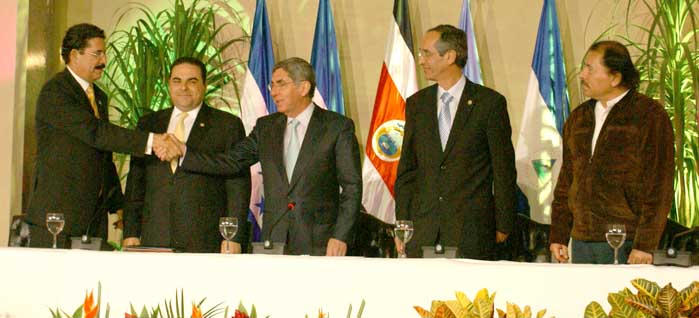
| President Óscar Arias Sánchez
shakes hands with Manuel Zelaya of Honduras while Antonio Saca of El |
Salvador, Álvaro Colom of Guatemala and Daniel Ortega of Nicaragua await their turns. |
| Five
presidents meet to outline strategy for pact with Europe |
|
|
By José Pablo Ramírez
Vindas
of the A.M. Costa Rica staff Costa Rica hosted an unusual meeting of five presidents from Central America Wednesday. The heads of state were here to outline strategy in negotiations for a trade agreement with the European Union. The most newsworthy aspect took place when President Óscar Arias Sánchez accused the European Union of hypocrisy because of the advantages it gives its small politically powerful population of farmers at the expense of agricultural producers overseas. Nicaraguan President Daniel Ortega, the Sandinista leader, said that his country wanted something fair and just, not like the free trade treaty recently approved with the United States. He said the United States was blocking Honduran products. He also said he did not want Europeans meddling in Nicaraguan affairs. He said the country already had two internals wars, one against the dictatorship of the Somoza family and the other against Yankee imperialism. |
The presidents issued a 14-point
summary at the end of their private
session at Casa Presidencial. Among other points, the chief executives
want a fund set up to aid in the reduction of poverty in Central
America. In addition to Arias and Ortega, the presidents were Antonio Saca of El Salvador, Álvaro Colom of Guatemala and Manuel Zelaya of Honduras. Casa Presidencial also noted that the next series of negotiations with the European Union is from April 14 to 18 in San Salvador. This will be the third meeting. The purpose of the negotiations is to try to get the greatest advantage possible for five small economies compared to the Europeans, said Arias. The agreement is being called an association instead of a free trade agreement. The presidents said in their summary of the meeting that they hoped the agreement would be finalized by the end of 2009. Costa Rica exports bananas to Europe, but there have been disputes over import duties as European countries gave preference to bananas produced in their former colonies. |
| Sala
IV says birth certificates should not list fact that a child is
abandoned |
|
|
By the A.M. Costa Rica staff
Youngsters who are disowned or otherwise abandoned by their parents when they are born will no longer have that fact noted on the public version of their birth certificate. The decision came from the Sala IV constitutional court that ordered the Dirección General de Registro Civil to make the change, said the Poder Judicial. The case was brought to the court by the organization Aldea S.O.S. which operates a shelter for youngsters in Santa Ana. |
Until now the birth certificates
contained a margin note that said if
the child had been abandoned or if the parents had lost their rights.
Such situations are common among very young mothers, drug addicts and
others without fixed residencies. Aldea S.O.S. argued that the note in the margin stigmatized the child. The Santa Ana location of the organization is specialized in caring for children when their parents are involved in a separation or possible adoption. About 46 children are living here, said the organization. |
 |
 |
 |
|
|
|
|
| You need to see Costa Rican tourism information HERE! |
| A.M. Costa Rica fourth news page |
|||||||||
| Home |
Tourism |
Calendar |
Classifieds |
Entertainment |
Real
estate |
Rentals |
Sports |
About us |
|
|
|
|||||||||
 |
|
L.A. indictments allege massive Latin human smuggling ring
|
|
|
Special to A.M. Costa Rica
A federal grand jury in Los Angeles indicted 12 defendants Wednesday for their roles in an alien smuggling ring that brought illegal aliens to the Los Angeles area and, for hefty fees, arranged to move those people around the country. Paperwork recently collected in the investigation indicates that the organization transported at least 5,400 illegal Latins since mid-2004. The indictment follows the arrest of six of the defendants nearly two weeks ago. Wednesday’s indictment charges all 12 defendants with conspiracy to harbor, conceal, and transport illegal aliens for commercial advantage and private financial gain. The investigation into the operation — dubbed the “three Franciscos” smuggling ring because the three lead defendants are named Francisco — began in May 2005 when the Los Angeles Police Department discovered two smuggling drop houses in a 24-hour period in south Los Angeles. More than 140 illegal aliens were packed into those houses. |
While a group of illegal aliens was being transported from Arizona into
the Los Angeles area last year, a driver for the organization had an
accident, which caused the minivan he was driving to careen into a
highway median near Barstow, California, according to the indictment.
The driver and 10 illegal aliens were ejected from the vehicle and
suffered serious injuries. According to the indictment and a criminal complaint previously filed in the case, an investigation by U.S. Immigration and Customs Enforcement uncovered an organization run by Guatemalan nationals who provided housing and transportation to illegal aliens who had previously been smuggled into the United States from Mexico, Central American and South America. The smuggled aliens were brought to drop houses in Los Angeles and Lancaster, where they were housed until they or family members paid up to $5,600 each for the domestic portion of their journey. The majority of those indicted Wednesday are Guatemalan nationals. If convicted, each of the defendants faces a maximum statutory sentence of 10 years in federal prison. |
|
Bush urges OK of Colombia trade pact as support for Uribe
|
|
|
By the A.M. Costa Rica wire services
President George Bush says Congress should approve a free-trade agreement with Colombia in recognition of President Alvaro Uribe's fight against violence and drug trafficking. Bush said failing to approve that agreement this year would embolden U.S. adversaries, including Venezuela's Hugo Chávez. Bush said time is running out for a free-trade agreement with Colombia. If the deal is not approved, Bush told the Hispanic Chamber of Commerce that it would send a signal to Latin America that the United States can not be trusted to stand by its allies. "The Colombia agreement is pivotal to America's national security and economic interests right now," he said. "And it is too important to be held up by politics." If approved, the deal would eliminate tariffs on more than 80 percent of U.S. exports of industrial and consumer goods and make permanent Colombia's preferential access to the U.S. market. Bush said Colombia is one of America's closest allies in the hemisphere and President Uribe has proven to be a strong and capable partner in fighting drugs, crime and terror. Bush says the Colombian leader has spoken-out against anti-Americanism, making hard choices that the president says deserve U.S. admiration and gratitude. |
Bush
is backing President Uribe in his stand-off with Ecuador and Venezuela
after Colombian troops attacked rebels based across the border in
Ecuador earlier this month. Bogota
apologized for the raid, but said it is a necessary part of its
struggle against the Fuerzas Armadas Revolucionarias rebels. Colombian officials said documents found during the fighting show that Venezuelan President Chávez paid $300 million to support those rebels. Venezuelan officials reject that claim. Bush said Colombia is waging an aggressive campaign against terrorists who do not respect national sovereignty or borders. He says praise by Chávez for the rebels and his decision to send Venezuelan troops to the Colombian border is the latest step in what Bush calls a disturbing pattern of provocative behavior. "As it tries to expand its influence in Latin America, the regime claims to promote social justice," said Bush. "In truth, its agenda amounts to little more than empty promises and a thirst for power. It has squandered its oil wealth in an effort to promote its hostile, anti-American vision." Bush said one of the most important ways the United States can demonstrate its support for Colombia is approving the free-trade agreement to support security in the Western Hemisphere and ensure a level playing field for U.S. products. |
|
|||||||||||||||||
| News from
the BBC up to the minute |
BBC sports news up to the minute | ||||||||||||||||
| BBC news and sports feeds are disabled on archived pages. |
|||||||||||||||||
| A.M. Costa Rica fifth news page |
Are
you
still
spending 70 percent You need to fill this space ASAP! |
||||||||
| Home |
Tourism |
Calendar |
Classifieds |
Entertainment |
Real
estate |
Rentals |
Sports |
About us |
|
|
|
|||||||||
 |
|
| International
agencies trying to help flood victims in Ecuador |
|
|
Special to A.M. Costa Rica
United Nations agencies are rushing food, medicines and other assistance to Ecuador to assist tens of thousands of people in need after heavy rains have inundated much of the South American country. Some 3,000 families, or around 13,000 people, have been forced from their homes by the two weeks of flooding, some of the country’s worst in two decades, and are living in more than 300 shelters. Heavy rains have impacted 13 of the country’s 24 provinces, with approximately 60,000 people being affected by the rains in total. As of late last month, nearly two dozen people have lost their lives, including several children, and some $82 million worth of crops have been lost. |
The UN World Food Programme has
distributed 135 metric tons of
high-energy biscuits and 10,000 food rations. Additionally the agency
is launching a food-for-work program in May for a three-month period. For its part, the UN Development Programme is continuing efforts to bolster early recovery efforts and is also organizing a three-day training event on risk identification and emergency management. The UN Children’s Fund through 500 young volunteers, is distributing some 10,000 information leaflets from the U.N. Development Fund for Women on the prevention of sexual violence and HIV/AIDS. Meanwhile, the World Health Organization is helping the national health ministry with the provision of vaccinations in Ecuador’s coastal region. |
|
Press freedom group stages
unusual protest on Internet By the A.M. Costa Rica wire services The press freedom group Reporters Without Borders is organizing an online protest to denounce Internet censorship in 15 countries around the world. The protest aims to raise attention to at least 62 people jailed as cyber-dissidents. Reporters Without Borders is holding the online protest to raise pressure on governments that it lists as Internet enemies, including China, Cuba and Eritrea. The Paris-based group said this year it added Ethiopia and Zimbabwe to the list of countries that tightly restrict Internet use and monitor Web traffic for dissident activity. The protest at the Web site of Reporters Without Borders (www.rsf.org) allows people around the world to take part in a virtual demonstration which the group says would not be possible in many of the targeted countries. Clothilde Le Coz, director of the group's Internet freedom desk, says users at the site can join with others around the world to send a message to the targeted governments. "Pick a slogan, for example 'Free all the cyber-dissidents' or 'Free our Internet' and you will be virtually demonstrating with other demonstrators," she said. The watchdog group says at least 62 people are in jail around the world because of online dissident activity, and more than 2,600 Web sites were shut down or blocked in the past year. Ms. Le Coz says Reporters Without Borders also publishes a guide to help bloggers and dissidents avoid Internet censorship and publish their information online. But she says security officials, especially in some Asian countries, are increasing their efforts to track banned activity. "The Chinese government for example knows how people are circumventing the censorship and is trying to find new ways to censor," said Ms. Le Coz. Despite the dangers, many journalists and informal online reporters continue to use the Internet to distribute information. Ms. Le Coz points to August protests in Burma, where dissidents and others were able to upload pictures and videos of a police crackdown for use by news organizations abroad. In Cuba, Internet access is restricted to Web sites on the island, while the use of computers that connect to other countries is limited to foreign tourists. The restrictions make it very difficult for reporters and dissidents to communicate with rights groups off the island, such as the Cuban Democratic Directorate in Miami. Janisset Rivero-Gutierrez, the group's national secretary, says reporters and activists still use the Internet despite the dangers, including laws that impose 20-year prison terms on people who report on certain events in the country. |
| A.M. Costa Rica Sports news local and from the wires |
 |
|
|
|
|
|
|
|
|
|
|
||||||
|
||||
|
|
|
|
|
|
|
|
|
|
|
|
| What we published this week: | Monday | Tuesday | Wednesday | Thursday | Friday | Earlier |
|
|