|
 |
Your daily |
 |
|
|
|
|
|
|
|
|
|
|
|
|
|||||||||||||
|
|
|||||||||||||
 |
| A.M. Costa Rica Second newspage |
 |
||||||||
| Home |
Tourism |
Calendar |
Classifieds |
Entertainment |
Real
estate |
Rentals |
Sports |
About us |
|
|
|
|||||||||
 |
| Costa Rica Expertise Ltd http://crexpertise.com E-mail info@crexpertise.com Tel:506-256-8585 Fax:506-256-7575 |
 Click HERE for great
hotel discounts
|
|
Proposed law would require
public employees to be good By the A.M. Costa Rica staff
Officials need to be reminded that their function is to serve the public, rather than lose themselves in their own authority, according to a proposal that a Libertario deputy has introduced. Carlos Manuel Gutiérrez Gómez of Cartago has proposed a reformation and an addition to current law that was created to simplify the bureaucracy of public administration. “The public official should be efficient in the completion of his duties, execute his work with speed, quality and responsibility, on the understanding that his function is to serve the citizen in the work that was entrusted to him,” said Gutiérrez. The proposal would benefit citizens that need to go through an administrative process by ensuring that the officials concerned would afford them the possible best service. Any official who shows negligence or is declared responsible for neglecting to follow this part of the law would be subject to a written reprimand, followed by a month-long suspension and finally dismissal. The existing law is intended to protect citizens from the arbitrary lengthening of administration procedures, but the addition of sanctions intends to lend coercive power to encourage the law to be upheld. Cruz Roja statistics show February was violent month By the A.M. Costa Rica staff
The Cruz Roja is calling February one of the most violent months in the last eight years. Statistics released by the organization this week said that 100 persons died a violent death last month. Only in March 2007 and October of the same year did deaths reach triple digits. The highest month was October in that year with 119 deaths, according to the Cruz Roja statistics. March 2007 saw 104 deaths. Nearly half the deaths, 46 persons, were the result of some form of motor vehicle accident. But 25 died from what the rescue agency called aggression with a knife or gun. Water deaths claimed 16 lives. The statistics from the Cruz Roja, which operates ambulances, are valid because the agency is called to nearly every scene of violence. Various police agencies handle different kinds of deaths. For example the Policía de Tránsito would file the report on auto accidents. So the Cruz Roja statistics include all types of deaths. Our reader's opinion
Canadian woman declinesto believe guns are answer Dear A.M. Costa Rica: In response to P. Meister’s naive and sad letter on the reason all citizens concerned for their own safety should carry a gun, I feel compelled to offer an alternate solution. To start: referring to the unfortunate experience of a woman in Alaska with a bear. I would hope that anyone out in the wilderness in Canada and the northern U.S. would and should be aware that bears can pose a threat to personal safety. I would not concede the point that the only way to protect yourself while camping is to carry a weapon and shoot any wild animal that threatens you. Educated trekking and perhaps traveling with a guide would be my first response. But, of course this is NOT coming from a card carrying member of the National Rifle Association. The same applies to the possible personal threats to an individual walking in a bad neighborhood or to a woman walking alone at night in a big city. Use care and think. Guns just beget more violence. And Mr. P. Meister, not to my surprise, forgot to include the very real possibility that a person carrying a gun, might actually feel the need to use it in a situation where they otherwise might have found an alternate course of action. However, after having used a gun, they quite possibly would have to live the rest of their life with the knowledge that they have killed another human being. Another person just trying to live their life, and going through a rough patch, or maybe — especially here in Costa Rica, just trying to feed their family. I do not think that violent death is the answer to a hunger or poverty problem. I am Canadian, and have been taught and brought up believing that guns are unnecessary, except perhaps when one hunts to eat. I have not just been told that guns are bad, but I have instead seen the safe societies that exist due to gun control and the absolute lack of patience of the authorities when prosecuting these violent crimes. Although I doubt P. Meister would believe it, the lack of guns and enforcement of gun control in cities in Canada actually results in less violent crimes than any other cities of their size in the U.S. each year. I could research and quote statistics here, but I think the truth is so blatantly obvious it is not necessary. Michael Moore already proved it. There are alternate courses of action, always, to using a pistol. The consequences of using one, both mental (living after murdering someone) and physical (if your assailant has a weapon and desires to shoot back) and judicial (jail for life) are equally as life threatening as carrying a gun itself. Please, let us not be so callous with respect to guns, and consider that the answer to violence is not always violence. Valerie Hopson
Playa Palo Seco
|
 |
 |
 |
 |
| A.M. Costa Rica third newspage |
 |
||||||||
| Home |
Tourism |
Calendar |
Classifieds |
Entertainment |
Real
estate |
Rentals |
Sports |
About us |
|
|
|
|||||||||
| A.M.
Costa Rica advertising is a bargain now with the revaluation of the colon! |
 |
 |
 |
| Another
free trade-related measure gets high court approval |
|
|
By the A.M. Costa Rica staff
The Sala IV constitutional court said that it found no legal flaws in the legislative measure that would ratify the Treaty of Budapest for Costa Rica. The measure is a companion to a bill that was approved to provide expanded rights to inventors of new plant species. The treaty question went to the court because legislators and the office of the Defensora de los Habitantes requested it. This is a frequent action in Costa Rica to get the court's opinion before passing a measure. The Asamblea Legislativa likely will approve the measure for the second and final time later this week. Magistrates Fernando Cruz Castro and Gilbert Armijo Sancho declined to vote with the majority, and they said |
that
they objected to a legislative fast track process that resulted
in the measure's initial approval. They also said that such a
measure involving a treaty required more than a majority vote. In
addition, they said, the treaty itself violates human dignity, in part
because the word microorganism
is not defined by the Treaty of
Budapest. The treaty specifies about 50 locations around the world where those who invent new types of microorganisms can deposit samples. Depositing a sample in one place is equivalent to depositing the sample in all places, according to the treaty. The sample can then be used to wage a legal battle to defend patent rights. The measure generated considerable controversy because it is one of the dozen or so legal changes that had to be passed to implement the free trade treaty with the United States, other Central American states and the Dominican Republic. Opponents to the free trade treaty oppose this measure. |
| Trio
from defunct Banco Elca facing a long criminal trial |
|
|
By the A.M. Costa Rica staff
The trial of representatives from the collapsed Banco Elca is under way in a Goicoechea court and the procedure is expected to last up to four months, said a court spokesperson Tuesday. Many customers said they lost hundreds of thousands of dollars when the Superintendencia General de Entidades Financieras closed the bank June 29, 2004. Three former bank executives, including the ex-president, are accused of hiding existing bank problems and committing fraud, among other charges. Reports allege that Banco Elca lent large sums of money, some around $200,000 without guaranteeing the loans or verifying the payment capacity of the borrower, according to a judicial spokeswoman. One man said he was told by the bank that his $1.7 million would be invested into an |
offshore account. He never saw that
money again, according to his
report in court documents. Another charge is that the bank made it look
as if it had received $23.5 million in new investments, when it hadn't. The three men on trial are ex-president of the bank, Carlos Alvarado Moya, ex-director Javier Filloy Esna and former adviser Hernán González Peña. The formal charges against the three men are conspiracy, illicit administration, and fraud. The trial began Monday at the Tribunal de Juicio de Goicoechea and 53 witnesses are expected to testify, according to a court spokesperson. A number of depositors got a percentage of their money returned through a liquidation process, but many, including foreigners, did not because the process was complex. Elca was a favorite bank for expats who had to post $60,000 to obtain residency as a rentista. |
|
California
woman brings personal transport devices here
|
|||
|
By the A.M. Costa Rica staff
Costa Rica's eco-tourism label has brought it various odd crazes, such as strapping yourself to a zip-line for a
places that everyone else could go but I was missing out on because of my hip.” After her first brush with the eco-friendly vehicle, she spent three years planning to start up a distribution business overseas, and finally settled on Costa Rica. Emitting zero emissions from their rechargeable electronic motor, the vehicles are environmentally friendly, and therefore compatible with Costa Rica's eco-tourism image, says Ms. McPherson. |
The machine consists of a platform
between wheels, with a pillar
joining the base with the handles. Riders operate it by shifting their
weight backwards and forwards and from side to side, and it contains
its own balancing system to guard against the risk of toppling over. With a top speed of around 12 miles an hour, the Segway is hardly a road vehicle. In the United States, where Segways have been marketed for several years, the machines are allowed to run on sidewalks, with the same rights of way as pedestrians. McPherson intends to market them to golf courses, security teams and closed communities, before moving on to national parks and major tourist areas such as Quepos and Jacó. “They are perfect for the more mature adult, who finds it harder to get around a large gated community,” Ms. McPherson said. “Also, the police are very interested — we are hoping to get city center businesses to sponsor two Segways for use by the police.” Segways have recently taken up a more prominent standing in Latin America, with distribution centers opening in Guatemala, Mexico, Venezuela, Colombia and Honduras within the last year. So far only 12 Segways have arrived at the distribution center in Rohrmoser, run by Ms. McPherson and her daughter, Tami Buttenhoff, but they intend to import more according to demand. They are also intending to take the vehicles to costumers for free demonstrations. More information can be found at www.segwaycostarica.com. |
||
 |
 |
 |
|
|
|
|
| You need to see Costa Rican tourism information HERE! |
| A.M. Costa Rica fourth news page |
|||||||||
| Home |
Tourism |
Calendar |
Classifieds |
Entertainment |
Real
estate |
Rentals |
Sports |
About us |
|
|
|
|||||||||
 |
|
Gates doubts
Colombian and Venezuelan troops will fight
|
|
|
By the A.M. Costa Rica Wire services
U.S. Defense Secretary Robert Gates says he does not expect fighting to break out between Colombia and Venezuela, and that if it does he believes the Colombian military can successfully defend its country. Gates was asked about the increased tension on the Colombia-Venezuela border during a news conference Wednesday. "My personal view is that there is relatively little likelihood of a military conflict between them," said Gates. "And my further impression is that the Colombians can take care of themselves." Venezuelan President Hugo Chávez announced Sunday he was sending thousands of troops to the border area. But early Wednesday a senior U.S. defense official said "there is not as much to" the Venezuelan buildup as has been reported. The official spoke on condition of anonymity because his information is based on intelligence reports. He said he has not seen any significant concern among U.S. defense officials about any Venezuelan troop movements. Later, the top U.S. military officer, Admiral Mike Mullen, was asked whether the United States is providing any intelligence to Colombia to help it assess the current situation. "We have supported President Uribe in Colombia for many, many years, sort of across the board, from a training perspective and other perspectives," said Admiral Mullen. "And I'd stay away from any of the details of any additional support, except to applaud their success in terms of impacting significantly on the FARC in lots of ways." He was referring to the Fuerzas Armadas Revolucionarias de Colombia, the principal rebel group. Gates also expressed his support for the Colombian government and its effort to deal with the rebels, whom he called terrorists. President Chavez of Venezuela has good relations with rebel leaders and previously tried to mediate between them and the Colombian government. A Colombian military strike on a rebel base in Ecuador Saturday sparked the current tension. Ecuador's government has protested the attack as a violation of its sovereignty, but has not taken any military action. A top Spanish official said Wednesday that Spain is helping to mediate the conflict between its former colonies, Ecuador and Colombia. Spanish Foreign Minister Miguel Ángel Moratinos said he spoke to his |
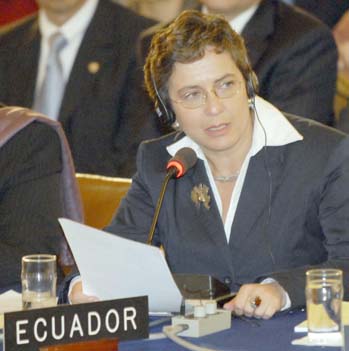 Organization of American States/
Juan Manuel Herrera
María Isabel Salvador, Ecuador's foreign minister,
addresses the Organization of American States in Washington.Ecuadorian and Colombian counterparts María Isabel Salvador and Fernando Araujo, who he said agreed to negotiations aimed at restoring normal relations between their countries. In Washington Tuesday for an emergency meeting of the Organization of American States, Ecuadorian Foreign Minister Salvador accused Colombia of perpetrating what she called a "planned and premeditated violation" of Ecuador's sovereignty. Colombia's representative, Camilo Ospina, acknowledged that Colombian military helicopters entered Ecuador's territory last week. He apologized to Ecuador but defended the incursion. Colombian officials say documents found during Saturday's raid show that Chavez paid $300 million to support rebels in Colombia. Venezuelan officials reject that claim. One of the rebels killed in the raid was Raul Reyes, a spokesman and leader of the rebels. The Permanent Council of the Organization of American States passed a resolution Wednesday that stopped short of condeming Colombia, and Secretary General José Miguel Insulza will visit the region to hold meetings with top officials in an effort to defuse the conflict. |
|
Laura Bush
will travel to Haiti and México next week to promote health care
|
|
|
By the A.M. Costa Rica wire services
President George Bush's wife, Laura, will travel to Haiti and Mexico next March 13 and March 14 for a two-day visit to highlight U.S. efforts to promote health care and education in the region. White House spokeswoman Dana Perino announced the trip Wednesday. |
In Haiti, Mrs. Bush will visit an
AIDS clinic and a U.S. Agency for
International Development education program. Haiti receives assistance
under President Bush's global AIDS initiative, the President's
Emergency Plan for AIDS Relief. In Mexico, the U.S. first lady will attend the launch of a U.S.-Mexico Partnership for Breast Cancer Awareness and Research. |
|
|||||||||||||||||
| News from
the BBC up to the minute |
BBC sports news up to the minute | ||||||||||||||||
| BBC news and sports feeds are disabled on archived pages. |
|||||||||||||||||
| A.M. Costa Rica fifth news page |
Are
you
still
spending 70 percent You need to fill this space ASAP! |
||||||||
| Home |
Tourism |
Calendar |
Classifieds |
Entertainment |
Real
estate |
Rentals |
Sports |
About us |
|
|
|
|||||||||
 |
|
| Notorious
Colombian loses citizenship over fake marriage |
|
|
By the A.M. Costa Rica staff
The Tribunal Supremo de Elecciones has annulled the citizenship of a Colombian man authorities said is linked to a group of Colombian assassins and an immense international drug trafficking ring. The man, Franklin Viveros Viveros of Colombia, was already deported twice from Costa Rica, said officials. He married a Costa Rican woman he had never met in order to gain citizenship status, according to his own testimony recounted in a tribunal decision. According to the decision, the woman, Evelyn Vanessa Murillo Rivas, was an indigent and had previously lost custody of her young son. In an interview last month, Francisco Castaing, head of the immigration police, said that even though Viveros was married to a Costa Rican citizen, he was still forbidden to enter the country because of his order of deportation. Nonetheless, Viveros entered Costa Rica again, through illegal means, said Castaing. Then he received citizenship on the strength of the marriage. The annulment of the naturalization, however, was a huge triumph, according to Fernando Berrocal Soto, minister of Gobernación, Policía y Seguridad Pública. Since the marriage of Viveros was a setup, according to the tribunal's |
ruling,
the citizenship was also illegitimate. The tribunal annulled the
citizenship, but cannot legally annul the marriage, per a
previous court decision. The Registro Civil, which distributed
cédulas
and naturalizes foreigners, is part of the tribunal. Viveros is tied to a group suspected of conspiring to assassinate Berrocal and Rodrigo Arias Sánchez, the minister of the Presidencia and the president's brother, last July, according to reports at the time. According to officials, the group of suspected assassins and Viveros are related to the González Rivas brothers who lead a huge narcotrafficking ring in Colombia. The group was sent to assassinate high-ranking Costa Rican officials because of their tough drug policies, said news reports. Officials said two men in the alleged assassin group were killed last month in Colombia after they were caught and deported from Costa Rica.. According to Castaing, marriages between foreign criminals and indigent Costa Ricans is one of the major problems facing immigration officials today. According to migration officials there could be more than 1,500 cases of fake marriages in Costa Rica. The security ministry reported Wednesday that Berrocal said, "Here the honest foreigners are welcome to work in the country, the delinquents are not." |
|
Court frees
defendants in baby marketing case By the A.M. Costa Rica staff
A San José court ruled that suspects charged with marketing babies in an illegal adoption ring, will not be put into preventative detention, said a court spokeswoman Wednesday. The Juzgado de Turno ruled instead, that six suspects will have to sign in with the court every 15 days. The cases of the remaining eight suspects had not yet been brought to court Wednesday, according to a judicial spokeswoman. Investigators detained the group of 14 suspects in different areas of the country Tuesday, according to the Judicial Investigation Organization. According to investigators, the ring contacted soon to be mother's who were in difficult financial situations. The mothers were paid from $2,000 to $10,000, for allowing their baby to be adopted said a judicial spokesperson. The suspects include a family trial lawyer from Liberia, a lawyer, a dentist, a publicist, and employees of a health clinic among others, said reports. Investigators detained the suspects in Escazú, Liberia, Atenas, and various neighborhoods in San José, according to the Judicial Investigation Organization. The six people interviewed by the court thus far include five women and one man, said a judicial spokeswoman. The man has the last name Soler and the five women have the last names of Calvo, Alvarado, Alvarez, Araya and Tabash. The Juzgado de Turno ordered the accused to stay away from witnesses and victims in the case. The court ordered three of the women to be suspended from their places of work, said a judicial spokeswoman. One is a family court lawyer and two are social workers. Investigators said that the suspects were only linked to three cases thus far, and that all the adoptive parents were Costa Ricans. Real estate firm forms society for research here Special to A.M. Costa Rica
A San José real estate firm says it is establishing the Nature Society of Costa Rica, a not-for-profit environmental research group. The Nature Society will provide grants and gifts to recognized academics and environmental professionals or organizations that have as their objective the preservation of the natural environment of Costa Rica, said a news release. The real estate firm, the Costa Rica Power Team, said it will donate an unspecified percentage of each sale commission to fund the society and it will begin to accept grant and research proposals in September. Jason LaFlesch is the firm's president. "As the Costa Rican economy grows it will face enormous pressures," he said. "Efforts must be made to save the rain forests, beaches and wildlife of Costa Rica. We hope to play an instrumental part in that effort." |
| A.M. Costa Rica Sports news local and from the wires |
 |
|
|
|
|
|
|
|
|
|
|
||||||
|
||||
|
|
|
|
|
Food, festivals, arts, entertainment, poker |
|
|
|
|
|
|
|
|
|
|
| Rising cello star will open the
season for Orquesta Sinfonica Nacional |
|
|
By
the A.M. Costa Rica staff
A young prodigy is set to start off the Orquesta Sinfonica Nacional's
first full concert of 2008 Friday. At the tender age of 15, Gabriel Cabezas is already on the road touring as a soloist, playing a cello that is almost five times his age. Born in 1992 in Chicago to a Costa Rican father, Cabezas took his first steps into what would become a quickly-flourishing career at the age of 4. He moved into the limelight when he was awarded second place in the Young Concert Artists auditions of 2007-8, after the judges bent the rules to allow a musician below the age of 17 to enter. He was the only Latin American entrant to reach the finals of the competition. The Young Concert Artists organization is set up to promote and encourage the careers of exceptional young musicians, and Cabezas was easily the youngest of this year's 300 entrants from around the world, not to mention of the 15 finalists. As a result of the competition, he also won the emerging artists prize award of the Seattle Chamber Music Festival, and also The Sanderson Buchman Memorial Prize Award. One of the pieces that he played during the auditions will form part of the program for the two concerts he will play in the Teatro Nacional. This is Dvorak's “Concerto in C Minor for Cello and Orchestra,” which he will perform alongside Tchaikovsky's “Capricho Italiano,” and Brahms' “Symphony Number One.” High praise has been afforded to Cabezas by various critics in the United States who have called him an “intense player who connects to the music naturally,” delivering a “remarkably poised and elegant account” of the music. The cello he plays was constructed in 1934, by Carl G. |
 Teatro
Nacional
image
Prodigy Gabriel Cabezas will
play the opening concert of the Orquesta Sinfonica NacionalBecker, a
legendary instrument maker who used a varnish that allows the
instrument to vibrate freely throughout its lifespan.
Cabezas is currently studying music under Hans Jørgen Jensen, and composition with Dr. Matthew Hagle at the Academy of the Chicago Music Institute on a scholarship. Cabezas has already played with many orchestras in the United States and appeared in such prestigious venues as Carnegie Hall. He has been invited to play a series of concerts in the Louvre museum, Paris, during 2010. He will open Costa Rica's symphony season at 8 p.m. Friday, with a second performance on Sunday at 10:30 a.m. The orchestra will be under the direction of Chosei Komatsu, and tickets will cost between 3,000 and 9,000 colons ($6-18). They can be bought be logging on to www.teatronacional.go.cr or by calling 221-5341. |
| Art Galleries .... |
|||
Rembrandt exhibition opens to high acclaim in downtown San José  Hailed
as the most important exhibition of the year, a collection of
the Dutch master Rembrandt's etchings opened amid much praise Thursday. Hailed
as the most important exhibition of the year, a collection of
the Dutch master Rembrandt's etchings opened amid much praise Thursday.
The 48 etchings usually reside in Amsterdam's Rembrandt House Museum, where the artist lived for about 20 years from 1620-40. They were collaboratively chosen from a wider collection by Dora Maria Sequiera, the director of Museos del Banco Central and Ed de Heer, the director of the Rembrandt House Museum. Although now better known for his marvelous paintings that capture intense emotion, facial expression, and deeply contrasted light and shadow, the etchings that are now on show in San José are considered by art buffs to be just as important. “Rembrandt was the most influential and original etchers possibly of all time,” said de Heer. “He is a shining beacon because he changed etching from a reproductive medium to a fully fledged artistic medium. “He used all sorts of different techniques to get all the possibilities out of the medium — he printed on copper plate, parchment, even sheepskin to make luxurious editions of prints. He didn't want any two to be the same.” Read more - click here Chicken suits, foot photos brought to Galeria Nacional by art colony residents  Those with a sharp
eye who look closely at Nancy Ennis' collages will
find a man in a chicken costume haunting each one. Those with a sharp
eye who look closely at Nancy Ennis' collages will
find a man in a chicken costume haunting each one. In some, he is the main focus of the piece, and in others he is as invisible as a smudge behind a layer of material. “One of my kids gave me this photo of their Dad when younger,” said Mrs. Ennis, as she pointed out the eerie figure, standing amid her as-yet unhung exhibition in the Galeria Nacional. “I like it because my ex-husband was a very funny man, although very irresponsible.” Mrs. Ennis, an American who lives in New Jersey, has been creating artwork on Costa Rican soil for the last six weeks, working in a private artists colony in Ciudad Colon. She is one of several dozen who seek out Costa Rica's tropical climes each year to spend a residency in the Julia and David White Artists' Colony. Read more - click here |
Imagen V show has a few gems but a pack of clinkers, too  New media art is
always a bit hit and miss with the potential to come
across as a foundationless piece of pretension if it is not done well. New media art is
always a bit hit and miss with the potential to come
across as a foundationless piece of pretension if it is not done well. The Bienal Iberoamericana Inquieta Imagen V, a competition for video artists from across Latin America, is a good example of this, containing a few pieces that engage well with the subject and make the most of their medium, but many that leave the viewer cold. Most of the works are video projections, some as short as a pistol shot and the flight of birds and some as long as a didactic letter that teaches about identity, isolation and fuschia flowers. Read more - click here Exhibit condemning illegal fishing would be better elsewhere For a while now, a large marquee has been standing outside the Museo de Arte y Diseño Contemporaneo in San José. In it hangs what has variously been described as an enormous bee hive, a throwback to sixties glow lamps or a swarm of schooling fish. The last explanation is the one that the artists propound. Huge, blue, glowing and transparent, the structure extends almost four meters down from the ceiling, nearly equaling its height with its width. It tapers towards the end, putting one in mind of a chrysalis, and its outside is made totally of clear nylon wires. Read more - click here Mistaken identity? No such thing, says new exhibition  Costa Rica is
a land of volatile volcanoes, orchids, coffee fincas,
Catholicism and Ticos. Costa Rica is
a land of volatile volcanoes, orchids, coffee fincas,
Catholicism and Ticos. Or you could say it's a country of wide seashores, football stadiums, fast food restaurants and beach towns overtaken by Gringos. Some are clichéd symbols of a tourist nation, while others are part of the country's changing culture, but all are involved in Museo de Arte Costarricense's new exhibition that challenges viewers to reconsider their own perceptions of the nation. Read more - click here |
||
| Food... |
|||
Mini-mall comes to the rescue of the not-rich-but-hungry 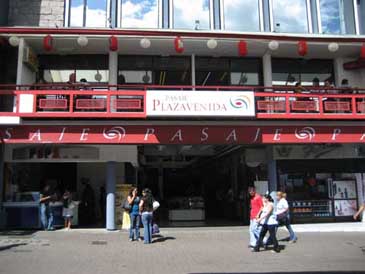 For those in the know, there is a clean, affordable, relatively quiet gastronomic surprise off the pedestrian mall in downtown San Jose. Between Arenas clothing store and the Patio Restaurant, behind a perfume counter and a Pops Ice Cream sits a food court without a McDonald's, Wendy's, Subway or Church's Chicken in sight. Tropical Food is a counter selling relatively healthy food. While their batidos aren't as delicious as the ones found at FrutiLand in Mall San Pedro, the water-or-milk- blended-with-fruit drink is a refreshing treat to carry during your walk along Avenida Central. A batido with the fruit of your choice mixed with water costs 650 colons, with milk, 750 colons. That's from $1.30 to $1.50. Adding honey or granola takes you up to a still-reasonable 900 colons ($1.80). The store also peddles fruit salads, ranging from 700 to 1.600 colons ($1.40 to $3.20). Marisqueria produces delicious looking and smelling seafood dishes. A customer-friendly hanging chalkboard lists their menu and respective prices. A small corvina ceviche will set you back 1,950 colons ($3.90). Get a small rice with shrimp for 2.150 colons ($4.30), 2,800 ($5.60) for a larger serving. Or try one of the fish filets prepared several different ways, the cheapest being with oil and garlic for 2,600 ($5.20) colons, the priciest fish filet dish is 3,600 colons ($7.20) for relleno with ham and cheese. Click here to read more |
Festive season proves troublesome even for established restaurant 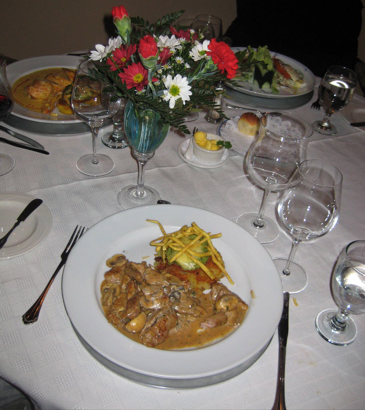 Being a chef in a
busy kitchen must be a pretty stressful job, but
around Christmas stress is something any successful restaurant should
factor in as inevitable. Being a chef in a
busy kitchen must be a pretty stressful job, but
around Christmas stress is something any successful restaurant should
factor in as inevitable. On a second visit to well-reputed French restaurant Le Chandelier, it soon became obvious that the staff were poorly equipped for the onslaught of Christmas party diners on a Tuesday night, leaving the usually decent food to deteriorate into a procession of almost inedible starters and bland entrees. Set in an old San Pedro house with brick ceilings and wooden beams that was converted into a restaurant around 15 years ago by Swiss owner Claude Dubuis, Le Chandelier purports to offer French cuisine that has been developed over generations of experience. Click here to read the full review A great meal is not all in the presentation 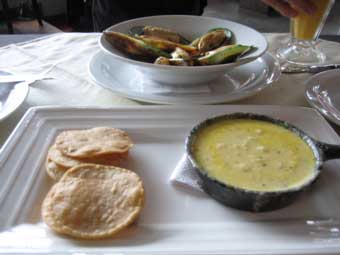 With a vaulted
glass ceiling, palm trees lining the pathway and posh lighting, one
would not expect Saga restaurant to be settled behind a dull parking
lot in Escazú. With a vaulted
glass ceiling, palm trees lining the pathway and posh lighting, one
would not expect Saga restaurant to be settled behind a dull parking
lot in Escazú. Although this restaurant may look out of place, it doesn't deviate much from the norm in Escazú, an area many would classify as suburban sprawl. The majority of the cuisine at Saga seems to fit with the setting: classy presentation, yet lacking any profound flavors. Although the restaurant boasts itself as an “international food restaurant” on its Web site, much of the inspired cuisine is lacking the depth which would be found in authentic dishes. Click here to read the full review |
||
| Festivals ... |
|||
| International acts to make rare
festival appearance in Costa Rica Excitement is rising over the announcement of headline acts for Festival Imperial, Costa Rica's most highly anticipated music festival of the year. Costa Rica is often missed off the list when world-famous bands are compiling their top international touring spots, but the second edition of the beer-backed festival is set to attract a few top names. Two years ago, the first Festival Imperial brought Sting and Jamiroquai to Costa Rica, while also promoting national bands such as Gandhi and Malpais, and April 2008's edition of the event promises similar quality. Read more - click here |
 British
group Duran Duran will headline Festival
|
||
| Dramatic Arts... |
|||
Prominent composer to diffuse Finnish culture in San José Finnish culture is not something you come across with ease in Costa Rica. Timo-Juhani Kyllonen, a well-known composer from the chilly Scandinavian country, is coming to San José to try to rectify this Thursday. Kyllonen will give a completely free concert involving a program of his own compositions, which include suites for strings and voice. Various Finnish organizations who decided it is time that their country's musical culture became better known in the Americas came together to make this happen. They include the Arts Council of Finland, the Foundation for the Promotion of Finnish Music and the Embassy of Finland in Managua, Nicaragua. Read more - click here |
Sunny days in San José complemented by free concerts The hot dry days are being put to good cultural use by the Museos del Banco Central with a series of outdoor concerts in the middle of the downtown area. Hundreds of shoppers stopped to lean over the balcony in Plaza de la Cultura for the first concert, when the Costa Rican singer MAF and her band played a sunny set of pop tunes outside the doors of the museum. Although the series is named 'Conciertos en las gradas', fewer people sat to on the steps outside the Museo de Oro than stood around the edges, looking down at the stage. The final concert of the series will be on March 29, with trio Villegas playing some classic Spanish rock from 2 p.m. |
||
| Books ... |
|||
Land use in Costa Rica documented by Fulbright scholar Forty years of living in the jungle, moving between secluded forestry stations and research labs, has led Louisiana resident and NASA veteran
Click here to read more |
New book dwells on the social aspects of food Food is not just a selfish pleasure or a way to stifle hunger, but is central to the evolution of art, according to a new book published by Museos del Banco Central. Artworks by Costa Rican painters are the main content of the hardback book, “Imagenes para Comer,” which follows the representation of food in art since still life painting became popular in the Renaissance. Full-color pictures of both traditional and modern works are far more common than recipes, as the author Marjorie Ross only provides seven recipes within the book. All are traditional Costa Rican dishes showing influences from different sections of the community, such as corn fritters, white beans and chorizo and fruit salad. The book focuses on the meanings that food has within society, and how these are portrayed by art. Click here to read more |
||
| Playing Hot and Cold Hands Late in a Tournament | |
|
Playing hot and cold hands refers to the strategy of entering into a pot solely on the basis of the hand’s merit before the flop. Running a hand hot and cold generally means that you’re willing to play out your cards with no more betting after the flop. Knowing how and when to play a hot and cold hand is especially important late in a tournament when escalating blinds and antes force players to move all-in rather than make standard-sized raises. When that happens, adjust your starting hand requirements by only playing hands that have a decent chance to win with no more betting after the flop. Say, for example, you’re sitting at a nine-handed tournament table with a large stack in relation to the blinds. In this situation, even a hand like 4h-5h has value because if you hit a straight, flush, or better, you stand to win a substantial pot by getting fully paid off on your later bets. A hand like, K-8 offsuit, though, would have negligible value -- unless your goal is to steal the blinds. And in that case, your hand is totally irrelevant anyway. Let’s tweak the scenario a bit. You’re still at the nine-handed table but now it’s much later in the tournament and your stack is taking a beating. Any raise will essentially commit all of your chips. That’s not good. In this situation, you’re going to have to wait for a hand that you can semi-confidently move all-in with. The question is: With which hand would you rather gamble for all of your chips, 4h-5h or K-8 offsuit? If you answered 4h-5h, you just might be too in love with suited connectors! The correct answer K-8 offsuit because that hand plays much better hot and cold. Playing a loose-aggressive style with small suited connectors can be effective early in a tournament. Later, though, as blinds increase and your chips start to dwindle, stick to high card hands. True, 4h-5h plays better than K-8 when there’s a lot of post-flop action, but the K-8 will fare much better in this classic hot and cold scenario. |
 Face it, sometimes you’ll have to make a desperation move late in a tournament in an attempt to steal the blinds. You’ll need cards that compete against a range of hands that any other player would likely call with. Small suited connectors will almost always be a substantial underdog. In our example, you’d be in huge trouble against any pair, fives or higher. And though you’d still likely be the underdog playing K-8, you’d actually be in much better shape. If your opponent has any pair, sevens through queens, spiking a king on the board will probably win you the pot. Though I’ve used K-8 in this example, hands that increase most in value in hot and cold situations are those that contain an ace. With an ace in your hand, you’ll only be a monster underdog against pocket bullets. Even ace-deuce could be a slight favorite against an opponent who holds a seemingly more powerful hand like K-Q. Get lucky with an ace coming up on the board and your opponent is pretty much cooked. Didn’t catch an ace? Well, he still needs to pair his king or queen to beat you. So here’s the bottom line. When you’re forced to move all-in late in a tournament, adjust your thinking away from playing pretty hands with implied odds. Instead, stick to hands that have a decent chance to win hot and cold. Visit www.cardsharkmedia.com/book.html for information about Daniel Negreanu’s new book, "Hold’em Wisdom for All Players." © 2008 Card Shark
Media. All rights reserved.
|
|
|
|
|
|
|
|
|
|
|
|
|
| What we published this week: | Monday | Tuesday | Wednesday | Thursday | Friday | Earlier |
|
|