|
 |
Your daily |
 |
|
|
|
|
|
|
|
|
|
|
|
|
|||||||||||||
|
|
|||||||||||||
| A.M. Costa Rica Second newspage |
 |
||||||||
| Home |
Tourism |
Calendar |
Classifieds |
Entertainment |
Real
estate |
Rentals |
Sports |
About us |
|
| San José, Costa Rica, Wednesday, Sept. 26, 2007, Vol. 7, No. 191 | |||||||||
 |
| Costa Rica Expertise Ltd http://crexpertise.com E-mail info@crexpertise.com Tel:506-256-8585 Fax:506-256-7575 |
 Click HERE
for great
hotel discounts
|
|
U.S. Embassy is jammed By the A.M. Costa Rica staff
Getting a visa for the United States always has been a sore point for Costa Ricans. And then the U.S. government said that travelers needed a visa even if they were just changing planes in the United States. This was an anti-terrorism change. Now the U.S. Embassy in Pavas says that visa approvals are running about five weeks. The embassy issued a press release Tuesday encouraging Costa Ricans to get their visa early, particularly those for December and January. The embassy said that the delays were the result of a temporary shortage of staff. The press release said that the consular staff hopes to cut into this backlog by getting more people for more U.S. citizens to arrive into the country. The vice consuls are all U.S. citizens. They decide after a brief interview if the applicant will get a visa. To get the appointment for the visa, Costa Ricans have to pay $14. They also have to bring a slip showing a $100 deposit to the visa interview. If they are rejected, the U.S. government still keeps the money. Non-U.S. citizens can find visa information at the embassy Web site. Guilty verdict in Burgos trial, but ex-girlfriend gets no time By the A.M. Costa Rica staff
The nation's version of court TV has ended with convictions of both a public defender and a former prosecutor. This is the Mauren Hidalgo Mora murder case. She was an employee of the courts who vanished July 11, 2006. Her body later was found near Atenas, and the next day investigators arrested her husband. He is Luis Fernando Burgos. A three-judge panel gave him 35 years Tuesday after a two-month trial. Zulay Rojas Sánchez, the fired prosecutor, was convicted of failing to tell authorities after Burgos confessed the murder to her. She is an ex-girlfriend, and the trial shed light on the romantic activities of the workers in the court system. Although she got two years, she does not go to prison. She faces what amounts to a suspended sentence for five years. There was no clear evidence of the guilt of Burgos, but the three-judge panel spoke at length of the supposed domestic violence to which Burgos subjected his wife of a year. The judges also accepted the testimony of other persons who said Burgos asked them to help him get rid of the body. In a dramatic moment last week, Ms. Rojas stood and confronted Burgos and told him that she knew he killed his wife. Evidence showed that the pair were in contact by telephone and e-mails after the death of the wife. Ms. Rojas had gone to a hospital during part of the trial and told judges that she was afraid of her ex-boyfriend. Burgos had reported his wife as missing and said she had gone out with a large amount of money to purchase a car. He blamed a gang of car thieves. The judges, Ana Patricia Araya, Linda Casas and María de los Ángeles Arana, said that Ms. Hidalgo died a cruel death as Burgos strangled her. The body was believed to have remained in the couple's apartment for two days. Still unknown is how the body was moved to where it was dumped near a road in Atenas. Burgos also was sentenced to pay his wife's family $136 million colons (about $261,500) as compensation for the death in the parallel civil action. An appeal by Burgos is likely. The judges also publicly chastised Ms. Rojas for bringing shame on the Ministerio Público, the nation's prosecutorial arm. The murder case had almost daily coverage on the San José television stations and the reading of the sentence at 4 p.m. Tuesday was covered live and dominated the later news shows. Man presumed drunk kills former companion in Cóbano By the A.M. Costa Rica staff
A man who appeared to be intoxicated broke into a Cóbano home early Tuesday, shot and killed his former female companion, shot three other persons and then commited suicide. The shootings took place in full view of the woman's 4-year-old boy and 6-year-old girl. Dead is Wendy Godoy García, 23, who was living with relatives in the Los Mangos section of the town on the Nicoya Peninsula. The presumed agressor was Francisco Burgos Moraga, 28, according to the Judicial Investigating Organization. Also shot was the mother of the dead woman, Rosa García Brenes; her stepfather, José Alex González Jiménez, and her sister, Jennifer. Gap bridged in tourist route By the A.M. Costa Rica staff
The public works ministry says it has bridged a gap in the highway between Tilarán and Nuevo Arenal with a temporary span. For nearly a month the road has been cut due to runoff damage. There was no adequate detour. Bus passengers had to walk alongside the empty space to continue their trip. The route is along the northeast shore of Lake Arenal and is a major tourism route. Cartago institute to host kids By the A.M. Costa Rica staff
Sunday is sports day at the Instituto Tecnológico de Costa Rica in Cartago. A group of sporting organizations plans competitions for kids from 2 to 14 years, and organizers say that no training or special skills are necessary. The purpose of the activity is to introduce youngsters to the dicipline of sports. Sponsors include the Asociación Deportiva Row, the Comité Cantonal de Deportes y Recreación de Cartago and the Asociación de Deportes.
|
 |
 |
|
on our real estate page HERE! |
| A.M. Costa Rica third newspage |
 |
||||||||
| Home |
Tourism |
Calendar |
Classifieds |
Entertainment |
Real
estate |
Rentals |
Sports |
About us |
|
| San José, Costa Rica, Wednesday, Sept. 26, 2007, Vol. 7, No. 191 | |||||||||
 |
 |
|
||||
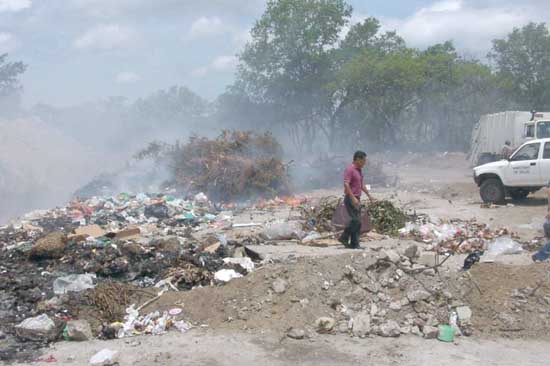
| A ministry of health worker does a checkup on the Bagaces dump. |
 Instituto de Fomento y Apoyo Municipal photo
|
| Growth includes garbage, and Guanacaste is facing a crisis |
||
|
By Dennis Rogers
Special to a.M. Costa Rica Rapid coastal development in Guanacaste continues without adequate infrastructure, and solid waste is no exception. All the coastal municipalities are in a state of crisis over disposal, according to Edmundo Abellán of the Instituto de Fomento y Apoyo Municipal, the government municipal oversight agency. Of the 11 Guanacaste municipalities, only the four with no coastal development are in control of their solid waste situation. Bagaces, Cañas, Tilarán, and Abangares have joined together for a landfill near the town of Cañas. It is approved by the relevant environmental authorities and should be under construction soon. Elsewhere the situation ranges from difficult to dire, according to Abellán. Pickup by the municipalities is in most cases limited to the main towns. Liberia, for example, covers only the town of the same name, with coastal areas not served. Liberia’s open dump was closed by court order two years ago, but a project to rehabilitate it as a proper landfill has been approved and is awaiting permits. Abellán said the compacted volcanic ash above the town has very low permeability and is ideal for a landfill. Liberia has relatively little coastline but does include the important Papagayo development. Erica Underwood of Papagayo Services Generales, managers of the concession, said the development has its own recycling and composting operation with residuals going to the Carrillo dump. The dump still operating to receive garbage from the coastal areas between Santa Rosa National Park and Tamarindo is known as La Pampa, near the town of Filadelfia. For about four years it was run by WPP International, the company that operates the Cartago and Alajuela landfills, and until it recently closed, Rio Azul near San José. WPP was never able to get permits and apparently never even submitted an environmental impact statement to make La Pampa a regional landfill. In 2006 management returned to the municipality of Carrillo where it is located. The ministerio of Salud has ordered it closed, but given the lack of alternatives for Carrillo and Santa Cruz, it remains open. The Carrillo coastal zone, which includes Playa Panama, Playas del Coco, and others, is served but with a truck purchased in 2006 by the local tourism operators. They claimed to be producing 200 tons per month, in July 2006, during a special session of the Carrillo council dedicated to the question of WPP’s future at La Pampa. This would presumably include some construction debris, which is not accepted by most municipalities. Santa Cruz is home to Tamarindo, where explosive development is overwhelming infrastructure including roads and water supply as well as garbage pickup. Municipal service does not reach the coast, so private pickup services have sprouted. Santa Cruz has no project on the horizon and will be linked to what Carrillo does, said Abellán. As the largest town on the Nicoya peninsula, Santa Cruz produces about 35 tons of garbage per weekday. Further south, Nicoya has an open dump also condemned by the ministry of health. The municipality includes the |
important beach towns of Sámara and Nosara and does provide pickup service there. Nicoya has no option available when its dump is closed. Two other small municipalities have coastline as well. Hojancha includes the important beach town of Carrillo, but provides no service outside the small county seat. Nandayure includes some coast presently with little development. Near the town of Carmona, a landfill program has financing and is in the process of site selection. Abellán suggested this may be a possible location for a regional landfill serving Nicoya, Hojancha, and the districts of Puntarenas that make up the remainder of the southern part of the peninsula. The other coastal canton, La Cruz on the Nicaraguan border, also has its small open dump which has been condemned. There is relatively little development on its portion of the coastline, much of which is in Guanacaste National Park. Most of the coastal zone has been given in concession (including an attempt to lease the national police school) and likely won’t stay undeveloped. In general, the Instituto de Fomento y Apoyo Municipal hopes to form more regional conglomerations like at Cañas, as even the larger towns like Nicoya and Santa Cruz cannot muster the resources to properly operate a landfill. Many municipalities around the country have resorted to rental compactor trucks. Those still with their own dumps also must rent the small bulldozers needed, as onerous procurement requirements mean parts cannot be quickly obtained in the event of a breakdown. |
|
| Beautiful property where air is clear — above 3,000 feet vistasdesarchi@gmail.com |
|
| This newspaper serves up more than 1 million pages a month to readers in 90 countries. Shouldn't your ad be here? |
 |
| You need to see Costa Rican tourism information HERE! |
| A.M. Costa Rica fourth news page |
 |
||||||||
| Home |
Tourism |
Calendar |
Classifieds |
Entertainment |
Real
estate |
Rentals |
Sports |
About us |
|
| San José, Costa Rica, Wednesday, Sept. 26, 2007, Vol. 7, No. 191 | |||||||||
| U.S.
sets up $40 million annual donation for labor rights |
|
|
Special to A.M. Costa Rica
The United States is providing funding for the labor provisions of its free-trade agreement with Central America and the Dominican Republic. The State Department's Michael Puccetti said that the U.S. commitment to free trade, as embodied in the Central America-Dominican Republic Free Trade Act, includes ensuring "that the benefits of free trade are enjoyed by workers and their families." Puccetti, the U.S. deputy coordinator for the Summit of the Americas, said the Dominican Republic and the Central American nations generally have good labor laws that conform with international standards but that the laws need to be enforced. U.S. support for protecting labor rights in the free trade treaty will help the Central American region be more competitive internationally by giving workers more training and employers more avenues for satisfying labor disputes, he said. U.S. funds help to build bridges among employers, labor groups and government that will protect workers in the region, Puccetti said. The funds, consisting of $40 million a year from 2005 to 2009, are usually provided as grants to non-governmental organizations. Contributors include the State Department's Bureau of Democracy, Human Rights, and Labor, which provides for a three-year program to enhance a business practice called corporate social responsibility. Under this principle, progressive companies recognize they should contribute to the broader public good and treat their employees, at a minimum, with dignity and respect. The funds also are backing rural development, and environmental projects in the Central American region for such activities as protecting biodiversity and promoting conservation. President George Bush signed the trade treaty in August 2005, saying that the agreement would help the signatory countries attract the trade and investment needed for economic growth. In addition to the United States and the Dominican Republic, the other signatories are Costa Rica, El Salvador, Nicaragua, Guatemala and Honduras. All those countries have ratified the trade pact except Costa Rica, which votes in a referendum Oct. 7. Costa Rican supporters of the treaty say the trade pact will give the country's exports, particularly such commodities as bananas and pineapples, permanent access to U.S. markets. However, opponents in Costa Rica contend that the trade pact not only will fail to generate employment, but also |
threatens many thousands of service,
agriculture and manufacturing jobs in that country. At least 40 percent of the country's registered voters must take part in the referendum for the results to be binding. A negative vote would kill the measure. Treaty critics in the United States argue that enforcement of labor laws in Central America needs more attention and resources. For instance, a leading critic in the U.S. Congress, U.S. Rep. Sander Levin, a Democrat of Michigan, said when voting against the measure in 2005 that the trade pact did not have the "basic legal framework in place to protect the rights of workers." "Trade has to be expanded in the right way" and the treaty "is exactly the wrong way. It doesn't protect the rights of workers overseas, and it encourages a race to the bottom in wages," said Levin, chairman of the House of Representatives' Subcommittee on Trade. A Levin spokeswoman said Tuesday that the congressman remains opposed to the treaty. However, Levin supports another trade bill now before the U.S. Congress, the U.S.-Peru Free Trade Agreement, because of its strong standards protecting labor and the environment, said the spokeswoman. Central American treaty supporters say the pact specifically is designed to improve labor law enforcement through a strategy that includes a dispute settlement system and possible stiff fines if a country does not effectively enforce its labor laws. Susan Schwab, the U.S. trade representative, said in a Feb. 5 letter to Congress that U.S. support for labor, environmental and rural assistance initiatives in the Central American region is a crucial factor to ensure the long-term success of the treaty. The U.S. funds include a new 24-month, $2 million grant for labor rights projects in the Central American trade treaty countries. The grant, announced Sept. 13, aims to raise awareness and understanding among workers of their rights under current labor laws and how to claim them. In addition, the grant aims to help worker and employer organizations learn more about compliance issues, and brings in civil society organizations to protect workers' rights. The grant will be administered through the Trust for the Americas, which is affiliated with the Organization of American States. José Miguel Insulza, the organization's secretary-general, said Sept. 13 that the U.S. grant will ensure that the Central American region provides greater levels of compliance with labor laws and more job training for workers while helping businesses to be more rigorous in their labor practices. |
| Ortega
critical of U.S. for questioning nuclear programs of other nations |
|
|
By the A.M. Costa Rica wire services
Nicaraguan President Daniel Ortega has lashed out at the United States for criticizing Iran and North Korea for their nuclear programs. At the United Nations General Assembly Tuesday, Ortega asked what right the United States has to question a country that is seeking nuclear development for peaceful — or even military — purposes. He said the United States not only possesses the greatest nuclear arsenal in the world, but is the only country to use nuclear weapons on civilians — in the Japanese cities of Hiroshima and Nagasaki during World War II. |
The Nicaraguan leader said the best
path for humanity is for nuclear
weapons not to exist, and he called on the United States to take the
first step in nuclear disarmament. Since taking office in January, Ortega has strengthened Nicaragua's ties with countries critical of the United States such as Iran, North Korea and Venezuela. He also has accused the U.S. of supporting opposition groups to undermine his leftist government. Ortega has a long history of opposing the United States. His Soviet-backed Sandinista guerrilla movement swept the U.S.- backed Anastasio Somoza from power in 1979. The U.S. countered by supporting what were known as Contra rebels to try to oust Ortega. |
| We can put your business announcement
here where those seeking international news will see it |
|
| News from
the BBC up to the minute |
BBC sports news up to the minute |
| BBC news and sports feeds are disabled on archived pages. |
|
| A.M. Costa Rica Sports news local and from the wires |
 |
|
|
|
|
|
|
|
|
| San José, Costa Rica, Wednesday, Sept. 26, 2007, Vol. 7, No. 191 | ||||||
|
||||||||
|
|
|
|
|
|
|
|
| What we published this week: | Monday | Tuesday | Wednesday | Thursday | Friday | Earlier |
|
|