|
 |
Your daily |
 |
|
|
|
|
|
|
|
|
|
|
|
|
|||||||||||
|
|
|||||||||||
 |
| A.M. Costa Rica Second newspage |
 |
||||||||
| Home |
Tourism |
Calendar |
Classifieds |
Entertainment |
Real
estate |
Rentals |
Sports |
About us |
|
|
|
|||||||||
 |
| Costa Rica Expertise Ltd http://crexpertise.com E-mail info@crexpertise.com Tel:506-256-8585 Fax:506-256-7575 |
 Click HERE for great
hotel discounts
|
|
Colombians and friends plan
protest against rebel group By the A.M. Costa Rica staff
Costa Rica will join people across the world today as residents gather to protest the largest rebel group in Colombia. “We don't want a bad group to represent us,” said Maria Fernanda Gualdron Blanco, coordinator of the San José demonstration against the Fuerzas Armadas Revolucionarias de Colombia. People in 46 countries around the world will gather to protest what is labeled as a terrorist group by 31 countries, including the United States. The group is known not only for its kidnapping stunts and violence, but for its heavy involvement with the narcotics trade. The U.S. Department of Justice lists the Fuerzas Armadas Revolucionarias de Colombia as one of the “highest priority targets in our fight against illegal drug trafficking.” There are about 1,000 Colombians living in Costa Rica, said Ms. Gualdron Sunday, and she expects 1,000 people to show up at the downtown protest. Many are in flight from the four decades of war that have ravaged their country. The main goals of the protest are to unify with affected families and victims of the rebel group and to demand liberation of hostages and peace, said Ms. Gualdron. The protest will be held at 11 a.m. in Parque de las Garantias Sociales, south of the headquarters of the Caja Costarricense de Seguro Social on Avenida 2 in downtown San José. Protest targets restaurant that serves shark fin soup By the A.M. Costa Rica staff
Students from Country Day School were among those who picketed an Escazú restaurant Saturday because shark fin sup is on the menu. The students, identified in a press release as from the Grupo Isla del Coco, part of the worldwide Roots and Shoots movement, were joined by others. The eating place is Restaurante Lotus in the Centro Comercial Paco in western San Rafael de Escazú. Also participating was the Fundación Amigos de la Isla del Coco and the Programa Restauracion de Tortugas Marinas., which issued the press release. The protesters say that sharks are in grave danger due to uncontrolled fishing. The organization said that the restaurant continues to serve the Chinese specialty despite contact from the conservationists. The Programa Restauracion said that the sale of shark fins was a $500 million a year business worldwide. Costa Rica is a key player in the shark fin trade. Officials have been slow to enforce laws and regulations against the practice, and many shark fishing boats unload their fins in Puntarenas. Among other aspects, conservationists are concerned with the waste in that only the fins are marketable. Hard-core treaty opponents will picket election tribunal By the A.M. Costa Rica staff
The hard-core opponents to the free trade treaty say they will picket the election tribunal today at 2:30 p.m. The organization that identifies itself as Grupo Costa Rica en Acción rejects the results of the Oct. 7 referendum because of what it says was fraud at the polls. Consequently it rejects the approval of the free trade treaty with the United States and vows to take its fight to the streets. The organization is protesting at the Tribunal Supremo de Elecciones because it said that opponents should have had equal financing and equal space in the media to present the opposing view against the free trade treaty. In addition, the group says that the names of thousands of free trade opponents were taken off the election rolls and could not vote, that the central government waged a campaign of terror against them and that factories whose owners supported the trade treaty turned their facilities into concentration camps and held workers hostage with threats they would lose their jobs if the treaty failed to pass. The group also says it plans to continue its picketing at least through Tuesday. One e-mail message from a man who identified himself as Ricardo Villalobos, coordinator of the Movimiento Cívico IV República, said the time has arrived to take to the streets. On its Web site, the Movimiento Civico prompts consideration of the Alternativa Bolivariana for Latin America proposed by Hugo Chávez, president of Venezuela. Venezuela officials are known to have provided at least advice to the free trade opponents. Some of the treaty opponents are circulating a petition seeking yet another referendum. This one would be on a key measure that is part of the implementing agenda of the trade treaty. The measure provides exclusivity for those who create new varieties of plants. Meanwhile, President Óscar Arias Sánchez went on television over the weekend explaining that delays in the Asamblea Legislative have forced him to seek an extension on approval of the implementation agenda from other countries that are party to the treaty.
|
 |
 |
 |
| A.M. Costa Rica third newspage |
 |
||||||||
| Home |
Tourism |
Calendar |
Classifieds |
Entertainment |
Real
estate |
Rentals |
Sports |
About us |
|
|
|
|||||||||
 |
 |
| One level below the Plaza de
la Cultura, the entrance to the Museos del Banco Central face east. Although the plaza is the heart of San José, many visitors never realize the museums are below. |
 A.M. Costa Rica/Elise Sonray
|
| Efforts
under way to make two attractions more visible |
|
|
By Bryan Kay
Special to A.M. Costa Rica The Plaza de la Cultura in central San Jose is sitting atop an under-utilized gold mine. The mine in question, of course, is the Museos del Banco Central Bank, a collection of three museums housing coins dating from various points in Costa Rica’s history, art work and pre-Colombian gold. The museums are more or less ignored much of the time by residents and visitors, said those who spoke to a reporter. The east-facing entrance is out of sight from the crowds that frequent the plaza. Plans have been announced to give the attraction a more public face by raising the entrance from the current, lower-level position to ground level. This would seem like an obvious more by authorities hoping to attract visitors to the capital, but in the meantime a rare piece of San José is languishing unexploited, said tourist Una McKain, 63, who visited the museums. “I would have missed it if it wasn’t for the person I was with having some local knowledge,” she said. “And it was very interesting and well laid out, I have to say.” Among the many gems to be found inside is a living history of Costa Rica’s Native American heritage. Intricate pieces of gold and other items of artwork from pre-Colombian times adorn two levels of the museum. Elsewhere, a monetary history of the country is housed in the numismatic museum on the upper level. It charts the progress of cash in Costa Rica from 1502 to present, with a particularly detailed account of money in the time of the filibuster period initiated by William Walker, the U.S. adventurer who set himself up as president of Nicaragua in 1856. There are other attractions, including pieces of artwork from both inside and out of the country. The stunning Bellavista fortress, which houses the Museo Nacional, the national museum, already is getting a makeover. Complete with bullet holes from the 1948 civil war and |
 A.M. Costa Rica/Elise Sonray
A new entrance to the Museo Nacional almost is compete.
Workmen had to remove large chunks of concrete at the Plaza de la
Democracia.with aging yellow turrets, it should have tourists rushing to admire its beauty, said Gadiel Alvarado, 31. The building’s entrance has been off a pedestrian walkway away from public view although work is being done to create a more visible entrance that fronts the Plaza de la Democracia. “I only know about the Museos del Banco Central because I live here,” said Alvarado. “It’s not visible enough.” Guillermo Urena, 32, another resident, says the area around the fortress is a mess. “It needs a major clean up,” he said. “How is San Jose supposed to attract visitors when our best attractions are either dirty or hidden?” |
| Three
bandits with gun shoot a young victim in Escazú |
|
|
By the A.M. Costa Rica staff
Three bandits, two of them later identified as minors, went on a stickup binge in Escazú Saturday. The trio of bandits help up a pedestrian in the vicinity of Palí in Escazú and then robbed a 17-year-old near the Centro Comerical Paco in western San Rafael de Escazú. The bandits then led police on a car chase until the Fuerza Pública detained three suspects in Alajuelita. |
The 17-year-old, identified as
Michael Navarro, went to Hospital San Juan de Dios with a bullet in his
leg. One of the three suspects had the last names of Ramírez Céspedes, said the Fuerza Pública. The other two suspects were 15 and 16 years old, so their names were not released. The Fuerza Pública said that officers confiscated a .38-caliber pistol in the car of the suspects as well as several cellular telephones. |
| Juan
Santamaría airport closes down briefly due to a glitch |
|
|
By the A.M. Costa Rica staff
The Juan Santamaría Airport closed for three hours Sunday due to problems with the control tower, said officials. The airport was closed from about 9:30 a.m. to 12:30 p.m. because of an operational complication with the control tower, said an official from the policía aeroportuaria. There |
was no official announcement as to
exactly what happened. An undetermined amount of flights were delayed
or canceled. A spokesman from Delta Airlines in Atlanta said there were no major problems with the company's 1 p.m. flight and that Atlanta employees had not received any sort of bulletin from the Juan Santamaría Airport about the airport closure. |
|
|
|
|
| You need to see Costa Rican tourism information HERE! |
| A.M. Costa Rica fourth news page |
|||||||||
| Home |
Tourism |
Calendar |
Classifieds |
Entertainment |
Real
estate |
Rentals |
Sports |
About us |
|
|
|
|||||||||
 |
 A.M. Costa Rica/Anne Clark
|
|
| How
can you have a Super Bowl party without tons of food? |
|
| The
most valuable players for the Super Bowl XLII Sunday were not on the
field. They were the folks hunkered over hot stoves preparing the
tacos, hot dogs, buffalo wings and all the other goodies wolfed down by
the anxious fans. The New England Patriots and the New York Giants were working out early to get limber for the big game. So were the cooks and helpers all over Costa Rica. Thousands of chickens and who knows how many cows gave their lives for the various Super Bowl parties, both public and private. And then there was the |
fermented grains. At the Sportmen's Lodge Ariel Escorsia managed the kitchen and severed up chicken fingers and french fries. He was assisted by others, including Mery Victoria, who handled the pans brimming with chicken and shredded beef. Adillé Carmana keep the taquitos filled. Of course despite the quality of the food, Patriot fans had to fight off a little indigestion as their team came out on the short end of a 17-14 score, thanks to a Giant touchdown with just 35 seconds remaining. |
| Fujimori
implicated by witnesses in 1992 killing of journalist, press group says |
|
|
By the A.M. Costa Rica wire services
Reporters Without Borders says two former members of a Peruvian paramilitary group have accused former President Alberto Fujimori of responsibility in the kidnapping and killing of a journalist during a 1992 crackdown on leftist rebels. The Paris-based media freedom organization said Friday that two former members of Peru's Colina paramilitary group, Pedro Guillermo Supo Sanchez and Julio Chuqui Aguirre, testified this week at Fujimori's trial in Lima on human rights violations. The rights group says the witnesses testified that |
paramilitaries
killed journalist Pedro Yauri with the approval of Fujimori and his
former intelligence chief, Vladimiro Montesinos. Fujimori is on trial for allegedly being connected to the deaths of 25 people in two massacres in 1991 and 1992. He faces up to 30 years in prison if convicted. A court recently convicted Fujimori and sentenced him to six years in prison in a separate abuse of power case, for ordering an illegal search of an apartment belonging to the wife of Montesinos. Fujimori has acknowledged ordering the search but said it was to investigate allegations of money laundering. |
| The
big party for about 700,000 is in Rio de Janeiro until Tuesday. |
|
|
By the A.M. Costa Rica wire services
Tens of thousands of revelers have packed the streets of Rio de Janeiro, Brazil, to celebrate the second day of the world famous Carnival festival. Local residents and tourists, clad in colorful costumes and whimsical hats, danced in the city center Saturday to the samba beats of the Black Ball band (Cordao do Bola Preta). The band has played at Brazil's Carnival since 1918. The partygoers are among an estimated 700,000 people expected to join the five-day fiesta. The highlight of the annual party comes Sunday and Monday, when the city's |
top 12 samba schools compete in
parades featuring thousands of dancers at Rio's Sambadrome. Rio's Carnival is billed as one of the world's largest parties, though there are similar Carnival celebrations in Europe and other parts of Latin America. The festival precedes the Christian solemn season of Lent. The best known celebration in the United States is in New Orleans in the southern state of Louisiana. It culminates with Mardi Gras, also known as Fat Tuesday. Most celebrations are slated to run until Tuesday, the day before Ash Wednesday, when many Christians begin observing a six-week period of fasting and prayer. |
|
|||||||||||||||||
| News from
the BBC up to the minute |
BBC sports news up to the minute | ||||||||||||||||
| BBC news and sports feeds are disabled on archived pages. | |||||||||||||||||
| A.M. Costa Rica Sports news local and from the wires |
 |
|
|
|
|
|
|
|
|
|
|
||||||
|
||||||||
|
|
|
|
|
Food, festivals, arts, entertainment, poker |
|
|
|
|
|
|
|
|
|
|
| Exhibit condemning
illegal fishing would be better elsewhere |
|
|
By
the A.M. Costa Rica staff
For a while now, a large marquee has been standing outside the Museo de Arte y Diseño Contemporaneo in San José. In it hangs what has variously been described as an enormous bee hive, a throwback to sixties glow lamps or a swarm of schooling fish. The last explanation is the one that the artists propound. Huge, blue, glowing and transparent, the structure extends almost four meters down from the ceiling, nearly equaling its height with its width. It tapers towards the end, putting one in mind of a chrysalis, and its outside is made totally of clear nylon wires. These wires started out life as fishing lines. Boats indulging in illegal long-line fishing in Costa Rican waters, killing millions of sharks and other sea life each year, had their deadly equipment confiscated by non-governmental organization Fundación Mar Viva. It is these materials that artists Ben Jakober and Yannick Wu have used in an effort to raise consciousness about illegal fishing practices in national waters. Called “Maricido,” the artwork takes the shape formed by a school of fish when it tries to make itself look like one large animal to defend itself against a predator. Video footage projected onto the walls is reminiscent of that seen in “Sharkwater,” which was released last year. In the documentary film, beautiful images of sharks gathering in their hundreds around Isla de Cocos were contrasted with harrowing pictures of sharks dangling from long-line hooks, and having their fins sliced off by fishermen for sale to the Chinese market. Continuing to raise awareness of this issue is a noble goal, considering around 4.4 million sharks, seabirds, billfish, marine mammals and sea turtles are killed every single year by this barbaric practice whose main aim is to catch sharks for their fins. But the question is, why put it here, in the middle of San Jose, in a marquee behind an art museum? The exhibition is usually deserted, the sharks swimming across the walls unobserved by man or beast. It could possibly be a lot more effective if put in a coastal |
 A.M. Costa Rica/Helen Thompson
Marecido exhibit in art and
design museum includes video projections of marine lifetourist town, targeting people who may realize that their enjoyment of Costa Rica depends on the marine environment as much as the land. Those who dive, snorkel and sail are likely to be more outraged when made aware of these issues than a city-bound businessman in San Jose. The name is designed to shock, indicating the assassination of the oceans by illegal fishing while the world ignores the problem, but the artwork itself is not strong enough to carry any real weight. A full exhibition with an exploration of other facets of the issue could have been more effective than the single structure, which means very little until an explanation is given. More information could easily be made available, whether through informative displays, leaflets, or interactive components, but the opportunity to spread knowledge of the problem to visitors is lost. Using the instruments of illegal fishing in order to inspire people to eradicate the practice is a cute idea, but this exhibition does not seem to be taking its job very seriously. The foundation and its supporters will have to look to more effective methods of getting their message out there if they are to achieve their goal of halting the extinction threat to some of the oceans' most majestic beasts. The exhibition is open until Feb. 29, and is situated in the Pila de la Meleza of the Museo de Arte y Diseño Contemporaneo. |
| Art Galleries .... |
|||
48 etchings by 17th century master Rembrandt to be displayed here San José will receive a visual treat from the Old World when 48 original etchings by Dutch master Rembrandt van Rijn will go on public display. The “Grabados de Rembrandt” exhibition opens Feb. 8 at the Museos del Banco Central. Rembrandt is best known for his dramatic and lively yet compassionate handling of various subject matters, particularly Biblical scenes and portraiture. The heightened emotion accompanying his work is aided by his famous use of chiaroscuro. Rembrandt's diverse thematic range will be represented in the exhibition. The exhibition will occupy the gallery space on the first level in the Museo de Numismática because of its high security and better exhibition environment. The works are on loan to Costa Rica from the Rembrandt House Museum and the Embassy of Holland. The exhibition runs through April 6. The Museos del Banco Central is open from 9:30 a.m. to 5 p.m. Admission is $7 for tourists and 1,000 colons for citizens. Wednesdays and the first Sunday of each month have free entry for nationals with identification. Imagen V show has a few gems but a pack of clinkers, too  New media art is
always a bit hit and miss with the potential to come
across as a foundationless piece of pretension if it is not done well. New media art is
always a bit hit and miss with the potential to come
across as a foundationless piece of pretension if it is not done well. The Bienal Iberoamericana Inquieta Imagen V, a competition for video artists from across Latin America, is a good example of this, containing a few pieces that engage well with the subject and make the most of their medium, but many that leave the viewer cold. Most of the works are video projections, some as short as a pistol shot and the flight of birds and some as long as a didactic letter that teaches about identity, isolation and fuschia flowers. Read more - click here |
Mistaken identity? No such thing, says new exhibition  Costa Rica is
a land of volatile volcanoes, orchids, coffee fincas,
Catholicism and Ticos. Costa Rica is
a land of volatile volcanoes, orchids, coffee fincas,
Catholicism and Ticos. Or you could say it's a country of wide seashores, football stadiums, fast food restaurants and beach towns overtaken by Gringos. Some are clichéd symbols of a tourist nation, while others are part of the country's changing culture, but all are involved in Museo de Arte Costarricense's new exhibition that challenges viewers to reconsider their own perceptions of the nation. Read more - click here Oriental engravings brighten up Semana Japonesa in Calderón Guardia  Oriental
engravings that have travelled half way across the world from
Japan have ended their journey in Museo Calderón
Guardia, where an
exhibition of 75 works was inaugurated Thursday. Oriental
engravings that have travelled half way across the world from
Japan have ended their journey in Museo Calderón
Guardia, where an
exhibition of 75 works was inaugurated Thursday.Subjects from autumn trees to high-rise apartments chart the growing influence of the West and development on post-war Japan. All the art works date from the 1950s until the 1990s, detailing an important time of change as the country opened up its borders and ideas after the tragedy of the Second World War. “We chose 1950 as starting point because there is a marked dividing line in Japanese art at this point. The country's art is very different to its precursors after this date," said a museum release. However, the influence of the 30s and 40s can be felt in this exhibition, as the bequest that it bestowed upon contemporary Japanese art is important to the understanding of this exhibition. To this end, the curators have involved artists who were also active in the 30s and 40s, the decades leading up to the divide in Japanese art, but who continued to produce and evolve after World War II. Read more - click here |
||
| Festivals ... | |||
First International Blues Festival Texas blues bands are heading down to Santa Ana for an afternoon of live music. BBQ's and cold beers will accompany artists including Smokin Joe Kubek & Bnois King and Robbie Clarke & the Live Wire Blues Band. Two stages at Motorpsychos Bar and Grill will host a total of seven bands during the afternoon of Feb. 9. Tickets cost $25 and can be found by contacting www.bluesdevilsband.com. |
Puntarenas Carnaval a mix of the traditional and the modern If you didn't know otherwise, you could be forgiven for thinking that Puntarenas Carnival is largely about scantily clad ladies fighting it out to be crowned queen of the show. However, the organisers claim that the carnaval tradition that will fill Puntarenas with people dressed in luminous feathers, steel bands, and brightly-coloured dancers, has roots that go back for thousands of years, to pagan celebrations of Baco, the God of wine. Read more, click here |
||
| Food... |
|||
Mini-mall comes to the rescue of the not-rich-but-hungry 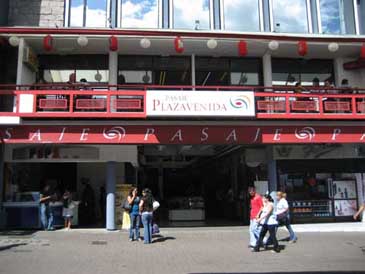 For those in the know, there is a clean, affordable, relatively quiet gastronomic surprise off the pedestrian mall in downtown San Jose. Between Arenas clothing store and the Patio Restaurant, behind a perfume counter and a Pops Ice Cream sits a food court without a McDonald's, Wendy's, Subway or Church's Chicken in sight. Tropical Food is a counter selling relatively healthy food. While their batidos aren't as delicious as the ones found at FrutiLand in Mall San Pedro, the water-or-milk- blended-with-fruit drink is a refreshing treat to carry during your walk along Avenida Central. A batido with the fruit of your choice mixed with water costs 650 colons, with milk, 750 colons. That's from $1.30 to $1.50. Adding honey or granola takes you up to a still-reasonable 900 colons ($1.80). The store also peddles fruit salads, ranging from 700 to 1.600 colons ($1.40 to $3.20). Marisqueria produces delicious looking and smelling seafood dishes. A customer-friendly hanging chalkboard lists their menu and respective prices. A small corvina ceviche will set you back 1,950 colons ($3.90). Get a small rice with shrimp for 2.150 colons ($4.30), 2,800 ($5.60) for a larger serving. Or try one of the fish filets prepared several different ways, the cheapest being with oil and garlic for 2,600 ($5.20) colons, the priciest fish filet dish is 3,600 colons ($7.20) for relleno with ham and cheese. Click here to read more |
Festive season proves troublesome even for established restaurant 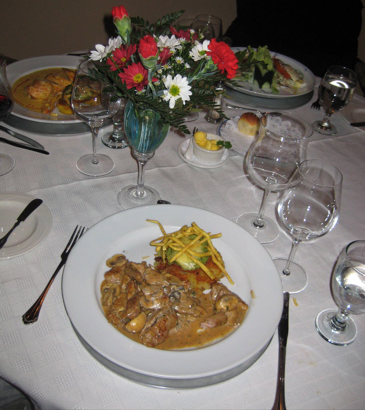 Being a chef in a
busy kitchen must be a pretty stressful job, but
around Christmas stress is something any successful restaurant should
factor in as inevitable. Being a chef in a
busy kitchen must be a pretty stressful job, but
around Christmas stress is something any successful restaurant should
factor in as inevitable. On a second visit to well-reputed French restaurant Le Chandelier, it soon became obvious that the staff were poorly equipped for the onslaught of Christmas party diners on a Tuesday night, leaving the usually decent food to deteriorate into a procession of almost inedible starters and bland entrees. Set in an old San Pedro house with brick ceilings and wooden beams that was converted into a restaurant around 15 years ago by Swiss owner Claude Dubuis, Le Chandelier purports to offer French cuisine that has been developed over generations of experience. Click here to read the full review A great meal is not all in the presentation 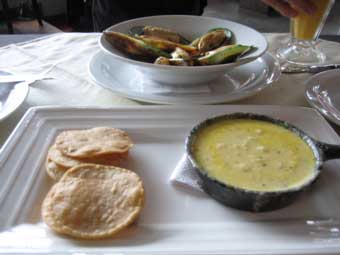 With a vaulted
glass ceiling, palm trees lining the pathway and posh lighting, one
would not expect Saga restaurant to be settled behind a dull parking
lot in Escazú. With a vaulted
glass ceiling, palm trees lining the pathway and posh lighting, one
would not expect Saga restaurant to be settled behind a dull parking
lot in Escazú. Although this restaurant may look out of place, it doesn't deviate much from the norm in Escazú, an area many would classify as suburban sprawl. The majority of the cuisine at Saga seems to fit with the setting: classy presentation, yet lacking any profound flavors. Although the restaurant boasts itself as an “international food restaurant” on its Web site, much of the inspired cuisine is lacking the depth which would be found in authentic dishes. Click here to read the full review |
||
| Dramatic Arts... |
|||
Sunny days in San José complemented by free concerts  The hot dry days
are being put to good cultural use by the Museos del
Banco Central with a series of outdoor concerts in the middle of the
downtown area. The hot dry days
are being put to good cultural use by the Museos del
Banco Central with a series of outdoor concerts in the middle of the
downtown area. Hundreds of shoppers stopped to lean over the balcony in Plaza de la Cultura Saturday, when the Costa Rican singer MAF and her band played a sunny set of pop tunes outside the doors of the museum. Although the series is named 'Conciertos en las gradas', fewer people sat to on the steps outside the Museo de Oro than stood around the edges, looking down at the stage. Onlookers were enthusiastic about the music, in spite of the singer's annoying lack of the ability to dance. She has recently released her debut album, Viaje Cosmico, for which she was recognised as 2007's revelationary interpretive artist by Costa Rica's music association, Asociacion de Compositores y Autores Musicales de Costa Rica. An alternative offering of rock trip-hop is up next on Feb. 9 at 2 p.m., played by group Parque en el espacio. The band recorded a live CD in San Pedro's Jazz Café during 2006, called Hello Hello. Miriam Jaraquín and Blues Latino will bring piano and accordion, flute and saxophone to the stage at midday on March 2., with an acoustic jazzy sound. The final concert of the series will be on March 29., with trio Villegas playing some classic Spanish rock from 2 p.m. |
Cultural prizes handed out to 2007's cream of the crop Premio Magón  A woman who devoted her life to the improvement of Costa
Rica's
education system was yesterday announced as the winner of 2007's Premio
Nacional de Cultura Magón. A woman who devoted her life to the improvement of Costa
Rica's
education system was yesterday announced as the winner of 2007's Premio
Nacional de Cultura Magón. María Eugenia Dengo started out by introducing new subjects and professions to the Universidad de Costa Rica in the early 70s, and moved on to such respected positions as minister of Educación Pública and UNESCO regional coordinator for Latin America and the Caribbean. Read more click here National Culture Prizes Hot on the heels of the Premio Cultural Magón winner have come the announcements of the numerous other national culture prize winners. María Elena Carballo, minister of Cultura y Juventud, read out the long list of Premios Nacional de la Cultura 2007 Tuesday, in a conference at the Centro Nacional de la Cultura. Along with the prizes for national theater, music, dance and literature, came two presented by the minister of Ciencia y Tecnología, Eugenia Flores. Read more click here |
||
| Books ... |
|||
Land use in Costa Rica documented by Fulbright scholar Forty years of living in the jungle, moving between secluded forestry stations and research labs, has led Louisiana resident and NASA veteran
Click here to read more |
New book dwells on the social aspects of food Food is not just a selfish pleasure or a way to stifle hunger, but is central to the evolution of art, according to a new book published by Museos del Banco Central. Artworks by Costa Rican painters are the main content of the hardback book, “Imagenes para Comer,” which follows the representation of food in art since still life painting became popular in the Renaissance. Full-color pictures of both traditional and modern works are far more common than recipes, as the author Marjorie Ross only provides seven recipes within the book. All are traditional Costa Rican dishes showing influences from different sections of the community, such as corn fritters, white beans and chorizo and fruit salad. The book focuses on the meanings that food has within society, and how these are portrayed by art. Click here to read more |
||
| Adjusting to tight games means playing more aggressively | |
When you play no limit hold’em, the ideal strategy is to take minimal risk, do little bluffing, and hope that weaker players call you when you have a strong hand. But that’s the perfect world. Sometimes you’ll face opponents that play very conservatively and will rarely pay you off when you have the goods. Tables like these aren’t as profitable as loose games but there are adjustments you can make to clean up here, too. In fact, if you approach tight games properly, they’ll provide a stable opportunity to steadily build your bankroll. Say you’re in a game where the other guys just seem to be waiting around for the nuts. They won’t play unless they’re dealt premium hands. You can exploit this situation by playing more aggressively. Raise more pots before the flop. Look to steal blinds and antes, and try to pick up pots when the other players don’t show strength. Use caution, though, especially when someone decides to call or reraise. That’s the basic adjustment to make in tighter games, but it doesn’t stop there. It also makes sense to bluff more at bigger pots, particularly if your opponents tend to play scared. Beating a tight game requires focus. You’ll need to seek out every opportunity where you can steal a big pot. One way is by representing a hand that your opponents probably can’t beat. Let’s look at a situation where you should be able to successfully bluff out a conservative opponent. With blinds at $5-$10, a tight player raises to $30 from first position. You call the raise with 10c-Jc. The flop comes 5c-6d-8c, giving you four cards to the flush. Your opponent bets out $50 and you call. The turn card is the 7d, adding a straight draw possibility on the board. He checks and the action is on you. Because your opponent is a rock, there’s a good chance that he has a hand like A-K, A-A, K-K, or Q-Q. And if that is the case, well, he obviously didn’t make his straight. Also consider that he won’t play a big pot unless he has the nuts or close to it. |
 A solid bet here and this pot is yours without even worrying about if you’ll catch the straight or flush on the river. With $175 in the pot, a bet of $100 should be enough to steal this pot away. There are other ways to exploit tight players. For example, they’re usually easy to read since the range of hands they’ll play is limited. And they’ll tend to bet their hands in a straightforward manner – another clue as to their holding. Make sure to use the board cards to tell your story when bluffing tight players. Be on the lookout for cards that you know your opponents don’t like. When they do come, bet to represent a hand they can’t beat. Keep in mind that this advice runs counter to the small ball style characterized by playing lots of marginal hands and needing a strong hand to play big pots. Small ball just doesn’t work in tighter games because the big payoff isn’t likely to be there. As you get more accustomed to playing in tighter games, it will become easier to get a feel for the pots you can steal. You’ll also recognize the ones that are best left unchallenged. Even if your hand is very strong, if a tight player raises you back, chances are he’s got you beat. Visit www.cardsharkmedia.com/book.html for information about Daniel Negreanu’s new book, Hold’em Wisdom for All Players. Visit www.cardsharkmedia.com/book.html for information about Daniel Negreanu’s new book, "Hold’em Wisdom for All Players." © 2008 Card Shark
Media. All rights reserved.
|
|
|
|
|
|
|
|
|
|
|
|
|
| What we published this week: | Monday | Tuesday | Wednesday | Thursday | Friday | Earlier |
|
|