|
 |
Your daily |
 |
|
|
|
|
|
|
|
|
|
|
|
|
|||||||||||
|
|
|||||||||||
 |
| A.M. Costa Rica Second newspage |
 |
||||||||
| Home |
Tourism |
Calendar |
Classifieds |
Entertainment |
Real
estate |
Rentals |
Sports |
About us |
|
|
|
|||||||||
 |
| Costa Rica Expertise Ltd http://crexpertise.com E-mail info@crexpertise.com Tel:506-256-8585 Fax:506-256-7575 |
 Click HERE for great
hotel discounts
|
|
Ultralight crash injured
pilot and his son in south By the A.M. Costa Rica staff
A pilot was in critical condition after his ultralight plane crashed in southern Costa Rica Saturday, said officials. the pilot, Mark Thukis, 58, was flying with his son, when his plane crashed near Ciudad Cortés, said officials. The plane landed in a farm at about 3 p.m., said a spokeswoman for Fuerza Pública in Puerto Cortés. It is still unclear as to why it crashed, she said. Thukis went to Hospital Escalante Pradilla de Pérez Zeledón, where he remained in critical condition, said a hospital spokeswoman Sunday. His son, is reported to be in stable condition. Thukis had lived in Costa Rica for about a year, said a Fuerza Pública official. The nationality of the two men was not clear, but it is believed they are originally from Europe. Sweep in Limón province results in detention of 60 By the A.M. Costa Rica staff
In another huge effort, police swept Limón and investigated 400 people and checked 300 vehicles over the weekend, said officials. Authorities asked people for their passports or cédulas and vehicle registrations, detaining those who could not provide the documents. Police originally detained 60 people, and later arrested 16 of them, all foreigners who failed to prove legal status. They also seized 15 firearms, they said. Of those detained by the Policía de Migración, 11 were illegal citizens from Nicaragua, two from Perú, and others from Poland, India and Venezuela. Most of the firearms seized were pistols, although one was a hand made gun constructed from wood, rubber bands and metal. It had the capacity to shoot a .22-caliber bullet, said officials. Police also apprehended one man with half a kilo of marijuana and another with 100 grams of the same drug, they said. They also seized small amounts of crack. Authorities also investigated numerous bars the area. One was shut down for serving liquor to a minor, said officials. The legal drinking age in Costa Rica is 18. Authorities said they were satisfied with the results of the operative and citizens were encouraging and thanked them for their efforts, according to the Fuerza Pública. The Unidad Especial Motorizada, la Unidad de Intervención Policial, la Policía de Migración, la Dirección de Investigaciones Especializadas, the Archivo Policial, the Unidad Canina, the Policía Municipal of San José officials from the Municipalidad of Limón all worked together on the operation. Officials swept downtown Límon, Cieneguita, Moín, Santa Rosa, Bananito, Cahuita, Peshurt, Hone Creek, Siquirres, Puerto Viejo and the entrance to the Limón airport, said officials. Complex drug case sent to court in first step By the A.M. Costa Rica staff
Prosecutors have presented formal accusations against eight persons linked to a case involving more than $2 million and 1,500 kilograms (3,300 lbs.) of cocaine. The allegations were filed with the Juzgado Penal del II Circuito Judicial de San José Friday, officials said. Officials arrested suspects on three separate occasions in 2006 for allegations of attempting to smuggle cocaine across Costa Rica's northern border in trailers, they said. The final arrest in October of 2006 yielded nearly $2 million in cash hidden in a secret compartment of the trailer as well as a suspect hiding in the same location, said officials. The cocaine shipments were all on their way to Guatemala, said authorities. After four people were arrested in trailer operations, all near the Nicaraguan border. Officials arrested four more suspects in November 2006. They were all found in houses belonging to the first group of detainees, said officials. Authorities believe the eight were all part of a drug smuggling group. The date for the first court hearing has yet to be set, said court officials. Five of the eight suspects remain in preventative detention, said the Tribunal Penal del II Circuito Judicial de San José. Unrest at school results in a trial for defamation By the A.M. Costa Rica staff
A mother and two teachers are going to court today to face a trail for defamation stemming from what amounted to a strike at a school in Ciudad Quesada. The victim is the school principal,identified by the last name of Quirós Araya. The allegation stems from statements that the trio made to local and national news media reporters after the Escuela San Juan was locked up with a chain last March 19. The teacher and mother of a student claimed that the principal had been guilty of aggression and other irregularities. However these allegations were never proved in a subsequent investigation. Defamation in Costa Rica is a criminal offense. Some 33 witnesses are scheduled to appear during the trial, said the Poder Judicial. The defendants were identified by the last names of Chavarría Espinoza, Soto Araya and Sandoval Hernández. said the Poder Judicial.
|
 |
 |
 |
| A.M. Costa Rica third newspage |
 |
||||||||
| Home |
Tourism |
Calendar |
Classifieds |
Entertainment |
Real
estate |
Rentals |
Sports |
About us |
|
|
|
|||||||||
 |
 |
| Main crater of the
Irazú volcano measures 3445 feet across. Irazú last had a
major explosion in 1963, and the Central Valley was covered
periodically in ash for two years. The nearby Turrialba volcano seems to be preparing for some additional activity. |
 A.M. Costa Rica/José Pablio
Ramírez Vindas
|
| Eruptions
elsewhere put spotlight on Costa Rican volcanoes |
|
|
By Elise Sonray
of the A.M. Costa Rica staff With two recent volcano eruptions in South America, some may be wondering is Costa Rica next? During a visit this month to the Turrialba volcano, scientists documented an increase of activity in gaseous emissions in three areas of the mountain. Researchers also noticed severe burns in the tree canopy to the lower west and north west of the volcano, according to the Observatorio Vulcanológico y Sismológico de Costa Rica. The volcano has been expelling gas for months. Tungurahua, Ecuador's most active volcano erupted Wednesday and continued to erupt Thursday, spewing lava, smoke and ash into the air and forcing the evacuation of people living nearby. Llaima in Chile erupted last month forcing 150 people to evacuate. The volcano spouted small amounts of lava last week, said officials. Costa Rica is part of the Pacific Ring of Fire and has about 100 volcanoes, seven of which are considered active. Turrialba has shown the most activity lately, said scientists at the seismology center at Universidad Naciónal de Costa Rica. In July, thousands of earthquakes were measured in just a few days and in December the volcano released a large plume of smoke which worried residents. Should tourists be worried? “There are eruptions everywhere in the world all the time,” said Patricía Alpízar, a spokeswoman for Ministerio de Ambiente y Energía, referring to the recent eruption in Ecuador. “We are careful and monitor what is going on,” she said. Ms. Alpízar discussed cycles and seismic activity, but did not give specifics. “Tourism here hasn't been affected by eruptions in neighboring countries,” said Marcela Villalobos, a spokeswoman for the Instituto Costarricense de Turismo. She added that there is security presence in the national parks in case anything did happen. In fact, an emergency evacuation plan is in place for the area around the Turrialba volcano. Ms. Alpízar said she doubted that even if a volcano in Costa Rica erupted, tourism to the other six volcanoes would slow. “When there were problems with acid rain at Poás, we continued to have strong numbers at the other volcanoes,” she said. |
In July when Turrialba was covered
in acid rain, Volcano Irazú received
over 15,000 visitors, up 8,000 from the previous month, according to
the Parque Nacional Volcán Irazú. Irazú and
Turrialba are adjacent and
share roots deep in the earth. When pressed Ms. Alpízar said tourism to all the volcanoes could lower if one erupted, “It would really depend on the type of problem,” she said. “I was at the eruption in 1963,” said Enid Gómez Quirós, a worker at the Parque Nacional Volcán Irazú. “We were working in the fields in the afternoon and heard thunder. We thought it was a storm,” said Ms. Gómez. No one warned Ms. Gómez or her family about the impending eruption of Irazú. Although no one in her family died, the ash covered their crops and killed the surrounding vegetation. “All was lost,” said Ms. Gómez, “we were hungry for five years.” Forty five years later, Ms. Gómez still lives on the slopes of the volcano and now works at the national park. She said she is not worried about another eruption. “They have more information now, they can measure the temperature and gases and see it,” said Ms. Gómez. When the Irazú erupted it destroyed over 100 square kilometers of land. Volcanologists expect some kind of an eruption from Turrialba within the next few years or decades, and like the Irazú eruption, they expect several layers of ash on the metropolitan area. The major involvement will be confined to some two to three kilometers around the volcano. However, they point out that the volcano now could also return to dormancy. After the volcano began to show activity, a number of remote sensing devices were put in place. There are personnel at every volcano, said Ms. Alpízar. “There are about 10 to 12 at Arenal and Irazú and four or five at Turrialba. There are not many now, but if the danger level was higher there would be more,” she added. However, a trip to Irazú last month revealed only two men on patrol. More than 100,000 people visited the volcano last year, according to reports from the national park. Arenal Volcano near La Fortuna holds the record for the longest-running, continuously active volcano in the world. In 1968 Arenal erupted killing 87 people. It also erupted in 2000 and 2003. And it puts on a show for tourists nightly. |
| On
last free day before start of school it's shopping or picnic |
|
|
By the A.M. Costa Rica staff
Boys with fresh haircuts, moms tugging on children's' arms, people young and old waiting in line to buy notebooks and crayons. School starts today and last-minute supply shopping was in full force Sunday afternoon. Downtown, Avenida Central was brimming with children, many carrying their own shopping bags as they held their parents' hands. In the crowded department stores, people wove through brightly displayed pink backpacks, puppy notebooks and Strawberry Shortcake glitter pens before braving their turn in the long lines. But on the other side of town things were more relaxed, children fed the ducks, moms stayed cool in the shade, and dads played soccer with their sons. It is the last free day before high schoolers begin a year of late night study sessions, elementary students memorize times tables and construct volcano dioramas, and kindergardeners enter a new world of shapes and letters. Laylin Rodríguez Rosales, sat under a tree in Parque La Sabana, preparing crackers and tuna fish as her kids play near by. “We still need everything,” she laughed, “one is missing shoes, the other needs his uniform.” Ms. Rodríguez has four children, and three have school tomorrow. “It's hard, because everything is so expensive,” she said. “We are looking for cheaper prices, but they just aren't good quality,” she explained. A recent study conducted by the Ministerio de Economía, Industria y Comercio found that prices for obligatory school uniforms differed by as much as 555 percent depending on the store. The ministry said that to outfit an elementary school youngster with two sets of a uniform, a parent would pay on the average 41,020 colons ($82) for girls and 35,521 colons ($71) for boys. The average for outfitting a boy or girl for high school is about 39,000 colons ($78), although parents could pay much more or much less for about the same sets of clothing and school items, said the ministry. |
 A.M. Costa Rica/Elise Sonray
Children and relatives of the Rodríguez Family join for
a picnic in Parque La Sabana on the eve of the start of school. Laylin
Rodríguez Rosales is in pink and seated.Nearly 1 million students will be attending preschool, elementary or colegio this year, so the moneyinvolved is substantial. Ms. Rodríguez and a dozen of her family members tried not to worry about prices and school supplies as they joined hundreds of others on one of Parque la Sabana's most busy days. “This is the last vacation with the kids before they enter classes,” she said “We're still missing a lot of people, the grandparents aren't even here yet,” she laughed. Other families set up lunch on picnic tables as their kids biked, roller skated, and were swept through the air on teeter totters. Ms. Rodríguez said she wasn't planning on buying her missing items today. “When I have money,” she said, “soon, probably Holy Week.” For now, she said, “we will just use last year's things.” |
|
|
|
|
| You need to see Costa Rican tourism information HERE! |
| A.M. Costa Rica fourth news page |
|||||||||
| Home |
Tourism |
Calendar |
Classifieds |
Entertainment |
Real
estate |
Rentals |
Sports |
About us |
|
|
|
|||||||||
 |
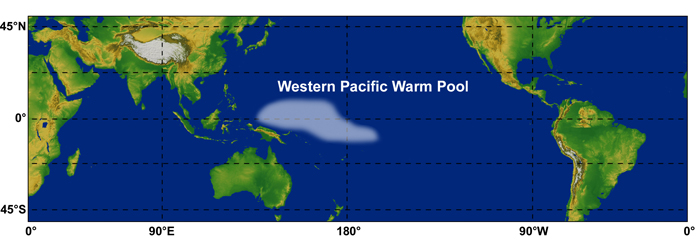 Illustration by Steve Deyo,
©UCAR
Water temperatures in the warm pool have risen less than
elsewhere in the tropics |
|
| Oceans
seem to have a natural thermostat protecting reefs |
|
|
Special to A.M. Costa Rica
Natural processes may prevent oceans from warming beyond a certain point, helping protect some coral reefs from the impacts of climate change, new research finds. The study, by scientists at the National Center for Atmospheric Research and the Australian Institute of Marine Science, finds evidence that an ocean "thermostat" appears to be helping to regulate sea-surface temperatures in a biologically diverse region of the western Pacific. The research was to be published online Saturday in Geophysical Research Letters. . The research team, led by scientist Joan Kleypas of the National Center for Atmospheric Research, looked at the Western Pacific Warm Pool, a region northeast of Australia where naturally warm sea-surface temperatures have risen little in recent decades. As a result, the reefs in that region appear to have suffered relatively few episodes of coral bleaching, a phenomenon that has damaged reefs in other areas where temperature increases have been more pronounced. The study lends support to a much-debated theory that a natural ocean thermostat prevents sea-surface temperatures from exceeding about 88 degrees Fahrenheit (31 degrees Celsius) in open oceans. If so, this thermostat would protect reefs that have evolved in naturally warm waters that will not warm much further, as opposed to reefs that live in slightly cooler waters that face more significant warming. "Global warming is damaging many corals, but it appears to be bypassing certain reefs that support some of the greatest diversity of life on the planet," Kleypas said. "In essence, reefs that are already in hot water may be more protected from warming than reefs that are not. This is some rare hopeful news for these important ecosystems." Coral reefs face a multitude of threats, including overfishing, coastal development, pollution, and changes to ocean chemistry caused by rising levels of carbon dioxide in the atmosphere. But global warming presents a particularly grave threat because unusually warm ocean temperatures can |
lead to episodes of coral bleaching,
in which corals turn white after
expelling the colorful microscopic algae that provide them with
nutrition. Unless cooler temperatures return in a few days or weeks,
allowing algae to grow again, bleached corals often collapse and die. Bleaching can occur naturally, but it has become increasingly widespread in recent decades. This is largely because sea-surface temperatures in tropical waters where corals live have increased about 0.5-0.7 degrees Fahrenheit (0.3-0.4 degrees Celsius) over the last two to three decades, with temperatures occasionally spiking higher. However, between 1980 and 2005, only four episodes of bleaching have been reported for reefs in the Western Pacific Warm Pool. This is a lower rate than any other reef region, even though the western Pacific reefs appear to be especially sensitive to temperature changes. Sea-surface temperatures in the warm pool naturally average about 84 degrees Fahrenheit (29 degrees Celsius), which is close to the proposed thermostat limit. They have warmed up about half as much as in cooler areas of the oceans. To study the correlation between temperatures and bleaching, the authors analyzed sea-surface temperatures from the period 1950-2006 in tropical waters that are home to corals, relying on measurements taken by ships, buoys, and satellites. They also used computer simulations of past and future sea-surface temperatures. The team compared the actual and simulated temperatures to a database of coral bleaching reports, mostly taken from 1980 to 2005. Researchers have speculated about several processes that could regulate ocean temperatures. As surface waters warm, more water evaporates, which can increase cloud cover and winds that cool the surface. In some areas, warming alters ocean currents in ways that bring in cooler waters. In addition, the very process of evaporation removes heat. Kleypas and her co-authors say more research needs to be conducted on the thermostat. In particular, scientists are uncertain whether global warming may alter it, raising the upper limit for sea-surface temperatures. Computer model simulations tend to capture the slow rate of warming in the western Pacific over the last few decades, but they show the warm pool heating rapidly in the future. |
| Lice
and other parasites are helping scientists track early migrations |
|
|
By the University of Florida new service
Lice from 1,000-year-old mummies in Perú may unravel important clues about a different sort of passage: the migration patterns of America’s earliest humans, a new University of Florida study suggests. “It’s kind of quirky that a parasite we love to hate can actually inform us how we traveled around the globe,” said David Reed, an assistant curator of mammals at the Florida Museum of Natural History on the University of Florida's Gainsville campus and one of the study’s authors. DNA sequencing found the strain of lice to be genetically the same as the form of body lice that spawns several deadly diseases, including typhus, which was blamed for the loss of Napoleon’s grand army and millions of other soldiers, he said. The discovery of these parasites on 11th-century Peruvian mummies proves they were infesting the native Americans nearly 500 years before Europeans arrived, Reed said. His findings are published this week in an online edition of the Journal of Infectious Diseases. “This definitely goes against the grain of conventional thought that all diseases were transmitted from the Old World to the New World at the time of Columbus,” he said. It came as a surprise to Reed and his research team that the type of lice on the mummies was of the same genetic type as those found as far away as the highlands of Papua, New Guinea, instead of the form of head lice that is widespread in the Western Hemisphere, Reed said. This latter version, the bane of many school children, accounts for more than half the cases of lice that appear in the United States, Canada and Central America, he said. |
“Given its abundance in the Americas
on living humans, we thought for
sure that this form of lice was the one that was here all along and had
been established in the New World with the first peoples,” he said. “We hope to be able to understand human migration patterns by investigating their parasites since people have carried these parasites with them as they moved around the globe,” he said. “Called a parascript, it’s a whole other transcript of our evolutionary history that can either add to what we know or in some cases inform us about things we didn’t know.” Today, the people who don’t have the opportunity to change their clothes are the ones at risk for epidemic typhus, which along with the lesser-known diseases of relapsing fever and trench fever are carried by body lice, Reed said. These pests lay their eggs in clothing fibers and washing the clothes is all it takes to get rid of them, he said. “The disease pops up primarily in refugees who have been displaced from their homeland with the clothes on their backs and nothing else,” he said. “They’re living in crowded conditions where hygiene is poor.” Reed said he hopes the team’s lice research might someday increase human understanding of typhus by pinpointing where the disease originated. Studying parasites to learn about their hosts’ history has been around for only about 20 years, Reed said. “By looking at things like tapeworms, pinworms, lice or bedbugs that humans have carried around for at least tens of thousands of years, and in some cases millions of years,” he said, “we can learn much more about human evolutionary history.” |
|
|||||||||||||||||
| News from
the BBC up to the minute |
BBC sports news up to the minute | ||||||||||||||||
| BBC news and sports feeds are disabled on archived pages. | |||||||||||||||||
| A.M. Costa Rica Sports news local and from the wires |
 |
|
|
|
|
|
|
|
|
|
|
||||||
|
||||||||
|
|
|
|
|
Food, festivals, arts, entertainment, poker |
|
|
|
|
|
|
|
|
|
|
| Rembrandt exhibition opens to high acclaim
in downtown San José |
|
|
By
Helen Thompson
of the A.M. Costa Rica staff Hailed as the most important exhibition of the year, a collection of the Dutch master Rembrandt's etchings opened amid much praise Thursday. The 48 etchings usually reside in Amsterdam's Rembrandt House Museum, where the artist lived for about 20 years from 1620-40. They were collaboratively chosen from a wider collection by Dora Maria Sequiera, the director of Museos del Banco Central and Ed de Heer, the director of the Rembrandt House Museum. Although now better known for his marvelous paintings that capture intense emotion, facial expression, and deeply contrasted light and shadow, the etchings that are now on show in San José are considered by art buffs to be just as important. “Rembrandt was the most influential and original etchers possibly of all time,” said de Heer. “He is a shining beacon because he changed etching from a reproductive medium to a fully fledged artistic medium. “He used all sorts of different techniques to get all the possibilities out of the medium — he printed on copper plate, parchment, even sheepskin to make luxurious editions of prints. He didn't want any two to be the same.” There is no sheepskin involved in this exhibition, as some of the finer materials are too fragile to export for exhibition in humid tropical countries like Costa Rica. The collection does, however, but include something from each of Rembrandt's main themes. His famously revealing self-portraits stand alongside biblical scenes, studies of nudes, and tranquil Dutch landscapes containing windmills and thatched cottages. All are black and white, made by etching lines into waxed plates, then rolling them over with ink. The detail, shading, and depth of emotion achieved through this technique brought Rembrandt great acclaim even within his lifetime. His expertise is obvious especially in such pieces as “Christ Preaching,” a luminous depiction of Jesus that was his most admired etching during the 17th Century. This was one of the pieces that other artists, including such famed names as Goya, tried to emulate for centuries. The works were brought to Costa Rica thanks to the efforts of a Dutch forestry company, Grupo Ecodirecta, that decided that after decades of working in the northern zone of Costa Rica and sending Costa Rican wood all over the world, the time had come to give something back to the country. |
 A.M. Costa Rica/Museos del Banco Central
image
The Good Samaritan, etched in
1633, is one of 48 etchings by Rembrandt on display at Museos del Banco
Central“This exhibition is a gift to the Costa Rican people,” said León Ipema, director of Grupo Ecodirector. “This is the best that Holland can give – it is our top-quality export.” President Oscar Arias' speech during the Thursday inauguration encouraged Costa Ricans to make the most of this opportunity, saying that Rembrandt's artistic achievements are something in which all human beings should feel pride. “In the world there are about 290 engravings by Rembrandt,” said.”That's one for every 23 million people. From tonight, 4.5 million Costa Ricans can appreciate 48 engravings of the Dutch master – a magnificent opportunity and an invaluable privilege.” He added that this exhibition is part of his desire to have a country filled with music and painting, dance and sculpture, theater and literature. Controlled humidity and lighting will keep the prints from fading during their stay at the Museos del Banco Central exhibition, which includes informative plaques and bibliographies in both Spanish and English. The engravings will be on display until April 6, with an entry charge of $2 for nationals and $7 for foreigners. Museos del Banco Central is situated below the Plaza de la Cultura, in downtown San José. |
| Art Galleries .... |
|||
Chicken suits, foot photos brought to Galeria Nacional by art colony residents  Those with a sharp
eye who look closely at Nancy Ennis' collages will
find a man in a chicken costume haunting each one. Those with a sharp
eye who look closely at Nancy Ennis' collages will
find a man in a chicken costume haunting each one. In some, he is the main focus of the piece, and in others he is as invisible as a smudge behind a layer of material. “One of my kids gave me this photo of their Dad when younger,” said Mrs. Ennis, as she pointed out the eerie figure, standing amid her as-yet unhung exhibition in the Galeria Nacional. “I like it because my ex-husband was a very funny man, although very irresponsible.” Mrs. Ennis, an American who lives in New Jersey, has been creating artwork on Costa Rican soil for the last six weeks, working in a private artists colony in Ciudad Colon. She is one of several dozen who seek out Costa Rica's tropical climes each year to spend a residency in the Julia and David White Artists' Colony. Read more - click here Exhibit condemning illegal fishing would be better elsewhere For a while now, a large marquee has been standing outside the Museo de Arte y Diseño Contemporaneo in San José. In it hangs what has variously been described as an enormous bee hive, a throwback to sixties glow lamps or a swarm of schooling fish. The last explanation is the one that the artists propound. Huge, blue, glowing and transparent, the structure extends almost four meters down from the ceiling, nearly equaling its height with its width. It tapers towards the end, putting one in mind of a chrysalis, and its outside is made totally of clear nylon wires. Read more - click here |
Imagen V show has a few gems but a pack of clinkers, too  New media art is
always a bit hit and miss with the potential to come
across as a foundationless piece of pretension if it is not done well. New media art is
always a bit hit and miss with the potential to come
across as a foundationless piece of pretension if it is not done well. The Bienal Iberoamericana Inquieta Imagen V, a competition for video artists from across Latin America, is a good example of this, containing a few pieces that engage well with the subject and make the most of their medium, but many that leave the viewer cold. Most of the works are video projections, some as short as a pistol shot and the flight of birds and some as long as a didactic letter that teaches about identity, isolation and fuschia flowers. Read more - click here Mistaken identity? No such thing, says new exhibition  Costa Rica is
a land of volatile volcanoes, orchids, coffee fincas,
Catholicism and Ticos. Costa Rica is
a land of volatile volcanoes, orchids, coffee fincas,
Catholicism and Ticos. Or you could say it's a country of wide seashores, football stadiums, fast food restaurants and beach towns overtaken by Gringos. Some are clichéd symbols of a tourist nation, while others are part of the country's changing culture, but all are involved in Museo de Arte Costarricense's new exhibition that challenges viewers to reconsider their own perceptions of the nation. Read more - click here |
||
| Festivals ... | |||
First International Blues Festival Texas blues bands are heading down to Santa Ana for an afternoon of live music. BBQ's and cold beers will accompany artists including Smokin Joe Kubek & Bnois King and Robbie Clarke & the Live Wire Blues Band. Two stages at Motorpsychos Bar and Grill will host a total of seven bands during the afternoon of Feb. 9. Tickets cost $25 and can be found by contacting www.bluesdevilsband.com. |
Puntarenas Carnaval a mix of the traditional and the modern If you didn't know otherwise, you could be forgiven for thinking that Puntarenas Carnival is largely about scantily clad ladies fighting it out to be crowned queen of the show. However, the organisers claim that the carnaval tradition that will fill Puntarenas with people dressed in luminous feathers, steel bands, and brightly-coloured dancers, has roots that go back for thousands of years, to pagan celebrations of Baco, the God of wine. Read more, click here |
||
| Food... |
|||
Mini-mall comes to the rescue of the not-rich-but-hungry 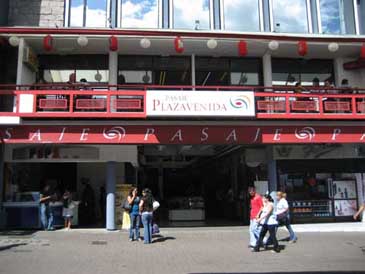 For those in the know, there is a clean, affordable, relatively quiet gastronomic surprise off the pedestrian mall in downtown San Jose. Between Arenas clothing store and the Patio Restaurant, behind a perfume counter and a Pops Ice Cream sits a food court without a McDonald's, Wendy's, Subway or Church's Chicken in sight. Tropical Food is a counter selling relatively healthy food. While their batidos aren't as delicious as the ones found at FrutiLand in Mall San Pedro, the water-or-milk- blended-with-fruit drink is a refreshing treat to carry during your walk along Avenida Central. A batido with the fruit of your choice mixed with water costs 650 colons, with milk, 750 colons. That's from $1.30 to $1.50. Adding honey or granola takes you up to a still-reasonable 900 colons ($1.80). The store also peddles fruit salads, ranging from 700 to 1.600 colons ($1.40 to $3.20). Marisqueria produces delicious looking and smelling seafood dishes. A customer-friendly hanging chalkboard lists their menu and respective prices. A small corvina ceviche will set you back 1,950 colons ($3.90). Get a small rice with shrimp for 2.150 colons ($4.30), 2,800 ($5.60) for a larger serving. Or try one of the fish filets prepared several different ways, the cheapest being with oil and garlic for 2,600 ($5.20) colons, the priciest fish filet dish is 3,600 colons ($7.20) for relleno with ham and cheese. Click here to read more |
Festive season proves troublesome even for established restaurant 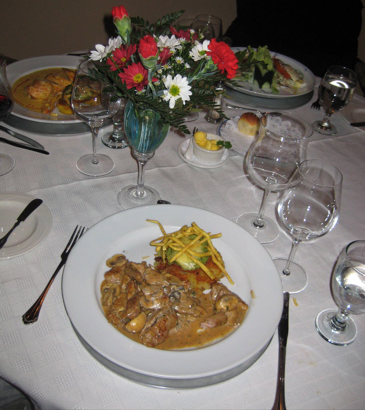 Being a chef in a
busy kitchen must be a pretty stressful job, but
around Christmas stress is something any successful restaurant should
factor in as inevitable. Being a chef in a
busy kitchen must be a pretty stressful job, but
around Christmas stress is something any successful restaurant should
factor in as inevitable. On a second visit to well-reputed French restaurant Le Chandelier, it soon became obvious that the staff were poorly equipped for the onslaught of Christmas party diners on a Tuesday night, leaving the usually decent food to deteriorate into a procession of almost inedible starters and bland entrees. Set in an old San Pedro house with brick ceilings and wooden beams that was converted into a restaurant around 15 years ago by Swiss owner Claude Dubuis, Le Chandelier purports to offer French cuisine that has been developed over generations of experience. Click here to read the full review A great meal is not all in the presentation 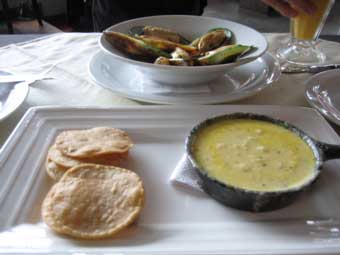 With a vaulted
glass ceiling, palm trees lining the pathway and posh lighting, one
would not expect Saga restaurant to be settled behind a dull parking
lot in Escazú. With a vaulted
glass ceiling, palm trees lining the pathway and posh lighting, one
would not expect Saga restaurant to be settled behind a dull parking
lot in Escazú. Although this restaurant may look out of place, it doesn't deviate much from the norm in Escazú, an area many would classify as suburban sprawl. The majority of the cuisine at Saga seems to fit with the setting: classy presentation, yet lacking any profound flavors. Although the restaurant boasts itself as an “international food restaurant” on its Web site, much of the inspired cuisine is lacking the depth which would be found in authentic dishes. Click here to read the full review |
||
| Dramatic Arts... |
|||
Sunny days in San José complemented by free concerts  The hot dry days
are being put to good cultural use by the Museos del
Banco Central with a series of outdoor concerts in the middle of the
downtown area. The hot dry days
are being put to good cultural use by the Museos del
Banco Central with a series of outdoor concerts in the middle of the
downtown area. Hundreds of shoppers stopped to lean over the balcony in Plaza de la Cultura Saturday, when the Costa Rican singer MAF and her band played a sunny set of pop tunes outside the doors of the museum. Although the series is named 'Conciertos en las gradas', fewer people sat to on the steps outside the Museo de Oro than stood around the edges, looking down at the stage. Onlookers were enthusiastic about the music, in spite of the singer's annoying lack of the ability to dance. She has recently released her debut album, Viaje Cosmico, for which she was recognised as 2007's revelationary interpretive artist by Costa Rica's music association, Asociacion de Compositores y Autores Musicales de Costa Rica. An alternative offering of rock trip-hop is up next on Feb. 9 at 2 p.m., played by group Parque en el espacio. The band recorded a live CD in San Pedro's Jazz Café during 2006, called Hello Hello. Miriam Jaraquín and Blues Latino will bring piano and accordion, flute and saxophone to the stage at midday on March 2., with an acoustic jazzy sound. The final concert of the series will be on March 29., with trio Villegas playing some classic Spanish rock from 2 p.m. |
Cultural prizes handed out to 2007's cream of the crop Premio Magón  A woman who devoted her life to the improvement of Costa
Rica's
education system was yesterday announced as the winner of 2007's Premio
Nacional de Cultura Magón. A woman who devoted her life to the improvement of Costa
Rica's
education system was yesterday announced as the winner of 2007's Premio
Nacional de Cultura Magón. María Eugenia Dengo started out by introducing new subjects and professions to the Universidad de Costa Rica in the early 70s, and moved on to such respected positions as minister of Educación Pública and UNESCO regional coordinator for Latin America and the Caribbean. Read more click here National Culture Prizes Hot on the heels of the Premio Cultural Magón winner have come the announcements of the numerous other national culture prize winners. María Elena Carballo, minister of Cultura y Juventud, read out the long list of Premios Nacional de la Cultura 2007 Tuesday, in a conference at the Centro Nacional de la Cultura. Along with the prizes for national theater, music, dance and literature, came two presented by the minister of Ciencia y Tecnología, Eugenia Flores. Read more click here |
||
| Books ... |
|||
Land use in Costa Rica documented by Fulbright scholar Forty years of living in the jungle, moving between secluded forestry stations and research labs, has led Louisiana resident and NASA veteran
Click here to read more |
New book dwells on the social aspects of food Food is not just a selfish pleasure or a way to stifle hunger, but is central to the evolution of art, according to a new book published by Museos del Banco Central. Artworks by Costa Rican painters are the main content of the hardback book, “Imagenes para Comer,” which follows the representation of food in art since still life painting became popular in the Renaissance. Full-color pictures of both traditional and modern works are far more common than recipes, as the author Marjorie Ross only provides seven recipes within the book. All are traditional Costa Rican dishes showing influences from different sections of the community, such as corn fritters, white beans and chorizo and fruit salad. The book focuses on the meanings that food has within society, and how these are portrayed by art. Click here to read more |
||
| Should you play limit or no-limit Texas hold’em? | |
Until the start of the current poker boom that dates back to 2003, you couldn’t find a no-limit Texas hold’em cash game if you tried. Limit hold’em ruled. But that all changed once No Limit tournaments started to air on television. Back before the boom started, poker professionals played Limit games to pay the bills. And hold’em wasn’t the only game they played. Stud, Omaha, stud hi-lo, and Omaha hi-lo were also played – all of them limit games. Like these pro players, you can become a better overall player by investing the time and effort to learn both disciplines of the game. Playing limit hold’em will certainly improve your no limit game. There are subtleties to the limit game that will enhance your technique at the no limit tables. Mastering these uniquely aggressive limit tactics will enable you to steal more pots when you sit down to play no limit hold’em. So, if you’re trying to make a living playing hold’em, which is the better game to play, limit or no-limit? Here are some factors to consider. Go Fishing Inexperienced players generally flock toward the no limit tables because it’s clearly the most popular form of the game. Having said that, where the fish go, so go the sharks! As a result, you’ll often find that limit games are even softer because the pros are concentrating on the no limit games, baiting their hooks and reeling in their catch. Playing the Percentages Your winning percentage by session will likely be higher in no limit games than in limit games. Winning 65 percent of your sessions in limit hold’em is excellent. In no-limit, however, it’s not uncommon to log winning sessions 80 percent of the time. That’s due to the natural differences between the two games. Less control can be exerted in limit games because it’s more difficult to force players out of pots with structured betting. In no-limit, though, hands can be protected from being outdrawn by making large bets that force opponents to fold weak draws. |
 Bankroll Protection Despite the fact that you’ll likely win a higher percentage of sessions in no-limit hold’em, choosing to play limit hold’em is a safer decision to protect your bankroll. You won’t win as often, but you also won’t risk losing everything you have on any single hand. Your results in limit hold’em will be more consistent over time, and that’s especially important if you plan to grind it out at the tables for 40 hours every week. No-limit hold’em is simply a much more volatile game. Level of Aggression Contrary to popular belief, limit hold’em is the more aggressive form of the game. It’s characterized by constant raising and re-raising before the flop. On the other hand, no-limit hold’em is played more carefully since any hand could cost you your entire stack. If, for example, you flop top pair in limit hold’em, it’s usually correct to raise and re-raise on the flop. No limit hold’em should be played more cautiously. You need to be concerned about over pairs and flopped sets. Pace of Play Limit hold’em is the game for you if you bore easily and crave fast action. Conversely, in no-limit, the game will often slow to a halt when someone is faced with a big decision. That’s uncommon in limit games because all-in bets are rare. Whatever game suits you best, learn to play both limit and no-limit Texas hold’em. Your overall game will definitely improve. Visit www.cardsharkmedia.com/book.html for information about Daniel Negreanu’s new book, "Hold’em Wisdom for All Players." © 2008 Card Shark
Media. All rights reserved.
|
|
|
|
|
|
|
|
|
|
|
|
|
| What we published this week: | Monday | Tuesday | Wednesday | Thursday | Friday | Earlier |
|
|