|
 |
Your daily |
 |
|
|
|
|
|
|
|
|
|
|
|
|
|||||||||||||||
|
|
|||||||||||||||
 |
 |
| A.M. Costa Rica Second newspage |
|||||||||
| Home |
Tourism |
Calendar |
Classifieds |
Entertainment |
Real
estate |
Rentals |
Sports |
About us |
|
|
|
|||||||||
 |
| Costa Rica Expertise Ltd http://crexpertise.com E-mail info@crexpertise.com Tel:506-256-8585 Fax:506-256-7575 |
 |
|
to disputed telecom bill By the A.M. Costa Rica staff
The Asamblea Legislativa approved on second reading Wednesday the telecommunications bill that will allow private companies to offer mobile telephone and Internet services. The bill is a key element of the free trade treaty with the United States because within the treaty Costa Rica promised to let private companies offer wireless services. The bill, once signed by President Óscar Arias Sánchez, will end the monopoly that the Instituto Costarricense de Electricidad has had over telecommunications. The Unión Costarricense de Cámaras y Asociaciones del Sector Empresarial Privado and Casa Presidencial immediately praised the vote. In the Legislature, long-time treaty foes Partido Acción Ciudadana and José Merino del Río of Frente Amplio criticized the measure to no avail. The measure passed 35 to 14. However, there still is plenty of work before a private company begins to offer cell telephone service in Costa Rica. The supervision of telecommunications will be taken over by the current Ministerio de Ambiente y Energía. The bill creates a superintendencia of telecommunications to regulate the rates. The country now has to designate radio frequencies for use by private companies and set up the regulations for awarding concessions. The bill also includes a provision for a fund into which telecommunication companies pay that will be used to providing services in unprofitable, remote areas. The bill does not affect the current land line service, although the heavily subsidized service probably will be dependent on the future success of the Instituto Costarricence de Electricidad. Both the Instituto Costarricence de Electricidad and its subsidiary, Radiográfica Costarricense S.A., offer Internet service. The government in 2000 tried to open up telephone services but union members of the government telecommunications giant, also known as ICE, took to the streets, and then-president Miguel Ángel Rodrígez was forced to withdraw the proposal. ICE workers also opposed the free trade treaty because of its telecommunication clauses, but the treaty was approved narrowly in an October referendum. That took the steam out of the protests. Another negotiation date with Europe is May 29 By the A.M. Costa Rica staff
Costa Rica will enter the fourth round of negotiations with the European Union May 29. Central American countries are talking about an association agreement with the Union that basically amounts to a trade agreement. Europe represents about 20 percent of the world's international commerce, with a huge market of 500 million inhabitants. Of all the goods Europe imports from Central America, 60 percent come from Costa Rica. Vice President Laura Chinchilla will be present at the event, which runs from 8 a.m. to 6 p.m., in Hotel Radisson Europa. Businesses from various European countries will be in attendance, and any business who wants to take part can contact www.coeccr.com. Tamarindo zoning plan topic at Friday meeting By the A.M. Costa Rica staff
Tamarindo's residents will be discussing the plan regulador that is proposed for their town in a meeting to be held Friday at 2 p.m. Representatives of the Instituto Nacional de Vivienda y Urbanismo and the Municipalidad de Santa Cruz will be in attendance to hear peoples' worries and suggestions. Participants must submit a request by logging on to www.tamarindowiki.com and will be given five minutes at the meeting to explain what their request concerns. Officials will present the answer to the person's question at the beginning of the next meeting to be held on this subject. The zoning plan is available online at the same Web site. All residents from the communities of Tamarindo, Langosta, el Llanito, Villareal, Santa Rosa, Cañafistula, Hernández, Pinilla, Avellanas and La Garita are invited to attend.
|
 |
 |
 |
| A.M. Costa Rica third newspage |
|||||||||
| Home |
Tourism |
Calendar |
Classifieds |
Entertainment |
Real
estate |
Rentals |
Sports |
About us |
|
|
|
|||||||||
 |
 |
| Massive
project to watch nation still in the planning stage |
|
|
By Helen Thompson
of the A.M. Costa Rica staff Costa Ricans are still not being watched as they go about their daily business even though a project to install security cameras across the country should have begun before Christmas. Signed by now ex-security minister Fernando Berrocal in October, the initiative authorized the installation of an eventual 3,000 cameras at strategic points around the country, such as city centers and borders. Originally it was planned that a tenth of these would be in place by the end of 2008, but a representative from the Fuerza Pública confirmed Wednesday that the project has still not gotten off the ground. Daniel Calderón, who used to be in charge of the project but who now works at the Escuela Nacional de Fuerza Pública, said that negotiations with the Banco Centroamericano de Integración Económica are continuing. “The bank still has to approve the studies and plans that we have been making,” said Calderón. “We estimate the total cost of the project to be around $20 million.” This estimate is slightly larger than the original figure, which was stated at $18 million. |
Feeds
from all the cameras in the country will come to a principal
center in San José, but local police will also have access to
the cameras in their areas. Calderón said that studies indicate about 75 new employees will be taken on to watch the cameras. Considering that each employee will work only 8 hours a day, 5 days a week, this leaves each employee watching at least 166 cameras at one time. Eric Lacayo, who is now the director of Fuerza Pública, said in an interview with A.M. Costa Rica in November that it would be impossible for a person to effectively monitor more than two cameras at one time. Calderon said that he hopes that installation will begin in the second semester of this year – in other words, any time from July onwards. The Municipalidad de San José already has some cameras covering the downtown but there has been little mention of their success. At the time of signing the national measure, Berrocal appeared confident that the cameras would contribute to discouraging crime in Costa Rica, even though studies in Britain have found them to be ineffective. Although there has now been a change in the leadership of the Ministerio de Gobernación, Policía y Seguridad Pública with Janine del Vecchio taking Berrocal's place, there seems to be no indication that the plan will be dropped. |
| Judicial
panel grants extradition request in lottery scam case |
|
|
By the A.M. Costa Rica staff
A San José court added two months preventive detention while his extradition is arranged in the case of a U.S. man accused of working in a lottery scam, said a judicial spokeswoman Wednesday. The man, Severin Marcel Stone, 28, was part of a lottery scam that took more than $40,000 from U.S. citizens, said investigators. Former casino owner Jaime Ligator and former sportsbook owner Max Allan Stone, have also been named in the case, said a spokesman from the International Police Agency Wednesday. All of the victims in the lottery scam were U.S. citizens, said the police spokesman. The scam artists called people in the United States informing them they had won a lottery. The victim was then supposed to send a “deposit” anywhere from $300 to $4,000 via Western Union, said the police spokesman. Many were elderly, the infirm or retirees, said officials at the time. |
Agents from the Judicial
Investigation Organization arrested 11 people
they said were involved in the operation, said the police spokesman.
Agents from the International Police Agency followed that up with five
more arrests, he said. Authorities in the United States detained the ring leader and others involved in the operation there, said the police spokesman. Severin Marcel Stone was detained in January in San Rafael de Escazú where he operated a food outlet in a shopping mall, said the International Police Agency at the time. He will be extradited to the United States to face charges there, said the judicial spokeswoman. The extradition was granted by the Tribunal Penal de San José. Ligator, when he was arrested, was the president of World Wide Land Investments which had offices on the third floor of Mall San Pedro. This is a firm that specializes in selling lots to North Americans. |
| EARTH
to present the creations of its students this weekend |
|
|
By the A.M. Costa Rica staff
Students described as “stewards of the Earth” will be displaying the products of their own small businesses this weekend at the Feria América Tropical. Every student at Universidad EARTH is required to set up a business producing environmentally sustainable products, such as natural soaps, and this weekend the university will hold an exposition of the results. There will be cultural contributions from 25 countries and a dance performance by the Compañía Nacional de Danza. The institution was recently featured on NBC Nightly News with reporter Anne Thompson describing EARTH's banana production program. It doesn't use pesticides, pays workers above minimum wage and makes a profit of half a million dollars a year. Students at EARTH come from all over the world, but are mainly scholarship students from poorer countries in Latin America and Africa. After a degree program stressing sustainable agriculture and entrepreneurship, they return to their home countries to share their knowledge and contribute to development. |
The feria is the university's
biggest annual event, inviting the public
in to view the year's successes. Fourth-year students organize the
event, and the funds they collect are used to bring their families to
Costa Rica for the graduation ceremonies held in December. This year's theme is “In times of climate change: searching for solutions,” and there will be a varied cultural program of food, dancing, music and sports. The feria runs all day Saturday and Sunday, with the Compañía Nacional de Danza performing at 2.30 p.m. Sunday. Festival de Coreógrafos winner Antonio Corrales will be performing his work “Solo sueño minotauro,” alongside three other interpretations by different dancers. The style is contemporary with one work including tango dancing. A recreational cycling race takes place Sunday at 9 a.m. Short-route riders will cover 20 kilometers, with more confident sportsmen cycling for 40 kilometers. There will be a raffle for a Gary Fisher bicycle worth 500,000 colons ($10,000) on the day. EARTH University is located in Guácimo de Limón. For more information, log on to http://www.earth.ac.cr. |
 |
| A.M. Costa Rica fourth news page |
 |
||||||||
| Home |
Tourism |
Calendar |
Classifieds |
Entertainment |
Real
estate |
Rentals |
Sports |
About us |
|
|
|
|||||||||
|
Chávez says he will renew his efforts to free leftist hostages
|
|
|
By the A.M. Costa Rica wire services
Venezuelan President Hugo Chávez says he will try to re-establish contacts with the Fuerzas Armadas Revolucionarias de Colombia to try to win the release of more hostages in their custody. Chávez has previously said he lost contact with the leftists following a Colombian raid on a camp in neighboring Ecuador March 1. But Wednesday, Chávez said he discussed the hostage issue by telephone with his French counterpart, Nicolas Sarkozy. Chávez announced the renewed effort as he met with Portuguese Prime Minister Jose Socrates in Venezuela's oil-rich Orinoco region. Ironically Colombian government intelligence sources say that the March 1 raid was triggered by a satellite telephone call from Chávez to Raúl Reyes, a leader of the leftists. Tracking the telephone call gave military forces the location of the camp just over a river into Ecuador. Reyes died in the raid. |
The Venezuelan leader helped mediate the rebel release of six captives
earlier this year and has called on the leftists to free
French-Colombian politician Ingrid Betancourt. The French government
has made her release a priority. She was kidnapped in February 2002 while campaigning for the Colombian presidency and is believed to be seriously ill. The leftist group, branded terrorists by a number of nations, is believed to be holding at least 700 people in secret jungle camps. Three Americans are among them. Chávez, meanwhile has ridiculed an investigation into his possible ties to the leftist who are known for kidnappings and drug smuggling. Colombian officials also say computer files found during their raid on the camp in Ecuador link him to the group. The international police organization, Interpol, is investigating the files. Chávez has said the computer files are not trustworthy. |
|
Leaders from 60 nations will gather in Lima for two-day summit starting Friday
|
|
|
By the A.M. Costa Rica wire services
Leaders from 60 countries in Europe and the Americas will meet in Lima, Perú, Friday for a two-day summit that is expected to focus on poverty, climate change and free trade. Costa Rica will be represented by Vice President Laura Chinchilla. The summit marks the fifth meeting among officials from Europe, Latin America and the Caribbean. At the talks, European governments are expected to pursue ongoing free trade negotiations with Central America, the Andean Community as well as the South American trade bloc. Separately, participants are expected to discuss efforts to |
reach an
agreement in the so-called Doha round of world trade talks.
Agricultural disputes between rich and poor countries have blocked a
deal on the talks, which began in Doha, Qatar in 2001. Poor nations have complained that government aid to farmers in rich countries prompts wealthy farmers to overproduce, driving down prices and making it difficult for poor farmers to compete. Wealthy nations say they are willing to reduce farm subsidies if developing nations drop import tariffs and open their markets to manufactured goods from developed nations. Brazil has played a major role in the Doha trade talks by representing the interests of developing countries. |
|
Brazilian film opens the Cannes Film Festival with a dark tales of blindness
|
|
|
By the A.M. Costa Rica wire services
The 61st Cannes Film Festival has opened in the southern French resort with the showing of independent Brazilian movie "Blindness." The dark tale of mass hunger and blindness that sweeps the globe is based on a novel by Portuguese Nobel Laureate José Saramago Critics say "Blindness" and another Brazilian film, "Line of Passage," face a stiff challenge |
this year from American actor-director Clint Eastwood's "Changeling," a missing child drama. Steven Soderbergh's two-part epic, "Che," on the life of Latin American revolutionary Che Guevara, is also seen in the running for the festival's top prize, the Golden Palm. The 12-day gala brings together cultural figures, filmmakers and movie stars from across the globe and generally insured the commercial success of winners. |
 |
|
| News from
the BBC up to the minute |
BBC sports news up to the minute |
| BBC news andsports feeds are disabled on archived pages. |
|
| A.M. Costa Rica fifth news page |
Are
you
still
spending 70 percent You need to fill this space ASAP! |
||||||||
| Home |
Tourism |
Calendar |
Classifieds |
Entertainment |
Real
estate |
Rentals |
Sports |
About us |
|
|
|
|||||||||
 |
 |
| Our
reader's opinion Playa Grande reader says that article on park has inaccuracies |
||
| Dear A.M. Costa Rica: I enjoyed reading your article regarding Playa Grande. It certainly is an important issue on which resolution is long past due. However, the article contained a number of misleading and untrue statements which I would like to rectify. I would recommend that your reporter perform some investigative journalism and report the facts rather than repeating unsupported allegations. The environmental tribunal alleges that majones have been moved by property owners. If they are aware of such abuses, it is their responsibility to identify and correct majones that have been moved and prosecute anyone they can prove moved the majones. Surely if they are alleging such practices, they will be able to prove several examples of this to support their allegation. If they have no examples of majones moved in Playa Grande, they should cease making the accusation. Moving a majone is a very serious offense and carries with it very strong penalties. Property owners would be taking a huge risk by moving a majone, as it can easily be proved where the majone should properly be. Please investigate whether the tribunal has any evidence to support their allegation, and what actions they have taken to correct the situation. The facts are that the house shown in the picture is built outside of the declared park boundary, and the environmental tribunal is fully aware of that fact. The lot on which the house is being built does extend a few meters into the declared park boundary. However the house was set back a sufficient distance so that the entire house structure is out of the declared park boundary. This was done with full knowledge of the environmental ministry. The declared park boundary is 75 meters back from the 50-meter line. It is a very simple matter to take a tape measure and find out with irrefutable evidence whether the house structure is inside or outside the park. There is no need for
 |
false unsupported allegations to mislead
your readers. This house has been built in full compliance with all Costa Rican laws, and has the approvals of the municipality and the Secretaria Tecnica National Ambiental. There is nothing improper about this construction at all. Owners are entitled to build a house on their private property outside of the declared park boundary in accordance with all Costa Rican laws. It is unfair to group this house with other projects that may not have received proper permits, or are not developing the property in compliance with the law. Construction on this house has not been stopped. The Secretaria Tecnica National Ambiental has the authority that can stop this construction, but it has not, as it has stated the environmental viability for this lot was granted in full compliance with Costa Rican law. It is untrue to say that construction has been stopped on this house. The lot that the house is on does extend a few meters into the declared park boundary. However, the entire lot is still private property including that portion of the property that is within the declared park boundary. This property does not become part of the national park until that portion of the property is expropriated by the government. Thus it is misleading to say the property is within a national park. It remains private property. In addition, the lot that this house is on has never been noticed for expropriation. Nor has any lot in the second row been noticed for expropriation. This is despite the fact that the law that created the park was passed in 1995. Obviously there has been sufficient time to notify the owner of any intention to expropriate the first few meters of the lot. To the contrary, the environmental ministry has verbally stated that these second row lots will never be expropriated as they are of very low value in protecting the turtles, and would only add to the extremely high cost of expropriation. Even The Leatherback Trust has purchased these lots with the intention of constructing on them. The Environmental Tribunal states that these properties should not be sold prior to expropriation. This statement has no basis in law, equity or environmental protection. The law that created the park was passed in 1995. It is now 13 years later, and the property remains unexpropriated. The owner of the property is legally free to sell this property to anyone, and does not need to wait 13 years and counting for the government to expropriate the property. It is not fair for property owners to have this cloud over there private property for this period of time and be forced to hold it. The owner is free to sell it, and the buyer is free to buy it, and the buyer then assumes all the risks and rewards of the property. Selling the property to a new owner causes no damage to the environment and is not illegal, unethical or immoral. Furthermore, while expropriation of property in Playa Grande is currently the law in Costa Rica, there is no certainty that this expropriation will ever be completed, never mind when it will be completed. It has already been 13 years and the property has not been expropriated. The Leatherback Trust said it would raise donations to fund the entire cost of expropriation, and now has reneged on that commitment. Expropriation is also not scientifically necessary, and there are alternative solutions. The population of the leatherback turtle has declined by over 90 percent in the last 20 years despite little development in Playa Grande. Similar leatherback turtle population declines have also been seen in Costa Rica where there is absolutely no development. It is not development that is causing the decline of the leatherback turtle population. There are many turtle nesting beaches throughout the world where the turtles successfully co-exist with environmentally responsible development. The turtles can be adequately protected through lighting controls that are commonplace on turtle nesting beaches throughout the world. Access to the beach is already restricted and guarded during the night in turtle nesting season. Turtles nest on the sandy beach, and never enter the 75-meter zone slated for expropriation. The turtles can be adequately protected by restricting the park to the beach area. It is widely acknowledged that the turtles are being killed at sea by long line fishing practices. Expropriating property will not protect the turtles from that danger. While we would all love to save the leatherback turtle, there is little reason to believe that expropriating property will reverse this trend. Saving the leatherback turtle will require changes in international fishing practices. Expropriation is also prohibitively expensive. It is estimated to cost $300 to 700 million. Surely these funds are needed to fund worthwhile health care, education and other environmental initiatives. It would simply be irresponsible for the government to spend such a great sum of money for an ineffective environmental solution. Playa Grande land owners are pro-environmental and strongly support the leatherback turtle. Playa Grande land owners believe that expropriation is unnecessary, ineffective, prohibitively costly, and that better alternatives exist to protect the leatherback turtles. I would appreciate it if you would continue your coverage of Playa Grande, and further inform your readers of the facts regarding Playa Grande. Bob Reddy
Mr. Reddy is the CFO of Playa Grande Estates. EDITOR'S NOTE: The letter refers to an article that was published May 8 citing the Tribunal Ambiental as a source. Murder suspect coming home
By the A.M. Costa Rica staff
A man captured by police in Texas on a murder warrant was expected to arrive in Costa Rica Wednesday night, said a spokesman from the International Police Agency. The suspect, Marco Tulio Salas Lopéz, 33, is wanted by the Juzgado Penal de Upala on charges of first degree murder. Agents tracked him through New York, California and Texas for a number of months, said the police spokesman. Law officials arrested Salas April 1 in Amarillo, Texas, said the spokesman. |
|
| A.M. Costa Rica Sports news local and from the wires |
 |
|
|
|
|
|
|
|
|
|
|
||||||
|
||||
|
Food, festivals, arts, entertainment, poker |
|
|
|
|
|
|
|
|
|
|
| Poetry festival brings artists
from 15 countries to Costa Rica |
|
|
By
the A.M. Costa Rica staff
Latin America is renowned for its literature, and this weekend marks the inauguration of a festival that unites poets from across the region, not to mention from Europe, Africa and the United States. The VII Festival Internacional de Poesía will bring prize-winning writers from all over the world to venues all over Costa Rica, including hospitals and prisons, with the grand opening scheduled for Friday at 7 p.m. It claims to be the second most important poetry festival in the Americas, and is organized by Fundación Casa de Poesía, who said getting visas for all the artists to enter the country proved rather difficult. Among the poets who come to present their works and talk about their art is Alhaji Papa Susso, from Gambia, whose poetry is a narration of the history of his community. He uses ritual singing and plays the kira instrument to his recitals. Iraqi poet Salah Hassan, who asked the world to rise against the United States' “occupation” of Iraq, and who has won the Iraqi Poetry Prize and the Dunya Poetry Prize of Holland, will also be attending. Other known names include Fatoumata Ba, a female poet from Mali who won the UNICEF poetry prize in 1996, the Argentinian Jorge Bocanera, winner of the Premio Casa de las Américas and the Cuban Miguel |
 Barnet, who won the Premio Nacional de Literatura de Cuba and the Premio Juan Rulfo. Bob Holman, who has been said to be central to the re-emergance of poetry in the country, will be the representative from the United States. He performs energetic poetry from slam to hiphop and performance poetry. He has won several Emmys for his work. European contributions will be made by Gabriela Rosenstock from Ireland and Montserrat Doucet from Spain. The other poets involved are: Fernando Rendón from Colombia, Javier Campos from Chile, Ahmad Al-Shahawi from Egypt, Dennis Ávila from Honduras, Pedero Xavier Solis from Nicaragua, Myriam Moscona from Mexico and Frank Báez from the Dominican Republic. Each poet will have their work published in an anthology to be distributed at the events. Plaza de la Democracia in San José will hold the inauguration at 7 p.m. Friday. The festival moves on to Monteverde on Saturday, and to Escazú's Galería 11-12 at 8 p.m. Sunday. Throughout the week, the festival will be heading to venues in San José, Escazu, Heredia, Limón, Perez Zeledón, Curridabat, Talamanca, Turrialba, Cartago, Alajuela, San Ramón and Belén until May 26. |
| The old squeeze play and how to
crush the squeezer |
|
|
The
squeeze play has been around poker for a long time, but I’ve seen many
more players using it in recent years. What is the squeeze
play? Well, it goes something like this. Player A raises before the flop and player B calls. Then, usually from late position or from one of the blinds, Player C reraises — with anything. The theory behind this play is that the initial raiser, Player A, has to be worried about at least two other players -— in this case, Players B and C -— although he’s less concerned with Player B because he doesn’t figure to have a monster hand. Why? He didn’t reraise before the flop and that’s a sure sign of weakness. You see, squeezers will attack whenever they sense weakness. And when they do, they’ll turn to the squeeze play because it works. It’s even more successful when there are multiple callers after the initial pre-flop raise. Here’s an example. With blinds at 100 to 200, a player makes it 600 to go and three others call. At that point the pot’s worth 2,700. Now for the squeeze play. A squeezer in late position reraises pre-flop to 3,000 whether he has a strong hand or not. Unless the initial raiser has a powerful hand himself, he’ll probably fold, as will all the other players. The squeeze play works, and the squeezer picks up a nice pot without even having to see the flop. Now, if any other player happens to reraise the squeezer, well, the squeezer can fold, unless, of course, he actually does have the goods. On the other hand, if other players just call the reraise, the squeezer can usually win the pot with a bet after the flop since he has position. Fortunately, there is an effective counterplay specifically designed to trap a squeezer. This tactic can be a bit risky but when it works out like planned, it generally results in a hefty payday. Here’s how it goes. With the blinds at 100 to 200, a player raises to 600. You look down at your hand and see pocket aces. Normally, you’d reraise to protect this monster hand. However, with potential |
 squeezers still remaining, you set the trap by smooth calling instead of reraising. A squeezer will see this as a sign of weakness and might decide to try and steal the pot right there with a big reraise. In fact, the more players that call the reraise, the more enticing the squeeze play will be to the potential squeezer sitting to your left. Okay, let’s continue with the example. Three other players call the 600 raise as the squeezer lays waiting in the big blind with 7,000 chips. The 3,300 in the pot would increase his stack size by almost 50% if he were to move all-in and get everyone to fold. He thinks that if his big reraise could force the first player to fold, the other players would probably fold too. He (mistakenly) assumes that if any other player had a strong hand they would have reraised before the flop. That’s why a squeezer might even move all-in with a hand like Ks-5d, trying to pick up an uncontested pot. Were that to happen, though, you’d obviously move all your chips in with A-A and likely win a big pot, eliminating a cagey player at the same time. There’s another added benefit to this counter strategy. Once squeezers catch on to the fact that you don’t always reraise before the flop with a strong hand, they’ll be less likely to attack you when you call with marginal hands like middle suited connectors. Visit www.cardsharkmedia.com/book.html for information about Daniel Negreanu’s new book, "Hold’em Wisdom for All Players." © 2008 Card Shark
Media. All rights reserved.
|
| Art Galleries ... |
|
Surreal circus art leaves circle of life question open to onlookers  Wandering around the
Museo Calderon Guardia, looking at austere
historical artifacts about the socialist former president complete with
wax-work statue, the last thing a visitor expects to come across is a
circus tent. Wandering around the
Museo Calderon Guardia, looking at austere
historical artifacts about the socialist former president complete with
wax-work statue, the last thing a visitor expects to come across is a
circus tent. Until May 22, that is precisely what museum-goers can expect when they enter the small temporary exhibition space. A colorful toy snake curls around the bottom of a notice board announcing “Introvoco” with two clown shoes fastened to it. The floor is covered in a carpet of hay, giving the room a barn-yard smell, and most of it is obscured by a blue tarpaulin. Read more - click here |
Art Biennial breaks down national stereotypes  A work of art that
involves only a
metal key is among the most acclaimed piece in the Museo de Arte
Costarricense's latest exhibition. A work of art that
involves only a
metal key is among the most acclaimed piece in the Museo de Arte
Costarricense's latest exhibition.Also on display are old Caterpillar boots, a patchwork quilt and a foosball table, all aimed at breaking down the stereotypes that exist between Costa Ricans and Nicaraguans. As Nicaraguan migration into Costa Rica continues, so do tensions between the two national groups. The U.S. Department of State's most recent estimate was that up to 15 percent of the population of Costa Rica is made up of Nicaraguans who have migrated here mainly in search of work. Read more - click here |
| Dramatic Arts ... |
|
Weekend of belly dance will present the traditional side of the art  Belly dance and
other oriental forms will be celebrated in three nights
of dance and plenty of workshops during the first Festival Nacional de
Danza Oriental. Belly dance and
other oriental forms will be celebrated in three nights
of dance and plenty of workshops during the first Festival Nacional de
Danza Oriental.Dance group Zuhair Danza Oriental decided to put on a weekend of oriental dancing due to the growing success of belly dance in Costa Rica. The festival aims to show the dance, called baile de vientre in Spanish, in its traditional form, with emphasis on its rythmic characteristics and the key part that exotic clothing plays in the dance. Belly dancing originates from the Middle East, and it is often claimed to be the earliest social dance in history, due to depictions in ancient Egyption artwork. Read more - click here |
Salsa and big band collide in a night of dinner and dancing Music students of Pérez Zeledón and salsa-dancing fans of the group Son de Tikizia are preparing for a night of dinner and dancing to be held in the capital of the province. The big band of the town that calls itself Pérez Zeledón, but whose actual name is San Isidro del General, will join dancers from the Universidad Nacional to present Cena Bailable May 23. A concert by the 25 members of the big band will start off the evening, which will continue with a buffet-style dinner and end up with dancing. The big band musicians are all students of the Escuela de Música Sinfónica de Pérez Zeledón, Universidad Nacional, and will be interpreting everything from jazz to popular under the direction of Leonel Rodríguez Cambronero. Read more - click here |
| Food... |
|
Café culture uncovered in San José  In San José there are plenty of places to catch a coffee. A soda will give you a coffee on the run, but it won't have a nice selection of frapucchinos, and the most European lunch on offer will be the ubiquitous ham and processed cheese sandwich. The plastic atmosphere of the proliferation of coffee shops found in city malls doesn't cut it in comparison with the artsy, individualistic establishments in which musicians, revolutionaries, poets and artists got together next to the river Seine. After one casado too many, there are, however, a few places to go for a brief retreat towards the European ideal. Claudio's Delicafé  Arguably one of San José's most attractive buildings, this café is attached to an art school and is not afraid of letting the creativity filter through into the café itself. Previously known as Café Arte, the French owner of San Pedro restaurant Le Chandelier recently took over the café and has restyled the entire thing, very much to its benefit. One corner of the café is a tower-like extension, its cylindrical shape and many windows giving an airy atmosphere. Wicker-backed chairs, wooden sofas and arty photography give the interior an understated style. Click here for more café reviews |
Mini-mall comes to the rescue of the not-rich-but-hungry 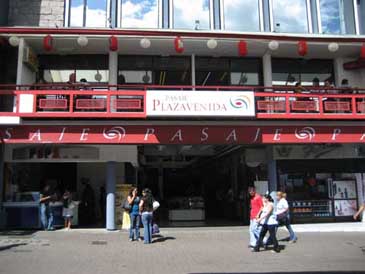 For those in the
know, there is a clean, affordable, relatively quiet
gastronomic surprise off the pedestrian mall in downtown San
Jose. Between Arenas clothing store and the Patio Restaurant,
behind a perfume counter and a Pops Ice Cream sits a food court without
a McDonald's, Wendy's, Subway or Church's Chicken in sight. For those in the
know, there is a clean, affordable, relatively quiet
gastronomic surprise off the pedestrian mall in downtown San
Jose. Between Arenas clothing store and the Patio Restaurant,
behind a perfume counter and a Pops Ice Cream sits a food court without
a McDonald's, Wendy's, Subway or Church's Chicken in sight. Click here to read more Festive season proves troublesome even for established restaurant  Being a chef in a
busy kitchen must be a pretty stressful job, but
around Christmas stress is something any successful restaurant should
factor in as inevitable. Being a chef in a
busy kitchen must be a pretty stressful job, but
around Christmas stress is something any successful restaurant should
factor in as inevitable. On a second visit to well-reputed French restaurant Le Chandelier, it soon became obvious that the staff were poorly equipped for the onslaught of Christmas party diners on a Tuesday night, leaving the usually decent food to deteriorate into a procession of almost inedible starters and bland entrees. Click here to read the full review A great meal is not all in the presentation 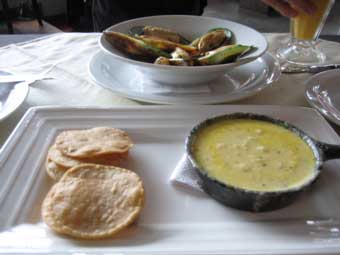 With a vaulted
glass ceiling, palm trees lining the pathway and posh lighting, one
would not expect Saga restaurant to be settled behind a dull parking
lot in Escazú. With a vaulted
glass ceiling, palm trees lining the pathway and posh lighting, one
would not expect Saga restaurant to be settled behind a dull parking
lot in Escazú. Although this restaurant may look out of place, it doesn't deviate much from the norm in Escazú, an area many would classify as suburban sprawl. Click here to read the full review |
| Books ... |
|
Heredia author mixes teen romance with leatherback turtles  A 15-year-old girl
who is infatuated with buff surfers and Gucci shoes is setting out to
convince other teenagers her age that caring for leatherback turtles
and saving the environment is just as cool as going to the mall. A 15-year-old girl
who is infatuated with buff surfers and Gucci shoes is setting out to
convince other teenagers her age that caring for leatherback turtles
and saving the environment is just as cool as going to the mall.Penelope, as she is called, is the creation of Heredia resident Marina Kuperman, a New York native who has recently finished the “eco-adventure” novel “Turtle Feet, Surfers Beat.” Written to target girls aged 9-14, the 86-page novel is printed entirely on eco-friendly paper and follows the story of Penelope and her family as they relocate to Tamarindo for a month. Forced to work as a volunteer at the Leatherback Biological Centre, Penelope, who has been recently dumped by her quarterback boyfriend, falls in love almost simultaneously with leatherback turtles and a blonde surfer called Kendall Brown. Click here to read more |
Land use in Costa Rica documented by Fulbright scholar Forty years of living in the jungle, moving between secluded forestry stations and research labs, has led Louisiana resident and NASA veteran Armond Joyce to write a book about the changing uses of land in Costa Rica. After winning a presitgious Fulbright scholarship in 1998, he came back to Costa Rica to revisit forest sites that he worked on over three decades earlier as a graduate student. Click here to read more New book dwells on the social aspects of food Food is not just a selfish pleasure or a way to stifle hunger, but is central to the evolution of art, according to a new book published by Museos del Banco Central. Artworks by Costa Rican painters are the main content of the hardback book, “Imagenes para Comer,” which follows the representation of food in art since still life painting became popular in the Renaissance. Click here to read more |
|
|
|
|
|
|
|
|
| What we published this week: | Monday | Tuesday | Wednesday | Thursday | Friday | Earlier |
|
|