|
 |
Your daily |
 |
|
|
|
|
|
|
|
|
|
|
|
|
||||||||||||||
|
|
||||||||||||||
 |
 |
| A.M. Costa Rica Second newspage |
|||||||||
| Home |
Tourism |
Calendar |
Classifieds |
Entertainment |
Real
estate |
Rentals |
Sports |
About us |
|
|
|
|||||||||
 |
| Costa Rica Expertise Ltd http://crexpertise.com E-mail info@crexpertise.com Tel:506-256-8585 Fax:506-256-7575 |
 |
|
that are termed eco-friendly By the A.M. Costa Rica staff
Hoteliers and homeowners looking for new ways to be eco-friendly may find answers Wednesday and Thursday at the III Expo Verde being held in San José. Talks on how to be carbon neutral, use biodegradable plastics and ideas on carrying out sustainable tourism will aim to help Costa Rica's residents uphold the country's environmentally-friendly image. From energy-saving devices to water-treatment ideas, a wide range of products that can otherwise be difficult to encounter will also be on display, The event, titled the III Feria de Proveedores Amigos del Ambiente, “Expo Verde,” is being held by the Fundación Corcovado, which works in the Parque Nacional Corcovado on the Osa Peninsula. The idea for the exposition came after the foundation was approached by hoteliers and other poeople asking for information about the technology, products and accessories that are best used to protect the environment. Although they had the infomation readily available, customers and suppliers found it equally difficult to obtain and supply the “alternative” products, said organizers. The feria thus became a space in which the two can come together, exchange information and advertise products. Last year, 25 businesses exhibited their products and over 500 people attended. Open from 10 a.m. until 7 p.m., Expo Verde will be held in the salón Las Orquídeas of the Hotel Ramada, Plaza Herradura. Entry is free. For more information contact the foundation on 2297-3013 or e-mail funcorco@racsa.co.cr Airport computer system did not fail, spokesman says By the A.M. Costa Rica staff
MIAMI, Florida- Officials at the Miami International airport said there have never been any computer outages or slowdowns resulting from too many passengers. Miami International Airport receives 20,000 to 25,000 passengers per day and JFK Airport in New York receives about 40,000 per day, said Zachary Mann, a spokesman for the Department of Homeland Security. The systems across the country continue to work whether passengers are arriving by land, seaports, or airports, said Mann. A news story Tuesday said that the computer system had been overwhelmed by arrivals. Our reader's opinion
Tourism institute promotionshould be done fairly Dear A.M. Costa Rica: Your article Wednesday about the Instituto Costarricense de Turismo and their statistics has prompted me to write to you about how we see the reality of the hotel business these days. I have never believed the vastly inflated statistics put out by ICT, and now you have confirmed that they do not know if the tourists are really tourists or simply returning residents who live here. As a B&B owner for the last 15 years, I am frankly tired of ICT's policy of promoting Guanacaste and its luxury resorts, Liberia airport, other Pacific destinations and all-inclusive packages to the exclusion of the rest of Costa Rica. Where does the $14 million come from to pay for the publicity campaign? By the way, I am sure the majority of tourists are not "affluent." The same old destinations (Arenal, Monteverde, Manuel Antonio, Tamarindo) are promoted over and over again. Nothing is done to promote the Central Valley, small hotels and the "real" Costa Rica. This year has been the worst year we have experienced since opening our B&B in 1994. The economic downturn in the United States has a ripple effect worldwide. What makes Costa Rica think it is immune from the economic problems in the U.S.? I suggest that your reporters interview hotel owners in the Central Valley and elsewhere to get a real picture of what is happening in tourism and not simply rely on ICT statistics and other government sources. Who better than hotel owners to know the real truth? Tessa Borner
Grecia
|
 |
 |
 |
| A.M. Costa Rica third newspage |
|||||||||
| Home |
Tourism |
Calendar |
Classifieds |
Entertainment |
Real
estate |
Rentals |
Sports |
About us |
|
|
|
|||||||||
| Judicial
police chief says agency is overwhelmed by murders |
|
|
By Elise Sonray
and the A.M. Costa Rica staff The director of the Judicial Investigation Organization said the agency's homicide unit is so flooded with murders that each investigatory team of two persons has five cases to solve. The number of murders is up to 70 already this year, said the director, Jorge Rojas Vargas, noting that this number was not reached last year until August. In addition, he said, the nation is faced with a wave of kidnappings. There have been five in the last two weeks. The latest victim was set free Wednesday night. Rojas reported that his investigators had made two arrests Thursday in the murder of a man the night before in Paso Ancho. He said that the motive for the killing was robbery. Detained were two brothers with the last name of Marín. Dead was Fernando Rueda Ahumada. Rueda, an architect for the transport ministry, was the brother of Amelia and Alejandro Rueda, two well known media figures. Rueda died when he was hit with three bullets as he got out of his car in his garage at his home. Investigators wasted no time in making arrests. They conducted raids about 12 hours later, about 8 a.m. in the Torremolinos section of Desamparados. That the motive of the crime was robbery suggested that the killing was unrelated to one Monday night and a another Tuesday night in the metropolitan area. Killed Monday was a business woman who was murdered by two men on a motorcycle who pulled up near her car in Zapote. Tuesday the victim was a police officer, Félix Ángel Ruíz |
Matarrita, coincidentally in
Torremolinos. For a time
it appears that all three murders instead of just the first two were
planned hits rather than street crimes. Rojas said that the police officer's murder was being investigated by agents outside the homicide division because of the overwhelming workload. Three men were detained by agents after the kidnap victim was liberated Wednesday night. The family of the victim is believed to have paid the equivalent of $50,000 for his freedom. The victim is believed to be a restaurant owner. Some of the money was recovered, agents said Rojas said that over about the last two weeks investigators had reports of five abductions, including the one that resulted in arrests Wednesday. Three cases were in Puntarenas, and two were in San José, Rojas said. In speaking of the growth of serious crime, Rojas noted that house burglaries have gone down but car thefts and homicides have gone up. “This seed has now grown,” said Rojas. As if to punctuate the point made by Rojas, investigators reported two more murders Wednesday night. A 23-year-old man with the last name of Rojas died from a beating and a stab wound after a fight outside a bar in Pérez Zeledón. A 32-year-old San José man and a 17-year-old, both residents of León XIII, were detained. In Limón a 32-year-old man with the last name of Cordero died of a bullet to the head in the public right-of-way. He was standing outside a store near his motorcycle when a man in a ski mask appeared, fired the fatal shot and took something from the fallen man's back pocket, investigators said. |
| Berrocal
gives lawmakers his views on terrorists infiltration |
|
|
By the A.M. Costa Rica staff
The Fuerzas Armadas Revolucionarias de Colombia have used both criminal and political methods to infiltrate the country, the fired security minister told legislators Thursday. The minister, Fernando Berrocal, appeared before a special legislative committee and distributed a 36-page, single-spaced document to support his testimony. He spoke for more than two hours until the committee ran out of time. He is to appear again Monday. Berrocal was criticized incorrectly for saying that he had a list of Costa Rican politicians who were involved with the Colombian drug terrorist organization. He repeated Thursday that this misconception was a product of journalistic speculation. Berrocal lost his job, in part, because of the way his comments were reported in the Spanish-language press. Thursday he said he sought to give an integrated and coherent outline of what he learned as minister. Berrocal said that the international committee of the Fuerzas Armadas, headed by Raúl Reyes and Rodrigo Granda, took advantage of Costa Rica' tradition of helping refugees and providing political asylum. He branded the Dirección de Migración y Extranjería as a source of corruption and cited the thousands of Colombians who received refugee status and the thousands of marriages permitted by proxy. Some of the marriages were defended by the Sala IV constitutional court. Berrocal supervised the immigration department until he left March 30. Upon taking over the job two years ago, he and his aides said that eliminating corruption in the immigration department was a priority. He said he deplored the subterranean and illegal network |
that sends drugs from Costa Rica to
up to 27 countries. He based some
of his statements on information he received from the Colombian
national police, the U.S. Drug Enforcement administration and the U.S.
military's Southern Command. He said that there was no alphabetized list with names and cédula numbers and political parties of those linked to the Fuerzas Armadas. That would be simplistic, he said. But he said there were names of persons of politicians and of organizations in documents he delivered to President Óscar Arias Sánchez. His comments had an impression on lawmakers. Marvin Rojas of the Partido Acción Ciudadana said he was convinced after hearing Berrocal that there is absolute and total penetration by the Colombian drug and terror organization in Costa Rica. Mario Quirós of Movimiento Libertario said that he concluded after hearing Berrocal that the situation is much more grave than he had thought originally. Wednesday the same lawmakers heard from Francisco Dall'Anese, the fiscal general or chief prosecutor. He said there was no certainty of penetration by the Fuerzas Armadas but there were indications. He noted that in the computer of Raúl Reyes there were 36 separate mentions of Costa Rica. Reyes was the Fuerzas Armadas commander killed by Colombia soldiers March 1 in a cross-border raid into Ecuador. From the information on the computer, agents here were able to confiscate some $480,000 in a small safe in Santa Bárbara de Heredia. Both Berrocal and Dall'Anese mentioned the case of a terrorist leader who was detained in Puntarenas. The man, Héctor Orlando Martínez Quinto, was detained Aug. 10, 2006, and sent back to Colombia. He has been credited with organizing the Puntarenas fishing fleet as an effective drug smuggling force. |
| From bocas to feria fruit: enough to make your mouth
water |
|||
| This past weekend was
devoted
to two of my favorite things — good food and good company. Steve, a
long-time pen pal whom I met through my column, arrived in Costa Rica
with the idea of moving here, so I had a small gathering of people who
might be able to tell him what life here is like. Of course, you cannot have people over without refreshments, so I prepared some special bocas for the occasion. One was experimental but proved to be a big success. The original recipe is from Paula Dean. I added my own touches of some grated nutmeg and finely chopped nuts to spinach Gruyere puff pastry. (You can find the recipe on Food Channel.) Next time I am going to add a bit of garlic. Another recipe I served was thanks to Grady who got it from a Tico friend. Mince at least four cloves of garlic and sauté in at least four TB of butter. Add a can or pack of refried beans (either red or black), and about a cup or more of grated white cheese, the kind you can buy in the feria, already grated, maybe the supermarket. I am passing this on without specific quantities because that is the way I got it. Just test it as you go. Keep it warm in a chafing dish — and serve with taco chips, of course. Always a hit is a little sweet I serve — chocolate mint sticks (Milan chocolate mentas) dipped in my chocolate fudge sauce kept hot in a small fondue pot I found in a second hand store in California. Steve accompanied three of us to the feria Saturday. He is a very curious man, who writes in a little notebook as he asks about and learns something new. And he asks a lot of questions, questions I should have asked a long time ago. Well, I did, but not with his persistence. One of the chapters in my book, "Butterfly in the City," is about how many of us live “the narrow, comfy life.” I am guilty of that myself when it comes to fruits and vegetables. Thanks to Steve, I learned about a number of fruits that I have never bought. I do buy mangos and recently learned that there are five different types of mango. The guaba (probably Inga edulis) is the Frankenstein-like overgrown pea pod. The white pulp inside is edible. It surrounds a beautiful mahogany lima bean shaped seed that is used for jewelry by some. I don’t think I will |
 Photos by Steve Harrington Photos by Steve Harringtonmake it part of my diet unless I go into the jewelry designing
business. |
||
 |
 |
|
 |
 |
|
 |
| A.M. Costa Rica fourth news page |
|||||||||
| Home |
Tourism |
Calendar |
Classifieds |
Entertainment |
Real
estate |
Rentals |
Sports |
About us |
|
|
|
|||||||||
|
Dominical
social note Nicole D'Angelo and Eric Blaker will be married Saturday at the Hotel Cristal Ballena in Playa Dominical, and some friends came into town Wednesday, mostly from New Jersey and California. So there was an impromptu bachelor party at the El Patio in downtown San José with T-shirts bearing the groom's photo. They were having so much fun that editors decided this should be a tourism ministry poster. |
 A.M. Costa Rica/Saray Ramírez
Vindas
|
|
10-year-old community
policing plan gets favorable review
|
|
|
By Elise Sonray
of the A.M. Costa Rica staff Ten years ago current Vice President Laura Chinchilla started a community security program initiative to prevent crime instead of react to it. Thursday a benchmark study announced some results of the security program and what still needs to be done in order to better the program. The program, Programa de Seguridad Comunitaria, organizes and teaches in 5,000 Costa Rican communities, said the director, Manuel Espinoza Campos. The evaluation was conducted by a company called Culturas y Desarollo en Centro America between September 2006 to September 2007. The study evaluated and studied criminology, the program's institutional functions, institutional impact, and social impact. The study showed that one third of adults felt unsafe in their communities. Researchers found between 1998 and 2003 one third of those convicted in crimes against property were between 18 and 25 years of age. Men under 35 years made up half of those convicted in drug-related crime. People with higher education were three times more likely to report a crime than lesser educated people, according to |
the study. The study also said
education could play a part in reducing
criminality since only three out of 10 children who start elementary
school finish high school. The committee suggested a more organized communication system between the community security program and police agencies, a new training program and a unifying document. It also said the committees are most successful when focus is put on the entire community and not individually. Espinoza said he has seen definite results since the program formed 10 years ago. Ms. Chinchilla is a former security minister. In Turrialba Espinoza said he has seen a 99 percent improvement in community organization and crime prevention. Radios and communication between communities have helped catch criminals, he said. If one community spots a suspicious car, a resident can radio other nearby towns to be on the lookout. There are only 25 workers in the Programa de Seguridad Comunitaria, but the police coordinate with them, said Espinoza. “I'm not interested in the statistics. I'm interested in the cause of the problems,” said Espinoza. Although Ms. Chinchilla was listed as a major participant in the conference Thursday, she did not show up, nor did Gerardo Láscarez, vice minister of security. |
|
Cartago dog breeder arrested
to face drug charge in U.S.
|
|
|
By the A.M. Costa Rica staff
Police and national security agents arrested a U.S. man in Cartago wanted by the Drug Enforcement Agency, said a police spokesperson Thursday. The Drug Enforcement Agency put out a summons for the suspect, Augustus Pat Saunders, 48, in 2007, said the spokesperson for the International Police Agency in Costa Rica. Saunders has had an extensive criminal record that |
dates back to 1978, said the
spokesperson. Agents arrested Saunders in a Cartago bar where he was accompanied by a woman, said the spokesperson. Suanders entered Costa Rica in 2000 and lived on a property in Ujarrás, Cartago, where he raised and exported pedigree dogs with his wife, said the spokesperson. The Policía de Migración will hold Saunders until he is deported back to the United States, said the spokesperson. |
| News from
the BBC up to the minute |
BBC sports news up to the minute |
| BBC news and sports feeds are disabled on archived pages. |
|
| A.M. Costa Rica fifth news page |
Are
you
still
spending 70 percent You need to fill this space ASAP! |
||||||||
| Home |
Tourism |
Calendar |
Classifieds |
Entertainment |
Real
estate |
Rentals |
Sports |
About us |
|
|
|
|||||||||
 |
 |
| Expert says Chile
lucky that volcano is far from cities |
||
|
By the University of Colorado news services
The Chaiten volcano now erupting in southern Chile is one of 200 to 300 volcanoes in the "Andean Arc" region of Chile, Peru, Ecuador and Columbia considered active by volcanologists, some of which lie in much more densely  Chilean air force photo
The Chaiten volcano in Chile prior to its
eruption May 2.
|
populated areas, said a University
of Colorado at Boulder geologist who has studied Chaiten. While the public perception is that volcanoes that have not erupted in historic times are dormant, volcanologists consider any volcanoes that erupted during the last 10,000 years during the Holocene Period — including Chaiten — to be potentially active, said the professor, Charles Stern. Stern said the pyroclastic flow and ash-fall deposits he and Chilean colleagues analyzed in 2004 indicate Chaiten last erupted about 9,370 years ago. "We consider the lifespan of Andean volcanoes to be about 1 million years, which is supported by this new eruption," he said. He said Chaiten, which started to erupt Friday and which "ramped up significantly," could bury the nearby town of Chaiten much like the Roman city of Pompeii was buried by tephra, or volcanic material, following the eruption of Mount Vesuvius in 79 A.D. "There are 25 million to 30 million people that live very close to at least one of these potentially active volcanoes in the Andean Arc, including the cities of Quito and Santiago," said Stern. "This is a good example of what could happen at any time in the region, and it is fortunate the Chaiten eruption is occurring in a pretty sparsely populated area." Only a few dozen of the 200 to 300 active volcanoes in the Andean Arc are actively monitored, said Stern. More than 25,000 people were killed by the eruption of the Nevado del Ruiz volcano in Columbia in 1985, he said. By Tuesday morning Chilean authorities had evacuated more than 4,000 people from the region, including the population in the town of Chaiten six miles from the volcano and the town of Futaleufo, roughly 70 miles to the east near the Argentine border. The five-day eruption of Chaiten has sent a thick column of ash and smoke into the stratosphere moving east across Patagonia to the Atlantic Ocean. "The volcano went into a higher state of activity this morning," Stern said Wednesday. "What happens after today is anybody's guess." In addition to covering towns and villages and polluting air and water, the ash fall will undoubtedly affect agricultural and ranching activities, Stern said. "Because there is relatively little precipitation in the region of Patagonia east of the volcano, it will take a long time to naturally wash the ash from the landscape." Stern and Jose Naranjo of the National Service of Geology and Mining, who published a 2004 paper in the journal "Geology of Chile," used radiocarbon methods to date the last eruption of Chaiten and concluded the eruption generated layers of volcanic tephra on the surrounding landscape up to five feet thick. The same prehistoric eruption apparently created the two-mile-diameter crater where the current eruption is centered, the authors said. Stern said the possibility of the Chaiten volcano affecting Earth's climate is probably fairly low. "In order to significantly affect the climate, a volcano has to put out a lot of sulfur dioxide aerosols into the stratosphere for an extended period, which then reflects sunlight away from the Earth," he said. "Our data from Chaiten showed the last eruption was high in silica and low in sulfur." In contrast, the massive eruption of Mount Pinatubo in the Philippines in 1991 cooled the global climate for about one year because of high sulfur dioxide emissions, he said. The eruption of Tambora in Indonesia in 1815 affected the world's climate for about three years and caused what is known as the Year Without a Summer in 1816 by cooling Europe and North America with huge atmospheric sulfur dioxide emissions. Last volcano neighbors ordered from region By the A.M. Costa Rica wire services
Authorities in southern Chile have forced the remaining residents who live near the Chaiten volcano to leave the region, after a strong eruption spewed hot rocks. Officials say the residents had to leave because of what are known as pyroclastic flows, which are fast moving currents of hot gas and rocks. The long-dormant volcano began erupting last Friday. About 4,000 people have been evacuated from a town bearing the same name as the volcano. Winds have also blown volcanic ash into neighboring Argentina, grounding flights and forcing some schools to close. Major airlines have canceled flights to the Patagonia region due to concerns that ash from the erupting Chaiten volcano could damage airplane engines. |
|
| A.M. Costa Rica Sports news local and from the wires |
 |
|
|
|
|
|
|
|
|
|
|
||||||
|
||||
|
Food, festivals, arts, entertainment, poker |
|
|
|
|
|
|
|
|
|
|
| Weekend
of belly dance will present the traditional side of the art |
|
|
By
the A.M. Costa Rica staff
Belly dance and other oriental forms will be celebrated in three nights of dance and plenty of workshops during the first Festival Nacional de Danza Oriental. Dance group Zuhair Danza Oriental decided to put on a weekend of oriental dancing due to the growing success of belly dance in Costa Rica. The festival aims to show the dance, called baile de vientre in Spanish, in its traditional form, with emphasis on its rythmic characteristics and the key part that exotic clothing plays in the dance. Belly dancing originates from the Middle East, and it is often claimed to be the earliest social dance in history, due to depictions in ancient Egyption artwork. Both men and women traditionally participate, but the modern midriff-showing costumes did not come to be used commonly until the 1930s. Specialist oriental dancers will come from Spain and the United States to dance at the inauguration show May 16 and at the gala show May 18. Yemaya, an American dancer, and Serta Huertas, from Spain, will take to the stage of the Teatro Eugene O'Neill on both dates, accompanied by Costa Rican dancers and dance teachers who include oriental dance in their repetoirs. |
 Organizers will be giving 10 workshops a day on Saturday and Sunday at the Centro de Artes Promenade, and say that participants can lose up to 300 calories during one hour of practice while also toning muscles and developing flexibility. There is also an amateur night on Saturday. May 17, when learners are able to show off their stuff. Entry to the inauguration and gala shows costs 5,000 colones ($10) each. For more information contact 8841-6060 or e-mail danzazuair@gmail.com. The Teatro Eugene O'Neill is located in the Centro Cultural Costarricense Norteamericano in San Pedro. |
| Play it safe in tournament poker |
|
|
There’s a misconception
about tournament poker that goes like this: Players need to try
frequent sophisticated bluffs and make lots of risky moves to maintain
an unpredictable image and to win. Well, there might be some truth to that in small buy-in tournaments, or even online poker tournaments where the blinds and antes escalate quickly. But on poker’s biggest stage, the World Series of Poker, nothing could be further from the truth. The best tournament players actually try to avoid risky plays altogether. They prefer to wait for their opponents to make the risky moves. They’ll wait patiently until they catch a strong hand. When they do, they’ll take down their overly aggressive foes. Watch any tournament on television and you’re sure to see some no-name player at the final table. Chances are you’ll never see him again. Sure, you’ll occasionally you’ll see an unknown player win using ultra-aggressive tactics, but trust me, that kamikaze style just doesn’t work consistently. You see, great players will play a wide range of dealt cards but they’ll never risk a large percentage of their chips on a marginal hand. When they do push in their chips, they’ll have a premium hand to back up their bet. In situations where it’s unclear whether they have the best hand, the best players will choose to play it safe. To be sure, playing it safe isn’t a flashy style of poker. Some even claim that it’s too weak and passive. That being said, playing safe poker is still a proven recipe for success in the world’s biggest poker tournaments. That’s because the goal in high-stakes tournaments is to win lots of small pots without the risk of going broke. Of course, you’ve got to occasionally win a big pot too. Just stay patient. Eventually, some hyper-aggressive player will go crazy with a bluff when you do have a premium hand. Or, he won’t believe you when you have a strong hand and he’ll call your big bet. It’s bound to happen. Don’t get me wrong, bluffing is a critical part of the game. It’s a weapon all pros use in tournament play. They just won’t bluff nearly as often as you think. |
 Also, professionals will tend to make smaller, more controlled bluffs to minimize their risk. If they get caught, well, that’s not the end of the world. A failed bluff could easily payoff later in a much bigger pot when the pro has the unbeatable hand. Now, you will have to change up your game when you become short-stacked in a tournament. You’ll be forced to make more risky plays. Just be sure you don’t push the panic button too quickly! Skilled players realize that a short stack doesn’t mean it’s time to give up on patient play. In poker, unexpected situations can occur at any time but you have to wait for the right opportunity. If you do choose to run a bluff, don’t be afraid to put your table image to work. When other players observe that you don’t bluff often, that’s the time to confuse them with a little well-timed deceit. And always pay attention to the skill level of your opponents. Big buy-in events attract players with a wide range of poker ability. If you find yourself seated at a table full of bad players, running a risky bluff would be foolish. Instead, wait for a good hand and hope you’re called. That same approach won’t be quite as effective against highly skilled players; they’ll know just what you’re up to. Against tough players, you’ll have to bluff occasionally, but again, not as often as you think. Visit www.cardsharkmedia.com/book.html for information about Daniel Negreanu’s new book, "Hold’em Wisdom for All Players." © 2008 Card Shark
Media. All rights reserved.
|
| Art Galleries ... |
|||
Surreal circus art leaves circle of life question open to onlookers  Wandering around the
Museo Calderon Guardia, looking at austere
historical artifacts about the socialist former president complete with
wax-work statue, the last thing a visitor expects to come across is a
circus tent. Wandering around the
Museo Calderon Guardia, looking at austere
historical artifacts about the socialist former president complete with
wax-work statue, the last thing a visitor expects to come across is a
circus tent. Until May 22, that is precisely what museum-goers can expect when they enter the small temporary exhibition space. A colorful toy snake curls around the bottom of a notice board announcing “Introvoco” with two clown shoes fastened to it. The floor is covered in a carpet of hay, giving the room a barn-yard smell, and most of it is obscured by a blue tarpaulin. Read more - click here |
Art Biennial breaks down national stereotypes  A work of art that
involves only a
metal key is among the most acclaimed piece in the Museo de Arte
Costarricense's latest exhibition. A work of art that
involves only a
metal key is among the most acclaimed piece in the Museo de Arte
Costarricense's latest exhibition.Also on display are old Caterpillar boots, a patchwork quilt and a foosball table, all aimed at breaking down the stereotypes that exist between Costa Ricans and Nicaraguans. As Nicaraguan migration into Costa Rica continues, so do tensions between the two national groups. The U.S. Department of State's most recent estimate was that up to 15 percent of the population of Costa Rica is made up of Nicaraguans who have migrated here mainly in search of work. Read more - click here |
||
| Dramatic Arts ... |
|||
| Russian and Uruguayan artists invited to
play with symphony A Uruguayan conductor and a Russian pianist are the invitees for this weekend's Orquesta Sinfonica Nacional concert in the Teatro Nacional. Famous Russian pianist Andrei Pisarev, whose style of interpretation has been said to closely coincide with that of composer Sergei Rachmaninoff, will be performing works by Berlioz, Smetana, Chopin and Mussorgsky. He will be conducted in these pieces by the Uruguayan Giséle Ben-Dor, who has conducted with symphony orchestras all over the world and who is now the Conductor Laureate with the Santa Barbara Symphony, in California. She has held the post since 2006. This year she is also invited to conduct with the Rotterdam Philharmonic, Jerusalem Symphony, Israel Symphony, and Bern Symphony Orchestras, among others. In the past she has conducted the London Symphony Orchestra and the Boston Pops orchestra. Read more - click here |
Salsa and big band collide in a
night of dinner and dancing Music students of Pérez Zeledón and salsa-dancing fans of the group Son de Tikizia are preparing for a night of dinner and dancing to be held in the capital of the province. The big band of the town that calls itself Pérez Zeledón, but whose actual name is San Isidro del General, will join dancers from the Universidad Nacional to present Cena Bailable May 23. A concert by the 25 members of the big band will start off the evening, which will continue with a buffet-style dinner and end up with dancing. The big band musicians are all students of the Escuela de Música Sinfónica de Pérez Zeledón, Universidad Nacional, and will be interpreting everything from jazz to popular under the direction of Leonel Rodríguez Cambronero. Read more - click here |
||
| Food... |
|||
Mini-mall comes to the rescue of the not-rich-but-hungry 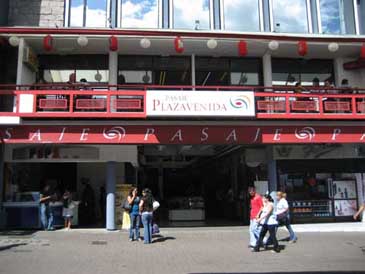 For those in the know, there is a clean, affordable, relatively quiet gastronomic surprise off the pedestrian mall in downtown San Jose. Between Arenas clothing store and the Patio Restaurant, behind a perfume counter and a Pops Ice Cream sits a food court without a McDonald's, Wendy's, Subway or Church's Chicken in sight. Tropical Food is a counter selling relatively healthy food. While their batidos aren't as delicious as the ones found at FrutiLand in Mall San Pedro, the water-or-milk- blended-with-fruit drink is a refreshing treat to carry during your walk along Avenida Central. A batido with the fruit of your choice mixed with water costs 650 colons, with milk, 750 colons. That's from $1.30 to $1.50. Adding honey or granola takes you up to a still-reasonable 900 colons ($1.80). The store also peddles fruit salads, ranging from 700 to 1.600 colons ($1.40 to $3.20). Marisqueria produces delicious looking and smelling seafood dishes. A customer-friendly hanging chalkboard lists their menu and respective prices. A small corvina ceviche will set you back 1,950 colons ($3.90). Get a small rice with shrimp for 2.150 colons ($4.30), 2,800 ($5.60) for a larger serving. Or try one of the fish filets prepared several different ways, the cheapest being with oil and garlic for 2,600 ($5.20) colons, the priciest fish filet dish is 3,600 colons ($7.20) for relleno with ham and cheese. Click here to read more |
Festive season proves troublesome even for established restaurant 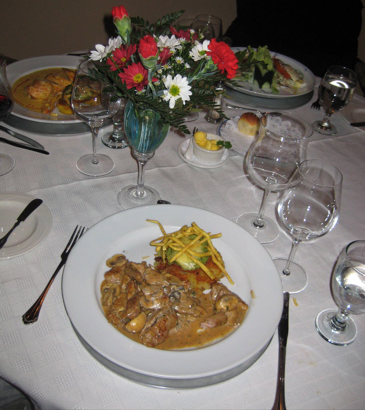 Being a chef in a
busy kitchen must be a pretty stressful job, but
around Christmas stress is something any successful restaurant should
factor in as inevitable. Being a chef in a
busy kitchen must be a pretty stressful job, but
around Christmas stress is something any successful restaurant should
factor in as inevitable. On a second visit to well-reputed French restaurant Le Chandelier, it soon became obvious that the staff were poorly equipped for the onslaught of Christmas party diners on a Tuesday night, leaving the usually decent food to deteriorate into a procession of almost inedible starters and bland entrees. Set in an old San Pedro house with brick ceilings and wooden beams that was converted into a restaurant around 15 years ago by Swiss owner Claude Dubuis, Le Chandelier purports to offer French cuisine that has been developed over generations of experience. Click here to read the full review A great meal is not all in the presentation 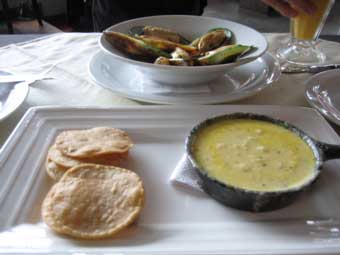 With a vaulted
glass ceiling, palm trees lining the pathway and posh lighting, one
would not expect Saga restaurant to be settled behind a dull parking
lot in Escazú. With a vaulted
glass ceiling, palm trees lining the pathway and posh lighting, one
would not expect Saga restaurant to be settled behind a dull parking
lot in Escazú. Although this restaurant may look out of place, it doesn't deviate much from the norm in Escazú, an area many would classify as suburban sprawl. The majority of the cuisine at Saga seems to fit with the setting: classy presentation, yet lacking any profound flavors. Although the restaurant boasts itself as an “international food restaurant” on its Web site, much of the inspired cuisine is lacking the depth which would be found in authentic dishes. Click here to read the full review |
||
| Books ... |
|||
Land use in Costa Rica documented by Fulbright scholar Forty years of living in the jungle, moving between secluded forestry stations and research labs, has led Louisiana resident and NASA veteran
Click here to read more |
New book dwells on the social aspects of food Food is not just a selfish pleasure or a way to stifle hunger, but is central to the evolution of art, according to a new book published by Museos del Banco Central. Artworks by Costa Rican painters are the main content of the hardback book, “Imagenes para Comer,” which follows the representation of food in art since still life painting became popular in the Renaissance. Full-color pictures of both traditional and modern works are far more common than recipes, as the author Marjorie Ross only provides seven recipes within the book. All are traditional Costa Rican dishes showing influences from different sections of the community, such as corn fritters, white beans and chorizo and fruit salad. The book focuses on the meanings that food has within society, and how these are portrayed by art. Click here to read more |
||
|
|
|
|
|
|
|
|
|
|
|
|
| What we published this week: | Monday | Tuesday | Wednesday | Thursday | Friday | Earlier |
|
|