|
 |
Your daily |
 |
|
|
|
|
|
|
|
|
|
|
|
|
|||||||||||||
|
|
|||||||||||||
 |
| A.M. Costa Rica Second newspage |
 |
||||||||
| Home |
Tourism |
Calendar |
Classifieds |
Entertainment |
Real
estate |
Rentals |
Sports |
About us |
|
|
|
|||||||||
 |
| Costa Rica Expertise Ltd http://crexpertise.com E-mail info@crexpertise.com Tel:506-256-8585 Fax:506-256-7575 |
| |
 |
|
 A.M. Costa Rica/Elise Sonray
Vince Urcuyo Lacayo, 29, ponders a move against Robert
Velázquez Lacayo, 26, while teammate Daniel Hernández
Araya. 23. considers the options.Growing sport of chess
includes a team competition By Elise Sonray
of the A.M. Costa Rica staff Three young men gathered in Parque Morazán Sunday afternoon smoking cigarettes and sipping on Red Bull energy drinks. They'd had a long night, they said, but they had to prepare for today's competition. Although most sports players wouldn't be caught dead smoking before the big game, this isn't just any sport, this is a sport where some players sit the entire game and others casually stroll around the room between each move. This is chess. Chess, seen by some as a boring hobby, is seen by others as an addictive and intense game. The popularity of chess is on the rise in Costa Rica. And so is the competition. Robert Velázquez Lacayo, started playing chess when he was about 14, he said, and he hasn't stopped since. Now 26, Velázquez said he loves the competition and feel of the game. “It's addicting and obsessive,” he said, “It will take over your life.” Velázquez was practicing near the fountain in Parque Morazán just 30 minutes before the big game, to be held in La Escuela de Metalica. Campeonato Nacional por Equipos is an annual competition hosted by the Federación Central de Ajedrez. Chess is called ajedrez in Spanish. It is one of those words the language has adopted from the Arabic and earlier Persian. The contest has been going on for more than 20 years, said one official. Teams of three to six players compete for prizes up to $400 (200,000 colons). The competition lasts until May 4. Chess is more popular in Costa Rica than in any other Central American country, said Francisco Hernández, a judge at the competition. Registered players with the federation have grown significantly in recent years. One reason for the growth is because of the growing number of chess classes given in private schools, said Hernández. Anyone who can pay the $60 team fee can play in the competition. Each player is given two hours to complete a game. Players as young as 10 and as old as 60 could be seen Sunday bent over their chess boards. Like many players, Hérnandez said he started early. “My mom gave me a chess board when I was young, and my grandpa taught me to play,” he said. Others said it was their first time ever playing in a competition, but they were already addicted. U.S. citizen in Jacó sent home for third time By the A.M. Costa Rica staff
Immigration officials deported a man from the United States for the third time Sunday, said a security ministry spokesman. The man who has the last name of Morgan, 46, was working as an administrator at a night club in Jacó, said a spokesman. Morgan was arrested in a police sweep when he failed to produce his legal documents, said a spokesman for the Ministerio de Gobernación, Policía y Seguridad Pública. Later, the man gave police a fake cedula, said the security spokesman. Morgan was deported twice in 2006, said the spokesman. Generally when someone is deported from Costa Rica he or she cannot return for 10 years. Morgan is believed to have entered the country from the north through a non-official route. Costa Rica generally deports people even though they could face criminal action here. The allegation that Morgan had a false residency cédula suggests he may be guilty of a crime. But Costa Rican security officials even deported Colombians they insisted had entered the country illegally in order to assasinate high government officials at the request of a drug cartel.
|
 |
 |
 |
| A.M. Costa Rica third newspage |
 |
||||||||
| Home |
Tourism |
Calendar |
Classifieds |
Entertainment |
Real
estate |
Rentals |
Sports |
About us |
|
|
|
|||||||||
 A.M. Costa Rica/Helen Thompson
Dawn as seen from a spot near the highest peak in the country. |
|
| Even
at more than 11,000 feet, humans bring their problems |
|
|
By Helen Thompson
of the A.M. Costa Rica staff Hikers who drag themselves out of their sleeping bags in the early hours of the morning, don their woolly hats and strike out towards the summit in the dark, can have sunrise at the highest point in Costa Rica all to themselves. After a groggy two-hour walk and a final scramble up to the peak of Cerro Chirripó, the intrepid walker sits 3,820 meters above sea level (about 12,533 feet), with valleys, lakes, and blankets of calm, white clouds spread out below. There is no sound except the wind and an occasional bird, a world void of human presence. This may seem suprising, considering that the refuge near the summit is booked out months in advance. Costa Ricans take great pride in the activity of hiking the 20 kilometers (about 12 miles) from the little village of San Gerardo de Rivas to the stark peak that provides such a sharp contrast to the beaches and rainforests of the rest of the country. But Parque Nacional Chirripó does, in fact, have something in common with Tamarindo and many of its brother beaches. Refugio Los Crestones, the refuge situated 400 meters (about 1,300 feet) below the summit where the majority of visitors spend at least one night, has been designated a public health risk. The septic tank cannot cope with the traffic that it sees, and if something is not done soon, the park is in danger of being shut down. Tourists have been known to camp outside the gates of the park station in San Gerardo de Rivas from 3 a.m., in the hope of being first in line for the 10 spots that the officials reserve for latecomers, but which can only be booked one day in advance. Often they are told that there is no room at the inn, but this is not literally true. Each night, at least 20 of the 60 beds in the refuge lie empty. “The situation is pretty bad for business,” said John, owner of Casa Mariposa hostel in San Gerardo de Rivas. “Most tourists come here wanting to climb the mountain, and if they can't get a spot, they just leave, whereas otherwise they may have stayed for several days.” Local businesses are clubbing together to help pay for repairs to the existing septic tank, and a delegation will head up the mountain Tuesday to carry out the work. On average, each business is paying around $100 and giving a day of time to help with the project. Banco Nacional is also donating funds to help pay the 5 million colons ($10,000) cost of the project. Even this may not help the situation much. “There was some problem with the original design of the septic tank, and it has just not responded to the demand placed on it,” said Oscar Esquivel, a ranger in San Gerardo de Rivas. “The repairs are essential. It won't necessarily mean we can let more people stay in the refuge. We would need a second tank to be able to fill the refuge to capacity.” For the foreseeable future, it will still be a hit-and-miss business trying to get a spot at the highest altitude hotel in the country. To do so, it is necessary to call the Ministerio de Ambiente y Energia office in San Isidro del General to make a reservation or to turn up early at the station in San Gerardo de Rivas. The hike technically starts out four kilometers (2.5 miles) outside Chirripó national park and winds its way up through |
A.M. Costa Rica/Helen Thompson
This is Refugio Los Crestones where the majority of visitors
spend at least
one night. It has been designated a public health risk.ever-changing vegetation on obvious paths. Between the start of the trail and the peak, hikers ascend 2,300 meters (7,546 feet), starting at around 1,500 meters above sea level, about 4,920 feet. Each kilometer is marked with a named sign, which is helpful until a hiker gets nearer the top where the kilometers take on names such as "The Burns" and "The Repentants'" – accurate, but not very encouraging after six hours of walking. Cloud forest surrounds the trail for the first few kilometers, and birdlife is plentiful. Among the more interesting species is the toucanette, a bird that is slightly smaller than a regular toucan, with green feathers. After about 10 kilometers (some six miles), the trees thin out and are replaced by short flowering bushes, and the clouds disappear. Lizards of every colour and pattern bask on the rocks. At the top, the sun is often fierce, and the weather is unpredictable. Various trails lead out from the refuge. They go to the eerie Los Crestones, an outcrop of rocks that resemble organ pipes sitting at the top of one peak and to various lakes and lesser summits. Many people reserve two nights in the refuge in order to spend the middle day hiking around the valleys. It can get very cold in the refuge, so warm clothing is essential. All food must be carried up the mountain, as there are few facilities in the refuge, and the stoves in the kitchen can only be used if reserved in advance. One thing that is available is Internet. Bizarrely, two brand new computers are available for guests to use for free. Chirripó is a friendly mountain, considering that it is hard to get lost, requires no guide or technical knowledge, and provides a stunning view from the top. It is rumoured that on a clear day it is possible to see both oceans, but this is a very rare occurrence. Even so, the sweep of the Talamanca mountain range and the incredible calm and remoteness from the general rush of tourism in Costa Rica makes the long hike worthwhile. |
 A.M. Costa Rica/Helen Thompson
Above the clouds the landscape can become pretty stark. |
|
 |
 |
|
 |
 |
|
|
|
|
|
| You need to see Costa Rican tourism information HERE! |
| A.M. Costa Rica fourth news page |
|||||||||
| Home |
Tourism |
Calendar |
Classifieds |
Entertainment |
Real
estate |
Rentals |
Sports |
About us |
|
|
|
|||||||||
|
Our readers' opinions
Playa Pelada lost blue flagover paperwork glitch Dear A.M. Costa Rica: Recent news has revealed that several beaches have lost their blue flags. Playa Pelada in Nosara is in the news as one of those beaches. Playa Pelada however did not lose the blue flag because the water is contaminated or for any other reason related to environmental negligence or abuse. Unfortunately, the paperwork that is required to be submitted by a specific date was not submitted, and this is the reason the Blue Flag was denied. We don't have condos, hotels, homes or other establishments on the beach that would cause contamination of the water like some of the other losers, and the locals work hard on a daily basis to keep the beach clean. This year Playa Pelada was too busy enjoying its clean water and beach to do its paperwork. Pamela Ellsworth
Nosara Very poor and very rich show failure of capitalism Dear A.M. Costa Rica: Opening scene: It is March 28. I am riding in a cab in Sao Paulo, Brasil. The driver stops at a traffic light in an upscale shopping neighborhood. Out of the corner of my eye appears a little girl who can not be more than a year old. She stands erect in the middle of the sidewalk completely naked and covered in soot. Next to her, holding her hand, stands another little girl 5 years old at the most. She wears a hand-me-down adult dress. She is also covered in soot. Both children are staring down and my eyes catch the object of their attention, a young women in her late 20s, also covered with soot climbing out of the city's sewer. The heavy black iron cover has been pushed aside, and the young woman gingerly steps out onto the sidewalk, reaches for the sewer cover and, with all the strength she can muster, pushes it back in place while indifferent pedestrians casually walk by. She then reaches for the 1-year-old and in one swoop wraps her up in a dirty blanket she was carrying under her arm. The light changes, and the family disappears in the taxi's rear view mirror. Fade to black. Second scene. It is the same day, late afternoon and I am back at my hotel. I turn on CNN for the latest news. Forbes Magazine is making the news with its annual report of the richest men on the planet. Poor Bill Gates has lost his title of the richest man on the planet to his buddy and bridge partner Warren Buffet. Score $62 Billion for Buffet to $58 Billions for Gate. Warren's revenue for 2007, a cool $10 billions, more than the total salary of all Ticos in 2007. That's right, more than what the 1,866,000 Ticos that worked in 2007 earned, more than the gross national product of 124 of the nations that populate this world. Voice-over: Has the world gone mad? How can we celebrate wealth to that extreme and ignore human beings reduced to living as rats and with rats in city's sewers? How can we celebrate capitalism without recognizing that it has been hijacked by unscrupulous operators as lately witnessed in the sub-prime scandal. Worldwide economic practices that would have been considered shameful a generation ago are now the norm, and unless world economists begin to speak out and governments begin to pay attention, Capitalism will eventually self destruct. Andre Bruneau
Escazú |
More European
airports stop checking arriving passengers By the A.M. Costa Rica wire services
Passport-free travel in Europe has expanded further as border checks at airports in nine mainly former Communist countries have disappeared. Sunday's move allows 400 million people unlimited travel in what is known as the "Schengen zone." Starting Sunday, citizens of Europe's 24-country "Schengen zone" were no longer required to undergo passport checks at airports in Malta and eight other European Union countries that joined the EU in 2004. Among them are ex-communist Hungary, Poland, the Czech Republic, Estonia, Latvia, Lithuania, Slovakia and Slovenia. The Schengen zone takes its name from a village in Luxembourg where five founder-member governments agreed in 1985 to abolish border controls. It is now comprised of 22 EU member states plus non-EU nations, Iceland and Norway. Land and maritime border controls had already been abolished among all the EU member countries, allowing Europeans to travel from Norway to Portugal without a single border check. European Transport Commissioner Jacques Barrot suggests the removal of airport controls will revolutionize air travel for some 400 million people. He says, "The enlargement of the Schengen area to 24 states will mean that passengers within that zone can now freely travel without submitting to any kind of formality." He admits airlines will continue their identity checks at borders and says controls will be maintained for any flight regardless to destination because of security reasons. Airports of Budapest, Tallinn, Warsaw and Prague had to build new terminals to physically separate passengers from the control-free countries and from other places, including the United States. Witnesses help taxi driver by reporting his abduction By the A.M. Costa Rica staff
It was a regular Thursday evening for taxi driver Joel Valdés Janes. He stopped in Goicoechea to pick up three passengers around 9 o'clock. But before he knew it, someone was pointing a gun at him and telling him to get in the trunk of the car. Fortunely for Valdés a number of witnesses reported the incident to the Fuerza Pública, said a security ministry spokesman. Fuerza Pública officers arrested two suspects in Purral de Goicoechea. One man escaped however, they said. A woman with the last names of Pérez Barrantes, 26 was arrested as was a young man with the last names of Araya Castro, 19. Police officers freed the taxi driver and found a number of belongings in the vehicle, said the security spokesman. This is a common type of theft according to Humberto Ballestero, a spokesman from Fuerza Pública. “They probably were planning on abandoning the vehicle and driver and then stealing another car,” he said. Teachers say they'll strike today By the A.M. Costa Rica staff
High school teachers, still irked by salary and resource concerns, plan another stirke today. The Asociación de Profesores de Segunda Enseñanza has called on all public education workers to walk out nationwide. Previous strikes have not had strong participation. |
|
|||||||||||||||||
| News from
the BBC up to the minute |
BBC sports news up to the minute | ||||||||||||||||
| BBC news and sports feeds are disabled on archived pages. |
|||||||||||||||||
| A.M. Costa Rica fifth news page |
Are
you
still
spending 70 percent You need to fill this space ASAP! |
||||||||
| Home |
Tourism |
Calendar |
Classifieds |
Entertainment |
Real
estate |
Rentals |
Sports |
About us |
|
|
|
|||||||||
 |
 |
| Hemispheric press
group says media had troubling decline |
||
|
Special to A.M. Costa Rica
The Inter American Press Association has cited what it said are the serious adversities that continue to threaten press freedom and freedom of speech in the Americas. At the conclusion of the organization's midyear meeting in Caracas Sunday, a statement underscored the group's concern over the continued threats, assaults, acts of intimidation, and killings to which journalists and media outlets are subjected in various countries in the region. Here are the major conclusions listed by the organization: • Freedom of the press in the Americas has suffered a troubling decline in the last six months, as seen in court
|
cases and judicial rulings against
the media, as well as in increasing violence against journalists. • In Venezuela, President Hugo Chávez and several of his ministers continued their hostile attitude toward independent newspapers and journalists. Radio Caracas Televisión was shut down last year, and more recently the threats against Globovisión have been stepped up. At the midyear meeting in Caracas, members participated in a wide-ranging debate featuring a variety of views on freedom of the press in the region. Unfortunately, all efforts by the Inter American Press Association to open up channels of communication with the government of Venezuela were unfruitful, not only at this meeting but in prior attempts and missions. • Five journalists were killed during the past six months: three in Mexico, one in Argentina and another in Honduras. More than 30 were attacked in Peru, and 32 were threatened in Colombia. The transfer of power in Cuba from Fidel Castro to his brother Raúl did not improve the status of the 25 journalists still in prison or the adverse working conditions of independent journalists. The midyear meeting also expressed concern over the impunity surrounding crimes against journalists, especially in Brazil, Colombia, Mexico and Peru, among other countries. • Paraguay, headed by President Nicanor Duarte Frutos, was the country which saw the greatest increase in reports of verbal attacks on the media during the past six months. Attacks aimed at undermining the credibility of the press were also noted in Uruguay, Venezuela, Honduras, Ecuador, Nicaragua, Bolivia and Argentina. • The recent increase in state-owned media outlets in the region is clear evidence of new efforts by various governments to control information. In Venezuela, the government has taken control of several radio and TV stations. A monopoly of radio frequencies currently is in the hands of the government of Guyana. In Bolivia, with alleged backing from Venezuela and Iran, the government has created chains of state-owned radio and TV stations. • There were legal improvements with new laws allowing the public to gain access to official information. Nicaragua and Honduras issued regulations and Chile has approved similar initiatives. In Guatemala, a presidential decree released classified information about the military. • In terms of constitutional reforms, Bolivia unfortunately insisted that its new constitution includes a clause requiring that all information be truthful and responsible. On the other hand, Brazil and Ecuador have had positive initiatives. Ecuador’s constitutional court declared unconstitutional the mandatory licensing of journalists. In Brazil, a supreme court justice declared various press law articles unconstitutional. • In the judicial arena, judges in Brazil allowed prior restraint against 16 newspapers and one Web site, blocking the distribution of information. Also in Brazil, several dozen lawsuits were filed against media outlets and journalists by an evangelical church seeking compensation for damages because of published reports on the church's finances and vandalism of religious images by one of its followers. • In another troublesome development, the governments of Guyana, Argentina, Uruguay, Nicaragua, Mexico, Dominican Republic and Venezuela discriminated against newspapers because of their editorial policies by punishing or rewarding them through the placement of government advertising. Nevertheless, for the first time in Argentina, a provincial government, following a supreme court ruling, established a procedure to allocate advertising in a nondiscriminatory manner. Editor's note; A.M. Costa Rica through its parent corporation is a member of the Inter American Press Association but employees had no role in developing the above report. |
|
| A.M. Costa Rica Sports news local and from the wires |
 |
|
|
|
|
|
|
|
|
|
|
||||||
|
||||
|
|
|
|
|
Food, festivals, arts, entertainment, poker |
|
|
|
|
|
|
|
|
|
|
| Art Galleries .... |
|||
Rembrandt exhibition opens to high acclaim in downtown San José  Hailed
as the most important exhibition of the year, a collection of
the Dutch master Rembrandt's etchings opened amid much praise Thursday. Hailed
as the most important exhibition of the year, a collection of
the Dutch master Rembrandt's etchings opened amid much praise Thursday.
The 48 etchings usually reside in Amsterdam's Rembrandt House Museum, where the artist lived for about 20 years from 1620-40. They were collaboratively chosen from a wider collection by Dora Maria Sequiera, the director of Museos del Banco Central and Ed de Heer, the director of the Rembrandt House Museum. Although now better known for his marvelous paintings that capture intense emotion, facial expression, and deeply contrasted light and shadow, the etchings that are now on show in San José are considered by art buffs to be just as important. “Rembrandt was the most influential and original etchers possibly of all time,” said de Heer. “He is a shining beacon because he changed etching from a reproductive medium to a fully fledged artistic medium. “He used all sorts of different techniques to get all the possibilities out of the medium — he printed on copper plate, parchment, even sheepskin to make luxurious editions of prints. He didn't want any two to be the same.” There is no sheepskin involved in this exhibition, as some of the finer materials are too fragile to export for exhibition in humid tropical countries like Costa Rica. The collection does, however, but include something from each of Rembrandt's main themes. Read more - click here |
Imagen V show has a few gems but a pack of clinkers, too  New media art is
always a bit hit and miss with the potential to come
across as a foundationless piece of pretension if it is not done well. New media art is
always a bit hit and miss with the potential to come
across as a foundationless piece of pretension if it is not done well. The Bienal Iberoamericana Inquieta Imagen V, a competition for video artists from across Latin America, is a good example of this, containing a few pieces that engage well with the subject and make the most of their medium, but many that leave the viewer cold. Read more - click here Mistaken identity? No such thing, says new exhibition  Costa Rica is
a land of volatile volcanoes, orchids, coffee fincas,
Catholicism and Ticos. Costa Rica is
a land of volatile volcanoes, orchids, coffee fincas,
Catholicism and Ticos. Or you could say it's a country of wide seashores, football stadiums, fast food restaurants and beach towns overtaken by Gringos. Some are clichéd symbols of a tourist nation, while others are part of the country's changing culture, but all are involved in Museo de Arte Costarricense's new exhibition that challenges viewers to reconsider their own perceptions of the nation. Read more - click here |
||
| Food... |
|||
Mini-mall comes to the rescue of the not-rich-but-hungry 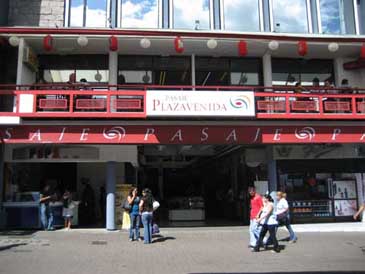 For those in the know, there is a clean, affordable, relatively quiet gastronomic surprise off the pedestrian mall in downtown San Jose. Between Arenas clothing store and the Patio Restaurant, behind a perfume counter and a Pops Ice Cream sits a food court without a McDonald's, Wendy's, Subway or Church's Chicken in sight. Tropical Food is a counter selling relatively healthy food. While their batidos aren't as delicious as the ones found at FrutiLand in Mall San Pedro, the water-or-milk- blended-with-fruit drink is a refreshing treat to carry during your walk along Avenida Central. A batido with the fruit of your choice mixed with water costs 650 colons, with milk, 750 colons. That's from $1.30 to $1.50. Adding honey or granola takes you up to a still-reasonable 900 colons ($1.80). The store also peddles fruit salads, ranging from 700 to 1.600 colons ($1.40 to $3.20). Marisqueria produces delicious looking and smelling seafood dishes. A customer-friendly hanging chalkboard lists their menu and respective prices. A small corvina ceviche will set you back 1,950 colons ($3.90). Get a small rice with shrimp for 2.150 colons ($4.30), 2,800 ($5.60) for a larger serving. Or try one of the fish filets prepared several different ways, the cheapest being with oil and garlic for 2,600 ($5.20) colons, the priciest fish filet dish is 3,600 colons ($7.20) for relleno with ham and cheese. Click here to read more |
Festive season proves troublesome even for established restaurant 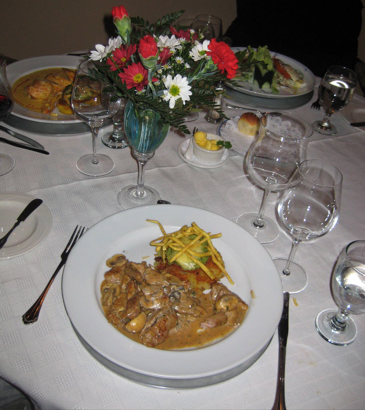 Being a chef in a
busy kitchen must be a pretty stressful job, but
around Christmas stress is something any successful restaurant should
factor in as inevitable. Being a chef in a
busy kitchen must be a pretty stressful job, but
around Christmas stress is something any successful restaurant should
factor in as inevitable. On a second visit to well-reputed French restaurant Le Chandelier, it soon became obvious that the staff were poorly equipped for the onslaught of Christmas party diners on a Tuesday night, leaving the usually decent food to deteriorate into a procession of almost inedible starters and bland entrees. Set in an old San Pedro house with brick ceilings and wooden beams that was converted into a restaurant around 15 years ago by Swiss owner Claude Dubuis, Le Chandelier purports to offer French cuisine that has been developed over generations of experience. Click here to read the full review A great meal is not all in the presentation 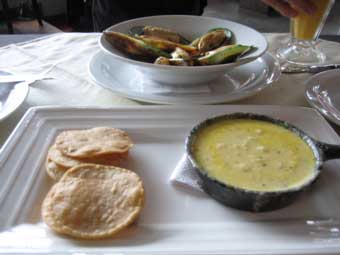 With a vaulted
glass ceiling, palm trees lining the pathway and posh lighting, one
would not expect Saga restaurant to be settled behind a dull parking
lot in Escazú. With a vaulted
glass ceiling, palm trees lining the pathway and posh lighting, one
would not expect Saga restaurant to be settled behind a dull parking
lot in Escazú. Although this restaurant may look out of place, it doesn't deviate much from the norm in Escazú, an area many would classify as suburban sprawl. The majority of the cuisine at Saga seems to fit with the setting: classy presentation, yet lacking any profound flavors. Although the restaurant boasts itself as an “international food restaurant” on its Web site, much of the inspired cuisine is lacking the depth which would be found in authentic dishes. Click here to read the full review |
||
| Film and Dramatic Arts ... |
|||
| Brazilian flavors to entertain diners at
Women's Club fundraiser Brazilian musicians will be the guests at the Women's Club of Costa Rica's next fundraising night, filling the El Rodeo Country Inn in San Antonio de Belén with exotic sounds and dancing. The Fiesta Brasileña offers a full night from welcome drinks and dinner to dancing and a silent auction. Dance group Bailando Brasil will be in charge of the entertainment, dressed in elaborate costumes and dancing to the rythms of bossa nova and samba played on traditional Brazilian instruments. Proceeds from the $30 (15,000 colons) tickets, the raffle and auction go to scholarships for economically disadvantaged high school students and to the development of libraries in public and primary schools in Costa Rica. The event takes place on April 5, at 6 p.m. For tickets and information, call 285-1276. |
Costa Rica's cinematic heritage shared with
all at public libraries All over the country, film lovers are being given the chance to learn a bit more about Costa Rica through cinema screenings in public libraries. Viewers will probably be surprised to find out there are so many Costa Rican films in circulation, and although none is famous, they deal with issues close to the country's history. Subjects range from the nation's love of guaro and documentaries on influential figures such as Francisco Amighetti and Juan Santamaría, to racial issues, lighter animated films, and even how to fish shrimp responsibly. Margarita Rojas, director of the Sistema Nacional de Bibliotecas, initiated the project, making copies of the works that she considers essential to Costa Rican cinema to send around the country. Read more - click here |
||
| Festivals ... |
|||
International acts to make rare festival appearance in Costa Rica Excitement is rising over the announcement of headline acts for Festival Imperial, Costa Rica's most highly anticipated music festival of the year. Costa Rica is often missed off the list when world-famous bands are compiling their top international touring spots, but the second edition of the beer-backed festival is set to attract a few top names. Two years ago, the first Festival Imperial brought Sting and Jamiroquai to Costa Rica, while also promoting national bands such as Gandhi and Malpais, and April 2008's edition of the event promises similar quality. Read more - click here |
 British
group Duran Duran will headline Festival
|
||
| Books ... |
|||
Land use in Costa Rica documented by Fulbright scholar Forty years of living in the jungle, moving between secluded forestry stations and research labs, has led Louisiana resident and NASA veteran
Click here to read more |
New book dwells on the social aspects of food Food is not just a selfish pleasure or a way to stifle hunger, but is central to the evolution of art, according to a new book published by Museos del Banco Central. Artworks by Costa Rican painters are the main content of the hardback book, “Imagenes para Comer,” which follows the representation of food in art since still life painting became popular in the Renaissance. Full-color pictures of both traditional and modern works are far more common than recipes, as the author Marjorie Ross only provides seven recipes within the book. All are traditional Costa Rican dishes showing influences from different sections of the community, such as corn fritters, white beans and chorizo and fruit salad. The book focuses on the meanings that food has within society, and how these are portrayed by art. Click here to read more |
||
| Some thoughts on value betting the river | |
|
Making a value bet
defines a situation where you place a bet — a bet that you hope is
called — because you think you have the best hand. Before you even consider making a value bet, try to determine if the bet will have any value at all. Attempt to put your opponent on a hand that he’d likely call a bet with on the river. To do this, you’ll have to mentally play back the details of the hand. Think about your opponent’s playing tendencies. Is he a calling station? Is he a skilled player? What type of player does he think you are? Try to figure out what percentage of the time your opponent would call a bet on the river with the worst hand. If the percentage is low, checking would be your best option. Delve into your memory bank and think about your opponent’s betting history. Is he capable of check-raising on the river? Is he a tricky player? If your opponent is unlikely to call with the worst hand, but he is capable of check-raising, then betting would be a mistake. On the other hand, if he’s likely to call every bet and would never check-raise on the river, a river bet would probably have substantial value. Think hard about the type of player you’re facing. Will he check hands that have you beat? Does he play semi-weak on the river? Does he rarely miss a value bet? Does he think you’re a bluffer? If he senses that you’re bluffing, he may conclude that there’s more value in checking his top pair. He’ll let you bluff and build the pot yourself. If you’ve picked up a pattern that he’s apt to check some of his stronger hands, be wary of making thin value bets against him. That’s exactly what he’s setting you up to do — make a value bet that only holds value for him! A highly skilled player will pick up on the fact that you’re trying to make a value bet. Betting is extremely dangerous in this situation as it could cause you to actually lose a pot that you would have won had you simply checked. Play |
 cautiously when facing these tricky players. They won’t call your river bet as often as you’d like when they have the worst hand. But remember, they are capable of stealing pots away from you any time they sense your weakness. It really all comes down to this one question: Is it worth the risk to bet on the river? The essential issue is whether you need to make a marginal play at all. If you have full command of the table, you can simply wait for higher percentage plays to invest your chips. If the table already lets you get away with highway robbery by allowing you to steal pot after pot, why risk squeezing out a little extra value on the river in a marginal situation? There’s too little to gain and too much too lose. Chip stacks are another consideration. Don’t put yourself at risk with a value bet when you and your opponent each have a healthy chip stack. Conversely, if you’re playing on a short stack, a value bet could account for a significant portion of your remaining chips. If that’s the case, it’s more important to protect what’s already in the pot. Check it down and avoid a possible check-raise. Hold on to your precious chips because there’s always the chance that you’ll end up making a value bet with the worst hand. Visit www.cardsharkmedia.com/book.html for information about Daniel Negreanu’s new book, "Hold’em Wisdom for All Players." © 2008 Card Shark
Media. All rights reserved.
|
|
|
|
|
|
|
|
|
|
|
|
|
| What we published this week: | Monday | Tuesday | Wednesday | Thursday | Friday | Earlier |
|
|