|
||
|
A.M. Costa Rica
Your daily English-language news source Monday through Friday |
||
 |
 |
 |
|
|
 |
||||||||||||||||||||||||
|
|
|||||||||||||||||||||||
 |
||||||||||||||||||||||||
 |
||||||||||||||||||||||||
|
|
|||||||||||||||||||||||
 |
| What we published this week: | Monday | Tuesday | Wednesday | Thursday | Friday | Earlier |
|
|
|
|
|
|
|
Food |
|
Jo
Stuart |
|
|
| A.M. Costa Rica's Second news page | |||||||||
| San José, Costa Rica, Wednesday, Oct. 24, 2012, Vol. 12, No. 212 | |||||||||
|
|
|
|
|
|
|
Food |
|
Jo
Stuart |
 |
 |
 |
|
sleeping Los Yoses family By
the A.M. Costa Rica staff
Three men broke into an occupied home in Los Yoses Monday night and stole cash, jewelry and electronic equipment, according to a judicial bulletin. The bulletin says that the men woke the owners of the home and threatened them with a gun. A spokesperson for the Judicial Investigating Organization confirmed that the home is 300 meters south of the Hyundai dealership in the Los Yoses neighborhood of San Pedro Montes de Oca. The three men broke into the home at about 11:30 p.m. Monday night while the occupants were sleeping, said the Judicial Investigating Organization. All three wore masks and brought a police radio with them. The report says that the men woke the residents of the home and demanded that one of the occupants open a safe. The crook threatened to shoot them if they did not cooperate, the bulletin said. However, the robbery was cut short when the men heard on the police radio they brought with them that the police were on their way to the home according to the bulletin. The men still managed to take a computer tablet, a laptop computer, a cellular phone, jewelry and some cash. Agents did not give an estimate to the value of that which was stolen. Private employee salary hike set at 3.65 percent for Jan. 1 By
the A.M. Costa Rica staff
The Consejo Nacional de Salaries has fixed the increase in the nation's minimum wages at 3.65 percent as of Jan. 1. The decision closely parallels the proposal that was advanced Monday by employers and Tuesday by the central Government. The Ministerio de Trabajo y Seguridad Social estimated that the decision affects 1.2 million workers, about 85 percent of the labor force. Sandra Piszk, the minister, said on the agency's Web page that the Consejo uses a new methodology to arrive at the figure. A policy established in 1998 that recognized just the increase in the cost of living has been changed to a policy that seeks to redistribute the wealth of the country, she said. The increase is more than the 2.47 estimated inflation for the last six months of 2012. Ms. Piszk said that the increase is the largest in the last two years when pay hikes ranged from 2.63 to 3.17 percent. The minimum salaries are different for various occupations, and the ministry will post the news salaries on its Web site before the first pay period in January. The new wages go into effect Jan. 1.
|
||||||||||||||||||||||||||||||||||||||||||||||||
 |
|||||||||||||||||||||||||||||||||||||||||||||||||
|
|
|
|
|
|
|
Food |
|
Jo
Stuart |
| What we published this week: | Monday | Tuesday | Wednesday | Thursday | Friday | Earlier |
| The contents of this page and this Web site are copyrighted by Consultantes Río Colorado 2012 and may not be reproduced anywhere without permission. Abstracts and fair use are permitted. Check HERE for details | ||||||
| A.M. Costa Rica Third News Page | |
| San José, Costa Rica, Wednesday, Oct. 24, 2012, Vol. 12, No. 212 |
|
|
|
|
|
|
|
Food |
|
Jo Stuart |
| Costa Rica improves in business rankings,
but it is still low |
|
|
By
Aaron Knapp
of the A.M. Costa Rica staff Officials in the Ministerio de Economía, Industría y Comercio touted Tuesday that Costa Rica has moved up 12 spots in one year in an annual business study performed by the World Bank. However, the World Bank's rankings on the study's Web site show little reason for Costa Rica to celebrate. Costa Rica is now ranked as the 110th easiest country to have a business out of 185 countries around the world. Costa Rica fell slightly behind countries like Kosovo, Pakistan, Egypt and Belize. These rankings are part of the World Bank's 2013 “Doing Business” survey, which uses data collected up to June 2012 to set the rankings. The lower a country's number is, the easier it is to start and maintain a business in that country, according to the survey's Web site. The survey ranks each country in 10 sub-areas which correspond to tasks one must complete in order to have a business. They include categories like paying taxes, getting credit and trading across borders. At a press conference, World Bank spokespeople alongside ministry officials presented the results from the “Doing Business” study on Costa Rica. A 114 page report is available on the survey website HERE! |
At the conference, ministry
officials boasted that Costa Rica moved up 12 spots overall since last
year's survey. They also touted that Costa Rica is among the top 10 countries that implemented reforms to enhance the business climate. However, even with those gains, the study still does not make Costa Rica an attractive place for prospective entrepreneurs. Although Costa Rica did move up 12 spots overall, it went from 122nd last year to 110th this year. In six of the 10 areas on which each country's economy is evaluated, Costa Rica was near or within the bottom 30 percent. Costa Rica ranked 128th in starting a business overall, as well as in dealing with construction permits, enforcing contracts and resolving insolvency. Costa Rica also ranked 125th in paying taxes and 169th in protecting investors. On a more positive and surprising note, Costa Rica's strongest area was getting electricity, where it ranked 45th. Costa Rica also ranked 46th in registering property and 51st in trading across borders. The highest ranking economies on the survey in order are Singapore, Hong Kong, New Zealand, the United States and Denmark. |
|
Top judicial
figure faces a sexual harassment complaint
|
|
|
By
Kayla Pearson
of the A.M. Costa Rica staff The president of the Corte Suprema de Justicia, announced Tuesday morning that a full court session Monday ordered an investigation into a sexual harassment complaint against Oscar González Camacho, a magistrate on the supreme court. The magistrate has been accused of sexually harassing a court worker. In a release González acknowledged that he was the person against whom the woman filled a complaint. The court president, Luis Paulino Mora Mora, said he processed the complaint in accordance to the sexual harassment regulation called, "Reglamento para Prevenir Investigar y Sancionar el Hostigamiento Sexual en el Poder Judicial." Article three of the law specifically outlines the procedure and articles governing a complaint that pertains to a magistrate or judge of the court. Jesus Ramirez Quiros, another magistrate, was appointed to oversee the procedure. González is Costa Rican, married and a licensed lawyer after studying at the Universidad de Costa Rica. He later received a specialized diploma in constitutional rights and political |
science from the Centro de Estudios
Constitucionales in Madrid, Spain. His last degree was a
doctorate in administrative rights from the Universidad de
Alcalá de Henares, also in Madrid. Currently he works as a judge
in Sala Primera of the court, a job he received in 2002. Article 18 of the law calls for confidentially. The magistrate used this as a reason for not explaining the case. “Before the Court, I exercise my constitutional right to defend and respect the process and the duty of confidentiality referred to in article 18 of the regulation,” said González. “I will refrain from giving statements for the time being.” Although the filing of the case will affect the court, members said that the judicial body has demonstrated the ability to discipline their own judges and magistrates when it was so required in the past, according to the facts and evidence. The law applies equally to all, they said. The Sala Primera in which González serves is the final authority on civil matters. The term magistrate is reserved for members of the high court, the nation's highest ranking judicial figures. |
| Teachers who oppose new salary plan march
on Zapote |
|
|
By
Aaron Knapp
of the A.M. Costa Rica staff Thousands of public employees marched to the Casa Presidencial Tuesday to voice their opposition to a bill that would lower the wages of public employees. The crowd of protesters was largely made up of public school teachers from all areas of Costa Rica. Schools across the country were closed, which allowed teachers to come to the protest. During the protests outside the building, government officials including the minister of Trabajo, Sandra Piszk, issued a statement and held a press conference where they said they are open to having a dialogue. The public employees at the protest were there to oppose a law in the legislature that would set a universal salary for all employees of the Costa Rican government. For many groups, such as teachers, this would result in a cut to their wages and benefits. “This is a bill that will make a single salary for the public sector, but they want to lower it too,” said Ilvim Pineda, a high-school teacher in Puriscal on the northwest side of the San José province. “They want to eliminate the benefits that we have,” added Harbert Campos, who is also a teacher in Puriscal. Organizations like the Asociación de Profesores de Segunda Enseñanza and other public workers unions and associations led the protest. At the protest, groups of teachers from specific areas congregated together wearing matching shirts bearing matching signs. The protest also included the usual music, speeches and papier-mâché heads that are part of nearly every march and protest in Costa Rica. |
 A.M. Costa Rica/Aaron Knapp
Harbert Campos and Ilvim
Pineda, teachers from Puriscal,wave the flag at Casa Presidencial During the protest, numerous government officials addressed the press from within Casa Presidencial in Zapote but not the protesters. Minister Piszk addressed a letter issued by numerous organizations representing public employees demanding that the government not make these salary adjustments. Ms. Piszk said that the government is open to a discussion about this issue, but she remained firm that there should be adjustments in the overall pay scale of public employees. |
 |
| You need to see Costa Rican tourism information HERE! |
|
|
|
|
|
|
|
Food |
|
Jo
Stuart |
| What we published this week: | Monday | Tuesday | Wednesday | Thursday | Friday | Earlier |
| The contents of this page and this Web site are copyrighted by Consultantes Río Colorado 2012 and may not be reproduced anywhere without permission. Abstracts and fair use are permitted. Check HERE for details | ||||||
 |
|
||||
| A.M. Costa Rica's Fourth News page | |||||
| San José, Costa Rica, Wednesday, Oct. 24, 2012, Vol. 12, No. 212 | |||||
|
|
|
|
|
|
|
Food |
|
Jo
Stuart |
 |
| Tropical Storm Sandy reported to be
having effects here |
|
|
By
the A.M. Costa Rica staff
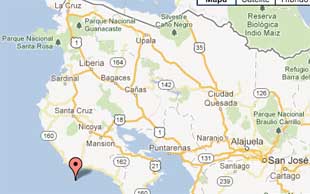
Tropical Storm Sandy may be headed slowly north in the Caribbean at about 10 mph, but the effects still are being felt on Costa Rica's Pacific coast. The national emergency commission expressed concern Tuesday that the soil already saturated by heavy rains or five days might suffer from more rain spawned by Sandy. In addition, Omar Lizano of the Centro de Investigación en Ciencias del Mar y Limnología said that Sandy would be causing strong winds along the coast between Quepos and the Panamá border. |
This condition should last until
Thursday, he said, according to the emergency commission. The emergency
agency also warned of a heavy sea arriving on the Pacific coast today
as a result of storms around New Zealand. The emergency commission, correctly the Comisión Nacional de Prevención de Riesgos y Atención de Emergencias, said that there were some slides in rural roads that cut off residents in the vicinity of San Isidro de Santa María de Dota. There also were problems in Pérez Zeledón, San José and Acosta, it said. Meanwhile, the latest depression in the mid-Atlantic, has graduated to be Tropical Storm Tony. The track of this storm, too, is estimated to be north and east. |
| U.S. judge gives Minor Vargas 60 years
for insurance fraud |
|
|
Special
to A.M. Costa Rica
The president of a Costa Rican company that sold reinsurance bonds to life settlement companies was sentenced Tuesday in Richmond, Virginia, to 60 years in prison for carrying out a half-billion-dollar fraud scheme that affected more than 3,500 victims throughout the United States and abroad, said the U.S. Justice Department. The man, Minor Vargas Calvo, 61, a citizen and resident of Costa Rica, is the majority owner of Provident Capital Indemnity Ltd., an insurance and reinsurance company registered in the Commonwealth of Dominica and doing business in Costa Rica, the government said. He was convicted April 30 of one count of conspiracy to commit mail and wire fraud, three counts of mail fraud, three counts of wire fraud and three counts of money laundering. “Mr. Vargas masterminded a criminal reinsurance company that fraudulently claimed to guarantee almost half a billion dollars of life settlement investments sold to thousands of investors worldwide,” said U.S. Attorney Neil H. MacBride in a release. “Many of these investors lost their life savings because of the worthless guarantees PCI made. Mr. Vargas mistakenly believed that he could avoid punishment for the countless lives he destroyed because he operated his scheme from a non-extradition country. But, this prosecution demonstrates our resolve and ability to pursue justice on behalf of U.S. victims regardless of where the fraudsters may be hiding.” “Mr. Vargas’s reinsurance company was a house of cards, built on a foundation of deception and lies,” said Assistant Attorney General Lanny A. Breuer in the same release. “He reaped millions in profit from his scheme to sell nearly $500 million worth of guarantee bonds to more than 3,500 victims, and then spent his spoils on his soccer team and himself. Today’s sentence reflects the determination of our agents and prosecutors to bring sham artists like Mr. Vargas to justice.” Vargas was president of the Brujas first division soccer team. The U.S. Justice Department gave this summary: According to court records and evidence at trial, Provident Capital Indemnity sold financial guarantee bonds to companies selling life settlements, or securities backed by life settlements, to investors. These bonds were marketed to Provident Capital Indemnity’s clients as a way to alleviate the risk of insured beneficiaries living beyond their life expectancy. Provident Capital Indemnity’s clients, in turn, typically explained to their investors that the financial guarantee bonds ensured that the investors would receive their expected return on investment irrespective of whether the insured on the underlying life settlement lived beyond his or her life expectancy. Evidence at trial showed that Vargas and Provident Capital Indemnity’s purported independent auditor, Jorge Castillo, 57, of New Jersey, used lies and omissions to mislead clients and |
investors regarding Provident
Capital Indemnity’s ability to pay claims when due on the financial
guarantee bonds that the firm issued. Vargas caused Castillo to
prepare audited financial statements that falsely claimed that
Provident Capital Indemnity had entered into reinsurance contracts with
major reinsurance companies, the government said. These false claims,
which were supported by a letter from Castillo stating that he
conducted an audit of the firm's financial records, were used to assure
Provident Capital Indemnity’s clients that the reinsurance companies
were backstopping the majority of the risk that Provident Capital
Indemnity had insured through its financial guarantee bonds, the
government said. The fraudulent financial statements Provident Capital
Indemnity distributed also showed significant assets and relatively
small liabilities, it added. From 2004 through 2010, Provident Capital Indemnity sold at least $485 million of bonds to life settlement investment companies located in various countries, including the United States, the Netherlands, Germany, Canada and elsewhere. Provident Capital Indemnity’s clients, in turn, sold investment offerings backed by Provident Capital Indemnity’s bonds to thousands of investors around the world. Purchasers of Provident Capital Indemnity’s bonds were required to pay up-front payments of 6 to 11 percent of the underlying settlement as premium payments to Provident Capital Indemnity before the company would issue the bonds, the government recounted. Evidence at trial showed that Vargas spent more than $23 million of his ill-gotten gains on his professional soccer teams in Costa Rica, his unrelated companies, his family and himself, said prosecutors. Due, in part, to these expenditures, when it came time to make good on Provident Capital Indemnity’s promises to pay bond holders, Vargas resorted to yet more lies to justify Provident Capital Indemnity’s inability to do so, they added. Castillo, who was a Provident Capital Indemnity employee prior to becoming Provident Capital Indemnity’s outside auditor, pleaded guilty last Nov. 21 to conspiring to commit mail and wire fraud, which carries a maximum penalty of 20 years in prison. Castillo is scheduled to be sentenced Nov. 30. In addition, Provident Capital Indemnity pleaded guilty on April 18 to conspiring to commit mail and wire fraud. The firm was sentenced on Sept. 6 to one year of probation. This investigation is being conducted by the U.S. Postal Inspection Service, the Internal Revenue Service and FBI, with assistance from the Virginia State Corporation Commission, the Texas State Securities Board and the New Jersey Bureau of Securities. The U.S. Securities and Exchange Commission conducted a parallel investigation and in January 2011 filed a parallel civil enforcement action against Provident Capital Indemnity, Vargas and Castillo. |
|
|
|
|
|
|
|
Food |
|
Jo
Stuart |
| What we published this week: | Monday | Tuesday | Wednesday | Thursday | Friday | Earlier |
| The contents of this page and this Web site are copyrighted by Consultantes Río Colorado 2012 and may not be reproduced anywhere without permission. Abstracts and fair use are permitted. Check HERE for details | ||||||
| A.M. Costa
Rica's Fifth news page |
 |
||||||||
| San José, Costa Rica, Wednesday, Oct. 24, 2012, Vol. 12, No. 212 | |||||||||
|
|
|
|
|
|
|
Food |
|
Jo
Stuart |
|
| Major
questions raised over GMO study with rats By
the A.M. Costa Rica wire services
French officials and experts have added their voices to the chorus of criticism over a recent study linking genetically modified corn to tumors in experimental rats. The French national food safety agency joined six scientific academies in concluding the study was too badly done to support its conclusions. The debate comes as voters in the U.S. state of California consider whether to require labels on all foods with ingredients from genetically modified organisms, or GMOs. The study in the journal Food and Chemical Toxicology included shocking photos of rats which researchers say grew giant tumors after eating GMO corn for two years. Study author Gilles-Eric Seralini at the University of Caen says his findings show regulations on the crop are not good enough. "GM foods have been evaluated in an extremely poor and lax way with much less analysis than we have done," Seralini says. Eighty percent of the packaged foods on U.S. supermarket shelves contain GMO ingredients, according to the Grocery Manufacturers Association. California advocates of a law requiring those ingredients to be identified on food labels have used the French study to bolster their argument. The “Yes on 37” campaign, backing mandatory GMO labeling in this November’s statewide voter referendum, held a press conference with Seralini to announce the results of his research. However, other scientists immediately found problems with the study, including geneticist Alan McHughen at the University of California at Riverside, an expert with the prestigious U.S. National Academy of Sciences. “First of all, the authors of the study used a line of rats that was genetically predisposed to form tumors in the first place," McHughen says. "So right off the bat the whole study was suspect.” The European Food Safety Authority also found numerous problems with the French study, from not enough control rats to substandard analytical methods. And the French science academies said the release of the study, which coincided with the release of a book and a film highlighting the work, raised ethical problems. At the University of California at Davis, toxicologist Alison van Eenennaam questioned the researchers’ motives. “I think it was a cynical ploy to exploit the scientific process to create fear in the minds of consumers,” she says. Even opponents of genetic engineering agree the study was flawed. But they believe more long-term studies should be done. “There should be required safety assessments before these crops are put on the market," says Michael Hansen, with the advocacy group Consumers Union. "That is not what happens in the United States.” The French food safety authority called for more publicly funded research covering the entire life span of experimental animals. The U.S. Food and Drug Administration normally reviews voluntary safety assessments that companies submit for new GM crops. They typically include a 90-day rat-feeding test for toxicity. That is the international standard. And the longer studies that have been done have not shown major problems, says UC Davis’s Ms. van Eenennaam. “The science doesn’t show there’s any additional data that wouldn’t already be caught at these 90-day studies,” she says. Regulators in the U.S. and Europe, as well as the U.N.’s World Health Organization and Food and Agriculture Organization, have concluded that genetically modified products on the shelves today are no more dangerous than products made the usual way, according to University of California - Riverside’s Alan McHughen. “All of those, I think, give us the body of scientific evidence to state with a certain degree of confidence that yes, these products are as safe as other products on the market,” McHughen says. Public confidence in this reassurance will be put to the test in the California referendum Nov. 6, when state voters decide if GM foods should carry a special label. Lower corporate earnings put a strain on the markets By
the A.M. Costa Rica wire services
Disappointing corporate earnings and continuing worries about Spain's battered economy cut stock prices on key European and U.S. exchanges Tuesday. Crude oil prices also declined. France's CAC-40 and Germany's DAX were down more than 2 percent at the close, while in New York, the benchmark Dow lost more than 1.7 percent while the S&P 500 fell more than 1.4 percent. Analysts say the declines follow weaker than expected earnings from major companies like IBM, FedEx, and McDonald's. Chemical company DuPont said it will cut 1,500 jobs after profits declined sharply. Traders apparently saw the disappointing earning reports as a sign that the economy will slow down, cutting demand for energy. That perception is one reason that oil prices declined in key markets. |
|
||||
|
|
|
|
|
|
|
Food |
|
Jo
Stuart |
| What we published this week: | Monday | Tuesday | Wednesday | Thursday | Friday | Earlier |
| The contents of this page and this Web site are copyrighted by Consultantes Río Colorado 2012 and may not be reproduced anywhere without permission. Abstracts and fair use are permitted. Check HERE for details | ||||||
| A.M.
Costa Rica's sixth news page |
|
||||||||
| San José, Costa Rica, Wednesday, Oct. 24, 2012, Vol. 12, No. 212 | |||||||||
|
|
|
|
|
|
|
Food |
|
Jo
Stuart |
 |
Latin America news |
Bill barring
pregnancy tests
sent to the full legislature By
the A.M. Costa Rica staff
Women in the Costa Rican workforce frequently are apprehensive when they find that they are pregnant. Some employers have a policy of firing women employees who are pregnant to avoid paying a salary for four months when the woman gives birth. Some employers also demand a pregnancy test before hiring woman. Such a test would be prohibited under a proposal that was sent to the full legislature Tuesday by the Comisión de la Mujer. The measure rewrites part of the labor code. Although women typically are off for four months after giving birth, the rewrite would allow paid absence from work for up to a year with a physician's approval. The measure also sets up a special investigative procedure when an employer discharges a woman who is pregnant. There are penalties if the woman was fired without cause. Government plans to invest $40 million more in Moín By
the A.M. Costa Rica staff
APM Terminals may be prepared to invested $1 billion in a new container facility in Moín near Limón, but the central government is not off the hook. Juan Carlos Pacheco Romero, a vice minister of Hacienda, was at the legislature Tuesday to explain to lawmakers why the country has to borrow $40 million to fix up the port. The biggest expenditure of the money, some $22 million, will fix up the existing docks. The country already has agreed to fix up the road leading to the APM site. That is some $2 million. And the shipping channel must be dredged for $11 million more, lawmakers heard. Unlike most loan proposals, the central government has not yet approved this one. The money would be disbursed over three years. Highway work taking place on Ruta 32 to Zurqui tunnel By
the A.M. Costa Rica staff
Road crews are stripping old asphalt and applying new material on some 16 kilometers of Ruta 32 from the Río Virilla in north San José to the Zurquí tunnel. Much of the work is being done from midnight to 5 a.m., said the Consejo Nacional de Vialidad. However, the daytime is when the new asphalt will be put down. |
|
Latin
American news feed are disabled on archived pages.
|
|
| Costa Rican News |
AMCostaRicaArchives.com |
Retire NOW in Costa Rica |
CostaRicaReport.com |
|
|
|
|
|
|
|
Food |
|
Jo
Stuart |
| What we published this week: | Monday | Tuesday | Wednesday | Thursday | Friday | Earlier |
| The contents of this page and this Web site are copyrighted by Consultantes Río Colorado 2012 and may not be reproduced anywhere without permission. Abstracts and fair use are permitted. Check HERE for details | ||||||