|
||
|
A.M. Costa Rica
Your daily English-language news source Monday through Friday |
||
 |
 |
 |
|
|
 |
||||||||||||||||||
|
|
|||||||||||||||||
 |
||||||||||||||||||
 |
||||||||||||||||||
|
|
|||||||||||||||||
| What we published this week: | Monday | Tuesday | Wednesday | Thursday | Friday | Earlier |
|
|
|
|
|
|
|
Food |
|
Jo
Stuart |
|
|
| A.M. Costa Rica's Second news page | |||||||||
| San José, Costa Rica, Tuesday, Aug. 14, 2012, Vol. 12, No. 161 | |||||||||
|
|
|
|
|
|
|
Food |
|
Jo
Stuart |
 |
 |
 |
|
Spark from fan blamed
in blaze fueled by gas By the
A.M. Costa Rica staff
Residents in a small home in San Rafael de Alajuela returned home to find that the dwelling was filled with the odor of liquid petroleum gas. This is the product that many homeowners in Costa Rica use for cooking and heating of water. The homeowner removed a 25-pound cylinder of gas and then used a fan to attempt to blow the gas outside the dwelling. Unfortunately, according to the Cuerpo de Bomberos, the fan emitted a spark that ignited the gas fumes. Lester Ayerdis Cuadra suffered burns over 45 percent of his body in the Sunday night incident. Seven small homes, including that of the injured man were destroyed, and 12 adults and seven children lost their small homes, said the bomberos. The fire agency said that escaped gas accounts for more than eight calls a day this year. There is an upward trend, said the agency. In more than 80 percent of the cases, the problem is the valve, the agency added. Woman held in murder of her hostess in San Ramón By the
A.M. Costa Rica staff
Judicial agents detained a 25-year-old woman Monday morning in the case of a San Ramón murder. The victim also was a woman, 56. The Judicial Investigating Organization said that the dead woman was accustomed to entertain the area young people in her home. The victim was identified as Alba Iris Zúñiga Quesada. The killing appears to have been the result of a robbery that took place Saturday. The body was not discovered until Sunday, agents said. The weapon was a knife. Agents said that two television sets and jewelry were stolen. Evidence was recovered in the home of the suspect in Buenos Aires de Palmares, agents said. Agents hinted that they are seeking others in the crime. The victim was reported to have lived in the United States for a time. Money laundering trial scheduled to begin today By the
A.M. Costa Rica staff
Today the trial begins of Carlos Howden Pascal who is accused of laundering money provided him by an associate in the United States. He was detained June 2, 2011 in a made-for-television raid that showed police breaking into his Limón home while he stood in his underwear on the second floor watching them. The Poder Judicial said that 14 witnesses will testify. The suspect is well known because he was the president of the Limón first division soccer club. The trial is in San José.
|
||||||||||||||||||||||||||||||||||||||||
 |
|||||||||||||||||||||||||||||||||||||||||
|
|
|
|
|
|
|
Food |
|
Jo
Stuart |
| What we published this week: | Monday | Tuesday | Wednesday | Thursday | Friday | Earlier |
| The contents of this page and this Web site are copyrighted by Consultantes Río Colorado 2012 and may not be reproduced anywhere without permission. Abstracts and fair use are permitted. Check HERE for details | ||||||
A.M. Costa Rica Third News Page |
 |
| San José, Costa Rica, Tuesday, Aug. 14, 2012, Vol. 12, No. 161 | |
|
|
|
|
|
|
|
Food |
|
Jo Stuart |
| High seas warning issued on Pacific coast
for next three days |
|
|
By
the A.M. Costa Rica staff
Another run of high waves is expected to hit the Pacific coast today and last for three days. The high seas are generated by a storm near New Zealand, said Omar Lizano of the Centro de Investigación en Ciencias del Mar y Limnología at the Universidad de Costa Rica. This is a similar problem that some residents of the area faced five days ago. The national emergency commission is taking steps and has issued a small boat warning and a warning to bathers. |
The high waves are expected to be
about 20 to 22 seconds apart and are
expected to be strong, said the Centro. Last week a section of Caldera near Puntarenas suffered flooding, and some of the residents are moving from the area for good. They are being relocated in Esparza. Sand, carried by the waves, accumulated in the rooms. In some cases, the rooms that were below grade were nearly filled. The areas where the greatest impact is expected are Caldera, Playa Azul and Corralillo de Tárcoles, Palo Seco and Isla Damas, said the Comisión Nacional de Prevención de Riesgos y Atención de Emergencias. The commission said that river mouths are particularly dangerous in these situations. |
| Two more Genesis Fund figures are
sentenced in California |
|
|
By
the A.M. Costa Rica staff
and special reports. David L. Johnson and Michael L. Putnam were sentenced Monday following their convictions for tax crimes related to their involvement in the Genesis Fund, the Justice Department and Internal Revenue Service announced. Both Johnson and Putnam had previously pleaded guilty before U.S. District Judge Dale S. Fischer in the Central District of California. According to the original indictment filed in this case, the Genesis Fund was a private investment fund that was marketed as investing in foreign currency trading, but that operated as a ponzi scheme. Investors gave the fund $80 million. The Genesis Fund was relocated from Anaheim, California, to Costa Rica in April 2000. Johnson, 73, of Loma Linda, California, was sentenced to 30 months in prison for filing two false tax returns in which he failed to disclose his bank account in Costa Rica to the IRS. According to the plea agreement, Johnson used this bank account to conceal Genesis Fund distributions from the IRS. Judge Fischer also ordered Johnson to pay restitution of $2.3 million, approximately $1.9 million to investors in the Genesis Fund and $400,000 to the IRS. Putnam, 68, of St. George, Utah, formerly of Huntington Beach, Calif., was sentenced to 12 months and a day in prison for conspiracy and tax fraud and ordered to pay over $13 million in restitution: approximately $10 million to investors in the Genesis Fund and $3 million to the IRS. According to court documents, Putnam had cooperated with the government in the prosecution of other defendants charged for their involvement in the Genesis Fund. |
According to court documents,
Johnson and Putnam received significant
distributions that they hid in foreign bank accounts and did not report
to the IRS. Johnson received over $2.4 million while Putnam received over $1.5 million. Johnson and Putnam are the 10th and 11th defendants to be sentenced for crimes related to the promotion of the Genesis Fund. The U.S. government characterized the fund as a ponzi scheme in which interest payments are made from funds provided by new investors. The government said that the organization promised investors 4 percent a month returns. • John S. Lipton, 58, a founder and the principal manager of the Genesis Fund, who lived in Mission Viejo and Laguna Hills, California, until about March 1998 when he relocated to Costa Rica. He pleaded guilty in 2010 and received 70 months in prison. • Richard B. Leonard, 71, another early investor, and later a promoter and manager of the Genesis Fund, who lived in Littleton, Colo., until he relocated to Costa Rica in about June 2000. He also pleaded guilty. • Victor H. Preston, 64, a founder and manager of the Genesis Fund, who from about July 1994 to about June 2000 lived in Huntington Beach and Laguna Hills, Calif., after which he relocated to Costa Rica. He also pleaded guilty, said the Justice Department. Lipton and Leonard lived in the upscale Tangomar subdivision on the east shore of the Nicoya Peninsula. Preston lives in La Sabana. |
 |
| You need to see Costa Rican tourism information HERE! |
|
|
|
|
|
|
|
Food |
|
Jo
Stuart |
| What we published this week: | Monday | Tuesday | Wednesday | Thursday | Friday | Earlier |
| The contents of this page and this Web site are copyrighted by Consultantes Río Colorado 2012 and may not be reproduced anywhere without permission. Abstracts and fair use are permitted. Check HERE for details | ||||||
 |
|
||||
| A.M. Costa Rica's Fourth News page | |||||
| San José, Costa Rica, Tuesday, Aug. 14, 2012, Vol. 12, No. 161 | |||||
|
|
|
|
|
|
|
Food |
|
Jo
Stuart |
| Regulating agency confirms gasoline has
controversial additive |
|
|
By
the A.M. Costa Rica staff
The agency that controls the price of gasoline confirmed Monday that there is an additive present in the fuel distributed by the Refinadora Costarricense de Petróleo. The additive is methylcyclopentadienyl manganese tricarbonyl, known as MMT. The statement from the Autoridad Reguladora de los Servicios Públicos followed a television news report that a dangerous chemical had been found in the country's gasoline. The Authoridad said it had ordered a study of the contents of gasoline more than a year ago after sediment and water had been found. The analysis showed that there was an average of 23.4 milligrams per liter of manganese in both types of gasoline, plus and super. The average amount of MMT was 92.8 and 93 milligrams per liter at samples taken at a service station in La |
Garita. That is far in excess of the
recommendation of the supplier,
Afton Chemicals, a Virginia firm, said the agency. The additive is
supposed to boost the octane of the fuel. The Authoridad said that the quantity of the additive is not regulated by Costa Rica law, but that after finding water in some fuel, the agency has opened an administrative hearing for the government refinery, which has a monopoly in Costa Rica. Water or sediment was found in samples at La Garita, El Alto and Moín, the agency said. The U.S. National Institute of Environmental Health Sciences says that more study needs to be done on the impact of this additive in fuel. The chemical is known to be toxic in its liquid form and can enter the body and cause harm through the skin. The manganese can do damage in the body. However, the additive is permitted in both the United States and Canada, although it was banned during the early years of the Clean Air Act. |
| Rifle shots encourage suspected drug boat
to stop in Pacific |
|
|
By
the U.S. Southern Command news service
Law enforcement crews aboard the cutter “Morgenthau” seized more than 4,000 pounds of cocaine from a go-fast boat and apprehended four suspects July 24, during a counter-narcotics patrol in the eastern Pacific. A marksman on a U.S. helicopter disabled the craft's outboard motors with a rifle shot. The incident was reported Monday. It all began when a maritime patrol aircraft flying above international waters off the coast of Panamá spotted a speeding boat in the early morning hours. Suspicious, the aircrew notified the cutter, which was patrolling nearby. As the “Morgenthau” neared the area and spotted the target, it deployed its onboard helicopter and two small boats to intercept the speeding craft. When the helicopter flew above the speeding boat, the vessel’s crew began to throw bales of suspected contraband overboard. Despite being ordered to stop by the Coast Guard, the go-fast boat crew continued. “Morgenthau’s” helicopter and flight crew from the Coast Guard's Helicopter Interdiction Tactical Squadron based out of Jacksonville, Florida, provided the capability needed to quickly stop the go-fast boat before it could evade prosecution. A crewman on the helicopter disabled the boat by firing a rifle at its outboard engines. |
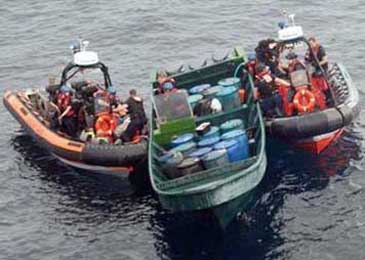 U.S.
Coast Guard photo
Crewmen
from 'Morgenthau' bring in suspected drug boat.
The “Morgenthau’s” law enforcement crew then took custody of the suspects and recovered the floating bales which tested positive for cocaine. “These very large seizures at-sea are the most effective way to keep cocaine off the streets of America,” said Capt. Gregory Burg, commanding officer aboard the Morgenthau. “Our incredibly dedicated group of sailors continue to leave their families for months at a time to provide this vital service to the nation.” |
|
|
|
|
|
|
|
Food |
|
Jo
Stuart |
| What we published this week: | Monday | Tuesday | Wednesday | Thursday | Friday | Earlier |
| The contents of this page and this Web site are copyrighted by Consultantes Río Colorado 2012 and may not be reproduced anywhere without permission. Abstracts and fair use are permitted. Check HERE for details | ||||||
| A.M.
Costa Rica's Fifth news page |
 |
||||||||
| San José, Costa Rica, Tuesday, Aug. 14, 2012, Vol. 12, No. 161 | |||||||||
|
|
|
|
|
|
|
Food |
|
Jo
Stuart |
 |
| Egg
yolks put in same class as smoking cigarettes By
the University of Western Ontario
communications staff Newly published research led by David Spence shows that eating egg yolks accelerates atherosclerosis in a manner similar to smoking cigarettes. Surveying more than 1,200 patients, Spence found regular consumption of egg yolks is about two-thirds as bad as smoking when it comes to increased build-up of carotid plaque, a risk factor for stroke and heart attack. The research is published online in the journal Atherosclerosis. He is with the University of Western Ontario. Atherosclerosis, also called coronary artery disease, is a disorder of the arteries where plaques, aggravated by cholesterol, form on the inner arterial wall. Plaque rupture is the usual cause of most heart attacks and many strokes. The study looked at data from 1,231 men and women, with a mean age of 61.5, who were patients attending vascular prevention clinics at London Health Sciences Centre’s University Hospital. Ultrasound was used to establish a measurement of total plaque area and questionnaires were filled out regarding their lifestyle and medications including pack-years of smoking (number of packs per day of cigarettes times the number of years), and the number of egg yolks consumed per week times the number of years consumed (egg yolk-years). The researchers found carotid plaque area increased linearly with age after age 40, but increased exponentially with pack-years of smoking and egg yolk-years. In other words, compared to age, both tobacco smoking and egg yolk consumption accelerate atherosclerosis. The study also found those eating three or more yolks a week had significantly more plaque area than those who ate two or fewer yolks per week. “The mantra ‘eggs can be part of a healthy diet for healthy people’ has confused the issue. It has been known for a long time that a high cholesterol intake increases the risk of cardiovascular events, and egg yolks have a very high cholesterol content. In diabetics, an egg a day increases coronary risk by two to five-fold,” said Spence, a professor of Neurology at Western’s Schulich School of Medicine & Dentistry and the director of its Stroke Prevention and Atherosclerosis Research Centre at the Robarts Research Institute. “What we have shown is that with aging, plaque builds up gradually in the arteries of Canadians, and egg yolks make it build up faster — about two-thirds as much as smoking. In the long haul, egg yolks are not okay for most Canadians.” Spence added the effect of egg yolk consumption over time on increasing the amount of plaque in the arteries was independent of sex, cholesterol, blood pressure, smoking, body mass index and diabetes. And while he says more research should be done to take in possible confounders such as exercise and waist circumference, he stresses that regular consumption of egg yolk should be avoided by persons at risk of cardiovascular disease. Indonesia seeks to become a contender for tourism By
the A.M. Costa Rica wire services
Indonesia’s economy has become a bright light amid global economic gloom, with strong growth drawing new attention from international investors. Officials say the country's economic potential, however, is not the only thing worth promoting. An effort is underway to export the country's cultural traditions to new audiences abroad. Indonesia’s economy recently made global news for growth that beat most economists’ expectations. Strong domestic spending in the world’s fourth most populous country has sparked investor interest. But with all the attention pointed toward the economy, artists, culinary experts and some officials now say not enough attention is being paid to promoting the country’s cultural riches. Mari Pangestu, the head of the Ministry of Tourism and Creative Economy, said that needs to change. “We need to develop creative industries because it has a lot of economic potential, but it’s also important because it has a lot of potential for raising the image of a country,” said Ms. Pangestu. Her ministry has 15 subsectors that focus on building support for creative industries, including films, fashion and culinary traditions. She said food, in particular, can have a powerful impact on showcasing a culture, and can help to generate increased tourism. To better tout Indonesian cuisine, the Ministry of Tourism and Creative Economy plans to identify a few iconic Indonesian dishes that are already known internationally and then focus on promoting their history and roots for foreign consumers. Rendang curry, a spicy meat dish cooked for hours in coconut milk with ginger, lemongrass, chilies and other spices, is at the heart of those discussions. William Wongso, a culinary expert who travels around the world extolling the taste sensations of rendang, said the dish is the gateway to popularizing Indonesian cuisine abroad. In addition to food, fashion labels are also working to promote Indonesian heritage by mixing traditional patterns and images with contemporary trends. One of the most notable is “Damn, I love Indonesia,” a line that started in 2008 by screen printing tee-shirts with cultural symbols or pop-art images of political icons like Indonesia’s first president Sukarno. Fidel Castro turns 86 with little notice in Cuba By
the A.M. Costa Rica wire services
Former Cuban president Fidel Castro turned 86 Monday, far from the limelight in the country he led for nearly 50 years. The ailing Castro has been keeping a low profile, making his last public appearance, with visiting Pope Benedict XVI, in March. State media have not published one of his occasional opinion columns, called "Reflections," since June, and the latest writings drew attention for their brevity and choice of topics, such as yoga and edible plants. Castro remains popular to many in Cuba, where previous absences have fueled questions about his health. He temporarily ceded power to his brother, Raúl, in 2006 while suffering from an intestinal illness, before fully transferring power in 2008. Last year, Cuba celebrated Castro's birthday with concerts, art exhibits and other events in his honor, but he did not attend. |
|
||||
|
|
|
|
|
|
|
Food |
|
Jo
Stuart |
| What we published this week: | Monday | Tuesday | Wednesday | Thursday | Friday | Earlier |
| The contents of this page and this Web site are copyrighted by Consultantes Río Colorado 2012 and may not be reproduced anywhere without permission. Abstracts and fair use are permitted. Check HERE for details | ||||||
| A.M.
Costa
Rica's sixth news page |
|
|||||||||
| San José, Costa Rica, Tuesday, Aug. 14, 2012, Vol. 12, No. 161 | ||||||||||
|
|
|
|
|
|
|
Food |
|
Jo
Stuart |
 |
Latin America news |
Animal rescue fundraiser
planned in Manuel Antonio Special
to A.M. Costa Rica
Hotel Byblos Resort in conjunction with Kids Saving the Rainforest will be hosting a community fundraiser to collect funds and supplies to enable the continued care and operation of the only locally government sanctioned wild animal rescue center located near Costa Rica's world famous Parque Nacional Manuel Antonio. Kids Saving The Rainforest, a not-for-profit Costa Rican organization and U.S. non profit 501 C 3, was founded 13 years ago with the monkey bridge program, and later expanded to include an animal rescue center for the Quepos and Manuel Antonio area. Two pre-teen girls who recognized the need to help the local wildlife as tourism developments began to effect their natural habitat founded the organization. This will be Kids Saving the Rainforest first fundraiser since it was founded. The organization is accustomed to bringing in enough proceeds for the rescue center through their own souvenir shop. With the downturn in the economy, this facility will be forced to close if enough money cannot be raised to cover their monthly expenses. "A full time resident vet, animal caretaker, volunteers and a guard all live on the property helping to rehab the many injured or confiscated animals,” said rescue center coordinator Jennifer Rice. “Unfortunately, this comes with a certain fixed cost, not to mention the food, maintenance, vet supplies and numerous other items required to care for a variety of exotic animals." "The rescue center is the only legal facility in the Central Pacific area, and is a very necessary part of our community." added Ms. Rice. All injured wild animals are brought by community members or by environmental ministry workers. At present there are some 55 different animals being treated to include exotic birds, four species of monkeys, two species of sloths, armadillos, agoutis, coati mundis, marmesets, timirins, and other exotic wildlife, said the organization. Most are eventually re-released in the wild, though some are beyond rehabilitation and must stay permanently at the rescue facility. The fundraiser will be held from 1 p.m. until 5 p.m. at Byblos Hotel Sept. 9, coinciding with Costa Rica's national children’s day. There will be live music, kids activities, ice cream, drinks, food, a raffle, and lots of fun! Tickets will be on sale at numerous local businesses and are $25 for adults and $10 for children. More information is available from Anita Myketuk at (506) 2777-1002. “Saving injured wildlife is an integral part of living in this area.” says Kimberly Barron, director of marketing at Hotel Byblos. “This is not just a feel-good fundraiser. These beautiful animals are one of the main attractions for tourism in our area. Local Manuel Antonio hotels and tourism operations that depend on national and international visitors cannot afford to ignore the need for a full-service animal rescue center. With plans to offer awareness tours of the facility to area visitors, the rescue center's continued operation is a win win for all concerned.” added Ms. Barron. The Kids Saving the Rainforest souvenir store located at Hotel Mono Azul. The Web site is www.kidssavingtherainforest.org. |
|
Latin
American news feeds are disabled on archived pages.
|
|
| Costa Rican News |
AMCostaRicaArchives.com |
Retire NOW in Costa Rica |
CostaRicaReport.com |
|
|
|
|
|
|
|
Food |
|
Jo
Stuart |
| What we published this week: | Monday | Tuesday | Wednesday | Thursday | Friday | Earlier |
| The contents of this page and this Web site are copyrighted by Consultantes Río Colorado 2012 and may not be reproduced anywhere without permission. Abstracts and fair use are permitted. Check HERE for details | ||||||