|
||
|
A.M. Costa Rica
Your daily English-language news source Monday through Friday |
||
 |
 |
 |
|
|
 |
||||||||||||||||||||
|
|
|||||||||||||||||||
 |
||||||||||||||||||||
 |
||||||||||||||||||||
|
|
|||||||||||||||||||
| What we published this week: | Monday | Tuesday | Wednesday | Thursday | Friday | Earlier |
|
|
|
|
|
|
|
Food |
|
Jo
Stuart |
|
|
 |
| A.M. Costa Rica's Second news page | |||||||||
| San José, Costa Rica, Friday, Aug. 10, 2012, Vol. 12, No. 159 | |||||||||
|
|
|
|
|
|
|
Food |
|
Jo
Stuart |
 |
 |
 |
|
This is a really hot job
that includes travel By the
A.M. Costa Rica staff
Life a little dull? Want a little excitement? Well, the volcano people are seeking someone to monitor the gases being emitted by the active mountains. This does not appear to be a desk job. In addition to having a doctorate or master's degree in a relevant field like geochemistry, the successful applicant will have to go to the various volcanos and get samples of the gases being spewed from cracks and crevices. Volatile gases. And there is travel because that's where the volcanoes are. The successful applicant should be bilingual, too, said the Observatorio Vulcanológico y Sismológico de Costa Rica at Universidad Nacional in Heredia. The full posting is on the Observatorio's Web site. Police agencies get warnings on use of excessive force By the
A.M. Costa Rica staff
The Sala IV constitutional court has issued a warning to both the Fuerza Pública and the Judicial Investigating Organization in cases that are considered use of excessive force. In summaries provided by the Poder Judicial, the court considered a case in which judicial agents were accused of using excessive force on a prisoner. The prisoner, who was not named, accused agents of brutally attacking him. The court said that a medical report showed the use of excessive force. The Fuerza Pública case involved two Liceo de Moravia students who said they were abused physically and verbally. Despite the fact that the youths were held for drug use in a public street and resisted officers, the court said that officers infringed on their fundamental rights. More bales of cocaine pulled from the ocean Special
to A.M. Costa Rica
The guided-missile frigate USS Underwood recovered 49 bales of narcotics from the Caribbean Sea last Friday. Underwood pursued a speed boat late the previous evening, but the crew dumped its load before Underwood was able to effect a boarding, said the U.S. Southern Command. A Customs and Border Protection maritime patrol aircraft flying overheard, reported the crew was dumping packages and crew members of the Underwood marked the position of the debris field in order to locate the packages in daylight. Underwood recovered approximately 1,225 kilograms of narcotics. The boat is deployed to Central and South America and the Caribbean in support of Southern Seas 2012.
|
||||||||||||||||||||||||||||||||||||||||
 |
|||||||||||||||||||||||||||||||||||||||||
|
|
|
|
|
|
|
Food |
|
Jo
Stuart |
| What we published this week: | Monday | Tuesday | Wednesday | Thursday | Friday | Earlier |
| The contents of this page and this Web site are copyrighted by Consultantes Río Colorado 2012 and may not be reproduced anywhere without permission. Abstracts and fair use are permitted. Check HERE for details | ||||||
A.M. Costa Rica Third News Page |
 |
| San José, Costa Rica, Friday, Aug. 10, 2012, Vol. 12, No. 159 | |
|
|
|
|
|
|
|
Food |
|
Jo Stuart |
| Agents study links between retired nurse
and other deaths |
|
|
By
the A.M. Costa Rica staff
Investigators are checking the history of patients in Hospital San Juan de Dios to see if there is a connection between other deaths and a woman who has been detained on suspicion of killing a neighbor. Lilliam Arias Prendas, 55, of Desamparados died in the hospital Tuesday after she was visited by a neighbor, Angela Barrantes Moreno, a retired nurse. Ms. Barrantes gained access to the restricted area due to her nurse uniform and an expired identification card. Agents have a statement from another patient who said that he saw the retired nurse inject something into Ms. Arias. Fuerza Pública officers confiscated a syringe that contained a fluid. The contents are being examined to determine the chemical makeup, and a full autopsy was done on the dead hospital patient. |
Typically patients who die in a
hospital are not subjected to an autopsy. Agents have information that at least one other neighbor died recently at the same hospital, and that Ms. Barrantes was a visitor. Hospital officials have admitted to a breach of security, and a damage case is expected from the family of the dead woman. Ms. Arias was in ill health, but her family appears to have thought that it was not terminal. The Poder Judicial said that the defense lawyer for Ms. Barrantes has been given more time to argue against incarceration for her. The first court appearance was Wednesday, but there is another scheduled for today. If there is a correlation between other deaths and the visits by the retired nurse, prosecutors are expected to argue strongly for preventative detention. |
| Joint French-German project opposes
violence against women |
|
|
By
Kayla Pearson
of the A.M. Costa Rica staff A joint Germany and French human rights project will end with a presentation from Sabine Kräuter-Stockton of Germany and French Michele Vianés of France today. Ms. Kräuter-Stockton is an expert in domestic and sexual violence against women. Her background in this area dates back 10 years to when she worked as a lawyer for the department of domestic violence in Saarbrücken, Germany, and in the coordination unit against domestic violence in the ministry of justice in Saarland, one of the states of Germany. Ms. Vianés founded the Organization "Regards de Femmes" in 1997. The organizaiton says it is designed to denounce the stereotypes between expected behaviors of women and men, to promote political and professional equality, to fight against the moral, psychological and physical violence against women, and to promote solidarity among the women of the world. The women will address the causes, social factors, and context of violence against women. These include sexual violence, domestic violence, symbolic violence, harassment and domination. Their presentation, which began Thursday, is titled “Forum on the fight and prevention against violence towards women.” It is at the Instituto Interamericano de Derechos Humanos. This is relevant to Costa Rica due to an increase in female homicides this year. During a workshop by the judiciary, the local gender equality and women's empowerment divisions of the United Nations and the Instituto Nacional de las Mujeres held June 7, officials noted at that time that eight women have died in domestic conflicts already this year. Last year there were 11 such cases. There have been several other cases since June 7. The Instituto Interamericano de Derechos Humanos, the U.N. Development Programme, the la Red Feminista Centroamericana Contra la Violencia hacia las Mujeres, |
Universidad de Costa Rica, and
Instituto Nacional de las Mujeres and Cefemina helped organize the
forum. The Franco-German project in human rights was designed to promote the exchange of ideas, experiences and methodologies on the prevention and the fight against violence towards women. It has consisted of forums, workshops, round tables, film series and a photography exhibit in various locations in San José since Monday. The Franco-German cultural fund was created on the 40th anniversary of the Elysée Treaty in 2003 and symbolizes Franco-German cultural programs in third world countries for friendship and cooperation. For its 10th edition, the cultural fund supports 67 projects in 78 countries. Patrons can also enjoy a cycle of Franco-German films organized by Mi Butaca Cine Club and Cine Variedade, each Monday in August at 7:30 p.m. in Cine Variedade. Movies include “Die Fremde” by Feo Aladag, “Je veux tout de la vie, la liberté selon Simone de Beauvoir” by Pascale Fautrier and Pierre Seguin, “Gegen die Wand” by Fatih Akin and “Les bureaux de Dieu” by Claire Simon. The organizations will present all the movies in original language with subtitles in Spanish. Ticket price is 1,000 colons, about $2. Another feature of the project is an exhibition of photographs in the Universidad de Costa Rica called "Planet of Women.” It is made up of 42 color images made by different photographers in the world. The images present women in their different roles. The exhibit is the result of a public contest made last year by the Costa Rican French Alliance Foundation and has the support of the school of fine arts and the publishing house of the University of Costa Rica. The embassies of Germany and France in San José presented the idea for two different Franco-German projects for Costa Rica for 2012, one on human rights and the other dance. Both were approved, positioning Costa Rica as the only country in Latin America where there are two projects in the same year. |
| Utopian legacy spotlights dual nature of human progress |
|||
| Ernest
Callenbach, who wrote “Ecotopia,” published in 1975, died this past
April. Evidently he had been told that his demise was near
because he wrote an “Epistle to Ecotopians,” which was found on his
computer after his death. Ecotopians, loosely translated, are
people who want to live in balance with nature so that both may survive
the history that has led to our present day threats to life as we know
it, or rather knew it. One might call Callenbach the gloomy
futurist. According to him, “Humans tend to try to manage things: land, structures, even rivers. We spend enormous amounts of time, energy, and treasure in imposing our will on nature, on preexisting or inherited structures, dreaming of permanent solutions, monuments to our ambitions and dreams. But in periods of slack, decline, or collapse, our abilities no longer suffice for all this management. We have to let things go.” Maintaining these man-made structures that support our civilization depends upon the consumption of goods, and right now the world is experiencing a “crisis of under-consumption.” (A phrase Callenbach borrowed from Marx that seems apt.) Under-consumption is the result of underemployment and the under employed, those who are known as consumers, must cut back to the basics. Without people buying and using up the products of our present system, corners are cut, fewer people are hired, more people are laid off, and the result, according to Callenbach, is “something like México, where a small, filthy rich plutocracy rules over an impoverished mass of desperate and hopeless people.” He has some advice for us for surviving our history: First, we should not lose hope. Without hope we give up. Hope is sustained when we help each other. cooperation has proven to be more productive in the long run than competition, and friendships are more apt to flourish. He advises us to learn practical skills: Learn how to chop wood (and not your fingers), and to build a fire, to build a simple shelter and know what to do in case of emergencies. Learn first aid. In fact, never stop learning. And learn to live with contradiction. These are the best of times and the worst of times because with each new wonderful time-saving or world-expanding invention or discovery, we make the planet less habitable. The discovery of an oil |
deposit brings cheers, because it brings down the price of fuel to run our cars and make our plastics, which can also produce more wasteland and waste. It brings a boomtown where money is plentiful but relationships, living conditions and the amenities are lost. More efficient ways of fishing have enabled greater catches, but fishermen became big business resulting in wasteful killing, reducing the population of edible fish. Faster cars and cell phones are great for getting there quicker and being in touch with faraway friends, and they also make it easier to kill ourselves. Today most of our financial institutions, businesses, manufacturing and power generators are run by computers. They are more efficient, but these systems are vulnerable to hacking and viruses. Should there be a breakdown or sabotage in any one of these sectors, it would be catastrophic to more people than ever before. Fewer people are being killed in wars, but more money is being spent on war supplies and more people are being left maimed, both mentally and physically. Both weather and human catastrophes are happening more and more often. These are the times when people come together and show their generosity and humanity. It is the worst and best of times. There does seem to be a sea change in the world. (I mean this metaphorically, although it is also happening literally). People in many countries are thinking “green” and recycling rather than throwing things out. Some are even eating less meat and discovering the world of vegetables and that they can grow them themselves. They are opting for energy-saving machines and even learning that tolerance and an open mind are better than hate and a closed one. Maybe, even if we are not, our children will be ready for the future. |
||
 |
| You need to see Costa Rican tourism information HERE! |
|
|
|
|
|
|
|
Food |
|
Jo
Stuart |
| What we published this week: | Monday | Tuesday | Wednesday | Thursday | Friday | Earlier |
| The contents of this page and this Web site are copyrighted by Consultantes Río Colorado 2012 and may not be reproduced anywhere without permission. Abstracts and fair use are permitted. Check HERE for details | ||||||
 |
 |
||||
| A.M. Costa Rica's Fourth News page | |||||
| San José, Costa Rica, Friday, Aug. 10, 2012, Vol. 12, No. 159 | |||||
|
|
|
|
|
|
|
Food |
|
Jo
Stuart |
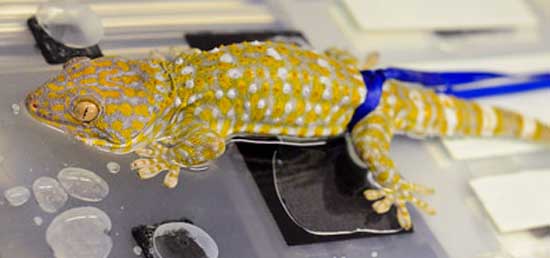
Gecko is harnessed to a device that tests its adhesion on a wet surface. Researchers hope that the experiments will give clues to creating bandages that stick when wet. |
 The
University of Akron photo
|
| Sticky ability of gecko feet tested
during wet conditions |
|
|
By
the University of Akron news service
Scientists already know that the tiny hairs on gecko toe pads enable them to cling, like Velcro, to vertical surfaces. Now, University of Akron researchers are unfolding clues to the reptiles’ gripping power in wet conditions in order to create a synthetic adhesive that sticks when moist or on wet surfaces. Place a single water droplet on the sole of a gecko toe, and the pad repels the water. The anti-wetting property helps explain how geckos maneuver in rainy tropical conditions. Saturate that same toe pad in water or drench the surface on which it climbs, and adhesion slips away, the researchers say. As researcher Alyssa Stark, a doctoral candidate in the University of Akron's Integrated Bioscience Program and research team leader explains, geckos don’t fall from trees during downpours in the tropics. What, then, makes them stick? The team hopes to make that discovery in order to create synthetic materials that hold their grip in wet environments, such as inside the body, for surgical procedures. Findings by Ms. Stark and Timothy Sullivan, who received his bachelor’s degree in biology in May, and Peter Niewiarowski, a professor of biology and integrated bioscience, are published in the Thursday's issue of The Journal of Experimental Biology. “We’re gathering many clues about how geckos interact with wet surfaces and this gives us ideas of how to design adhesives that work under water,” says Ali Dhinojwala, Department of Polymer Science chairman. “Nature gives us a certain set of rules that point us in the right direction. They help us understand limitations and how to manipulate materials.” Ms. Stark and her research team members tested gecko toe hair |
adhesion in a series of scenarios:
dry toe pads on dry, misted and wet surfaces and soaked toe pads on
dry, misted and wet glass. The
soaked toe pads demonstrated low to no adhesion proportionately with
the wetness of the surface on which they were applied and pulled.
Likewise, dry toe pads lost their adhesive grip increasingly with the
amount of water applied to the surface upon which they were pulled. For
the experiments, geckos were pulled on a glass surface by way of a
small harness placed around their midsections. “There were anecdotes before the study that geckos can’t stick to wet glass. We now know it is a bit more complicated than that. What we expect to learn is going to be relevant to synthetics and their capabilities to work not only on dry surfaces, but also wet and maybe, submerged ones,” Niewiarowski said. “This implies a more versatile adhesive capability.” After close study of the tiny hairs at the bottom of gecko feet that enable them to cling to surfaces, Dhinojwala and his colleagues have already developed a dry synthetic adhesive, comprised of carbon nanotubes, that outperforms nature’s variety. Now, with these new findings, Dhinojwala and his colleagues are one step closer to unfolding the secrets behind gecko toe adhesion in wetness. The researchers plan to further study the lizards in their natural habitats and in laboratory conditions that simulate them. They’ll investigate grasping and release mechanisms, habits of the geckos in wet environments and other factors that enable the lizards to adhere to surfaces in wetness, such as to trees during rainfalls. “Our goal is to go back and look at what they’re doing in nature and at what kind of surfaces they are walking or running on,” said Ms. Stark. |
| Dig site on island in Panama gives
glimpse of multiple cultures |
|
|
By
the Smithsonian Tropical Research Institute news staff
Aside from accounts of probable stopovers by Christopher Columbus in 1502 and pirate Henry Morgan en route to – and returning from – his 1671 sacking of Panama City, little was known about the early inhabitants of modern day Boca del Drago, on Isla Colón in Panama’s western Caribbean. That started changing 10 years ago when a road grader exposed a wealth of archeological remains in the sleepy beachside hamlet. Since then, dozens of students led by archeologist from the University of California at Los Angeles and new Smithsonian research associate Thomas Wake, have pieced together the basic history of the area as far back as 750 AD. One of Wake's former students is Jerry Howard, now a graduate student at Berkeley, who has been conducting his last season of field research at the Drago site for his doctoral dissertation on the creolization of the area. From tales of marooned and escaped slaves, local-grown pirates and cultural exchange with the local native groups, Howard has unearthed a comprehensive tale of African diaspora. |
“It’s pretty amazing,” says Howard
of the mixture of artifacts that
have been found, while standing in the middle of four, one-meter square
beachside excavations in July. Stone tools, animal bones, pottery
shards, beads and glass bottles are among the remnants Jerry and
Berkeley student colleagues working with him have found. They have also gathered oral and archival histories. Howard, who first came to Drago on a field course in 2005, was drawn to further explore the site partly because of his creole background. His family hails from the Muskogee region of the southeastern United States. He said his driving interest is how different cultures came together. Afro-Antilleans and indigenous groups melded language, cuisine and tradition, while abandoning some customs. “At one point in time there were 900 Afro- Antilleans living out here on this coast,” said Howard, adding: “What was life like between 1780 and 1899, before the banana plantation comes in?” |
|
|
|
|
|
|
|
Food |
|
Jo
Stuart |
| What we published this week: | Monday | Tuesday | Wednesday | Thursday | Friday | Earlier |
| The contents of this page and this Web site are copyrighted by Consultantes Río Colorado 2012 and may not be reproduced anywhere without permission. Abstracts and fair use are permitted. Check HERE for details | ||||||
| A.M.
Costa Rica's Fifth news page |
 |
||||||||
| San José, Costa Rica, Friday, Aug. 10, 2012, Vol. 12, No. 159 | |||||||||
|
|
|
|
|
|
|
Food |
|
Jo
Stuart |
 |
| Google
gets an FTC fine for invasion of privacy By
the A.M. Costa Rica wire services
The U.S. consumer watchdog agency has imposed its biggest fine ever — on Google, the popular Internet search engine. The Federal Trade Commission fined the American technology giant $22.5 million Thursday as settlement of charges that it violated people's privacy even after pledging not to do so. The consumer agency said that for several months last year and into 2012, Google installed an advertising tracking cookie on the computers of Safari Web browser users so it could monitor what Internet sites the users visited. The head of the agency, Jon Leibowitz, said that Google is now paying many times what it would have if it had complied with its agreement to not track the Internet usage. Once the tracking was discovered by a Stanford University researcher, Google withdrew the intrusive technology. But the company did not admit any wrongdoing in settling the claim with the government. China becomes new source of foreign students in U.S. By
the A.M. Costa Rica wire services
China is a very important source of students for American education. And the money Chinese students bring with them has spawned an industry bent on seeing even more find their way here. As of last year, a report from the Institute of International Education says more than 723,000 international students are studying at U.S. colleges and Universities. One out of five of those students are from China, far more than any other country. And their numbers are growing. In 2011, 157,558 Chinese students were attending school in the United States, a 23.5 percent increase over the previous year. That's why many colleges and universities are busy trying to identify families from China who can afford to send their children to the United States to study. But since many of those families want to give their children a head start on college, hundreds of private academic placement services have joined the competition. And they provide packages that sometimes find entire families with a place to live and enrollment for their children in high schools, and in some cases, middle schools. One of those businesses is the Astar Education Institute located outside of Washington D.C. It's a business model that's doing very well. "It's very expensive," according to the school's assistant director, Candice Quinn. "All of our students and all of our families are of the upper echelon of the socio-economic background in China," she said. While refusing to divulge just how much Astar charges for its services, Ms. Quinn says all students must present a financial statement that shows they can support themselves for the length of time they will be in the United States just to qualify for a visa. "They have to have, in a bank account, somewhere between $70,000 and $150,000." said Ms. Quinn. Ms. Quinn said the families of the Chinese students have to pay school tuition as well as a fee paid to a host family with whom the student resides while in the United States, unless they choose to attend a boarding school. What do these students and their families get for this money? "Our primary function is to place international students into United States Schools" said Ms. Quinn. Astar recruits many Chinese students using an office they maintain in Shanghai, and makes use of agents that specialize in such services in China. Another aspect of the business is helping those students who lack the language skills to attend an American school. Those students will spend from three to six months to get them to a level of English proficiency so they can pass the kind of tests they need to go to a U.S. school, according to Ms. Quinn. Although many of the students recruited by Astar are placed in U.S. high schools, that's not their ultimate goal. "The parent's intention is not to have these kids terminate in a high school," said Ms. Quinn. "They're intention is for them to go to American universities, that's the ultimate goal". And not just any university. "The parents want them to go to the top one hundred universities," said Ms. Quinn. "So that is always the prize we have in mind." |
|
||||
|
|
|
|
|
|
|
Food |
|
Jo
Stuart |
| What we published this week: | Monday | Tuesday | Wednesday | Thursday | Friday | Earlier |
| The contents of this page and this Web site are copyrighted by Consultantes Río Colorado 2012 and may not be reproduced anywhere without permission. Abstracts and fair use are permitted. Check HERE for details | ||||||
| A.M.
Costa
Rica's sixth news page |
|
|||||||||
| San José, Costa Rica, Friday, Aug. 10, 2012, Vol. 12, No. 159 | ||||||||||
|
|
|
|
|
|
|
Food |
|
Jo
Stuart |
 |
Latin America news |
Presidential delegation heads
for China and for Korea By
the A.M. Costa Rica staff
President Laura Chinchilla is scheduled to leave today for a visit to China and Korea. The president will begin her travels with meetings in Shanghai in an effort to bring investments to the country. She is being accompanied by Anabel González, the minister of Comercio Exterior, and Allan Flores, the minister of Turismo. The delegation will visit Beijing Wednesday for more talks with Chinese officials. The delegation has a list of requests for aid from China. Aug. 20 the delegation will be in Korea. The travelers are scheduled to return home Aug. 22. Three quakes registered during Thursday evening By
the A.M. Costa Rica staff
Three earthquakes, including one with an estimated 4.6 magnitude, took place Thursday night. The first was at 5:06 p.m. near Angeles de Abangares in Guanacaste. That was estimated by the Observatorio Vulcanológico y Sismológico at Universidad Nacional at 3.5 magnitude. The Red Sismológica Nacional at the Universidad de Costa Rica said 3.7. The largest quake was at 10:27 p.m. The epicenter was estimated to be in the Pacific about 85 kilometers northwest of Playa Grande, Guanacaste. That would put it west of Parque Nacional Santa Rosa. This was the 4.6 magnitude event. A smaller quake, estimated at 2.6 magnitude, took place at 10:39 p.m. the epicenter was estimated to be near Pozo Azul de Sarapiquí in the northern zone. Caja says former hospital is not going to be sold By
the A.M. Costa Rica staff
The Caja Costarricense de Seguro Social said Thursday that it is considering moving local health service into the former Hospital St. Vicente de Paul in Heredia. Gabriela Murillo Jenkins, the man in charge of infrastructure and technology for the Caja, said that the security ministry had shown an interest in the building as a possible police headquarters. But he said the location would be used for the Área de Salud Heredia-Cubujuquí. The union that represents Caja employes said this week that the health organization was about to sell the former hospital and outlined plans by Mario Zamora Cordero, the minister of Gobernación, Policía y Seguridad Pública, to use the facility for his employees. Murillo Jenkins insisted that there were no plans to sell or give away the building. A new hospital recently opened in Heredia to replace the former hospital that was inaugurated in 1890. |
|
Latin
American news feeds are disabled on archived pages.
|
|
| Costa Rican News |
AMCostaRicaArchives.com |
Retire NOW in Costa Rica |
CostaRicaReport.com |
|
|
|
|
|
|
|
Food |
|
Jo
Stuart |
| What we published this week: | Monday | Tuesday | Wednesday | Thursday | Friday | Earlier |
| The contents of this page and this Web site are copyrighted by Consultantes Río Colorado 2012 and may not be reproduced anywhere without permission. Abstracts and fair use are permitted. Check HERE for details | ||||||