|
 mmmm
|
Your daily
English-language |
 |
|
|
|
|
|
|
|
|
|
|
|
|
|||||||||||||||||||||
|

|
|||||||||||||||||||||
|
Second news page |
 |
|
|
|
|
|
|
|
|
|
|
 |
| Costa Rica Expertise Ltd http://crexpertise.com E-mail info@crexpertise.com Tel:506-256-8585 Fax:506-256-9393 |

|
|
Go home HERE! |
 U.S. Geological Survey,
National
The star marks the probable epicenter of the quake Thursday,
and the purple line shows the juncture between two major plates.Earthquake Information Center graphic Country spared damage
from 5.3 afternoon quake By Saray Ramírez Vindas of the A.M. Costa Rica staff Much of the country shook Thursday afternoon when a 5.5 magnitude quake struck about 30 kms. (about 19 miles) south of the Costa Rican border with Panamá. The earthquake took place at a depth of about 35 kms. (22 miles). All sections of the country except Guanacaste reported feeling the shock at 3:26 p.m. The location was about 50 kms (30 miles) southeast of Golfito. There was no serious damage reported, according to the Comisión Nacional de Emergencias, although locations near the southern border probably suffered some minor breakage of household items. The location northeast of Puerto Armuelles was in the same area as the famous early Christmas morning quake that hit in 2003. That quake measured 6.3 and caused major damage in Costa Rica and in Panamá, where a child also died. The cause of the quake was reported as the subduction involving the Nazca and Coco tectonic plates. The National Earthquake Information Center of the U.S. Geological Survey in Denver, Colo., estimated Thursday's quake at 5.8 and said the depth was 42.9 kms. (some 26.5 miles). It said the epicenter was at 8.40 degrees north latitude and 82.79 degrees west longitude. U.S. Senate quickly OKs free trade measure By the A.M. Costa Rica wire services
WASHINGTON, D.C. — The top Bush administration trade priority in the U.S. Congress, the free trade agreement with Central American countries and the Dominican Republic, known as CAFTA, has moved ahead with approval of the U.S. Senate in a 54-45 evening vote. Also Thursday, a key House of Representatives committee, the House Ways and Means Committee, approved the measure, thereby improving the chances for the trade treaty when the full House considers it after the Independence Day congressional holiday, which ends July 11. The measure still faces strong opposition in the House, much more than in the Senate. The quick action by the Senate was not expected. Approval followed lengthy debate and came just a day after a committee had reported the bill to the Senate floor. The focus of intense lobbying, the trade treaty seeks to bring down tariffs between the United States and five Central American countries -- Costa Rica, El Salvador, Guatemala, Honduras and Nicaragua — and includes a separate pact with the Dominican Republic. Just as it is supported by a coalition of businesses which argue the pact will help fledgling democracies and their workers, it is opposed by many labor and other groups. In an effort to pick up votes, the Bush administration provided assurances of millions of dollars in financial help for treaty countries to strengthen and enforce labor and environmental laws. Bill Thomas, the Republican chairman of the House Ways and Means Committee, responds to critics. "You have to look at the countries, their intent, and their commitment. I think it is quite telling that some of our colleagues are looking for things that would stop people from doing some things they are concerned about, and not looking at the changes that have been made," he said. Democrat Rep. Ben Cardin said the trade treaty does not do enough to require improvements in labor standards in the countries concerned. "If this bill becomes law, the United States will not be able to use trade sanctions or threat of trade sanctions, as we can today under [the Caribbean Basin Initiative] to press these countries to improve their labor standards and enforcement practices. Instead, the only inquiry we will be able to make is whether a country is enforcing its own labor laws, however weak they may be," he said. The treaty produced a split among lawmakers over sugar, with U.S. producers opposing the pact on grounds higher quotas for Latin countries will harm the industry. The Bush administration worked hard to ease concerns on this issue as well, winning support from key Senate and House Republicans. Republican Mark Foley, who represents areas in Florida with many small sugar producers, voted for the pact in the committee, but hopes more can be done to address concerns before the full House votes to address concerns on this issue. "I ask my industry groups to re-think, reflect, and try to see if there is any way in which we can all accord an agreement which will provide opportunities for all agriculture to embrace this agreement,' he said. At present, it's estimated there are enough opponents of the trade treaty in the House for it to be rejected there, a matter of concern for the White House. During debate in the Senate Thursday, Democrat Kent Conrad argued the treaty would contribute to worsening U.S. trade deficits as happened with Mexico under the North American Free Trade pact. "We went from a $2 billion trade surplus with Mexico, to a $45 billion trade deficit. And the very people who negotiated that agreement are now going all over town telling us that this next one is another great success," he said. The Senate debate also touched on another sensitive issue: China's growing economic influence in the Western Hemisphere, and its trade surplus with the United States. Rep. J. D. Hayworth said he will vote for the treaty to underscore displeasure with China's trade practices. "It is important to hold [China] in check, to demand that that nation play by the rules. And I believe this agreement provides a serious and significant geopolitical and economic counterweight to growing influence from the People's Republic of China," he said. Fencing competition scheduled for two weekend By the A.M. Costa Rica staff
The winner of the junior national fencing championship that starts this weekend will represent Costa Rica in the Central American fencing championships in August. The four-day event is scheduled to start at 9 a.m. Saturday and will continue Sunday and the following weekend, July 9 and 10. Entrance is free, but donations will be accepted. The event is at the Gimnasio Nacional in La Sabana. |
|
|
with the observations of Dr. Lenny Karpman Click HERE! |
A new Gringo establishment just outside of town on the road to the Zurquí Tunnel and points north
|
 |
 |
| Origins of democracy based on scarcities here |
|||
| An article by Professor
Michael Ignatieff in The New York Times about the United States’
spreading democracy had me checking out the history of Costa
Rica. Ignatieff commented that “very few countries can achieve
and maintain freedom without outside help. Big imperial allies
are often necessary to the establishment of liberty.” Case in point: France’s help to the colonies in America to free themselves from England and now the U.S. in Iraq. I went to my book of essays, “The Costa Rican Reader,” edited by Marc Edelman and Joanne Kenen, to check out the origin of this country’s freedom from Spain. There was no revolution. A letter notified Costa Ricans that they were free. Guatemala had declared the Central American provinces independent on Sept. 15, 1821, but it took a month for the letter to arrive. Except for “uprisings in Guanacaste and small disturbances in Cartago,” “the move to independence was without incident.” The Costa Ricans set about establishing a government in a peaceful manner until March 17, 1823, when differences between two factions erupted into their first civil war. It is probably the shortest civil war in history, lasting three and one-half hours. However, 20 lives were lost. Unnecessarily, as it turned out, since the leader in Mexico, loyalty to whom the war was about, had abdicated a month earlier. The mail was still slow. Both independence and a democratic form of government in Costa Rica probably owed their existence to lack. The lack of natural resources that the conquering Spaniards wanted — most importantly the lack of gold. There was a lack of indigenous peoples to enslave in large haciendas or plantations, or for the church to convert. Even women were scarce, so the population remained small for a long time. Although plantations did exist, they were generally restricted to the Atlantic coast where cacao was cultivated or on the Pacific Coast where cattle were raised. In the Central Valley, the chacra or peasant family farm became the traditional model. To this day there are statues and sculptures in the city and elsewhere honoring these hard working small landowners. Even the so-called “aristocrats” were forced to work their own farms or hire help. Small farms in small communities led to helping one |
another and to a form of social equality that has co-existed
with intermittent authoritarianism. “Democracies may be a universal value but democracies differ.”
According to Professor Ignatieff democracies differ in what fundamental
rights they choose to protect and the limits of government they
choose
to observe. Costa Rica developed into a social democracy
with the
institutionalization of welfare programs. How this came about was
not
the work of liberal leaders. His reform ideas are considered a forerunner of what took
place in the
1940s, when another unlikely reformist became president. Dr.
Rafael
Angel Calderón Guardia was a medical doctor, a Catholic and
supposedly
a representative of the upper class. He introduced the social
security
system, job security for workers and labor regulation. Social
security
included government-sponsored health insurance and pension. |
||
| There is a long-standing barrier to a kosher Reuben |
||||
| A reader asked, “Where
can I
find a good Reuben sandwich?” I don’t know. “ Or at least a good corned
beef sandwich?” Now I do know, and it’s a first for me in Costa Rica. The New York Deli has been in business for only a month and a half and already has an ample loyal following, or perhaps, more accurately, a loyal and devout following. The minimalist five-table space plus bread, pastry and salad counter was packed with pre-Sabbath customers Friday at lunchtime. They left with armloads of oven-warm challah (braided egg bread with poppy or sesame seeds atop), hard crusted rolls, rye bread, potato latkes (pancakes), knishes (potato-filled pastries), salads and strudel. The aromas were reminiscent of my best childhood memories. There were more men, women and children with traditional Orthodox Jewish head coverings than I had seen in an entire day the previous week in Antwerp. With his lovely wife and gorgeous little daughter smiling at him from the corner table, Jeremy greeted nearly every patron by name with warm words and a heartfelt “Shabbat Shalom” a peaceful Sabbath wish. His demeanor was all the more impressive because of the spaces in his jaw from which two wisdom teeth had departed earlier in the morning. This is his first restaurant. He is a self-taught cook and makes everything on the premises — everything, the corned beef, pastrami, pickles, bread, pastries, marinades and even the pickling spice mixture which contains enough Jamaican allspice and red pepper flakes to add unique and pleasing character. A byproduct of his homemade manifesto is his ability to keep costs well below the range for imported pastrami and corned beef, when and if the Ministry of Health ever allows all American beef back into Costa Rica. His menu is simple. Sandwiches are ¢1,500 for about a quarter pound (100 grams) of salami, corned beef or pastrami and ¢ 2,500 for double the meat, about half a pound. For another ¢ 500 (a little more than a dollar at current exchange rates) you get coleslaw, a crunchy pickle and soft drink with your enormous sandwich for a third of New York Jewish style delicatessen prices. The most expensive menu item is a grilled marinated steak with fries and salad for ¢ 3,800. Grilled chicken plate is ¢ 3,200. Dessert offerings include brownies and apple strudel, with an additional three or four choices that were rapidly disappearing into shopping bags. The rest of the menu includes chicken soup (¢ 500), Israeli salad and potato salad, potato pancakes and knishes all for ¢ 250, and egg, smoked salmon, steak, burger and chicken sandwiches. You won’t get cream cheese with your smoked salmon or Swiss cheese with your corned beef. No room for a Reuben in a Kosher restaurant because of the prohibition on mixing milk products with meat products. Fish and chicken go either way. Why the prohibition? I can’t quote you chapter and verse from the Old Testament or pertinent commentaries from the Talmud without offending the knowledgeable and boring the unconcerned. The secular folklore version, however, goes like this: In pre-biblical tribal times the wisest man in the tribal community was the spiritual leader, the ethicist, the healer, the dispute settler, the judge and the public health officer. If he recognized health hazards and the need to change behavior, it was |
much easier and more acceptable to the people to say “Thou shalt not” as the commandment of God rather than as a personal dictum. One former teacher of mine was a medical historian and another was a biblical scholar. They agreed for the most part that tropical Middle East of biblical times had problems with fecal contaminated animal flesh, trichinosis in pigs and toxins from shellfish and scavenger fish particularly during hot weather. Religious monitors were assigned the tasks of supervising the slaughter of all meat, fish and poultry to assure freshness, cleanliness, appropriateness (no fish without scales, no meat from pigs or horses, no cuts of meat around the tail etc.) and rapid, sanitary and humane slaughtering techniques. One practice that was thought to be cruel was to slaughter a ewe to cook its newborn lamb in its milk as the other babies starved. This was a practice of the very wealthy often amidst general privation. Thus came the dietary law that milk and meat mustn’t be mixed. No baby lamb cooked in its mother’s milk. No butter or sour cream on the baked potato alongside the steak. No shellfish, pork, filet mignon (tail end of the cow) or cheese on the corned beef. No cream cheese on the smoked sandwich in a meat-containing kitchen. In New York there are therefore at least six kinds of “delicatessens,” kosher, Jewish-style, German, Greek, Italian and Middle Eastern. No room for a Reuben at a Kosher deli. You might find one (corned beef, sauerkraut, Swiss cheese and mustard on toasted rye) at a Jewish-style deli or at a German deli along with pickled pig’s feet, Black Forest ham and veal and pork wurst. My guess is you won’t find anything even approximating corned beef at Greek, Italian or Middle Eastern delis. In the Romanian, Russian, Polish Jewish tradition, you can find authenticity, flavor, quality, quantity and value at the New York Deli. The flavors, freshness and quantities are very good, especially at the rock-bottom prices for kosher food. Without addition of artificial coloring, the cured meats lack the lipstick red-orange color, but none of the authentic taste. It is in Pavas just off the main road. When you head from Sabana towards the U. S Embassy, the street crosses above the highway. Just before the overpass, a small street angles off to the left in front of the highway. The restaurant is barely around the corner of that street. Half a dozen parking spaces in front and street parking around the corner are available. My best advice for my Reuben-seeking reader is to take out a corned beef sandwich at the New York Deli and add Swiss cheese and sauerkraut at home. Two and a half stars. $-$$. A find. |
|||
| U.S. House barely maintains embargo with Cuba |
|
|
By the A.M. Costa Rica wire services
WASHINGTON, D.C. — The U.S. House of Representatives has voted against easing trade and travel restrictions on Cuba. Lawmakers voted 250 to 169 Thursday against an effort to end a U.S. economic embargo that has been in place against Cuba for more than 40 years. Additionally, the chamber voted 211 to 208 against an amendment that would have allowed Cuban-Americans to visit their families on the island more often. President George Bush has said the U.S. embargo will remain in place until the government of Cuban leader Fidel Castro holds free and fair elections, allows private enterprise and releases political prisoners. The U.S. embargo was the subject of intense debate in the House Thursday. Proponents of loosening trade and other restrictions on Cuba argued with opponents who said doing so would send the wrong message to Cuban President Fidel Castro. House lawmakers who have pushed for many years to break congressional resistance to ending the embargo on Cuba tried again during consideration of legislation to fund transportation and other government programs. No fewer than 10 separate Cuba-related amendments were offered, including attempts to end the embargo in general, along with others relating to the law against U.S. citizens traveling to the island nation. Congressman Charles Rangel is a New York Democrat and key supporter of ending the embargo. He says prolonging it only hurts American businesses, and ultimately helps Fidel Castro justify his hold on power: "It has cost us by allowing Castro to tell the people in |
Cuba that every economic crisis that they have is based on the U.S. embargo," he said. Arguing against this was Florida Republican Lincoln Diaz-Balart. "This is a normalization of relations amendment, that would reward the most brutal conduct by the only dictatorship in the western hemisphere," he said. Diaz-Balart and others also argued against another amendment submitted by Arizona Republican Jeff Flake who proposed easing restrictions on U.S. citizen travel to Cuba for religious purposes. "Every effort by those who oppose the freedom to travel to Cuba has been to restrict people's freedoms, and rights, and religion," he said. That brought this response from another Florida Republican, Rep. Ilena Ros-Lehtinen, who linked the travel issue with human rights in Cuba. "Proponents of this amendment and others seeking to revoke U.S. policy toward the Castro dictatorship argue that they are doing it to help the Cuban people, but when we speak of helping the Cuban people we need to focus on the freedom of the Cuban people," he said. Under U.S. law, travel to Cuba requires a special license and must be done under the auspices of legitimate religious or educational institutions, or for some other purpose. It also allows for the sale of certain items, like medicine and medical supplies. The House of Representatives, along with the Senate, have voted in the past to lift the ban on travel to Cuba but the legislation has never become law. President Bush has moved during his administration to tighten controls on Cuba, including such things as travel, remittances, and family visits by Cuban-Americans. |
| Chavez promised that oil agreement will help smaller Caribbean nations |
|
|
By the A.M. Costa Rica wire services
South America's leading oil exporter, Venezuela, led the signing of an energy cooperation agreement among 13 nations, including Cuba. Venezuelan President Hugo Chavez says the agreement helps small countries in the region afford fuel as prices rise. Chavez praised the creation of a new energy partnership among Caribbean countries, saying it is a way to help them afford fuel. Chavez says the pact "helps the people of the Caribbean" by creating a regional refinery network, overseen by Venezuela, to produce and ship oil to member countries. Venezuela is the world's fifth largest exporter of oil, producing 3.1 million barrels a day. Chavez also pledged to pick up 40 percent of the cost of oil going to Caribbean countries if the price per barrel on the world market was higher than $50 a |
barrel, as it is now. He also contributed $50 million to start the project called the "Petrocaribe Alliance." Fourteen countries signed the pact. But Barbados and Trinidad and Tobago elected not to join the Petrocaribe agreement, saying they needed more time to study its terms. Chavez said he was saddened by their reluctance to sign. Venezuela's close ally, Cuba, has been the recipient of preferential oil prices from Venezuela for years, the result of a growing political and economic relationship between Cuban President Fidel Castro and Chavez. Their ties have irked critics in the Bush administration, who accuse the Venezuelan president of trying to emulate Castro's authoritarian rule. In turn, the Venezuelan leader says the United States is "meddling" in his country's affairs and has alleged Washington played a role in a failed coup attempt in April 2002, an allegation the White House denies. |
|
a bit early
|
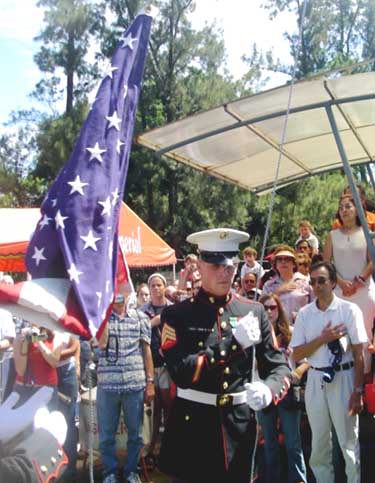 Old Glory begins the ascent |
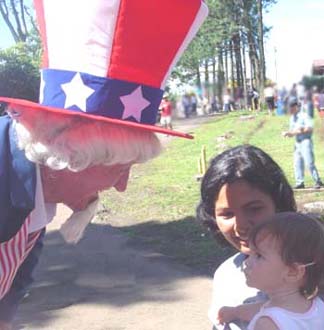
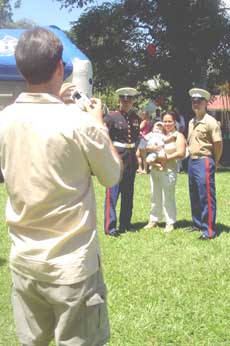
| U.S. citizens and families, mostly
from the Central Valley, had their July 4 celebration early this
year. The event was Saturday. The Independence Day party attracted a significantly smaller crowd this year, in part because of the Saturday date. However, fans, like Stan Burch (above), |
who portrayed Uncle Sam on stilts, came all the way from his home in Golfito. The weather cooperated. Skies were a rich blue with just a few puffy clouds all morning. The event was west of San José on the Cerverceria Costa Rica picnic grounds. |
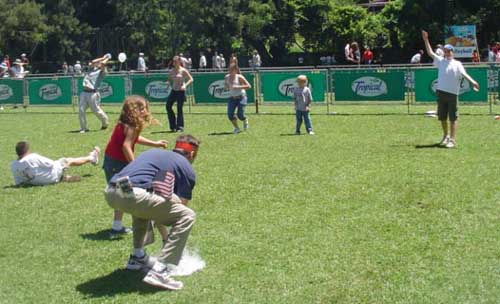 |
Sometimes you catch a water
balloon and sometimes you don't! Splash!
Photos by Jay Brodell
|
|
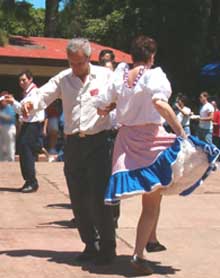
How Gringo can you get? |

|
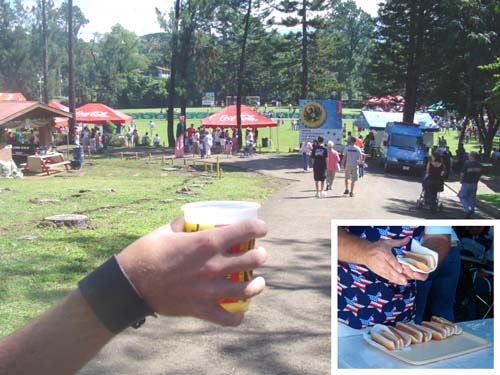
| Free
beer, soda, coffee and hot dogs are major attractions for the July 4th
party every year. But it also is a day for kids. |
 |
|
|
|
|
|
|
|
|
| What we published this week: | Monday | Tuesday | Wednesday | Thursday | Friday | Earlier |
|
|