|
 |
Your daily |
 |
|
|
|
|
|
|
|
|
|
|
|
|
||||||||||||||||||||||||||||||||||||||||||||||
|
|
||||||||||||||||||||||||||||||||||||||||||||||
 |
 |
| A.M. Costa Rica Second newspage |
|||||||||
| Home |
Tourism |
Calendar |
Classifieds |
Entertainment |
Real
estate |
Rentals |
Sports |
About us |
|
|
|
|||||||||
 |
| Costa Rica Expertise Ltd http://crexpertise.com E-mail info@crexpertise.com Tel:506-256-8585 Fax:506-256-7575 |
 |
|
 A.M. Costa Rica/José Pablo
Ramírez Vindas
Historical documents on display at Casa PresidencialHistoric documents include
two centuries of treasures By the A.M. Costa Rica staff
Some of the nation's historical treasures are on display at Casa Presidencial. Included are a photo of Avenida Central taken in 1868, the Oct. 29, 1821, Acta de Independencia, and letters written to heads of state by such figures as Adolf Hitler, Napoleon and Japan's Hirohito. Such documents normally are kept in the Archivo Nacional. But they are on display in the auditorium of the executive branch offices in Zapote through May 30 under the title "Descubriendo Nuestro Pasado, Tesoros y Curiosidades del Archivo Nacional”. There are more than 50 pieces from nearly two centuries of the "discovering our past" exposition, and similar expositions are planned for elsewhere in the country, said Casa Presidencial. Arias to make sudden trip for his throat problem By the A.M. Costa Rica staff
President Óscar Arias Sánchez is leaving the country today to seek medical treatment for what aides are calling inflamed vocal cords. Casa Presidencial did not say where Arias was headed, and the whole trip is being handled as a private happening. Arias, as a government employee getting a salary presumably would be eligible to treatment here at hospitals maintained by the Caja Costarricense de Seguro Social. However, even his brother, the minister of the Presidencia, opted for a private hospital for a hip replacement. Casa Presidencial said that Arias would cover the cost of the trip personally. He is expected to be gone for eight days. Arias suspended his schedule last week when it became difficult for him to talk. The announcement of his trip came from Francisco Antonio Pacheco, the president of the Asamblea Legislativa. Under the Constitution, Arias had to notify lawmakers of his absence. Vice President Laura Chinchilla will be in charge while Arias is gone. There was no further explanation of what kind of treatment Arias would receive. The secrecy and suddenness of the trip and the lack of information has generated speculation in the Casa Presidencial press corps. Man held in shotgun deaths of two pedestrians in Limón By the A.M. Costa Rica staff
Agents detained a suspect in a double murder that happened Sunday in Límón, said a judicial spokeswoman. Two men were walking in the area known as La Bomba, at around 3 a.m., according to judicial reports. A red pickup sped by, and the killer fired a 12-gauge shotgun various times, hitting both men, said the judicial spokeswoman. Pellets hit the man with the last name Lauréense, 27, in the chest. The murderer shot a man with the last name Mata, 20, in the back as he tried to run away, said the spokeswoman. Agents arrested a 34-year-old man with the last name of Camacho Monday, as a suspect in the case. Agents arrested the suspect in downtown Limón at a tire shop where he worked, said the spokeswoman.
|
 |
 |
 |
| A.M. Costa Rica third newspage |
|||||||||
| Home |
Tourism |
Calendar |
Classifieds |
Entertainment |
Real
estate |
Rentals |
Sports |
About us |
|
|
|
|||||||||
 |
 |
| Park
duty is a solitary affair for municipal police officers |
|||
|
By Elise Sonray
of the A.M. Costa Rica staff Gerardo Martínez Jiménez, a municipal police officer in Parque Morazán, works a 12-hour shift. He gets his
Adita Chávez Corrales, an officer in Parque Nacional, said the awful conditions of the casetas are overwhelming. “They are so hot in the sun and freezing when its cold since they are made of metal,” said Ms. Chávez, who added there is no heater or air conditioning. Ms. Chávez said her caseta only has electricity from 6:30 p.m. to 6:30 a.m., so there is no way to use the light during her 12-hour day shift. The municipal officers said they usually walk through the parks and don't use the casetas during the daytime hours. When it rains, Ms. Chávez sits in the metal booth and tries to watch what is going on, she said. “They really need to put it somewhere else,” said the officer, commenting on the caseta's location, “There is no window to see the street. It's very dangerous.” Both the caseta in Parque Morazán and in Parque Nacional are located on the far edges of the parks and give a view of the park itself but not the street behind. The casetas are supposed to be open 24-hours, said the officers. But a trip to Parque Morazán Monday night yielded a locked booth and no police officers in sight. Ms. Chávez said the night officer at Parque Nacional often sleeps on the job. Both municipal officers said the graveyard schedule was much more dangerous with more incidents of prostitution, including in the nearby transvestite zone near Escuela Metalica, more drug use and more crime in general. During the day, there are at least two, sometimes three Fuerza Pública officers in Parque Morazán, said Martínez, who added that the park was very calm in the day. |
 A.M. Costa Rica/Elise Sonray
Adita Chávez Corrales, who is on duty in Parque
Nacional, has served 25 years as a municipal officer and six
years in the park.Martínez, who has only seen one crime in six months of work at the park, said the protection was not too much for a small area. “There are four schools nearby,” he said, “so surveillance is very important.” But the night hours don't seem to benefit from that high surveillance. Ms. Chávez, on the other hand, said she has her hands full at Parque Nacional with people drinking alcohol and using drugs, and roller skaters falling and running into things. She said she rarely sees Fuerza Pública officers in the park, and now she is watching 20 fiberglass life-size cows, all by herself. “I'm not just an officer. I'm a farmer,” said Ms. Chávez, who has worked in the park for six years. The cows are part of the art initiative Cow Parade. Ms. Chávez said she would feel more secure if she had a partner. “An officer should never be alone,” she said. But she admitted this was hardly a possibility for most municipal police. Both officers said new buildings would better their work and improve protection of the communities. Martínez said other officers in the area could share his facilities, helping make their jobs easier. “I hope it will become a reality,” said Ms. Chávez, “For the community and all of us, especially since winter is coming.” The Sala IV gave the municipality six months to make the improvements. |
||
| First
dose of rainy season affects nearly 200, emergency commission says |
|
|
By the A.M. Costa Rica staff
Nearly 200 people were affected by heavy rainfalls over the weekend, reported the national emergency commission. The Comisión Nacional de Prevención de Riesgos y Atención said it responded to 14 emergencies in areas of San José, Heredia, Puntarenas and Alajuela. At least 37 houses were flooded due to the rainfall, said a commission spokesman. Daniel Gallardo, president of the emergency commission, said representatives had not yet assessed the total damages, but that they had sent food and water, blankets, small boats, electric generators, lighting systems and search teams. |
Gallardo called on municipalities to
come together with the community
and identify potential shelters and evacuation routes as well as
promote garbage removal from rivers. In Heredia, damage was reported in Palmar de San Rafael, San Juan de Santa Bárbara and San José de la Montaña. In Tambor, Alajuela emergency workers evacuated seven families from their homes, they said. In the province of Puntarenas waters affected Barranca, Quepos, Parrita, Pocares and in San José damage was reported in Alajuelita, San Josecito and Barrio Lámparas, San Miguel of Desamparados and San Gabriel de Cinco Esquinas, Tibás. |
 |
| A.M. Costa Rica fourth news page |
< |
||||||||
| Home |
Tourism |
Calendar |
Classifieds |
Entertainment |
Real
estate |
Rentals |
Sports |
About us |
|
|
|
|||||||||
|
U.S. officials crack down on Romanian credit scam, too
|
|
|
Special to A.M. Costa Rica
with local reports A week ago Costa Rican police officials captured three Romanians suspected of running a credit card scam and swindling thousands of dollars. Now U.S. officials have arrested five persons after they were among 33 indicted last week. U.S. officials said that the federal racketeering charges stem from their involvement in an international bank fraud ring in which Romanians obtained personal credit information and American-based confederates created bogus debit and credit cards that were used to fraudulently obtain millions of dollars in cash. The 65-count indictment returned by a grand jury Thursday accuses the 33 defendants of engaging in “phishing” and other surreptitious methods via the Internet to obtain personal data on thousands of victims. A phishing scheme uses the Internet to target large numbers of unwary individuals, using fraud and deceit to obtain personal and financial information such as names, addresses, bank account numbers, credit card numbers and Social Security numbers, federal investigators said. Phishing schemes often work by sending out large numbers of counterfeit e-mail messages, which are made to appear as if they originated from legitimate banks, financial institutions or other companies. The e-mails direct victims to legitimate-appearing Web sites that are controlled by criminals and are designed to obtain personal information. According to the indictment, the Romania-based members of the enterprise obtained thousands of credit and debit card accounts and related personal information by phishing, with more than 1.3 million spam e-mails sent in one phishing attack. Once directed to bogus Web sites, victims were prompted to enter information about their credit or debit cards, as well as personal identifying information. Romanian “suppliers” collected the victims’ information and sent the data to U.S.-based “cashiers” via Internet “chat” messages. The U.S.-based cashiers used hardware called encoders to record the fraudulently obtained information onto the magnetic strips on the back of credit and debit cards, and similar cards such as hotel keys. Cashiers then directed “runners” to test the fraudulent cards by checking balances or withdrawing small amounts of money at automatic tellers. The cards that were successfully |
tested, known as “cashable” cards, were used to withdraw money from
teller machines or point of sale terminals that the cashiers
had determined permitted the highest withdrawal limits. A portion of
the proceeds was then wire transferred to the supplier who had provided
the access device information. The racketeering case was announced Monday at two press conferences — one in Romania, where Deputy Attorney General Mark R. Filip joined the Romanian prosecutor general to announce the Los Angeles case and a similar case out of Connecticut, and one in Los Angeles, where U. S. Attorney Thomas P. O’Brien joined Salvador Hernández, FBI assistant director in charge, and other law enforcement officials to discuss the Los Angeles case. Five of nine U.S.-based defendants were arrested Sunday night and Monday morning in Southern California. Romanian law enforcement authorities executed search warrants in Romania earlier Monday in connection with the racketeering indictment. The individuals named in the indictment made public Monday operated from locations in the United States and abroad including Canada, Pakistan, Portugal and Romania, and include both U.S. citizens and foreign nationals. In a related case, seven Romanian citizens — including two named in the Los Angeles indictment — were charged in an indictment returned by a federal grand jury in New Haven, Conn., Jan. 18, 2007, and unsealed Friday in connection with an Internet phishing scheme. The indictment alleges conspiracy to commit fraud in connection with access devices, conspiracy to commit bank fraud and aggravated identity theft. Last week agents from the Sección de Fraudes here raided a San José hotel and confiscated $22,000 and 13 million colons ($26,000) in cash along with 450 fake credit cards, said a judicial spokeswoman. Scam operators here also used discarded prepaid credit cards that no longer had money on them. Officials noticed something was amiss when the names of numerous foreign companies began to appear on the withdrawal records. The three individuals entered the country May 3, said a judicial spokeswoman. Agents suspect they were transferring sums of money from $3,000 to $4,000 back to Romania. They found paperwork documenting the transfer of at least $57,000, said the spokeswoman. |
|
Economics group says U.S. is avoiding a true recession
|
|
|
By the A.M. Costa Rica wire services
A Washington-based business group says the U.S. economy remains sluggish, but will likely avoid a major recession. The last two U.S. recessions, in the early 1990s and in 2001, saw quarters in which America's economy contracted, with inflation-adjusted gross domestic product registering negative growth rates. This year, the U.S. economy has flirted with recession, but has averted an actual contraction, logging a 0.6 percent growth rate in the first quarter. A panel of economists surveyed by the National Association for Business Economics expects America's anemic economic growth to continue in the short term, expanding only 0.4 percent for the second quarter of this year. Lynn Reaser, an economist for Bank of America who heads the association's economic forecasting committee, says the overall projection is for an economic downturn that is both mild and brief. "This is a very shallow downturn," said Ms. Reaser. "In fact, only slightly more than half of our members believe it will ultimately be declared a recession. And, of those, the majority believe it will be over either this quarter or the next." The association panel expects economic growth to pick up in the second half of the year, at a two percent annual growth rate. The U.S. unemployment rate is expected to continue to rise, but only modestly to 5.6 percent next year. The association panel points to some encouraging signs for the economy, including expanding U.S. exports and a narrowing U.S. trade deficit. The panel expects the U.S. |
dollar, which has fallen dramatically
against the euro and other major currencies, to stabilize and strengthen. Worries about the U.S. economy began to escalate last year, prompted in large part by a rash of foreclosures among Americans with so-called "sub-prime" mortgages that were given to homebuyers with spotty credit histories. The sub-prime crisis provoked a broader credit crunch that has made it difficult for many businesses and consumers to secure loans, constraining economic activity and devastating the U.S. housing market. Turmoil in financial markets and higher energy prices are taking a toll on current growth, as well. Ms. Reaser says association economists believe the worst of the credit crunch is likely over. "What this survey suggests is that, perhaps, credit availability will actually improve in the second half of this year," said Ms. Reaser. "It is important because there have been concerns that all of the problems on Wall Street would crimp borrowing for businesses and consumers on Main Street. It still will be a constraint going forward, but we think that credit markets will loose some of their tight grip as we move through the balance of 2008." The association forecast appears to be in line with other U.S. economic signals. Another group, the New York-based Conference Board, said that its index of leading economic indicators edged higher in April. The slight rise in the index, which is designed to forecast short-term economic performance, is seen as a sign of continued economic weakness, but does not foreshadow a drastic downturn. |
 |
|
| News from
the BBC up to the minute |
BBC sports news up to the minute |
| BBC news and sports feeds are disabled on archived pages. |
|
| A.M. Costa Rica fifth news page |
Are
you
still
spending 70 percent You need to fill this space ASAP! |
||||||||
| Home |
Tourism |
Calendar |
Classifieds |
Entertainment |
Real
estate |
Rentals |
Sports |
About us |
|
|
|
|||||||||
 |
 |
|
Spy agencies face
problems recruiting Arabs, Muslims By the A.M. Costa Rica wire services
U.S. intelligence agencies have embarked on an ambitious program to hire new recruits from America's ethnic communities, particularly among Arabs and Muslims. But the effort has encountered skepticism from the immigrant communities. A recent meeting between intelligence recruiters and more than one dozen representatives of what the government calls "heritage communities" underscores the resistance the recruiters are encountering from ethnic Americans. At the gathering, held in a nondescript office building outside Washington, officials from various government agencies, such as the CIA, FBI, and National Security Agency, wanted to talk about how to reach out to the immigrant communities. But the ethnic representatives said lingering concerns about some U.S. activities make it difficult to sell the idea of a career in intelligence to their members. In an interview, lawyer Amina Khan, who represented the Association of Pakistani Professionals, said the intelligence community has to rebut suspicion and skepticism, particularly in the Muslim community. The failure to intercept the terrorist attacks of Sept. 11, 2001, spurred U.S. intelligence agencies to try to recruit new analysts and field officers who possess special skills, especially fluency in key languages such as Arabic, Persian, Dari, Pashto, and Urdu. The best place to find such people, they reasoned, is among the first- and second-generation immigrants who have become American citizens. But until recently rules barred intelligence agencies from recruiting people who have close relatives abroad. The agencies also avoided persons who had dual nationalities. U.S. citizen to be deported to face U.S. drug charge By the A.M. Costa Rica staff
Immigration police arrested a U.S. man in Sabanilla on charges of international drug trafficking Monday, said a security spokesman. The man, said to be Aaron Lee Fileger, has a warrant out for his arrest in the state of Pennsylvania, said the spokesman. Fileger, carried a U.S. passport under the name of Russell Bloom at the time of arrest in Montes de Oca, Sabanilla, said immigration agents. His identity was revealed after police found his driver's license and he was interviewed by employees at the U.S. Embassy, according to the spokesman. Fileger was working at a call center in La Sabana. He entered the country in March, through Peñas Blancas with the passport of a man named Russell Bloom, according to the spokesman. The head of the immigration police, Francisco Castaing, said he hoped to have Fileger deported by Friday so he could be processed by U.S. authorities. |
| A.M. Costa Rica Sports news local and from the wires |
 |
|
|
|
|
|
|
|
|
|
|
||||||
|
||||
|
Food, festivals, arts, entertainment, poker |
|
|
|
|
|
|
|
|
|
|
| Delay in World
Series showdown to add sophistication |
|
|
The
World Series of Poker, poker’s most prestigious event, will kick off in
a few short weeks. The World Series features world championships
in various forms of the game, all leading up to the granddaddy of them
all, the $10,000 buy-in main event. This year, however, the main event will be just a little bit different. Harrah’s, the operator of the World Series of Poker, with input from the Players Advisory Council, decided to postpone the final table of the main event until Nov. 9, 2008 – a delay of more than three months. That’s right; more than 7,000 players will start play on July 3 and battle down to the final nine on July 14 at which time play will come to a stop. Some players love this idea and think it will create tremendous buzz about poker’s biggest showcase event. Others believe that the lengthy delay will compromise the integrity of the final table. I think both camps make valid points. The extended build up will definitely create promotional opportunities and excitement about the final table. It will also give the finalists unprecedented time to work on their game, study their opponents, and develop winning game plans. Others, however, argue that winning the main event is a test not only of poker skill, but stamina too. I don’t agree. The main event wasn’t always a test of endurance. The ability to play winning poker on little sleep is not something that needs to be rewarded. As far as I’m concerned, the schedule change will benefit those players that study video of their opponents, seek expert coaching advice, and work on their game plans. Let me explain. Professional football was revolutionized when teams began to study their opponents by watching game tape. Today, all NFL coaches work long hours studying video leading up to game day. Players at the main event final table will have three months to study footage of their opponents. Not only should they search for physical tells and predictable betting patterns from their opponents, they should look for their own bad habits too. The schedule delay will also benefit those players who seek |
 out coaching advice. Now, this is something that might seem at odds with being a poker player. After all, poker is an individual game -— one player to a hand. But why pass up the opportunity to improve one’s game? Hey, if I don’t make the final table, I just might take on a student who could benefit from my poker experience. The presence of pro coaches will undoubtedly add a new dynamic to the main event. While you might not see Phil Hellmuth actually playing at the final table, it’s possible that he’ll be visible in the stands as he cheers for his amateur protégé. In fact, even the big name pros will probably hire coaches to help gather information on their opponents and help devise final table strategies. Lastly, the delay will allow ample time to develop winning game plans. Just like an NFL coach might draw up the first 20 plays, finalists at the main event can do the same. But in addition to Plan A, finalists should also be prepared with backup Plans B and C. Maybe you’ll win a big pot and become the chip leader, or perhaps you’ll lose a monster pot and find yourself on the short stack. Players should establish game plans for a wide range of scenarios. The main event schedule change will add an element of sophistication to the final table that will surely benefit those players that are best prepared. If I make it to the final nine, you can bet that I’ll be as prepared as anyone. Visit www.cardsharkmedia.com/book.html for information about Daniel Negreanu’s new book, "Hold’em Wisdom for All Players." © 2008 Card Shark
Media. All rights reserved.
|
| Art Galleries ... |
|
Surreal circus art leaves circle of life question open to onlookers  Wandering around the
Museo Calderon Guardia, looking at austere
historical artifacts about the socialist former president complete with
wax-work statue, the last thing a visitor expects to come across is a
circus tent. Wandering around the
Museo Calderon Guardia, looking at austere
historical artifacts about the socialist former president complete with
wax-work statue, the last thing a visitor expects to come across is a
circus tent. Until May 22, that is precisely what museum-goers can expect when they enter the small temporary exhibition space. A colorful toy snake curls around the bottom of a notice board announcing “Introvoco” with two clown shoes fastened to it. The floor is covered in a carpet of hay, giving the room a barn-yard smell, and most of it is obscured by a blue tarpaulin. Read more - click here |
Art Biennial breaks down national stereotypes  A work of art that
involves only a
metal key is among the most acclaimed piece in the Museo de Arte
Costarricense's latest exhibition. A work of art that
involves only a
metal key is among the most acclaimed piece in the Museo de Arte
Costarricense's latest exhibition.Also on display are old Caterpillar boots, a patchwork quilt and a foosball table, all aimed at breaking down the stereotypes that exist between Costa Ricans and Nicaraguans. As Nicaraguan migration into Costa Rica continues, so do tensions between the two national groups. The U.S. Department of State's most recent estimate was that up to 15 percent of the population of Costa Rica is made up of Nicaraguans who have migrated here mainly in search of work. Read more - click here |
| Dramatic Arts ... |
|
Poets from 15 countries come to San José Latin America is renowned for its literature, and this weekend marks the inauguration of a festival that unites poets from across the region, not to mention from Europe, Africa and the United States. The VII Festival Internacional de Poesía will bring prize-winning writers from all over the world to venues all over Costa Rica, including hospitals and prisons, with the grand opening scheduled for Friday at 7 p.m. It claims to be the second most important poetry festival in the Americas, and is organized by Fundación Casa de Poesía, who said getting visas for all the artists to enter the country proved rather difficult. Read more - click here |
Salsa and big band collide in a night of dinner and dancing Music students of Pérez Zeledón and salsa-dancing fans of the group Son de Tikizia are preparing for a night of dinner and dancing to be held in the capital of the province. The big band of the town that calls itself Pérez Zeledón, but whose actual name is San Isidro del General, will join dancers from the Universidad Nacional to present Cena Bailable May 23. A concert by the 25 members of the big band will start off the evening, which will continue with a buffet-style dinner and end up with dancing. Read more - click here |
| Food... |
|
Café culture uncovered in San José  In San José there are plenty of places to catch a coffee. A soda will give you a coffee on the run, but it won't have a nice selection of frapucchinos, and the most European lunch on offer will be the ubiquitous ham and processed cheese sandwich. The plastic atmosphere of the proliferation of coffee shops found in city malls doesn't cut it in comparison with the artsy, individualistic establishments in which musicians, revolutionaries, poets and artists got together next to the river Seine. After one casado too many, there are, however, a few places to go for a brief retreat towards the European ideal. Claudio's Delicafé  Arguably one of San José's most attractive buildings, this café is attached to an art school and is not afraid of letting the creativity filter through into the café itself. Previously known as Café Arte, the French owner of San Pedro restaurant Le Chandelier recently took over the café and has restyled the entire thing, very much to its benefit. One corner of the café is a tower-like extension, its cylindrical shape and many windows giving an airy atmosphere. Wicker-backed chairs, wooden sofas and arty photography give the interior an understated style. Click here for more café reviews |
Mini-mall comes to the rescue of the not-rich-but-hungry 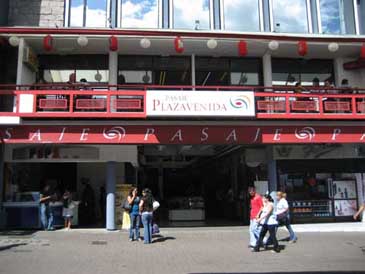 For those in the
know, there is a clean, affordable, relatively quiet
gastronomic surprise off the pedestrian mall in downtown San
Jose. Between Arenas clothing store and the Patio Restaurant,
behind a perfume counter and a Pops Ice Cream sits a food court without
a McDonald's, Wendy's, Subway or Church's Chicken in sight. For those in the
know, there is a clean, affordable, relatively quiet
gastronomic surprise off the pedestrian mall in downtown San
Jose. Between Arenas clothing store and the Patio Restaurant,
behind a perfume counter and a Pops Ice Cream sits a food court without
a McDonald's, Wendy's, Subway or Church's Chicken in sight. Click here to read more Festive season proves troublesome even for established restaurant 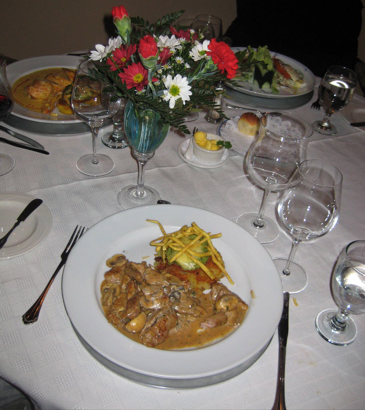 Being a chef in a
busy kitchen must be a pretty stressful job, but
around Christmas stress is something any successful restaurant should
factor in as inevitable. Being a chef in a
busy kitchen must be a pretty stressful job, but
around Christmas stress is something any successful restaurant should
factor in as inevitable. On a second visit to well-reputed French restaurant Le Chandelier, it soon became obvious that the staff were poorly equipped for the onslaught of Christmas party diners on a Tuesday night, leaving the usually decent food to deteriorate into a procession of almost inedible starters and bland entrees. Click here to read the full review A great meal is not all in the presentation 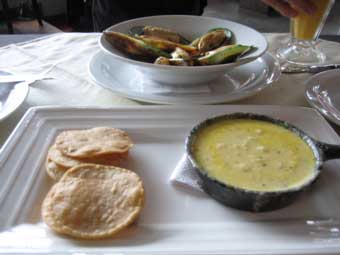 With a vaulted
glass ceiling, palm trees lining the pathway and posh lighting, one
would not expect Saga restaurant to be settled behind a dull parking
lot in Escazú. With a vaulted
glass ceiling, palm trees lining the pathway and posh lighting, one
would not expect Saga restaurant to be settled behind a dull parking
lot in Escazú. Although this restaurant may look out of place, it doesn't deviate much from the norm in Escazú, an area many would classify as suburban sprawl. Click here to read the full review |
| Books ... |
|
Heredia author mixes teen romance with leatherback turtles  A 15-year-old girl
who is infatuated with buff surfers and Gucci shoes is setting out to
convince other teenagers her age that caring for leatherback turtles
and saving the environment is just as cool as going to the mall. A 15-year-old girl
who is infatuated with buff surfers and Gucci shoes is setting out to
convince other teenagers her age that caring for leatherback turtles
and saving the environment is just as cool as going to the mall.Penelope, as she is called, is the creation of Heredia resident Marina Kuperman, a New York native who has recently finished the “eco-adventure” novel “Turtle Feet, Surfers Beat.” Written to target girls aged 9-14, the 86-page novel is printed entirely on eco-friendly paper and follows the story of Penelope and her family as they relocate to Tamarindo for a month. Forced to work as a volunteer at the Leatherback Biological Centre, Penelope, who has been recently dumped by her quarterback boyfriend, falls in love almost simultaneously with leatherback turtles and a blonde surfer called Kendall Brown. Click here to read more |
Land use in Costa Rica documented by Fulbright scholar Forty years of living in the jungle, moving between secluded forestry stations and research labs, has led Louisiana resident and NASA veteran Armond Joyce to write a book about the changing uses of land in Costa Rica. After winning a presitgious Fulbright scholarship in 1998, he came back to Costa Rica to revisit forest sites that he worked on over three decades earlier as a graduate student. Click here to read more New book dwells on the social aspects of food Food is not just a selfish pleasure or a way to stifle hunger, but is central to the evolution of art, according to a new book published by Museos del Banco Central. Artworks by Costa Rican painters are the main content of the hardback book, “Imagenes para Comer,” which follows the representation of food in art since still life painting became popular in the Renaissance. Click here to read more |
|
|
|
|
|
|
|
|
| What we published this week: | Monday | Tuesday | Wednesday | Thursday | Friday | Earlier |
|
|