|
 |
Your daily |
 |
|
|
|
|
|
|
|
|
|
|
|
|
|||||||||||||
|
|
|||||||||||||
 |
| A.M. Costa Rica Second newspage |
 |
||||||||
| Home |
Tourism |
Calendar |
Classifieds |
Entertainment |
Real
estate |
Rentals |
Sports |
About us |
|
|
|
|||||||||
 |
| Costa Rica Expertise Ltd http://crexpertise.com E-mail info@crexpertise.com Tel:506-256-8585 Fax:506-256-7575 |
 |
|
Readers respond with data
on Costa Rican flowers By the A.M. Costa Rica staff
Readers know their flowers. A Cartago woman identified the mystery bloom that was included in a display of flowering plants Tuesday. "The photo at bottom right in your article is a native of Costa Rica, Columnia linearis," wrote Kerry Dressler. "There are many beautiful columnias here in Costa Rica and they are easily seen in any of the national parks. They come in pink, red, yellow, or mixed." Editors had been unable to identify the plant, so the question was left open to readers. Mrs. Dressler has an advantage. Her husband, Robert Dressler, is coordinator of scientific research for the Jardin Botanico Lankester in Cartago, she said. He is an orchid expert who finds new species every year, she reported. Both Mrs. Dressler and Wm. Paul Mitchell of Alajuela and Tampa, Florida, were quick to point out that one of the blooms was misidentified. "The orchid photo on the main page today is incorrectly captioned as Cattleya gaskelliana, which is a South American species," said Mitchell. He and Mrs. Dressler were in agreement that the bloom is an Arundina graminifolia, an Asian species that has been planted widely. Intel reports record income Special to A.M. Costa Rica
Intel Corp. announced record first-quarter revenue of $9.7 billion, operating income of $2.1 billion, net income of $1.4 billion and earnings per share of 25 cents Tuesday. "Our first quarter results demonstrate a strengthening core business and a solid global market environment," said Paul Otellini, Intel president and CEO. "We saw healthy demand for our leading-edge processors and chipsets across all segments. Looking forward, we remain optimistic about our growth opportunities as we continue to reap the benefits of our 45nm technology leadership." Intel, the world's largest chip maker, is also a leading manufacturer of computer, networking and communications products. The company has facilities in Belén west of San José. Limón project legislation headed to assembly soon By the A.M. Costa Rica staff
The central government will send the legislation for the Limón Ciudad Puerto to the Asamblea Legislativa next week, Casa Presidencial said Tuesday. This is an $80 million face lifting and redevelopment of Limón. The date was set by Marco Vargas Díaz, minister of Coordinación Interinstitucional and of Economía, Industria y Comercio. He is heading the project. The project will bring new infrastructure to the community and develop a new port and modernize the existing ports. The plan may run into trouble in the legislature because the Óscar Arias administration would like to end direct government control of the ports in favor of a concession agreement with a contractor. The powerful dock unions and others will oppose this. Our reader's response
Hills of Esterillos thanksthose who made inspections Dear A.M. Costa Rica: My name is Robert Barras, and I am a close friend, confidant and business associate of the owner of Hills of Esterillos, Mr. Jeff McMullin. Jeff has asked me to write this letter to thank your Web-based publication for the wonderful exposure you have provided us in regard to the “sweep” of several developments in the Central Pacific coast of Costa Rica. The infractions for which we were responsible for were very small and easily corrected. At this time we would also like to take the opportunity to thank the Municipalidad of Parrita, the environmental agencies of SETENA and MINAE for helping us use the inspections to make our team, system and community better than before. We are grateful. Jeff is happy to announce that his project, The Hills Of Esterillos, is up and running again, and he felt it proper to communicate this good news through A.M. Costa Rica. Robert Barras
On behalf of Hills of Esterillos
|
 |
 |
 |
| A.M. Costa Rica third newspage |
 |
||||||||
| Home |
Tourism |
Calendar |
Classifieds |
Entertainment |
Real
estate |
Rentals |
Sports |
About us |
|
|
|
|||||||||
| Casino
industry, hurt, confused and worried about job loss |
|
|
By Elise Sonray
of the A.M. Costa Rica staff Most casino representatives are not talking after the government announced a crackdown Thursday. But a few suggest a big loss of jobs in the industry. Those who did talk Tuesday said the government gave them no warning whatsoever about the supposed crackdown and that the press was their only real source of information concerning the package of decrees. Torstyn Cole, casino player developer and a manager at Casino Paradiso in the Clarion Hotel, said he thought many aspects of the decrees were ridiculous. The decrees were too harsh he said. Cutting casino hours from 24 hours to 6 or 8 hours a day was plain crazy he said. The decrees have the force of law and some simply restate laws that are not being enforced. “It's the Ticos, the locals who work for the casinos who will be impacted by this,” Cole said. “The owners have already made their money.” Cole, who added that he does not represent the owners of the casino, said “If its just to keep the Russians out, that's just insanity.” The Russians, Cole mentioned are the owners of Storm International, a company that said in late February that it would invest $5 million to refurbish a downtown hotel. The proposal would just meet the decreed limits which require casinos to be located only in hotels and not free-standing. These hotels must have at least 60 rooms and three stars, and the casino must only take up 15 percent of the hotel. The Storm International project will include a 60-room hotel, said the company at the time. Industry sources say that the company is now reconsidering investing in Costa Rica. “They are scared of the Russian casino,” said Álvaro González, a manager at Fiesta Casino in Alajuela. The government said so themselves, added González. A Spanish-language newspaper quoted Vice President Laura Chinchilla as saying that the owner of Storm International bothered her a lot in the way he talked about Costa Rica and that the health minister said there was a zero percent change that the foreign company would enter Costa Rica. The decrees brand casinos as places that can encourage prostitution, drug addiction and insecurity. |
Fiesta Casino, which has four
operations in the country, will have to
cut half of its employees if the decrees go through, said
González. He
said he believed the decrees would go into effect. He said 450
employees out of 800 would be laid off. “I don't think it will go through because of the number of families and employees it would effect,” said an official at a downtown casino. He also speculated that the decrees were solely to keep out Storm International. The official, also refused to believe the casino for which he works will ever be shut down. The casino is not connected to a hotel, which is one of the major rules restated in the decrees. “No one is against regulations. They make things easier on us and give us a guideline to follow,” said Casino Paradiso's Cole. But, he added, it doesn't seem right for the government to inflict harsh regulations. “If they just stuck to the old laws, they probably wouldn't be in this situation,” added Cole, who said that previously laws were rarely enforced. “I would have preferred for the 2005 initiative to have been approved,” said González. That initiative still is in the Asamblea Legislativa. Most casino representatives were not concerned about the “no more free liquor” rule imposed by one decree. “An addicted gambler is going to play whether or not there are free drinks,” said Cole, who added that there are always ways around the law. He also said “addicts” would go to another casino if one was shut down, and that the decrees made little sense in their attempts to deter chronic gamblers. One of the stated purposes is to reduce gambling by addicts, which is how the Ministerio de Salud or health ministry figures into the matter. The Asociación de Casinos met Monday, said Cole, to discuss the issues. There are also rumors of lawsuits, although nothing can be certain until the decrees are published officially in La Gazeta, perhaps this week. Cole said the best thing to do would be for the government to have an open discussion with casino owners, ask their opinions and get feedback. The decrees, reported Friday, came from an executive branch committee that was empaneled in late march. |
| Woman
suspected of faking her own kidnapping avoids preventative detention |
|
|
By the A.M. Costa Rica staff
The wife of a U.S. citizen who faces a charge of faking her kidnapping did not go to jail Tuesday. Although the prosecutor in the case sought preventative detention for the woman, identified by the last name of Porras, a judge did not agree. Instead the 27-year-old woman was ordered to maintain a fixed living place, stay away from witnesses and to not leave the country. It was unclear if the woman will have to move back into the family home with her husband, who had been getting ransom demands via the Internet. |
The woman left her Alajuela home
Thursday with the couple's baby. Soon the husband was getting calls and
Internet demands for a
$200,000 ransom. Investigators located the woman and the child Monday. The Poder Judicial said she was located at a hotel in Puntarenas. Informal reports say she was at an Internet cafe. Investigators say they traced the woman by checking the headers on the Internet messages. A man who lives near Puntarenas also is involved in the case. He is suspected of making telephone calls to the husband and claiming to be a kidnapper. There was no word on the disposition of his situation Tuesday. |
 |
 |
|
 |
 |
|
|
|
|
|
| You need to see Costa Rican tourism information HERE! |
| A.M. Costa Rica fourth news page |
|||||||||
| Home |
Tourism |
Calendar |
Classifieds |
Entertainment |
Real
estate |
Rentals |
Sports |
About us |
|
|
|
|||||||||
|
Rising food prices may reduce many more into poverty
|
|
|
By the A.M. Costa Rica wire services
The rising cost of food has triggered riots in a number of countries in recent weeks. Economic policy makers warn that the inflationary effect could push millions back into poverty. And aid organizations are concerned that they will not be able to feed the poorest of the poor. A street protest against rising food costs recently turned violent in the Haitian capital Port-au-Prince, as well as in cities in other developing countries. Peter Smerdon of the World Food Program explains what the higher costs mean for aid agencies in Somalia: "We may have to cut rations or cut the number of people that we feed in Somalia because of these increased costs, so what we very much hope for is that donors will be able to step forward to cover these increased costs so that we can continue to help these people who are in such desperate need,” he said. World Bank President Robert Zoellick says food inflation disproportionately affects the world's poor. "In Bangladesh a two-kilogram bag of rice like this now consumes about half of the daily income of a poor family," Zoellick said. |
A drought in Australia and crop diseases in other parts of the world have contributed to the diminishing food supply. There also is increased demand in other countries. Christopher Flavin is president of Worldwatch Institute. Flavin said "As China and other developing countries increase their consumption of meat and of dairy products and a whole variety of other things that require lots of grain and soybeans to produce them, it means that supply is now having a hard time keeping up with demand." Higher fuel prices are partly to blame for the rising cost of food. Researcher Nicolas Minot of the International Food Policy Research Institute says fuel prices not only affect production costs, but they also entice farmers to convert land to bio-fuel production. "As oil prices go up, ethanol becomes more profitable pulling more maize into bio-fuel production and out of food production," Minot said. Minot says removing trade barriers could help mitigate the food crisis. But he says more research and technology is needed to produce ample energy and food for the world. |
|
Despite soaring prices, U.S.rice producers feel the squeeze
|
|
|
By the A.M. Costa Rica wire services
A dramatic surge in the international price for rice has U.S. producers planting more fields in an effort to increase profits. But high costs could limit their margins. Tractors are tilling the land and building earthen rows that will serve as levees once water flows into the fields around Dayton, Texas.. This area of southeast Texas is one of the best rice growing areas of the United States. Other states that also produce major amounts of rice include Arkansas, Louisiana and Mississippi. Ray Stoesser plants rice on more than 1,800 hectares (4,448 acres) of land in the area near his home in Dayton, and he is hoping the recent jump in prices will help him come out ahead. "Naturally, we watch the market and the market is better than it has been since 1974 right now," he said. "We can grow rice and make a good yield and we can usually get a second growth, so we will maximize our profits." The price of rice has more than doubled in the past year, but Stoesser says production costs have also risen. "Fertilizer went up $80 a ton last week," he added. "It just seems like when we need it, everything goes up. All our suppliers say they cannot get potash and they cannot get phosphorous and, of course, nitrogen is mostly imported into this country right now, so we have to depend on foreign sources for that." Dwight Roberts is president and chief operating officer of the Houston-based U.S. Rice Producers Association. He says rice is the most expensive crop to grow in the United States because it is fully mechanized, so he says farmers in some of the best growing areas for rice are cautious in their planting decisions. "The bulk of the U.S. rice crop is yet to be planted as we go north into Louisiana and up into Arkansas to the Missouri boot heel," he noted. Roberts says the United States exports about half the rice it produces, so when prices are low on the world market, |
farmers tend to shift production to crops that are more profitable at
home, like corn and soybeans. The price of both of those crops has
risen sharply in recent years because of their use in making bio-fuels. Roberts says the reason for the international shortage of rice has to do, in many cases, with government policies in nations where prices for consumers were subsidized without providing incentives for farmers. He also blames drought in Australia, where rice production has virtually come to a halt, and an increase in demand driven by population growth. "Economists predict that the world population will grow by one billion people during the next 10 years and the middle class will grow by 1.8 billion people and 600 million of those are in China, and when people move up in the economic chain they want to eat better, they want more protein, which requires more grain and more fuels to produce it," he said. Growth in population has also contributed to urban sprawl. The loss of arable land to housing, roads and other infrastructure has also reduced the world's rice production. Roberts says all of these factors have come together to reduce the amount of rice available. "We have seen in a number of countries including Vietnam, Thailand, the United States, India, Pakistan and, to some degree, in Uruguay and Argentina, we have seen reductions and so now it is a simple case of supply and demand, and we have gotten to a point where world stocks of rice are at the lowest today since the early 1970s and we have had a lot of population growth since then, so there is a very tight supply and Third World consumers in particular are hurting right now," he added. Increased production in the United States will help alleviate the rice shortage in some parts of the world. The United States has promised to help the Philippines, which imports about 15 percent of the rice consumed in the country and is facing severe shortages. But overall, the demand for this grain worldwide is likely to outpace production, keeping the price high and promoting social unrest in poor nations where food supplies are low. |
|
|||||||||||||||||
| News from
the BBC up to the minute |
BBC sports news up to the minute | ||||||||||||||||
| BBC news and sports feeds are disabled on archived pages. |
|||||||||||||||||
| A.M. Costa Rica fifth news page |
Are
you
still
spending 70 percent You need to fill this space ASAP! |
||||||||
| Home |
Tourism |
Calendar |
Classifieds |
Entertainment |
Real
estate |
Rentals |
Sports |
About us |
|
|
|
|||||||||
 |
 |
| Women who get a
husband also get more housework to do |
||
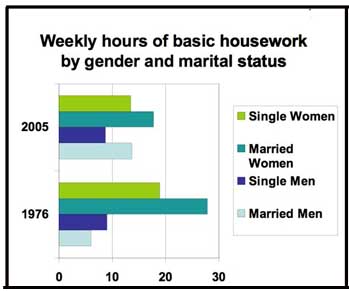 University of Michigan graphic
|
By the University of Michigan news service
Having a husband creates an extra seven hours a week of housework for women, according to a University of Michigan study of a nationally representative sample of U.S. families. For men, the picture is very different: A wife saves men from about an hour of housework a week. The findings are part of a detailed study of housework trends, based on 2005 time-diary data from the federally-funded Panel Study of Income Dynamics, conducted since 1968 at the uniuversity's Institute for Social Research. "It's a well-known pattern," said economist Frank Stafford, who directs the study. "There's still a significant reallocation of labor that occurs at marriage — men tend to work more outside the home, while women take on more of the household labor. Certainly there are all kinds of individual differences here, but in general, this is what happens after marriage. And the situation gets worse for women when they have children." Overall, the amount of housework done by U.S. women has dropped considerably since 1976, while the amount of housework done by men has increased, according to Stafford. In 1976, women did an average of 26 hours of housework a week, compared with about 17 hours in 2005. Men did about six hours of housework a week in 1976, compared with about 13 hours in 2005. But when the researchers looked at just the last 10 years, comparing how much housework single men and women in their 20s did in 1996 with how much they did in 2005 if they stayed single versus if they got married, they found a slightly different pattern. Both the men and the women who got married did more housework than those who stayed single, the analysis showed. "Marriage is no longer a man's path to less housework," said Stafford, a professor in the College of Literature, Science, and the Arts. For the study, researchers analyzed data from time diaries, considered the most accurate way to assess how people spend their time. They supplemented the analysis with data from questionnaires asking both men and women to recall how much time they spent on basic housework in an average week, including time spent cooking, cleaning and doing other basic work around the house. Excluded from these "core" housework hours were tasks like gardening, home repairs, or washing the car. The researchers also examined how age and the number of children, as well as marital status and age, influenced time spent doing housework. Single women in their 20s and 30s did the least housework—about 12 hours a week on average, while married women in their 60s and 70s did the most — about 21 hours a week. Men showed a somewhat different pattern. Older men did more housework than younger men, but single men did more in all age groups than married men. Married women with more than three kids did an average of about 28 hours of housework a week. Married men with more than three kids, by comparison, logged only about 10 hours of housework a week. Volcano causes evacuations By the A.M. Costa Rica wire services
Colombian authorities are evacuating thousands of people after a volcanic eruption about 240 kms (about 150 miles) southwest of the capital of Bogotá. The Nevado del Huila volcano began spewing hot ash over surrounding villages late Monday night, prompting authorities to evacuate at least 13,000 residents. So far, there are no reports of damage or injuries. |
|
| A.M. Costa Rica Sports news local and from the wires |
 |
|
|
|
|
|
|
|
|
|
|
||||||
|
||||
|
|
|
|
|
|
|
|
|
|
|
|
| What we published this week: | Monday | Tuesday | Wednesday | Thursday | Friday | Earlier |
|
|