|
 |
Your daily |
 |
|
|
|
|
|
|
|
|
|
|
|
|
||||||||||||||||||||||||||||
|
|
||||||||||||||||||||||||||||
 |
| A.M. Costa Rica Second newspage |
 |
||||||||
| Home |
Tourism |
Calendar |
Classifieds |
Entertainment |
Real
estate |
Rentals |
Sports |
About us |
|
|
|
|||||||||
 |
| Costa Rica Expertise Ltd http://crexpertise.com E-mail info@crexpertise.com Tel:506-256-8585 Fax:506-256-7575 |
| |
 |
|
Our reader's opinion
Cabo Caletas respondsto article on inspections Dear A.M. Costa Rica: I have been a long time reader of A.M. Costa Rica and read your article "Environmental inspectors close three Pacific projects" by Helen Thompson March 20. I would like to respond to the article as Cabo Caletas Ocean and Golf Club was unjustly targeted and misrepresented. The article insinuates that we are under investigation and places our project in the same category as the three projects that were closed when the facts are that Cabo Caletas has followed the environmental laws of Costa Rica as outlined below. On March 13 we had an inspection from MINAE, the Ministerio de Ambiente y Energía, (the eighth visit in two months) so they could inspect our project as they are doing a major sweep through the country on every project under construction. We spoke with them, took them where they wanted to go, and explained to them in great detail the project and our development process. We then showed them our paperwork and permits so they could see that we had everything in order. The inspection team consisted of two individuals from the Municipality of Parrita, six inspectors from MINAE including the senior official in Quepos and a reporter who was gathering facts and taking notes. At the end of the long and extensive visit, the senior official from MINAE told me that everything regarding our project was in order, that he was going to make a couple of recommendations and that we were doing a good job. I told him that anytime they wish to visit the site, just let us know and that we were glad that they were doing these sweeps as regulations for development are good for the country and the environment. They then left to visit other projects in the area which they later shut down as your article had reported. The facts about Cabo Caletas are as follows: • We were never shut down by MINAE or any other agency (that was not clearly stated in your article). • We were never investigated more than any other project in the area, as all of the projects in the area are being visited. MINAE will be inspecting every project along the coast which we believe is a positive thing. • When our project is complete, the building footprint on the entire 450 acres will be 15 percent. • We hired a full-time environmental consulting firm whose sole purpose is to regulate our construction activities and to make sure we comply with the environmental guidelines and laws of Costa Rica. • We are installing three sewer treatment plants. The treated effluent is used for irrigation throughout the project and golf course. This is very environmentally friendly and is not a requirement of any agency and is being done to benefit the environment. • We have designed a master storm drainage system to capture rainwater and discharge in lakes we are creating for retention and detention. These lakes store large quantities of water that would have been wasted which is now used to irrigate the golf course and common areas. This decreases the need to drill wells and tap into the local water aquifer. • All of our electric, cable, phone and equipment will be underground and concealed and will not be a hazard for animals. • Our potable water source is municipal water, not rainwater. We have an agreement with ASADA and AyA to invest in the water distribution system and to increase the total capacity. This new system will benefit the town of Esterillos and is already in the process of being implemented. • We are using several construction techniques during golf course construction to decrease the rain runoff from the golf course, using a strand of grass that uses 50 percent less fertilizer and 30 percent less water for irrigation and have dedicated many areas for reforestation which will enhance the golf experience. • We have done a full tree inventory in order to save specific trees and to incorporate them into our overall designs for streets, building sites and golf. • We are using landscape lighting which is low lighting thus to cut down on the light pollution from street lights that other developments experience. This is also very good for nocturnal animals whose eyes are sensitive to the lights. • We are creating a reforestation program for our pasture lands and building a nursery that will grow different species of plants, fruit trees and other vegetation to later replant throughout the project. In summary, Cabo Caletas is one of the most environmentally-friendly projects in Costa Rica, and the owners and employees are very conscientious of the environmental laws and regulations of Costa Rica. We pride ourselves on being a positive example for responsible development in Costa Rica. We enjoy your online news Web site and believe that you are doing a great service to those interested in Costa Rica. If you ever have any questions, or wish to clarify or verify the accuracy of your articles before you publish them, please contact me directly. Aaron Dowd
managing partner Cabo Caletas Ocean and Golf Club
|
 |
 |
 |
| A.M. Costa Rica third newspage |
 |
||||||||
| Home |
Tourism |
Calendar |
Classifieds |
Entertainment |
Real
estate |
Rentals |
Sports |
About us |
|
|
|
|||||||||
| A string of original art on
supplied cow bodies form a line on Avenida 4 amid Sunday passers-by. |
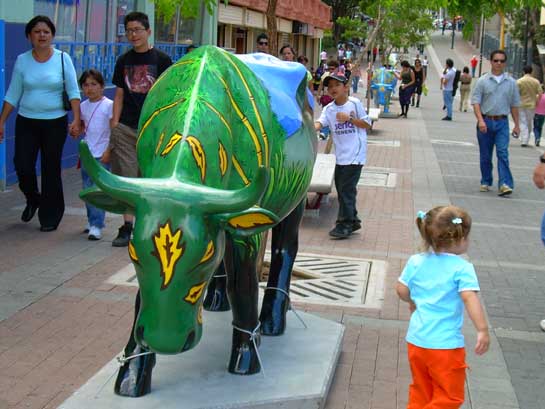 A.M. Costa Rica/Elise Sonray
|
| Unusual
bovine art form mooooves into the city streets |
|
|
By Elise Sonray
of the A.M. Costa Rica staff Oxen are paraded annually in cities throughout Costa Rica. It's just that they usually don't have wings or dinosaur spikes and aren't clad in fuchsia tennis shoes. CowParade has made it to San José and although these are not oxen and are not real they certainly are drawing a lot of attention. Live sized fiberglass creatures uniquely decorated by local artists, line Avenida 4. Children stop to touch the strange bueyes and adults snap photos. CowParade officially started in Chicago, Illinois in 1999. The year before in Zurich, Switzerland, lions, the symbol of the city were displayed in a similar fashion. The idea spread. Many cities have used the idea to raise funds with a variety of animals. But CowParade is the largest of its kind and has traveled to cities all over the world, relying on the hands and creativity of local artists, and the money from bidders across the globe. CowParade is the world’s largest public art event. “CowParade is not meant to be high art. It is first and foremost a public art exhibit that is accessible to everyone,” according to the organization. After the event is over, people bid on the fiberglass cows, and the money goes to a variety of charities, according to CowParade. |
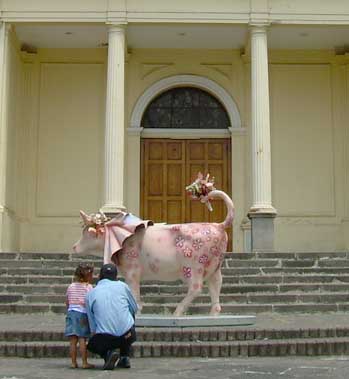 A.M. Costa Rica/Elise Sonray
Even the steps of the La Solidad church host a cow.The first auction in Chicago raised $3 million,
the second, in New York raised more than $1.3 million. Bidders can use
the cowparade.com Web site to bid on cows worldwide.
|
| Patrons
and friends seek to help mother of well-known Santa Ana worker |
|
|
By the A.M. Costa Rica staff
Olga Efimenko moved to Costa Rica from Russia about eight years ago and lived with her 86-year-old mother in Santa Ana, according to a coworker. But Saturday a fire left all her hard work in ashes and inflicted severe burns on her mother. Maria Paula, Ms. Efimenko's mother, heard the family's German shepherd, Rocky, barking Saturday morning and opened the bedroom door, according to friend Joanne Loewen. A curtain of flames rushed at her, and she tried in vain to fight the fire with a garden hose, said Ms. Loewen. Instead, Maria suffered burns to 50 percent of her body, according to Alonso Umaña Calzada, a fireman based in Santa Ana. As for the house, there is nothing left. Even the steel structure melted, said Ms. Loewen. The house fire is speculated to have started from an electrical problem, but the case is still being investigated, reported Umaña Sunday evening. |
Ms. Efimenko, has been a beloved
waitress at Rock & Roll Pollo in
Santa Ana for two years. Coworkers describe her as friendly and kind.
“We all love her a lot, and so do the clients,” said Lina Carrero
Congote, a fellow worker. “She is very special to us and always cares for everyone above herself.” Before that she worked nearby in another establishment frequented by expats. Ms. Loewen, decided to start a fund when she found out what happened. After a beach trip, Ms. Loewen planned to meet Ms. Efimenko at her house. When she saw the damage and heard what happened she began to spread the news and raise funds. Today, Ms. Loewen will set up a bank account and give the number to friends of Ms. Efimenko. She will also hang up posters and donation boxes in local restaurants. By noon on Sunday she had already received $300, she said. The money will go to pay medical bills and provide an existence, she said. Ms. Efimenko's mother has a 60 percent chance of survival, said Ms. Loewen. |
| Preliminary
Semana Santa holiday death toll put at 34 by Cruz Roja |
|
|
By the A.M. Costa Rica staff
The Cruz Roja reported 34 deaths since the beginning of Holy Week. Paramedics rushed 90 people in critical condition to hospitals during the week, reported the Cruz Roja Sunday afternoon. |
Holy Week started on March 16, Palm
Sunday, and ended yesterday, Easter
Sunday. During the week Cruz Roja performed 52 successful rescue operations in bodies of water, on highways and in the mountains, the agency reported. |
 |
 |
 |
| A.M.
Costa Rica advertising is a bargain now with the revaluation of the colon! |
 |
|
|
|
|
| You need to see Costa Rican tourism information HERE! |
| A.M. Costa Rica fourth news page |
|||||||||
| Home |
Tourism |
Calendar |
Classifieds |
Entertainment |
Real
estate |
Rentals |
Sports |
About us |
|
|
|
|||||||||
|
Traditional 'Judas night'
results in arrest of 49 participants
|
|
|
By the A.M. Costa Rica staff
Fuerza Pública officers cracked down hard on street revelers and detained 49 persons Saturday night and Sunday morning. The day was the traditional Quema de Judas or "burning of Judas." The Ministerio de Gobernación, Policía y Seguridad Pública credited José Fabio Pizarro, head of the Fuerza Pública, for the advanced planning and personal supervision that cut short the street disturbances that have marred previous years. The night is similar to Halloween in the United States where youths set fires and damage property, ostensibly to |
punish Judas,
the apostle who betrayed Jesus Christ in Christian tradition. In Barva and Santa Bárbara de Heredia police detained 46 persons. Heredia always is a center for activities on this night. Police said they confronted youths burning trash on the streets and also some who threw stones. Desamparados de Alajuela was another center of gathering youth, police said. Three persons were detained there. Santa Ana also was listed as a location where police encountered youth, although no one was reported detained. |
|
Colombia says one of those
killed in raid was Ecuadorian
|
|
|
By the A.M. Costa Rica wire services
Colombia's defense minister has confirmed that an Ecuadorian citizen was killed during Colombia's controversial March 1 raid on a rebel camp in Ecuador. The minister, Juan Manuel Santos, said Sunday one of two bodies brought to Colombia after the attack belonged to an Ecuadorian. Saturday, Ecuador's President Rafael Correa said diplomatic tensions with Colombia could rise if an Ecuadorian was killed in the raid. Correa ordered an investigation after family members of a |
missing Ecuadorian locksmith named
Franklin Aizalia claimed he was among those killed. The attack inside Ecuador killed more than 20 people, including Raul Reyes, a leader of the Fuerzas Armadas Revolucionarias de Colombia. Ecuador and its ally Venezuela condemned Colombia's raid as a violation of Ecuador's sovereignty. Correa and Venezuela's President Hugo Chavez ordered troops to their borders with Colombia. Tensions eased a week later after the presidents of the three countries met at a regional summit in the Dominican Republic. |
|
Network Solutions closes down
Web site that would have shown film on Islam
|
|
|
By the A.M. Costa Rica wire services
A U.S.-based Internet service provider has closed down a Web site that a Dutch lawmaker had reserved to post a controversial film that is triggering an uproar in much of the Islamic world. The service provider, Network Solutions, said it invoked the suspension after receiving complaints related to the film. A statement posted on the Internet says those complaints are under investigation. Dutch lawmaker Geert Wilders said the 15-minute movie, set for release March 31, will underscore his view that Islam's holy book, the Koran, is fascist. Wilders turned to Internet distribution after TV networks refused to air it. |
Network Solutions also cited
technical reasons for suspending the Web
site, including the anticipated "excessive use of services" by
onlookers who could overload and crash the site. Pakistani officials last month shut down the YouTube video-sharing Web site, because the site carried video clips of the Wilders film. The YouTube ban was lifted days later after Pakistani authorities said the offensive material had been removed. In 2005, Muslims in much of the world mounted protests against Denmark after Danish newspapers published satirical cartoons of the Prophet Muhammad that Muslims found to be offensive. |
|
|||||||||||||||||
| News from
the BBC up to the minute |
BBC sports news up to the minute | ||||||||||||||||
| BBC news and sports feeds are disbled on archived pages. |
|||||||||||||||||
| A.M. Costa Rica fifth news page |
Are
you
still
spending 70 percent You need to fill this space ASAP! |
||||||||
| Home |
Tourism |
Calendar |
Classifieds |
Entertainment |
Real
estate |
Rentals |
Sports |
About us |
|
|
|
|||||||||
 |
 |
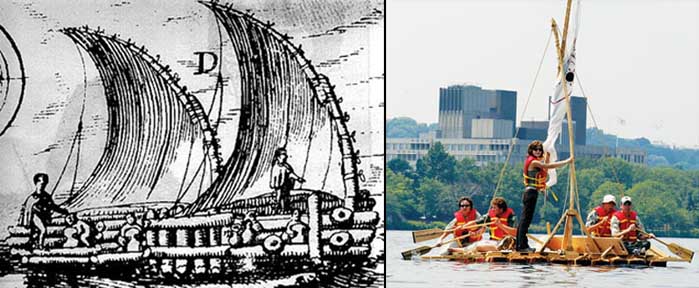 Sketch by Joris von Spilbergen and
Massachusetts Institute of Technology photo by Donna Coveney
|
||
| An early 17th-century sketch of a raft by the
Dutch envoy Joris von Spilbergen in 'Speculum Orientalis Occidentalis
que Indiae Navigation' gives the general |
outline of a seagoing raft, but it took student Leslie Dewan (standing on raft) and her professor to create a workable version. | |
| Cargo rafts carried goods and culture along Pacific coast |
||
|
By the Massachusetts Institute of
Technology
News Office Oceangoing sailing rafts plied the waters of the equatorial Pacific long before Europeans arrived in the Americas and carried tradegoods for thousands of miles all the way from modern-day Chile to western Mexico, according to new findings by researchers in the Department of Materials Science and Engineering at Massachusetts Institute of Technology. Details of how the ancient trading system worked more than 1,000 years ago were reconstructed largely through the efforts of former undergraduate student Leslie Dewan who worked with Professor Dorothy Hosler. Professor Hosler specializes in archeology and ancient technology at the Center for Materials Research in Archaeology and Ethnology. The findings are being reported in the Spring 2008 issue of the Journal of Anthropological Research. The new work supports earlier evidence documented by Professor Hosler that the two great centers of pre-European civilization in the Americas — the Andes region and Mesoamerica — had been in contact with each other and had longstanding trading relationships. That conclusion was based on an analysis of very similar metalworking technology used in the two regions for items such as silver and copper tiaras, bands, bells and tweezers, as well as evidence of trade in highly prized spondylus-shell beads.
|
Early
Spanish, Portuguese and Dutch accounts of the Andean civilization
include descriptions and even drawings of the large oceangoing rafts
but provided little information about their routes or the nature of the
goods they carried. In order to gain a better understanding of the rafts and their possible uses, Miss Dewan and other students in Hosler's class built a small-scale replica of one of the rafts to study its seaworthiness and handling and they tested it in the Charles River in 2004. Later, Miss Dewan did a detailed computer analysis of the size, weight and cargo capacity of the rafts to arrive at a better understanding of their use for trade along the Pacific coast. "It's a nontrivial engineering problem to get one of these to work properly," explained Miss Dewan, who graduated last year with a double major in nuclear engineering and mechanical engineering. Although the early sketches give a general sense of the construction, it took careful study with a computerized engineering design program to work out details of dimensions, materials, sail size and configuration, and the arrangement of centerboards. These boards were used in place of a keel to prevent the craft from being blown to the side and also provided a steering mechanism by selectively raising and lowering different boards from among two rows of them arranged on each side of the craft. Although much of the raft design may have seemed familiar to the Europeans, some details were unique, such as masts made from flexible wood so that they could be curved downward to adjust the sails to the strength of the wind, the centerboards used as a steering mechanism, and the use of balsa wood, which is indigenous to Ecuador. Miss Dewan also analyzed the materials used for the construction, including the lightweight balsa wood used for the hull. Besides having to study the aerodynamics and hydrodynamics of the craft and the properties of the wood, cloth and rope used for the rafts and their rigging, she also ended up delving into some biology. It turns out that one crucial question in determining the longevity of such rafts had to do with shipworms — how quickly and under what conditions would they devour the rafts? And were shipworms always present along that Pacific coast, or were they introduced by the European explorers? Shipworms are molluscs that can be the width of a quarter and a yard long. "Because balsa wood is so soft, and doesn't have silicates in it like most wood, they are able to just devour it very quickly," Miss Dewan said. "It turns into something like cottage cheese in a short time." That may be why earlier attempts to replicate the ancient rafts had failed, Dewan said. After construction, those replicas were allowed to sit near shore for weeks before the test voyages. "That's where the shipworms live," Miss Dewan said. "One way to avoid that is to minimize the amount of time spent in harbor." Dewan and Hosler did a simulation of the amount of time it would take for shipworms to eat one of the rafts and concluded that with proper precautions, it would be possible to make two round-trip voyages from Peru to western Mexico before the raft would need replacing. The voyages likely took six to eight weeks, and the trade winds only permit the voyages during certain seasons of the year, so the travelers probably stayed at their destination for six months to a year each trip, Miss Dewan and Professor Hosler concluded. That would have been enough time to transfer the detailed knowledge of specific metalworking techniques that the professor had found. While Professor Hosler's earlier work had shown a strong likelihood that there had been contact between the Andean and Mexican civilizations, it took the details of this new engineering analysis to establish that maritime trade between the two regions could indeed have taken place using the balsa rafts. "We showed from an engineering standpoint that this trip was feasible," Miss Dewan said. Her analysis showed that the ancient rafts likely had a cargo capacity of 10 to 30 tons — about the same capacity as the barges on the Erie Canal that were once a mainstay of trade in the northeastern United States. Professor Hosler said the analysis is the first paper of its kind to use modern engineering analysis to determine design parameters and constraints of an ancient watercraft and thus prove the feasibility of a particular kind of ancient trade in the New World. And for Miss Dewan, it was an exciting departure from her primary academic work. "I just loved working on this project," she said, "being able to apply the mechanical engineering principles I've learned to a project like this, that seems pretty far outside the scope" of her work in nuclear engineering. |
|
| A.M. Costa Rica Sports news local and from the wires |
 |
|
|
|
|
|
|
|
|
|
|
||||||
|
||||
|
|
|
|
|
|
|
|
|
|
|
|
| What we published this week: | Monday | Tuesday | Wednesday | Thursday | Friday | Earlier |
|
|