|
 |
Your daily |
 |
|
|
|
|
|
|
|
|
|
|
|
|
|||||||||||
|
|
|||||||||||
 |
| A.M. Costa Rica Second newspage |
 |
||||||||
| Home |
Tourism |
Calendar |
Classifieds |
Entertainment |
Real
estate |
Rentals |
Sports |
About us |
|
|
|
|||||||||
 |
| Costa Rica Expertise Ltd http://crexpertise.com E-mail info@crexpertise.com Tel:506-256-8585 Fax:506-256-7575 |
 Click HERE for great
hotel discounts
|
|
Tourism, Fuerza Pública
duo
suspended for theft probe By Elise Sonray
of the A.M. Costa Rica staff A court has suspended two police officers accused of stealing a tourist's video camera in Jacó, said officials Monday. The Juzgado Penal de Hacienda of the Segundo Circuito Judicial in Goicoechea suspended each officer for three months, said Kattia Chavarría, director of Polícia Turistica. One of the officers who has the last name of Méndez works for the Polícia Turistica, and the other officer who has the last name of Ulloa works for the Fuerza Pública in Jacó, said officials. Officials from both the tourism police and Fuerza Pública made it clear that the two officers were not accused of actually stealing the video camera from the tourists' car. “Four Colombians jimmied the lock and stole the camera from a window of the car,” said Chavarría. “The officers retrieved the stolen camera,” she added. One woman said she witnessed the event, and that the police officers did not give the camera back to the tourists, who were visiting from Argentina. The event took place at Playa Hermosa, said officials. Chavarría said that the Polícia Turistica would take the appropriate disciplinary actions, and she was sure the Puntarenas division would do the same. “This is not the image of the Polícia Turistica that we want, nor is it the image we want for the country,” said Chavarría. “It is not right” she added “we don't want officers of this type on the force,” she said “It is quite possible there will be a trial,” said Chavarria, “but nothing will be definite until the investigation is complete, she added.” Police will scan fans at Iron Maiden concert By the A.M. Costa Rica staff
The Fuerza Pública said that 200 officers will guard entrances and check for drugs at the Iron Maiden concert tonight. The heavy metal concert, scheduled for 8 p.m., is expected to draw a full house, according to reports. Although private security will be inside the Estadio Ricardo Saprissa, Fuerza Pública will be on the watch outside the gates, said José Fabio Pizarro, director of the Fuerza Pública. The main goal is to deter people from using or selling of drugs at the concert, said officials. Various Fuerza Pública units will join with members of the Policía de Control de Drogas and the Dirección de Investigaciones Especializadas to keep watch outside of the stadium, said Pizarro. This is the first performance of the English heavy metal band in Costa Rica. The group, founded in 1975, has a large following in the country as police already had to disperse fans from camping outside the stadium Friday, said officials. Fan Web sites, say the concert will be the biggest in the history of Costa Rica. Three men get 17 years in San Ramón kidnapping By the A.M. Costa Rica staff
A court sentenced three men to 17 years in prison each on kidnapping and robbery charges, the Poder Judicial said Monday. Two other men were acquitted of all charges, said court officials. The Tribunal de Juicio of San José, sentenced Elio Torres Díaz, Daniel Jovel Méndez Rochez and Carlos Alberto Varela Granada to 17 years in prison and ordered them to pay 5 million colons (about $10,000) for “moral and material damages.” The men were accused of kidnapping Allan Arrieta González, a businessman from San Ramón, Alajuela, in September of 2006. The kidnappers demanded a ransom of $650,000, said officials. Arrieta gave his captors two checks for the sum, according to authorities. The five suspects were detained later the same month and all were found to be illegally in the country, said officials. The court acquitted José Ángel González Arce and Jariz Murillo Riascos of all charges, said officials. Al Gore's associate to talk on tourism, climate change By the A.M. Costa Rica staff
A member of environmental activist Al Gore's Climate Change Project is giving a lecture here today. He is Gary Dunham, a 71-year-old former environmentally-indifferent Republican. He will address climate change and its effect on tourism. Dunham's presentation will touch on tourism's contribution to carbon emissions, according to an announcement. Dunham came out of retirement and uprooted his family from Houston to Nashville to become the director of operations for the former vice president's Climate Project. Dunham created the infrastructure for more than 1,000 Climate Project “messengers” to give the slide show presentation all over the world. He will conduct the presentation today at 2 p.m., on the third floor of the Instituto Costarricense de Turismo building in La Uruca.
|
 |
 |
 |
 |
| A.M. Costa Rica third newspage |
 |
||||||||
| Home |
Tourism |
Calendar |
Classifieds |
Entertainment |
Real
estate |
Rentals |
Sports |
About us |
|
|
|
|||||||||
 |
 |
 |
 |
| Executive
branch sends up proposal for security commission |
|
|
By the A.M. Costa Rica staff
The executive branch sent a proposal to the legislature Monday to create a commission to study ways to stem the nation's crime wave. The measure is No. 16.917 which would empower a legislative committee to compile, study, report and propose legal reforms to improve citizen security. Casa Presidencial coupled this announcement with a quote from President Óscar Arias Sánchez that seemed to put blame on citizens who try to protect themselves. "With a surprising velocity, violence has past from being condemned by the Costa Rican society to be justified as a legitimate way to protect ourselves," said the quote from Arias. "We have returned to the epoch of vengeance, the law of retaliation, the slogan of nowadays and everyone who clamors for their own idea of punishment. This is not the Costa Rica that we inherited from our past." Arias actually used the Spanish phrase Ley del Talión, which does not seem to have a direct English translation but is known in Engish law by the Latin name lex talionis. The concept of retribution stems from the earliest legal codes and is best summarized by the Old Testament mandate of an eye for an eye, and a tooth for a tooth. Arias is known to be upset by the rapid increase in gun ownership in the country as citizens arm themselves for protection. He has spent a lifetime trying to limit the world weapons market. Casa Presidencial called the problem of security the major concern of the citizens. During periods when the Costa Rican Constitution does not |
require the Asamblea Legislativa to
meet, lawmakers can and usually are
called into session by the executive branch which has the right to set
the agenda. This is why Casa Presidencial is sending the measure to the
legislature. The exact wording of the measure was unavailable Monday
night. There is another measure already in the legislature. That is No. 16.977 that was filed Nov. 22 by Luis Antonio Barrantes Castro, a member of the Movimiento Libertario. The bill summary has some grim statistics, including the claim that between 1992 and 2004 only 6 percent of the crimes were punished. The summary said that during that period only 11 percent of criminal cases ended in judicial sentences and only 54 percent of the sentences were convictions. The measure also cites statistics from the Poder Judicial that say that in the first four months of 2005 there were 2,997 robberies of pedestrians, 412 robberies of vehicles, 469 robberies of stores, 241 robberies of homes, 93 robberies of businesses, 70 robberies of bus drivers, 265 robberies of delivery truck drivers, 52 robberies of messengers, 25 robberies of offices and four attacks on armored cars. But Barrantes also notes in his bill that many crimes are not reported. He suggests beefing up penalties against thefts. Many are not prosecuted now if the value of the goods stolen are under 100,000 colons or about $200. He also wants to make technical changes to the self-defense sections of the penal code. There was no suggestion how long it may take the legislature to act on the measure presented by Casa Presidencial or how long the bill would give the security committee to study and make a report. Some have said this may take a year or more. |
| Crime
in a small section of the city shows extent of problem |
|
|
By Bryan Kay
Special to A.M. Costa Rica A 17-year-old girl walking with her friend is robbed at gunpoint and then subjected to an indecent sexual assault. A 71-year-old retired pastor walking with his wife is almost knocked over by a moving vehicle full of thieves as they rip a bag from his shoulder. A 36-year-old who leaves his car for just five minutes is relieved of his laptop after baseball bat-wielding robbers smash the vehicle’s window to steal the booty in front of shocked passers-by. An analysis on the news
What do all of these incidents have in common? The victims said they occurred in the Calle Blancos area of north San José, went unreported and so remain alleged crimes. And there lies the crux of the Costa Rica crime problem, according to popular opinion. There is a widespread lack of faith in the justice system and its ability to either convict perpetrators of crimes in the first place or hammer them adequately enough for their dirty deeds. The scale of the problem led Jorge Rojas Vargas, the chief of the Judicial Investigating Organization to tender his resignation towards the end of last year. He was an outspoken critic of the failure of the wheels of justice and a lack of police officers, particularly detectives for his own arm of the country’s judicial structure. The move by Rojas may be viewed by some as a masterstroke, but others might point to the fact a string of government ministers and family members were the victims of various forms of robberies themselves and finally lurched into action. The Arias administration earmarked funds for 500 more investigators, and Rojas swiftly rescinded his resignation. But there’s another facet to the crime problem. There are |
apparently those who would prefer to
pretend the problem doesn’t exist
in Costa Rica, despite official statistics — which exclude the alleged
hundreds of unreported incidents — showing rising crime. One expat
businessman who gave an honest assessment of the security situation to
an international newspaper said he received a phone call from a fellow
foreigner with business interests here and was accused of “trying to
ruin her trade.” Costa Rica’s crime wave seems to be part of a wider pan-Central American phenomenon. Guatemala and El Salvador have long been associated with rampant crime, much of it violent. Costa Rica has been popularly viewed as more secure. Crime here is not nearly on the same scale as Guatemala, Honduras or El Salvador, but even crime in those countries is rising at a time when the region is apparently seeing economic growth. Further north, many of the problems are related to impunity. Some have attributed at least part of the blame for Costa Rica’s problems on the ills of such regional neighbors. They claim the crime problem has spread like a virus through the country’s borders due to the lax immigration policies of previous administrations. So far, impunity here has not reached such levels, but serious incidents like those said to have occurred in Calle Blancos continue to go unreported, and there are those who apparently still hide from the facts. The expat businessman who gave a frank assessment of the situation as he saw it says he is breathing a little more easily now that the people who make the decisions that matter appear determined to take steps against crime. He may be optimistic. Changes in the criminal laws are bogged down in the legislature, and Rojas has a big job to train 500 investigative recruits. Meanwhile, the prosecutorial branch and the courts take potshots at each other, and the media highlights the most recent judicial misstep. |
|
|
|
|
| You need to see Costa Rican tourism information HERE! |
| A.M. Costa Rica fourth news page |
|||||||||
| Home |
Tourism |
Calendar |
Classifieds |
Entertainment |
Real
estate |
Rentals |
Sports |
About us |
|
|
|
|||||||||
 |
| U.S. residents may share Costa Rican-style constrictors |
|
|
By the A.M. Costa Rica staff
and U.S. Geological Survey reports. Call it the downside of globalization, but researchers in the United States fear a surge in foreign constrictor snakes after Burmese pythons, one of the world's largest snakes, were found in Florida. Residents of Costa Rica live with snakes but ever see them infrequently. Even in San José big snakes have been known to decorate doorknobs or door frames. One did so at the offices of A.M. Costa Rica in August 2004. Researchers think the Burmese pythons, called an invasive species, could gain a big foothold, er toehold, er hold on a good part of the southern United States. Big constrictors are not normally seen in the United States and the Sonora Desert usually keeps Latin species from immigrating. The Burmese pythons are presumed to be the offspring of pets that gained freedom. Burmese pythons could find comfortable climatic conditions in roughly a third of the United States according to new climate maps developed by the U.S. Geological Survey. Although other factors such as type of food available and suitable shelter also play a role, Burmese pythons and other giant constrictor snakes have shown themselves to be highly adaptable to new environments, the survey said. The just-released maps can help natural resource agencies manage and possibly control the spread of the non-native giant constrictor snakes, such as the Burmese python, now spreading from Everglades National Park in Florida. These climate match maps show where climate in the U.S. is similar to places in which Burmese pythons live naturally from Pakistan to Indonesia The snakes regularly reach 23 feet in length and 200 pounds. They have been known to eat alligators in the Everglades. The maps show where climate alone would not limit these snakes. One map shows areas in the U.S. with current climatic conditions similar to those of the snakes' native ranges. A second map projects these climate matches at the |
 U.S. Geological Survey map
Where researchers believe Burmese pythons can liveend of this century based on global warming models, which significantly expands the potential habitat for these snakes. Biologists with Everglades National Park confirmed a breeding
population of Burmese pythons in the Florida Everglades in 2003. Python
populations have since been discovered in Big Cypress National Preserve
to the north, Miami's water management areas to the northeast, Key
Largo to the southeast, and many state parks, municipalities, and
public and private lands in the region. Florida also hosts many other
species of foreign snakes. Researchers are also conducting a risk assessment for nine species of giant constrictors (including boa constrictors and yellow anacondas) that are prevalent in the pet trade and as such, potential invaders in the United States. |
| U.S.
officials say they expect little change in Raul's Cuba |
|
|
By the A.M. Costa Rica wire services
The United States said Monday the official transfer of power in Cuba from Fidel Castro to his younger brother Raúl was a disappointment, though hardly an unexpected development. The White House said the long-standing U.S. economic embargo against Cuba's communist government will continue. Bush administration officials have brushed aside suggestions that Raúl Castro may be a more pragmatic leader than his brother or a potential reformer, and they are making clear there will be no change in U.S. policy toward Cuba with the younger Castro now confirmed as president. In a talk with reporters on Sunday's unanimous decision by Cuba's National Assembly naming Raúl Castro the new chief executive, State Department deputy spokesman Tom Casey said anyone hoping for some kind of real transition in Cuba would be disappointed by the outcome. Casey said the continuation of the "Castro family dictatorship" is not something the United States wanted to see, nor is it in the interests of the Cuban people. |
"We'll see what, if any, differences
there are in terms of the policies
that are pursued," he said. "But in terms of the most important
policies, I unfortunately don't see much difference at this point. "We still have a government that believes it's appropriate to keep people held as political prisoners, to deny the population their basic political and human rights, and to continue with a system of governance that is fundamentally a dictatorship," he added. There were similar comments at the White House from press secretary Dana Perino who said President George Bush's position on maintaining the decades-old U.S. economic embargo on Cuba has not changed. A commission formed by Bush issued a report two years ago offering Cuba wide-ranging U.S. economic and other assistance if it set free elections. Spokesman Casey said the United States will continue to hope for, and do what it can to encourage that kind of transition. But he said the handover of power from one member of the Castro family to another does not bode well for Cuba's immediate political future. |
|
|||||||||||||||||
| News from
the BBC up to the minute |
BBC sports news up to the minute | ||||||||||||||||
| BBC news and sports feeds are disabled on archived pages. | |||||||||||||||||
| A.M. Costa Rica Sports news local and from the wires |
 |
|
|
|
|
|
|
|
|
|
|
||||||
|
||||
|
|
|
|
|
Food, festivals, arts, entertainment, poker |
|
|
|
|
|
|
|
|
|
|
| Sunday will be dog day in
Curridabat at the Festival de Canes |
|
|
By the A.M. Costa Rica staff Dog owners will come together for a day of canine appreciation Sunday for the 11th Festival de Canes. Kings and queens of the country's pooches will be elected during the festival that will have all the trimmings of similar Costa Rican community events that focus more on the human side of things. Owners whose pets look just like them, those whose dogs have special talents or don't mind being dressed up will also be in with the chance of winning one of the competitions. Competitions for animals will run alongside games for children, and music will be played while dishes for both owners and their pets will be on sale at the event, to be held in Plaza de Deportes José Maria Zeledon in Curridabat. Less entertaining, but more essential, pet care needs will also be attended to, such as parasite removal and vaccination at low prices, and pet-care tools and toys will be on sale. People without a pet to enter this year can adopt a new one which the organisers guarantee will already have been vaccinated, castrated and be free from parasites. Proceeds from the event will go to the Asociación Nacional |
 A.M. Costa Rica image
Pooches will get the chance to
become kings and queens at Sunday's Festival de CanesProtectora de Animales, which educates about animal wellbeing, and protects against animal cruelty. The festival starts at 10 a.m., and finishes at 4 p.m. More information can be found at http://www.anpacostarica.org/festival.htm. |
| Art Galleries .... |
|||
Rembrandt exhibition opens to high acclaim in downtown San José  Hailed
as the most important exhibition of the year, a collection of
the Dutch master Rembrandt's etchings opened amid much praise Thursday. Hailed
as the most important exhibition of the year, a collection of
the Dutch master Rembrandt's etchings opened amid much praise Thursday.
The 48 etchings usually reside in Amsterdam's Rembrandt House Museum, where the artist lived for about 20 years from 1620-40. They were collaboratively chosen from a wider collection by Dora Maria Sequiera, the director of Museos del Banco Central and Ed de Heer, the director of the Rembrandt House Museum. Although now better known for his marvelous paintings that capture intense emotion, facial expression, and deeply contrasted light and shadow, the etchings that are now on show in San José are considered by art buffs to be just as important. “Rembrandt was the most influential and original etchers possibly of all time,” said de Heer. “He is a shining beacon because he changed etching from a reproductive medium to a fully fledged artistic medium. “He used all sorts of different techniques to get all the possibilities out of the medium — he printed on copper plate, parchment, even sheepskin to make luxurious editions of prints. He didn't want any two to be the same.” Read more - click here Chicken suits, foot photos brought to Galeria Nacional by art colony residents  Those with a sharp
eye who look closely at Nancy Ennis' collages will
find a man in a chicken costume haunting each one. Those with a sharp
eye who look closely at Nancy Ennis' collages will
find a man in a chicken costume haunting each one. In some, he is the main focus of the piece, and in others he is as invisible as a smudge behind a layer of material. “One of my kids gave me this photo of their Dad when younger,” said Mrs. Ennis, as she pointed out the eerie figure, standing amid her as-yet unhung exhibition in the Galeria Nacional. “I like it because my ex-husband was a very funny man, although very irresponsible.” Mrs. Ennis, an American who lives in New Jersey, has been creating artwork on Costa Rican soil for the last six weeks, working in a private artists colony in Ciudad Colon. She is one of several dozen who seek out Costa Rica's tropical climes each year to spend a residency in the Julia and David White Artists' Colony. Read more - click here |
Imagen V show has a few gems but a pack of clinkers, too  New media art is
always a bit hit and miss with the potential to come
across as a foundationless piece of pretension if it is not done well. New media art is
always a bit hit and miss with the potential to come
across as a foundationless piece of pretension if it is not done well. The Bienal Iberoamericana Inquieta Imagen V, a competition for video artists from across Latin America, is a good example of this, containing a few pieces that engage well with the subject and make the most of their medium, but many that leave the viewer cold. Most of the works are video projections, some as short as a pistol shot and the flight of birds and some as long as a didactic letter that teaches about identity, isolation and fuschia flowers. Read more - click here Exhibit condemning illegal fishing would be better elsewhere For a while now, a large marquee has been standing outside the Museo de Arte y Diseño Contemporaneo in San José. In it hangs what has variously been described as an enormous bee hive, a throwback to sixties glow lamps or a swarm of schooling fish. The last explanation is the one that the artists propound. Huge, blue, glowing and transparent, the structure extends almost four meters down from the ceiling, nearly equaling its height with its width. It tapers towards the end, putting one in mind of a chrysalis, and its outside is made totally of clear nylon wires. Read more - click here Mistaken identity? No such thing, says new exhibition  Costa Rica is
a land of volatile volcanoes, orchids, coffee fincas,
Catholicism and Ticos. Costa Rica is
a land of volatile volcanoes, orchids, coffee fincas,
Catholicism and Ticos. Or you could say it's a country of wide seashores, football stadiums, fast food restaurants and beach towns overtaken by Gringos. Some are clichéd symbols of a tourist nation, while others are part of the country's changing culture, but all are involved in Museo de Arte Costarricense's new exhibition that challenges viewers to reconsider their own perceptions of the nation. Read more - click here |
||
| Food... |
|||
Mini-mall comes to the rescue of the not-rich-but-hungry  For those in the know, there is a clean, affordable, relatively quiet gastronomic surprise off the pedestrian mall in downtown San Jose. Between Arenas clothing store and the Patio Restaurant, behind a perfume counter and a Pops Ice Cream sits a food court without a McDonald's, Wendy's, Subway or Church's Chicken in sight. Tropical Food is a counter selling relatively healthy food. While their batidos aren't as delicious as the ones found at FrutiLand in Mall San Pedro, the water-or-milk- blended-with-fruit drink is a refreshing treat to carry during your walk along Avenida Central. A batido with the fruit of your choice mixed with water costs 650 colons, with milk, 750 colons. That's from $1.30 to $1.50. Adding honey or granola takes you up to a still-reasonable 900 colons ($1.80). The store also peddles fruit salads, ranging from 700 to 1.600 colons ($1.40 to $3.20). Marisqueria produces delicious looking and smelling seafood dishes. A customer-friendly hanging chalkboard lists their menu and respective prices. A small corvina ceviche will set you back 1,950 colons ($3.90). Get a small rice with shrimp for 2.150 colons ($4.30), 2,800 ($5.60) for a larger serving. Or try one of the fish filets prepared several different ways, the cheapest being with oil and garlic for 2,600 ($5.20) colons, the priciest fish filet dish is 3,600 colons ($7.20) for relleno with ham and cheese. Click here to read more |
Festive season proves troublesome even for established restaurant 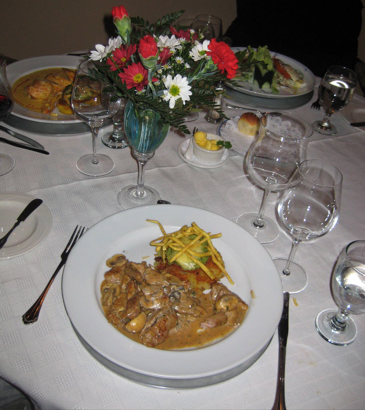 Being a chef in a
busy kitchen must be a pretty stressful job, but
around Christmas stress is something any successful restaurant should
factor in as inevitable. Being a chef in a
busy kitchen must be a pretty stressful job, but
around Christmas stress is something any successful restaurant should
factor in as inevitable. On a second visit to well-reputed French restaurant Le Chandelier, it soon became obvious that the staff were poorly equipped for the onslaught of Christmas party diners on a Tuesday night, leaving the usually decent food to deteriorate into a procession of almost inedible starters and bland entrees. Set in an old San Pedro house with brick ceilings and wooden beams that was converted into a restaurant around 15 years ago by Swiss owner Claude Dubuis, Le Chandelier purports to offer French cuisine that has been developed over generations of experience. Click here to read the full review A great meal is not all in the presentation 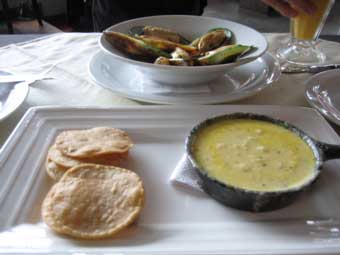 With a vaulted
glass ceiling, palm trees lining the pathway and posh lighting, one
would not expect Saga restaurant to be settled behind a dull parking
lot in Escazú. With a vaulted
glass ceiling, palm trees lining the pathway and posh lighting, one
would not expect Saga restaurant to be settled behind a dull parking
lot in Escazú. Although this restaurant may look out of place, it doesn't deviate much from the norm in Escazú, an area many would classify as suburban sprawl. The majority of the cuisine at Saga seems to fit with the setting: classy presentation, yet lacking any profound flavors. Although the restaurant boasts itself as an “international food restaurant” on its Web site, much of the inspired cuisine is lacking the depth which would be found in authentic dishes. Click here to read the full review |
||
| Dramatic Arts... |
|||
Verdi's operatic masterpiece to be performed in Teatro Melico Salazar High culture does not come to Costa Rica with great frequency, so operatic souls will be pleased to hear of the arrival of an Italian-produced "Rigoletto" to San Jose. Two Ticos and two Guatemalans will be part of the cast, who will perform in Teatro Melico Salazar Friday, Saturday and Sunday. "Rigoletto" was Verdi's first operatic masterpiece in his later career, and it is now one of the 10 most performed operas in the world The title character is a hunchbacked jester to a duke. The nobelman lustfully pursues women, whether they are married or not, often against their own will. Rigoletto is happy to be the duke's accomplice until the time that the duke's affections fall on his own daughter, Gilda. Unknown to Rigoletto, Gilda and the duke have fallen in love, and the young lady gets abducted to the palace. Read more - click here |
Sunny days in San José complemented by free concerts  The hot dry days
are being put to good cultural use by the Museos del
Banco Central with a series of outdoor concerts in the middle of the
downtown area. The hot dry days
are being put to good cultural use by the Museos del
Banco Central with a series of outdoor concerts in the middle of the
downtown area. Hundreds of shoppers stopped to lean over the balcony in Plaza de la Cultura for the first concert, when the Costa Rican singer MAF and her band played a sunny set of pop tunes outside the doors of the museum. Although the series is named 'Conciertos en las gradas', fewer people sat to on the steps outside the Museo de Oro than stood around the edges, looking down at the stage. Miriam Jaraquín and Blues Latino will bring piano and accordion, flute and saxophone to the stage at midday on March 2, with an acoustic jazzy sound. The final concert of the series will be on March 29, with trio Villegas playing some classic Spanish rock from 2 p.m. |
||
| Books ... |
|||
Land use in Costa Rica documented by Fulbright scholar Forty years of living in the jungle, moving between secluded forestry stations and research labs, has led Louisiana resident and NASA veteran
Click here to read more |
New book dwells on the social aspects of food Food is not just a selfish pleasure or a way to stifle hunger, but is central to the evolution of art, according to a new book published by Museos del Banco Central. Artworks by Costa Rican painters are the main content of the hardback book, “Imagenes para Comer,” which follows the representation of food in art since still life painting became popular in the Renaissance. Full-color pictures of both traditional and modern works are far more common than recipes, as the author Marjorie Ross only provides seven recipes within the book. All are traditional Costa Rican dishes showing influences from different sections of the community, such as corn fritters, white beans and chorizo and fruit salad. The book focuses on the meanings that food has within society, and how these are portrayed by art. Click here to read more |
||
| Heads-up poker techniques are playing your opponent | |
| Online
play has revived no limit Texas hold’em heads-up poker, a game that has
become especially popular among today’s young players. Even I’ve
become caught up in this trend. The correct strategy in heads-up poker is based on identifying and acting upon your opponent’s strengths and weaknesses. There are also specific bet-sizing and positional play considerations that will make you more successful in this challenging format. Get aggressive on the button In poker, position is power. When you’ve got position, play more hands and apply more pressure before the flop. There’s a misconception that you should always raise three times the big blind. Well, that’s not the case in heads-up play. A raise of that size can actually encourage your opponent to play more conservatively. It may, in fact, force him to fold his marginal hand. That’s bad because you want him to play more pots after the flop — not fewer — when you’re in charge. Consider this example. In heads-up play with 10/20 blinds, you’ve got 1,500 chips in front of you and make a huge raise to 500. Your opponent will only call if he’s got a premium hand. More likely, though, if he does have the goods, he’ll move all-in. That would be a disaster for you unless you’ve got a monster hand yourself. A minimum raise may seem weak, but in heads-up play, it’s actually a decent option when you’ve got position. Tighten up out of position If you merely make the minimum raise on the button while your opponent elects to raise three times the blind when it’s his button, it might seem that he has the advantage because he’s playing bigger pots in position. You can offset that perceived advantage, however, by only playing premium hands out of position, and laying down all others. Yes, it’s true that your opponent will often pick up the blinds before the flop. But on the other hand, he’ll get fewer opportunities to play big pots when he’s in position. If your opponent chooses to make minimum-sized raises, you’ll probably end up playing a few more hands since the price being laid is less significant. Play marginal hands cautiously A heads-up match features plenty of back and forth jabbing. |
 Jab all you want but don’t throw a wild knockout punch that could leave you open to a crippling counterpunch. You don’t want to be all-in on the flop unless you’ve got a monster hand or a monster draw. Play marginal hands cautiously after the flop by checking or making small bets no larger than 50-65 percent of the pot. If you’re raised, lean towards folding unless you sense a bluff and have a hand that is strong enough to call with. Don’t bluff too much The biggest mistake in heads-up play is that players attempt too many pointless bluffs in hopeless situations. Bluffing is most effective when done sporadically; bluff too often and you’ll blow your credibility. It’s far more effective to try to trap your opponent into making the first big mistake, especially if you’re a better player than he is. Induce bluffs This can be a deadly weapon when playing out of position against an aggressive opponent. Try checking your strong hand all the way down when facing an aggressive player who’s capable of bluffing a hand to the river. The reasoning is simple. If he has nothing and you bet, he’ll fold. If he has nothing and you check, he may bluff. If he also has a strong hand, well, he’ll do the betting for you. Once your opponent figures out that you’re using this ploy, you’ll have him tamed. He’ll likely play less aggressively in future hands. Visit www.cardsharkmedia.com/book.html for information about Daniel Negreanu’s new book, "Hold’em Wisdom for All Players." © 2008 Card Shark
Media. All rights reserved.
|
|
|
|
|
|
|
|
|
|
|
|
|
| What we published this week: | Monday | Tuesday | Wednesday | Thursday | Friday | Earlier |
|
|