|
 |
Costa Rica Your daily |
 |
|
|
 |
|
|
|||||||||||||||||||
 |
||||||||||||||||||||
 |
||||||||||||||||||||
|
|
|||||||||||||||||||
 |
 |
| What we published this week: | Monday | Tuesday | Wednesday | Thursday | Friday | Earlier |
|
|
|
|
|
|
|
Food |
|
Jo
Stuart |
|
|
 |
| A.M. Costa Rica's Second news page | |||||||||
| San José, Costa Rica, Friday, Feb. 17, 2012, Vol. 12, No. 35 | |||||||||
|
|
|
|
|
|
|
Food |
|
Jo
Stuart |
 |
 |
 |
|
in his visit to legislature By
the A.M. Costa Rica wire services
Former Costa Rica president José María Figueres Olsen maintained his innocence during a hearing Thursday at the Asamblea Legislativa, where lawmakers wanted to hear about his relationship with a telecom firm that has been involved in corruption. The hearing was held by the Comisión Permanente Especial de Control de Ingreso y Gasto Público. Christia María Ocampo Baltodano, a lawmaker from Figueres' own Partido Liberacion Nacional said that the commission members are not there as judges but rather to observe. She was one of the lawmakers who didn't accuse Figueres or mock him. The ex-president was being questioned because he was involved in the ICE-Alcatel scandal because he accepted $900,000 as a consultant for the telecom firm. Lawmaker Néstor Manrique Oviedo Guzmán from Partido Acción Ciudadana said he did nothing to earn the consultation fee. Figueres had left the country for eight years after getting paid the $900,000. His declaration on television also was open to the public. Besides media filling up the room and hallways, there was a small seating area specifically for the general public. Figueres maintained that he did nothing to influence a decision by the Instituto Costarricense de Electricidad to award the Alcatel CyL firm a cell telephone contract. Figueres was involved with the firm while he lived in Europe. He is the son of José Figureres Ferrer, the founder of the modern Costa Rican state. Figueres Olsen declined to appear at a legislative hearing seven years ago at the height of the Alcatel scandal. That was the case that resulted in the conviction of former president Miguel Ángel Rodriquez Echeverría and others. Rodriguez, despite his conviction, denies his guilt and has continued to appeal. U.S. driver dies in crash By
the A.M. Costa Rica staff
An American citizen died following a traffic accident Thursday in Miramar de Puntarenas. The man was 69-year-old Oliver Benton Stearns, according to the Judicial Investigating Organization. A report said the man and his wife arrived Thursday from the United States and were headed toward a farm property they had. Apparently Stearns lost control of the vehicle, a Hyundai Galloper, and crashed into a delivery truck parked outside of a warehouse, agents reported. He died on scene, the report said. His wife was transported to Clínica de Miramar in stable condition, they added. Body found in city lot By
the A.M. Costa Rica staff
A homeless man wandering Wednesday night through a lot in Hatillo I discovered a body wrapped in plastic bags. According to police, the man notified another passerby and that man alerted the authorities. Agents say the body has not been identified and had been in the lot some time. Physicians at the Judicial morgue will do an autopsy to determine the cause of death. Another offshore quake By
the A.M. Costa Rica staff
Another moderate earthquake took place in the Pacific Ocean off of Dominical just 42 minutes after midnight Thursday. The magnitude was estimated at 3.8 by the Laboratorio de Ingeniería Sísmica at the Universidad de Costa Rica. This is in the same area that has hosted dozens of earthquakes in the last few weeks.
|
||||||||||||||||||||||||||||||||||||||
 |
|||||||||||||||||||||||||||||||||||||||
|
|
|
|
|
|
|
Food |
|
Jo
Stuart |
| What we published this week: | Monday | Tuesday | Wednesday | Thursday | Friday | Earlier |
| The contents of this page and this Web site are copyrighted by Consultantes Río Colorado 2012 and may not be reproduced anywhere without permission. Abstracts and fair use are permitted. Check HERE for details | ||||||
 |
 |
 |
| A.M. Costa Rica Third
News Page |
|
| San José, Costa Rica, Friday, Feb. 17, 2012, Vol. 12, No. 35 | |
|
|
|
|
|
|
|
Food |
|
Jo Stuart |
 A.M.
Costa Rica photos/Andrew Rulseh Kasper
Marité Valenzuela
displays
photos of historic homes in her neighborhood as equipment nearby awaits
the go-ahead. |
|
| San Jose's new Barrio Chino is not
without its unhappy critics |
|
|
By
Andrew Rulseh Kasper
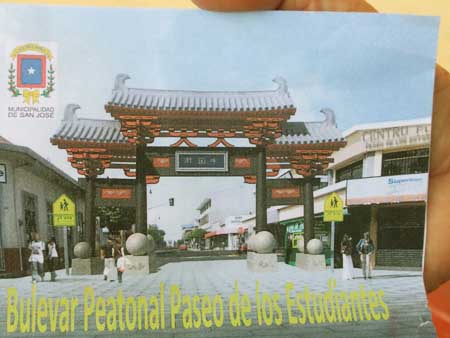
of the A.M. Costa Rica staff A groundbreaking ceremony for the construction to create San José's Barrio Chino, brought acclaim from many excited residents but also criticism. The construction will turn 600 meters of Calle 9 into a pedestrian-only boulevard lit by Chinese-style lamps. The project also will erect a Chinese-style archway over the start of the new walkway, which begins at the Plaza de Los Artes. The work will begin Friday, take roughly one year to complete and will cost 700 million colons, about $1.4 million. The Chinese government donated around 70 percent of the cost, the Municipalidad de San José said. Mayor Johnny Araya is a big promotor of the plan. The remodeling of the street is being done in the year of the Chinese dragon and is meant to create a cultural space for the many Chinese immigrants who have settled and opened businesses along Paseo de los Estudiantes. But the so-called improvements aren't seen as improvements by everyone. One owner of a shop located on the Plaza de los Estudiantes worried how the construction and reduced car traffic would affect his business. He said the last large project done years ago to construct the first walking-only boulevard that runs into the plaza from the west along Avenida 4, nearly put him out of work. He said it can take several years for the clientele and businesses to adjust. One group of residents protesting at the inauguration complained the idea to make the area Chinese in appearance will change the Costa Rican history. Marité Valenzuela said the Chinese facade will compete for attention with the nearby Iglesia de la Soledad, the plaza and other buildings in the neighborhood. Ms. Valenzuela manages the Casa Santo Pancracio, an old house on the list of Costa Rican historical places. The building sits on the corner at the start of the proposed boulevard. She also said she manages two other historically significant |
 A.M. Costa Rica/Andrew Rulseh Kasper
Neighborhood women protest with
signs opposing the creation of a Chinatown.buildings that are adjacent to the Casa Santo Pancracio. They will sit in the shade of the flamboyant Chinese portal structure once it is built. “It's going to change more than 100 years of history,” said Ms. Valenzuela. Ms. Valenzuela said at least the city agreed to keep the name of the street as Paseo de los Estudiantes after she said she and a few others raised a big stink. She is still fighting to have the portal moved 100 meters away from the plaza and her properties, which seemed like a lost cause. Construction equipment was parked next to her house Thursday, and city officials and representatives from the Chinese community stood just meters from her door and watched the ground-breaking |
| Gathering of friends reveals some present and historical
nuggets |
|||
| This
week our Book Club shared reports of books about the history and people
of Costa Rica. They ranged from an historical novel, by Tatiana
Lobo, “Asalto al Paraiso,” which takes place in the 17th century, to
present day hunters and gatherers. “Asalto al Paraiso,” is the story of a young woman who flees Spain during the Inquisition and comes to Costa Rica. The hunters and gatherers are members of the Cabécar Indians who have been here since before the Spaniards arrived and are living in the the Simiriñak, territorio indígena de Chirripó, in the Talamanca mountains beyond Turrialba, far removed from the modern world. Martha showed us pictures of the people, mostly of the children who attend the two schools in which she and others are involved. I immediately saw in their faces the beauty and complexion I have seen in Costa Ricans in the city. I asked Martha if the people were healthy because she had mentioned that many of the animals they once hunted have fled to higher altitudes, and they do not cultivate gardens. She said she was told that they have malnutrition, but it is hard to tell because they all seem so happy and active. Enrique Margery Peña has written a very fat Cabécar-Español dictionary, a copy of which is being given to the 72 children currently attending the two schools that Martha and others visit. Getting the dictionaries and other supplies to the community is a harrowing trip involving car, horses, and hiking and crossing the Río Paquare. Some Cabécar words have become part of Costa Rican culture. I finally learned the origin of the name of my little cell phone. Kôlbi is the Cabécar word for a little frog that hangs out high in the trees and sings. The Instituto Costarricense de Electricidad is being asked to donate cell phones to the schools in the community. The name Sibû, the organic chocolate made in Costa Rica, is taken from the name of Sibô, the Cebécar deity who, with the help of some animals, created the heavens and earth. Marguerite told us how the national symphony orchestra originated. (It did not automatically arrive with the Teatro Nacional.) She has it on good authority that once each province in Costa Rica had its own military and with it, a military band. Eventually, the best musicians in each band were organized |
into what became the orchestra to perform at the Teatro Nacional. Today it is a world class orchestra. Both Ileana and Linda brought Paula Palmer’s book, “What Happen.” It is a compilation of oral histories told by the descendants of the earliest settlers who came from the Caribbean islands to make their homes along the Talamanca coast. Ana brought us all back to the sometimes ridiculous present. She recently returned to the U.S. to visit the Grand Canyon. (which I was happy to hear because the U.S. is trying to make it easier for tourists to visit the country.) Ana has been a U.S. citizen for 40 years. Her children live in the States. She is also a resident of Costa Rica. At the Phoenix Airport immigration line for citizens, the woman official who took her passport, asked, “What brings you here?” Thinking that an unnecessary and silly question, she replied, “An airplane brought me.” “That is not an appropriate answer,” replied the customs official stiffly. Ana thought for a moment and said, “A happy occasion brought me here. After a 25-year relationship, my son finally decided to marry his boyfriend.¨ With an even stiffer face, the officer banged the stamp on her passport, and Ana went through the line, smiling as she usually is. When she returned to Costa Rica, she again went through the immigration line, at the airport, handing her resident´s card and U.S. passport to the official. He smiled, stamped it, and said, “Welcome home.” Costa Rica is a welcome home to a variety of people. |
||
 |
| You need to see Costa Rican tourism information HERE! |
|
|
|
|
|
|
|
Food |
|
Jo
Stuart |
| What we published this week: | Monday | Tuesday | Wednesday | Thursday | Friday | Earlier |
| The contents of this page and this Web site are copyrighted by Consultantes Río Colorado 2012 and may not be reproduced anywhere without permission. Abstracts and fair use are permitted. Check HERE for details | ||||||
 |
 |
||||
|
A.M.
Costa Rica's Fourth news page
|
|||||
| San José, Costa Rica, Friday, Feb. 17, 2012, Vol. 12, No. 35 | |||||
|
|
|
|
|
|
|
Food |
|
Jo
Stuart |
| Readers respond to the case of the badly
injured tourist |
|
| There
are many options that are not dangerous here Dear A.M. Costa Rica: First of all, my empathy and prayers go out to the woman from Minnesota, injured in the ATV accident near Jacó. I do, however, take issue with the outraged letters people wrote to A.M. Costa Rica about responsibility for the accident and medical care. I couldn't help but notice that it was the woman's first time on an ATV. I know that they are available to rent, ride and purchase in Minnesota, yet she never did. Typically people have a sense of safety when they are on vacation that puts them in danger. Yes, the tour operators need to better educate their customers on the operation and dangers of not only ATVs but zip lines, surf boards, deep sea fishing etc., etc. Putting up some signage would be a big help, too, but Costa Rica is a developing country, and people need to be aware of the dangers that are present and possible. As far as CIMA, well being an uninsured 59-year-old American I have been refused health care in hospitals in the the State of Florida because I do not have insurance. When I go to a "Doc in the Box" like a Solantic Health Care Center, they tell me what I have to pay up front before treatment is provided. When my Costa Rica wife had minor eye surgery here this summer, we had to pay in advance. And when I need to have elective health care done, removal of a skin cancer lesion, a tooth pulled, blood test performed as well as other exams or buy prescription meds, if I can I wait until I am traveling to Costa Rica where I use one of three different private clinics because even without insurance the cost is about 30-40 percent of what it would cost in the USA. I do speak Spanish, so I don't have language problems which enable me to shop for a better price, but most private hospitals do have English-speaking medical staffs, especially Clinica Biblica and CIMA where the care is world class.. This past August I had a tooth pulled, a cleaning w/fluoride treatments and x-rays at Clinica San Francisco, and it cost me less than $90. The dentist was educated through high school in Orlando, Florida, and decided to go to dental school in Costa Rica. Her english was perfect, and she performed the cleaning (typical) as well. Again my heartfelt sympathy to this woman, I hope your recovery is complete and you return to Costa Rica. Perhaps next time rather than speeding on a mountain path, check out the rare flocks of scarlet macaws that can be seen nearly every morning and evening near Río Tarcoles, or visit Poás or Irazú, lovely volcano parks. Go horseback riding near Arenal and enjoy a soak in the hot springs nearby at Baldi or Tabacon. There are many wonderful exciting things to do in Costa Rica that aren't quite as dangerous: Museums, night clubs with great local music, and beaches on both coasts. Patrick
Mach
St Augustine Florida /La Uruca Another tourist faced expensive problems here Dear A.M. Costa Rica: After reading your article about the Minnesota couple yesterday it sounded all too familiar to us. My husband and I were in Costa Rica, arriving Dec. 12th, 2011. We were staying in a rental home in Cocles on the Caribbean side. My husband experienced chest pains a few days after our arrival. Not knowing anyone except a neighbor who had just introduced himself the day before, he became our guardian angel. He runs a local self-employed tour business. I went over and told him the situation and he quickly told us that he would take us immediately to the Hone Creek Clinic 15 minutes away. When we arrived at the Hone Creek Clinic, the doctor on call suggested that my husband be transported by ambulance to the Limón hospital. We had an evacuation insurance policy which I called immediately to alert them on what was happening. I would rather not give you the name of the company due to an ongoing claim with them. My husband was admitted to the Limón hospital Dec. 15th, and after blood tests they told me he didn't have a heart attack and he would be released the next day. To make a long story short, the Limón hospital put him in ICU for five days on a nitro drip. After five days they decided he did have a heart attack and they were going to transport him to San Jose, CIMA hospital. While he was laying on the gurney, they demanded $5,500. He gave them the debit and the Limón hospital withdrew $5,500. I received a call telling me that they couldn't admit him in to CIMA hospital until I paid another $5,000. They then told me he was going to Clinica Biblica hospital in San Jose and they wouldn't do a catheterization unless we paid another $10,000, up to $20,000.00 CASH up front. After realizing this may be a scam, my husband took out his IV and took a taxi back to Cocles. We ended up taking a five-hour bus trip back to San José and flew back to Miami on our own. We were told to go to the University of Miami Hospital emergency room, they did the catheterization and found a 90 percent blockage in the right main artery. The cardiologist told us he had no idea how we made it from Costa Rica without a blood clot or death from the heart attack. After reading the story yesterday we felt the same way the couple from Minnesota must have felt. We to felt extorted for money. We want the travel warning out there also to people traveling to Costa Rica. We love Costa Rica but feel like we'd never ever return because of the health care situation with tourist. Tourist are victims. They really need to get something done in Costa Rica like Panama or NO one is safe traveling to Costa Rica unless you have unlimited amounts of cash on you. Walter
& Lori Hey
|
 Mr.
and Mrs. Merritt
Regulations are poor so tourists must think Dear A.M. Costa Rica: It is most unfortunate that a tourist sustained such horrible injuries on a 4-wheeler tour and that the family had the unfortunate incident at private Hospital CIMA of being required to pay in advance for medical care. There are questions about this situation that have not been answered and probably never will be. If the injured person had been taken to a public hospital with a trauma emergency room here in Costa Rica, the injured tourist would have been treated without a shakedown for prepayment. Did the patient or family member with her direct the ambulance to go to a private hospital. Since Costa Rica is not yet a nanny state with total control over who a hospital must treat when one is at a private hospital, prepayment is required. Why would any tourist go to a Third World country and participate in a very dangerous adventure tour without a good quality international medical insurance policy in place? Buyer beware applies in tours in Third World countries with limited or poor government regulations for safety. Just today you ran a story about a minimum standard electrical code going into effect by presidential decree not a new safety law passed by the congress. Four wheelers are very dangerous. They have characteristics that make turning them in normal circumstances difficult. Thousands of kids were injured in the U.S. when ignorant parents gave into peer pressure and bought baby four wheelers for kids until product liability cases forced more warnings and safety rules and age limits. An adult with no previous experience driving one of these dangerous things is in just as much danger as a child on a flat surface and in grave danger on a steep incline and a narrow road with no guard rails. This is a terrible result, but we are all responsible for proper pre-trip planning, including a plan for medical care in the event of an unfortunate accident. Tourist better not let the sunsets, chirping birds and umbrella drinks get them complacent in any Third World country. The crocs in the river will eat you, the snakes will bite you, and the rip tides will drown you, and the private hospitals will refuse to treat you if you don't pay. This is a Wild West kind of "BE PREPARED. Tourist medical insurance can be bought in the US and the Instituto Nacional de Seguros has policies here as well. It is not even a bad idea to verify the liability insurance status of tour providers in high risk tours in advance and to be careful about releases of liability signed prior to taken the tour. I wonder what if anything this lady signed before mounting up for this unfortunate ride? I am sure everyone wishes her a speedy recovery, and I am equally sure the Instituto Costarricense de Turismo hates that this bad news is being sent worldwide to further hamper tourism here. I bet all of the American and foreign investors here are just thrilled that fellow expats are blitzing this news article worldwide and sending it to friends to warn them not to come visit. We all need to be well informed about safety issues, but in the end we are responsible for our own well being and cannot leave our good judgment at home when we are on vacation on a tight budget. Dan
Wise
Barra del Colorado Travel insurance polices are not very expensive Dear A.M. Costa Rica: There are many things to do in Costa Rica, some of which are dangerous. I am sympathetic with the trauma Mrs. Merritt endured while on vacation here. If you are going to travel outside of the United States, it would be a good idea to check with your insurance carrier to see if you have coverage (and purchase additional coverage if necessary), or obtain private travel insurance (The options are many and the coverage is quite extensive for as little as $120 for an entire family), or check with your credit card provider to see if your gold or platinum card will cover medical expenses while traveling. This is especially true if you are going to engage in a dangerous activity in which you have no skill or experience. And this advice would apply wherever your travels take you. Tony
Waddell
Curridabat |
| Goumet food fair planned for weekend at
Antigua Aduana |
|
|
By
the A.M. Costa Rica staff
Small agri-food businesses in Costa Rica have a two-day festival where operators will show off their goods at the Feria El Gustico Costarricense Saturday and Sunday. The food fair will take place at the Antigua Aduana and run both days from 8 a.m. to 9 p.m. The majority of the vendors are women producers from rural areas all over the country. These women dedicate themselves to cultivation of products that are exotic, innovative and |
traditional, according to a press
release by Instituto Nacional de las Mujeres. Vendors will offer cooking lectures, music, and shows with Costa Rican famous national chefs. Some of the featured items at the expo will be lactose products from cow, goat and buffalo. There will also be products made from cacao, coffee, jellies, jams, and flour. Besides cooking ingredients there will be well-being products such as natural cosmetics, medicines, and personal care. The Antigua Aduana is in east San José on Calle 23 just north of the Estación al Atlántico train station. |
|
|
|
|
|
|
|
Food |
|
Jo
Stuart |
| What we published this week: | Monday | Tuesday | Wednesday | Thursday | Friday | Earlier |
| The contents of this page and this Web site are copyrighted by Consultantes Río Colorado 2012 and may not be reproduced anywhere without permission. Abstracts and fair use are permitted. Check HERE for details | ||||||
| A.M.
Costa Rica's Fifth news page |
 |
||||||||
| San José, Costa Rica, Friday, Feb. 17, 2012, Vol. 12, No. 35 | |||||||||
|
|
|
|
|
|
|
Food |
|
Jo
Stuart |
 |
| U.S.
senators give warning to Latin nations on Iran By
the A.M. Costa Rica wire services
U.S. senators are warning Latin American nations against deepening financial and military ties with Iran and pledging heightened U.S. vigilance of Iranian activities in the Western Hemisphere. The Senate's Foreign Relations Subcommittee took a close look Thursday at Tehran’s dealings with Latin America. Iran’s increasingly isolated regime retains friends in Latin America, most notably Venezuelan President Hugo Chávez. U.S. Sen, Robert Menendez, a New Jersey Democrat, had a stern message for the region. “Unfortunately, there are some countries in this hemisphere that, for political or financial gain, have courted Iranian overtures. They proceed at their own risk: the risk of sanctions from the United States, and the risk of abetting a terrorist state,” he said. Sen. Marco Rubio, a Florida Republican, echoed that message. “The leaders of these countries are playing with fire,” Rubio said. Researcher Douglas Farah said Iran's intentions in Latin America are twofold. “To develop the capacity and capability to wreak havoc in Latin America and possibly the U.S. homeland, if the Iranian leadership views this as necessary to the survival of its nuclear program, and to develop and expand the ability to blunt international sanctions that are crippling the regime’s economic life,” Farah said. Of particular concern: Iran’s quest for raw nuclear materials and what U.S. National Intelligence Director James Clapper recently described as Iran’s increasing willingness to mount attacks on U.S. soil. Former U.S. ambassador Roger Noriega said, “Venezuelan strongman Hugo Chávez and Iranian leader Mahmoud Ahmadinejad are conspiring to wage an asymmetrical struggle against U.S. security, and to abet Iran’s illicit nuclear program.” Noreiga noted that President Chávez has been stricken with cancer, and urged strong U.S. engagement with Venezuela in any post-Chávez era. Iranian influence is but one of many topics requiring U.S. attention in Latin America, according to Latin America expert Cynthia Arnson, who had a recommendation for senators. “That we not allow this issue to overshadow attention to the broader dynamics in the hemisphere, which are marked by economic growth, the fight against poverty and inequality, the emergence of Brazil,” Ms. Arnson said. But Iranian plots in the hemisphere span decades and merit U.S. attention, according to Rubio. “Let us remember that it was senior Iranian officials that were linked to the 1992 bombing of the Israeli embassy in Buenos Aires that killed 30 people, a 1994 bombing at the Argentine-Israeli Mutual Association that killed 85 people. In October, we uncovered a plot by the Quds Force to assassinate the Saudi Arabian ambassador in the United States — in this very city,” Rubio said. During a visit to Caracas last month, President Ahmadinejad described U.S. concern about Iran’s engagement with Latin America as laughable. President Chávez said it is the United States — not Iran — that is a true threat to international security. Inmate gets arson blame in deadly prison blaze By
the A.M. Costa Rica wire services
Officials in Honduras say the massive fire that killed at least 358 inmates at an overcrowded prison was started by an inmate. The blaze, one of the world's deadliest prison fires in history, took place at the farm prison in the town of Comayugua, located north of the capital of Tegucigalpa. Many of the victims suffocated in their cells or burned to death. Comayugua Gov. Paola Castro says she received a phone call from an inmate late Tuesday night, telling her that another inmate had set fire to a mattress. Many survivors managed to escape by breaking through the prison's sheet metal roofing. Prison guards fired their guns in the air as the prisoners escaped the blaze, believing they had a riot on their hands. The guards were outside and instead of letting the inmates out, they wanted to stop them and kept them inside, said Heriberto Rivas, a Comayagua prison inmate who survived the fire. “I don't know what their reasons were but thank God I am alive and I'll carry on," he said. Honduran President Porfirio Lobo announced during a nationally televised address Wednesday that he has suspended the director of the national prison system as well as the director of the Comayugua facility. $40 million libel verdict condemned by rights group Special
to A.M. Costa Rica
Freedom House has strongly condemned Ecuadorean Supreme Court’s decision to uphold the sentence against newspaper El Universo brought by President Rafael Correa. Wednesday Quito’s high court rejected the appeal filed by the newspaper and upheld the prison sentence of three years against three executives, and a fine for $40 million for libel against President Correa, the organization said. The verdict is not subject to further appeals, it added. President Correa sued El Universo owners, Carlos, Cesar and Nicolas Pérez, as well as Emilio Palacio, a former columnist of the newspaper and author of an El Universo opinion piece "No to the lies," where he calls Correa a dictator and holds him responsible for the deaths of civilians during the Sept. 30, 2010, police revolt. “This is a disturbing step backwards for freedom of expression in Ecuador,” said Viviana Giacaman, director for Latin America programs at Freedom House. “This ruling will have a chilling effect not only for the press but for all dissent in the country.” The judicial process that led to the verdict was highly controversial and left many questioning the independence and transparency of the judiciary. In the lower court, a temporary judge, Judge Juan Paredes reviewed the submissions made last July 19 and drafted the 156-page sentence in less than two days, notifying the parties of his decision on July 20. Judge Monica Encalada, a recused judge who was involved in the original sentencing, stated earlier this week that Correa’s attorney was highly involved in drafting the ruling, as the defense team for El Universo claimed during the first ruling. “The way the judicial process was conducted leaves serious doubts that there was full respect to the due process of law. Serious limitations to freedom of expression compounded with lack of respect for the rule of law can lead to a serious deterioration of democracy in Ecuador,” Ms. Giacaman added. |
|
||||
|
|
|
|
|
|
|
Food |
|
Jo
Stuart |
| What we published this week: | Monday | Tuesday | Wednesday | Thursday | Friday | Earlier |
| The contents of this page and this Web site are copyrighted by Consultantes Río Colorado 2012 and may not be reproduced anywhere without permission. Abstracts and fair use are permitted. Check HERE for details | ||||||
| A.M.
Costa
Rica's sixth news page |
|
|||||||||
| San
José,
Costa Rica, Friday, Feb. 17, 2012, Vol. 12, No. 35 |
||||||||||
|
|
|
|
|
|
|
Food |
|
Jo
Stuart |
 |
Latin America news |
 Hidden Garden Art Gallery photo
'El sueño de la luna condensed'
shows the influence of psychology and dance, as well as a mermaid.Mermaids and psychology define new exhibition By
the A.M. Costa Rica staff
The mermaids are coming to a Liberia art gallery. At least that is the name of the exhibit: Sirena or “Mermaid” in English. The artist is Rebeca Alvarado Soto, who was born in Costa Rica. She has been based in Guanacaste for five years. In addition to her work as an artist, she is a professional dancer and psychologist. She has a postgraduate degree in education. Her art combines the most varied techniques, working with beautiful textures that complement the multitudes of color in her works, said a spokesperson for the Hidden Garden Art Gallery, where the show will open Saturday. In all there are 15 works being exhibited. The gallery said that the artist is inspired by literature, psychoanalysis and her passion of ballet and that her works reflect this. Painting is part of her daily life, having grown up with art, and is a creative act she needs to live and express imagination, the gallery said. Ms. Soto's exhibition contains works in oils, watercolor, acrylic, chalk, charcoal and other mixed media. The opening is from 10 a.m. until 4 p.m. at the gallery 5 kilometers west of the Daniel Oduber airport in Liberia. Memorial service is set for Andrew Shaubach, 77 By
the A.M. Costa Rica staff
A memorial service will be Thursday for Andrew Shaubach, 77, of Bello Horizonte, Escazú. He died Tuesday after a long illness in Clinica Biblica in San José. Shaubach was clerk of the local Society of Friends (Quakers) weekly meeting and second vice commander of the Escazú post of the American Legion. Those who knew him said that he supported the Friends Peace Center and the adjacent Casa Ridgeway hostel in San José and many other causes, including providing school children with needed supplies. He had lived in the Central Valley for at least eight years and was involved in real estate ventures. Shaubach was born and raised in the Lancaster, Pennsylvania, area. He is survived by sons Craig and Andrew in the United States and a companion, Carmen Castillejo in Bello Horizonte. The memorial service will be at the Friends Peace Center at 6 p.m. |
|
|
|
| Costa Rican News |
AMCostaRicaArchives.com |
Retire NOW in Costa Rica |
CostaRicaReport.com |
|
|
|
|
|
|
|
Food |
|
Jo
Stuart |
| What we published this week: | Monday | Tuesday | Wednesday | Thursday | Friday | Earlier |
| The contents of this page and this Web site are copyrighted by Consultantes Río Colorado 2012 and may not be reproduced anywhere without permission. Abstracts and fair use are permitted. Check HERE for details | ||||||












 James
DeRoy
James
DeRoy