|
 |
Your daily
English-language |
 |
|
|
|
|
|
|
|
|
|
|
|
|
||||||||||||||||
|
|
||||||||||||||||
 |
|
Second news page |
Click HERE
for photo tour of 526 properties for SALE or RENT.

|
||||||||
|
|
|
|
|
|
|
|
|
|
 |
| Costa Rica Expertise Ltd http://crexpertise.com E-mail info@crexpertise.com Tel:506-256-8585 Fax:506-256-7575 |
 |
 |
|
Our reader's opinion
Seven steps to reducecrime in Costa Rica Dear A.M. Costa Rica: I am a U.S. citizen who has purchased a home in Costa Rica for the purpose of vacation with long-term plans for possible retirement. While this letter is to discuss the negatives, I want to make it perfectly clear that I love the country, it’s people, and all of the positives it has to offer. However, I realize that there is a desperate need for change concerning the safety and welfare of the tourist if the Costa Rican government and its people want to continue to enjoy the benefits of the tourism dollar. I am writing this letter because I also have an interest in protecting the future of this country I love, and I want to work with others to preserve it. Tourism minister, Rodrigo Castro, said “It has been shown scientifically that every positive comment generates an additional visit." However, each negative comment represents seven visitors who won't come. As a business owner in the States, I fully understand the power of positive or negative advertising. Word-of- mouth advertising acts as a testimonial, which is advertising in its most powerful form. I had the opportunity to experience this first hand one day while in the American consul's office in San José while replacing my passport that was robbed from our vehicle along with my video camera, digital camera, travelers checks, and cash. Just for the record, my home was broken into four times in the year I’ve owned it. There was an elderly American couple who also were robbed of their bags. The woman made the statement that she would never ever return to Costa Rica again. While she was in her moment of frustration she also made the comment “Pura Vida, my ass!" Can you just imagine how many of her friends and family will not be visiting Costa Rica after they ask her “So how was your trip?" In other words, every time there is a crime against a tourist, the Costa Rican government shoots itself in the foot. After spending time with Costa Rican friends there and in the States, I realize that they are just as frustrated with the problem because they have pride in their beautiful country and love to show it off. The problem is that they feel there is not much that can be done, thus thievery and robbery has become a part of life among the people and the police. To sum it up, the tourist has become the food these predators feed and exist on. Unless you cut the food source, they will continue to thrive. Now that the problem has been acknowledged by everyone including the tourism minister, let’s all work together to correct the problem to keep this beautiful country that we all love, free of crime and a competitive tourist destination for the future. From the many conversations with my Tico friends, they have told me that a major contributing factor to the problem is due to illegal immigration into Costa Rica from neighboring countries. These desperados come to suck the blood from Costa Rica and its tourism economy. The question is what steps can be taken? First of all, let’s all agree that there is only power in strength, and not in weakness. The only true ways to prevent crime are by removing the potential criminals before a crime occurs, then breaking it down to a deterrent level the remaining criminals can understand. Also let’s realize that there is not enough Fuerza Pública to protect the public. It’s impossible for them be on every street corner or other location where a crime can occur, and the resources aren’t there to deter these criminals through incarceration, so the laws are very soft. Here are some suggestions: 1.) Tighten the noose around the necks of the illegal immigrants that are criminals. If they are tied to any criminal activity, it should be grounds for immediate deportation. 2.) Reinstate the death penalty and enforce it whenever there is a crime that results in the death of another individual. 3) Create an incarceration system that is not criminal friendly. A system where the criminals are worked to generate income to pay for the costs of incarceration. Hard labor, chain gang-style for the violent crimes, which don’t involve death, or any illegal possession of a firearm, or any crime against a tourist. Incarcerated labor should be used to fix all the potholes and roads in Costa Rica. That would cut costs for the government and at the same time make prisoners pull there weight. 4.) Issue concealed carry permits to any Costa Rican resident, property owner, or tourist in Costa Rica over the age of 21 who has a clean criminal record and who has completed a firearms handling, self defense, and safety course in Costa Rica or their county of origin. This would give a potential victim an equal opportunity to protect himself and others against violent crime. This also helps compensate for the lack of enough police presence. You’re a basically deputizing the law-abiding citizen against crime. This would make choosing a victim like a game of Russian roulette for the criminal. 5). Create a cash reward system for any information leading to the arrest and prosecution of any criminal. 6.) Create laws protecting the victim’s rights instead of the criminal’s rights. 7.) Create a fund with a portion of the tourism tax when exiting Costa Rica, along with a portion of the luxury tax items such as car rentals, hotels, etc. going toward tourism security. If changes do not take place, the negative news concerning crime against Americans, Europeans, and other tourists in Costa Rica will reach worldwide. Just think of the effect these negative incidents in Costa Rica would have if they ever got coverage in The Associated Press or The New York Times. Kris Winters
Cartago
|
|
|||||||||||||||
 |
Do you need a reminder that today is St. Valentine's Day? |
|||||||||||||||
 |
 |
 |
|
on our real estate page HERE! |
 |
|
Third news page |
 |
|
|
|
|
|
|
|
|
| San José,
Costa Rica, Tuesday, Feb. 14, 2006, Vol. 6, No. 32 |
||||||
 |
|
Go to Page 4 HERE! |
 A.M. Costa
Rica photo
Want to renew your cédula at the Dirección
General de Migración without an appointment? These lines are for
you. Come early and bring a book. |
 A.M. Costa Rica/Saray
Ramírez Vindas
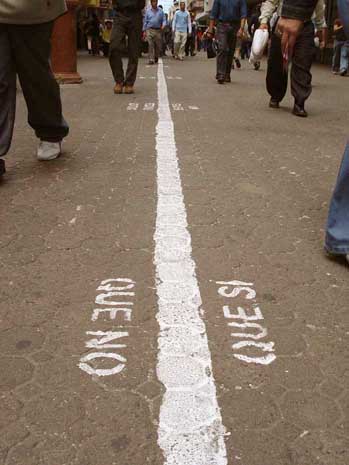
A work of art can be a simple white line. This one is on the
boulevard in downtown San José and protests treatment of
Nicaraguans here. |
| Canada offers training here in organized drug rings |
|
|
By
Saray Ramírez Vindas
of the A.M. Costa Rica staff Canada is offering Costa Rican police officials training in organized crime and drug trafficking. The course was inaugurated Monday at the same time that officials marked 50 years of diplomatic relations between the two countries. A number of other Latin countries will be getting the same training from instructors who, for the most part, are Canadian and members of the Royal Canadian Mounted Police. Mario Lagüe, the Canadian ambassador, was among the officials who opened the course Monday. The idea is to give police officials here more tools to fight organized crime, particularly in the area of illicit drugs. The event was at the Hotel San José Palacio. Canada, just like the United States, relies on local police to stop most of the drug flow. Organizations like the Policía de Control de Drogas are likely to disrupt drug flow before the substances reach the Canadian border. |
 A.M. Costa Rica/Saray
Ramírez Vindas
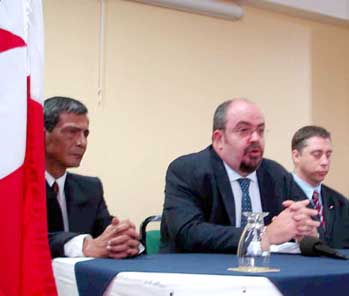
Mario Lagüe, center, the Canadian ambassador to Costa
Rica, helps inaugurate a program of training in drugs. To his left is
Brian Moreau, involved in foreign drug cooperation with the Royal
Canadian Mounted Police.In addition to Costa Rica, similar courses will be given in Panamá, Argentina, El Salvador, Nicaragua, the Dominican Republic, Honduras, Colombia, Ecuador, Perú, Venezuela, Brazil and México, officials said. |
| Top model Tyson
Beckford plans a TV filming session in Costa Rica |
||
 Tyson Beckford
|
By the A.M. Costa Rica staff
Model Tyson Beckford is planning to be in Costa Rica during March and April while filming segments for Hip Hop Xtreme TV. Besides filming, Beckford who dabbles in surfing, also is planning to sample the country's waves while here, his publicist said. He is scheduled to make an appearance at Club 360 in Curridabat March 31. Beckford is an American model and actor, the son of a Jamaican father and a biracial (African-American/ Chinese-American) mother. He is known for his muscular physique, facial structure, and tattoos and also as the lead model for Ralph Lauren, his publicist said. He is also reported to be |
one of the highest paid and richest
male supermodels in the world, said his publicist. In his early life, Beckford was a gang member and involved in crime including the sale and distribution of illegal narcotics, said publicist Mark Lugo. In 1991, he was recruited to the hip hop magazine The Source by a talent scout who had come across him by chance in a New York park. In 1993, Beckford was recruited by Ralph Lauren as the front model for the company's Polo line of male sportswear. He was named "Man of the Year" in 1995 by television channel VH1, as well as one of the 50 Most Beautiful People in the World by People magazine. |
 |
|
on our real estate page HERE! |
|
Fourth news page |
|
|
|
|
|
|
|
|
|
| San José,
Costa Rica, Tuesday, Feb. 14, 2006, Vol. 6, No. 32 |
||||||
 |
| Deforestation blamed for increase in strain of aggressive
mosquitoes |
|
|
By the A.M. Costa Rica wire services
Researchers are reporting a direct link between epidemic malaria and deforestation in the Amazon rainforest. They say the new finding has implications for global malaria control. Curious about a return of epidemic malaria in the Peru Amazon in the 1990s, investigators found there was a connection to uncontrolled deforestation. During a one-year period, they collected mosquitos at sites with varying levels of deforestation. The locations included untouched areas within the Amazon rainforest and locations that have undergone rapid development and landscape change. The investigators, led by Jonathan Patz of the University of Wisconsin, found that there were 200 |
times more of the
aggressive form of malaria mosquitos called Anopheles darlingi
in the heavily deforested areas than at pristine rainforest sites. Patz says there is reason to believe the warmer temperatures in deforested areas attract the darlingi. He says his team is trying to confirm that by studying the temperature, acidity, and plant growth along different water bodies. "We are trying to sort these things out," said Jonathan Patz. "To figure out, are there ways to predict, and therefore prevent, risky situations that enhance the risk of malaria?" The findings by Patz and his team were published in the January issue of the American Journal of Tropical Medicine and Hygiene. The issue had several other articles on malaria. |
| Both drivers held for investigation after crash that killed
six persons |
|
|
By the A.M. Costa Rica staff
The two drivers are in jail while investigators sort out the circumstances that led to the wreck between a bus and a semi-truck Saturday evening that left six persons dead, the worst toll from a single accident in recent history. The Juzgado Penal of Puntarenas has placed José Alarcón Consuegra of El Salvador and Marco Tulio Barías of Guatemala in preventative prison for three months while they await charges of wrongful death and wrongful injury, said Sergio Bonilla Bastos a spokesman for the Poder Judicial. Alarcón's bus and Barías' truck sideswiped each other as they rounded a corner near Puntarenas Saturday night. Alarcón was driving to San José from San Salvador, El Salvador, and was carrying mostly |
persons from
Honduras and El Salvador, said the Judicial Investigating
Organization. Barías was driving a truck loaded with steel north. The trailer slammed into the left rear side of the bus scattering the truck's load on the roadway and demolishing the truck's cab. Photographs showed a large hole in the left-rear side of the bus and at least five of the victims died on impact, said the Judicial Investigating Organization. The dead were identified as 20-year-old María Estela Meléndez Montes of El Salvador, 65-year-old Dolores Valladares De Guardado of El Salvador, Larissa Jacqueline Chavez Reyes of Honduras, 40-year-old Rosamirda Medina Rivera of Honduras, 13-year-old Rodolfo Eduardo Castillo Erazo of Panamá and Glenda Liseth Varela Vásquez of Honduras. |
| Haitians march demanding results of Sunday's presidential
vote |
|
|
By the A.M. Costa Rica wire service
PORT-AU-PRINCE, Haiti — Protesters filled the streets here Monday, demanding the results from last week's national elections, the first since former President Jean-Bertrand Aristide went into exile in 2004. Helicopters circled overhead, as thousands of demonstrators demanded election officials declare front-runner Rene Preval president. Protesters dragged the carcasses of cars into the road and burned tires, blocking all the major arteries of the city. Junior Masse, a resident of Petionville, a slightly upscale neighborhood of the city, said he is protesting what he thinks is a fraudulent election. "Something strange is happening here," he said. "We won't negotiate at all, unless Preval is president. Everyone here voted, and now we want the results. They don't give them, so, we had to take the streets." Many city residents who voted for Preval say they suspect that election officials and the international community have tampered with the vote, to prevent Preval from becoming president. Preval was president in Haiti from 1996-2001. He is widely popular among Haiti's urban poor, and is seen as a close ally of exiled former President Aristide. |
One day following last
Tuesday's elections, officials released partial results showing Preval
in the lead with 61 percent of
the vote. But, as more ballots arrived from rural areas, Preval's lead
slipped to 49 percent, with over 90 percent of the ballots counted. He
needs a simple majority of just over 50 percent to avoid a runoff
election next month, with second place candidate Leslie Manigat. Preval and two electoral officials say they want to launch an investigation for voter fraud. But David Wimhurst, spokesman for the U.N. peacekeeping mission in Haiti, says allegations of fraud are unfounded. "We have not heard of any official complaints of fraud or manipulation of the system," he said. "It is really important that people who say that to the media, is that the only way to proceed with voter fraud — if there are any — is to write it down, and make a proper complaint. . . . It doesn't serve anybody's purpose to make broad general claims through the media. There's no proof. The allegations are unfounded." Wimhurst says he hopes Haitians can remain calm, wait for the election results to be released, probably by Tuesday, and accept the final results peacefully. |
 |
 |
|
|
|
|
|
|
|
|
| What we published this week: | Monday | Tuesday | Wednesday | Thursday | Friday | Earlier |
|
|