|
 |
Costa Rica Your daily |
 |
|
|
 |
|
|
||||||||||||||||
 |
|||||||||||||||||
 |
|||||||||||||||||
|
|
||||||||||||||||
 |
 |
| What we published this week: | Monday | Tuesday | Wednesday | Thursday | Friday | Earlier |
|
|
|
|
|
|
|
Food |
|
Jo
Stuart |
|
|
 |
| A.M. Costa Rica's Second news page | |||||||||
| San José, Costa Rica, Wednesday, Feb. 8, 2012, Vol. 12, No. 28 | |||||||||
|
|
|
|
|
|
|
Food |
|
Jo
Stuart |
 |
 |
 |
|
Canadian visitor shocked
by way workers travel Dear A.M. Costa Rica: I have recently returned with my husband and some friends from a wonderful holiday in Costa Rica near Potrero in the northwest area. We were visiting for the first time from Canada. We loved your country, the people were friendly and the wildlife so abundant!! Such wonders from jungles to the beaches and the varied landscapes in between. We had a fantastic vacation and hope to return. However, the day we were leaving for the airport in the wee hours of the morning, we passed a stock truck that was hauling . . . men. They were all cramped in the back of the truck with no back door on it, so we were able to see in. They were standing holding onto the roof ropes or something. (A couple of days earlier one couple leaving for the airport saw the same thing, but the men were also overflowing and standing on the bumper hanging on for dear life!) We were all shocked and deeply saddened by this sight!!!! They may have been sugar cane field workers, and they were dark skinned so maybe foreign workers? Anyways, whoever they were, they are human beings and need to be treated as such. They need your help and protection. Should they not be afforded a bus ride with seats at least, after the hard physical labor that they do in your fields all day in such heat? I am not sure of your laws, as to treatment and protection of field/foreign workers, but this needs to be investigated. If they haul them to work in such a manner, how are they housing them, in what conditions are they living and how are they being compensated for the labor? Please let me know that you received this and what you can do to help, and if you can pass this on to someone else in government who would look into this and do something for these men. I will be contacting the Human Rights commission as well. Gwen
Day
Alberta, Canada 74 year old is bootlegger, judicial police allege By
the A.M. Costa Rica staff
Judicial Police detained a 74-year-old man Monday for making bootlegged alcohol in a makeshift cauldron in his house in southern Costa Rica. Agents reported that the man is dedicated to the trade of illegal alcohol, producing and selling roughly 10 gallons per week. Police say he has been involved in the illicit trade for the last 40 years and grows all the needed ingredients, such as sugar cane, on his property, Then he cooks them in his home-assembled equipment. His property is located in the Altamira de Biolley sector, in Buenos Aires de Puntarenas. When agents raided the house they said they recovered more than 74 liters, held in several different containers, ready to be distributed and sold. Illegal alcohol producers usually have the common goal of finding ways to skirt government regulation and taxes. Legally produced alcohol is regulated and taxed up to almost 50 percent of it's retail value. In recent months police have disrupted several larger operations. One bust involved an illegal manufacturing operation in which the bootlegged liquor was distilled in country and then labeled with popular and expensive brand names for resale. The most recent bust involved a ring of distributors who brought liquor hidden in trucks from Panamá and then distributed it from Cartago to avoid paying national taxes. Police caught on because the bottles was being resold for uncommonly low prices.
|
||||||||||||||||||||||||||||||||||||||||
 |
|||||||||||||||||||||||||||||||||||||||||
|
|
|
|
|
|
|
Food |
|
Jo
Stuart |
| What we published this week: | Monday | Tuesday | Wednesday | Thursday | Friday | Earlier |
| The contents of this page and this Web site are copyrighted by Consultantes Río Colorado 2012 and may not be reproduced anywhere without permission. Abstracts and fair use are permitted. Check HERE for details | ||||||
 |
 |
 |
| A.M. Costa Rica Third
News Page |
|
| San José, Costa Rica, Wednesday, Feb. 8, 2012, Vol. 12, No. 28 | |
|
|
|
|
|
|
|
Food |
|
Jo Stuart |
| Security officials want to stiffen
penalties for public drug use |
|
|
By
Andrew Rulseh Kasper
of the A.M. Costa Rica staff As schools begin instruction today, security officials are promising rigid enforcement of drug laws in educational areas. Meanwhile, they are looking to beef up the anti-drug law for people caught in public places children frequent. Celso Gamboa, a vice minister of security, said in a press conference Tuesday that introducing drugs into an educational area is punishable by up to eight years in prison. Gamboa said the ministry is attempting to expand the law to include prison time for those caught in other public areas selling, consuming or possessing drugs. The public areas would include parks, stadiums, recreation areas, among others. He said children frequent these areas, and to combat drug use the government can not only focus on schools. He said a draft of the proposal will be sent to the legislature. The goals of the ministry may be at odds with the judiciary where small amounts of drugs have not been a priority. The country's chief prosecutor announced several months ago his agency would not be prosecuting those arrested with drugs for personal consumption. It is common for people to be seen in public in San José smoking marijuana or selling other types of drugs. Also no plan was introduced by the ministry as to where a large influx of prison inmates would be housed. It was recently reported that the country's major prisons were overpopulated, as much as 50 percent in one central prison. In preparation for the start of classes, the Fuerza Pública has dispatched 3,300 police to focus on school and after-school safety in what officials classified as some of the more vulnerable areas. The operation is called Clase Seguro and will last for the 200 days of the school term. Last year the canine drug unit of the Fuerza Pública visited 123 different education centers in the country. |
 Ministerio de Gobernación,
Policía
Two of the young
drug-trafficking suspects await transportation in San Diego de Tres Riosy Seguridad Pública photo The ministry officials at the press conference also promoted preventative measures to combat drug use, such as the D.A.R.E. program used in the United States. The ministry reported 82,000 children participated in that program in 2011, and 62,000 were in another anti-drug educational program called Pinta Seguro, targeted at younger students and focusing on security and personal safety themes. In an enforcement action, the Policia de Control de Drogas detained Monday six suspects. Two are minors. They are accused of selling drugs in San Diego de Tres Rios. Police had 15 complaints on the group of suspected drug dealers through their anonymous phone hotline, they said. Agents arrested the suspects with 54 doses of crack and 20 doses of marijuana and then placed calls to their parents to inform them as to what had happened to their children, a report said. One suspect is 17, another is 16 and two are 18, one is 19 and the other is 20, the anti-drug police reported. |
| Not every branch of government is
tightening the financial belt |
|
|
By
the A.M. Costa Rica staff
President Laura Chinchilla Miranda may have tried to cap executive branch salaries, but the legislature and the Poder Judicial have not taken the hint. Casa Presidencial released a copy of the president's salary decree Tuesday. That is the document that generated protests and marches by public employees. It decrees a 5,000-colon, across-the-board raise for all workers in the executive branch. Casa Presidencial was quick to point out Tuesday that the raise, which amounts to about $10 a month, does not include the president, vice presidents, minsters, vice ministers and heads of other institutions. The decree, which was issued Jan. 17 when salary negotiations with public employees broke down, also noted that the executive branch has no control over the legislature or the judiciary. Lawmakers appear to have given themselves a 150,000 colon-a month pay raise, effective May 1. That is just short of $300 more a month. Some lawmakers are not happy with this decision and may try to block the raise. |
At the Poder Judicial, there also
are raises greater than the small
amount established by the president. In addition, magistrates have
increased from eight to 12 months the cap on severance pay given to
anyone who retires or leaves. That could mean an additional payoff of
up to $100,000 for retirees and those who leave of their own accord. Meanwhile, public employees have declared that they will have a general strike over what they consider to be the meager and insulting pay raise. The strike will be a week from today, according to the Asociación Nacional de Empleados Públicos y Privados. Initiating the strike is the Asociación Nacional de Educadores, the teachers union. That means that schools will function on a limited basis while unionized teachers are protesting. The school year begins today. The executive branch says that any money for pay raises will have to be borrowed because the country is broke. The public employee unions respond that there would be plenty of money if the government stemmed tax evasion and took the excess that is now in the hands of the various autonomous institutions. The unions claim that the amount would be three times what President Chinchilla seeks to bring in with her proposed new value-added tax. The president has estimated $500 million, if the tax proposal is passed. |
| Law officers grab three after tourist
victimized on Arenal bus |
|
|
By
the A.M. Costa Rica staff
Police and judicial agents on the San José-La Fortuna bus detained three men and said they made up a band that preyed on tourists by various means. Two of the men were jailed, but a third, who is the subject of an unrelated warrant, was placed at liberty, the Fuerza Pública reported. Agents were following the men when they were on a bus. They had been the subject of at least 11 complaints, mostly by tourists. La Fortuna is near the Arenal volcano. The Policía Turística and agents watched as the men handled the luggage of tourists this weekend on a bus, they said. At Florencia de San Carlos the trio got off the bus, and agents made the arrests. They recovered documents belonging to a |
Norwegian tourist and her portable
computer and skin diving equipment, agents said. Police were able to
interview the tourist. They said the robbery gang also punctured the tires of rental vehicles and used other techniques, such as stealing luggage when the owner was not looking. Detained were a 38-year-old man with the last names of Díaz Díaz, who is the subject of a warrant issued in Liberia for aggravated theft; a 35-year-old man with the last names of Martínez Rivas, who has a record of 14 arrests for similar crimes, and a 28-year-old man with the last names of López Gaitán, who has been turned over to prosecutors 19 times. Police reported that Díaz was let go while the other two men were given preventative detention. They did not say why a judge let the man go. |
 |
| You need to see Costa Rican tourism information HERE! |
|
|
|
|
|
|
|
Food |
|
Jo
Stuart |
| What we published this week: | Monday | Tuesday | Wednesday | Thursday | Friday | Earlier |
| The contents of this page and this Web site are copyrighted by Consultantes Río Colorado 2012 and may not be reproduced anywhere without permission. Abstracts and fair use are permitted. Check HERE for details | ||||||
|
A.M.
Costa Rica's
Fourth news page |
 |
||||
|
A.M.
Costa Rica's Fourth news page
|
|||||
| San José, Costa Rica, Wednesday, Feb. 8, 2012, Vol. 12, No. 28 | |||||
|
|
|
|
|
|
|
Food |
|
Jo
Stuart |
Walter Navarro, a security vice minister, and Luis Enrique Castillo, the foreign minster, leave a helicopter to take a tour of the Isla Calero that is frequently invaded by Nicaraguan troops. |
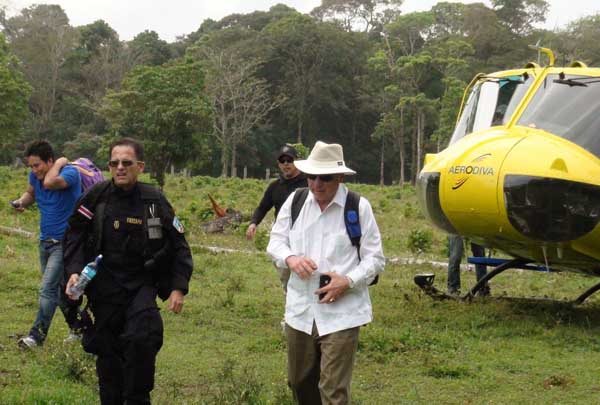 Ministerio de Gobernación,
Policía y Seguridad Pública photo
|
| Foreign minister checks out the
controversial northern border |
|
|
By
the A.M. Costa Rica staff
The foreign minster is the person who directs Costa Rica's cases at the International Court of Justice, so the current minister, Luis Enrique Castillo, took his first trip to the heart of the dispute in extreme northern Costa Rica. He visited the Isla Calero and Portillos where Nicaraguan troops invaded more than a year ago. He also got an air view of a 100-kilometer road that is being constructed on the south bank of the Río San Juan. Both figure in pending court cases. Costa Rica says Nicaragua invaded its territory and did extensive environmental damage. Nicaragua is trying to build a useable and shorter mouth to the sea for the Río San Juan. The International Court or World Court is the arbiter of the northern border, according to international treaties. |
Costa Rica officials recognized that
there was little access to the
northern area. So a road was begun along the south bank, which is the
international border. That is when Nicaragua brought it own International court case claiming environmental damage and debris falling into its river. Nicaragua controls the Río San Juan, and for years, that country has forbidden armed Costa Rican policemen from traveling by boat. Without the road, that is the only means of travel. Officials said that they would be planting trees along the controversial road. Castillo also visited Delta Costa Rica, Agua Dulce, Santa Marta and Barra del Colorado. He checked out border posts that are staffed with members of the Policía de Fronteras. There also are surveillance cameras. Castillo spent 12 hours making the tour, officials said. |
| Experiment shows effects of cold and heat
on ocean coral |
|
|
By
the University of California-San Diego news staff
Around the world coral reefs are facing threats brought by dramatic shifts in sea temperatures. While ocean warming has been the primary focus for scientists and ocean policy managers, cold events can also cause large-scale coral bleaching events. A new study by scientists at Scripps Institution of Oceanography at the University of California at San Diego compared damage to corals exposed to heat as well as cold stress. The results reveal that cool temperatures can inflict more damage in the short term, but heat is more destructive in the long run. The study was published in the Feb. 2 issue of Scientific Reports, a publication of the Nature Publishing Group. Climate change is widely known to produce warming conditions in the oceans, but extreme cold-water events have become more frequent and intense as well. In 2010, for example, coral reefs around the world faced one of the coldest winters and one of the hottest summers on record. During a unique experiment conducted by former Scripps Oceanography student Melissa Roth and current Scripps scientist Dimitri Deheyn, corals subjected to cold temperatures suffered greater growth impairment and other measurable damage in just days compared with heat treated corals. Yet the researchers found that corals were eventually able to adjust to the chilly conditions, stabilize their health and continue to grow. However, over the long term corals subjected to heat suffered more greatly than those in cold, with evidence of severe bleaching and growth stoppage, a trajectory that leads to death. “These results show distinct responses between cold and heat-treated corals on different time scales,” said Ms. Roth, now based at Lawrence Berkeley National Laboratory. “On a short time scale, the cold event was actually more harmful to the corals than an equivalent warming event, but over time, these corals were able to acclimate to the cold. Therefore, these corals showed more resilience to seawater cooling than seawater warming.” The coral’s ability to adjust to cool temperatures surprised the researchers, who say the study’s results highlight the complexities of monitoring coral health in response to varying environmental factors. |
 University of California-San Diego/Melissa
Roth
Branching Acropora corals
dominate shallow-water coral reefs such as those pictured here from the
central Pacific.During the investigations — conducted inside Scripps’ Experimental Aquarium — the researchers tracked the overall coral health and the stress of their symbiotic algae, sometimes called “zooxanthellae.” The symbiosis is an essential component for reef-building corals because the symbionts provide corals with most of their energy. Accordingly, the researchers found that the cold both disrupted the photosynthetic system of the symbionts and greatly reduced coral growth. “Global warming is associated with increases but also decreases of temperatures,” said Deheyn, a project scientist in Scripps’ Marine Biology Research Division. “Not much has been known about the comparative effects of temperature decrease on corals. These results are important because they show that corals react differently to temperature differences, which is critical for future management of coral reefs in the realm of climate change.” |
|
|
|
|
|
|
|
Food |
|
Jo
Stuart |
| What we published this week: | Monday | Tuesday | Wednesday | Thursday | Friday | Earlier |
| The contents of this page and this Web site are copyrighted by Consultantes Río Colorado 2012 and may not be reproduced anywhere without permission. Abstracts and fair use are permitted. Check HERE for details | ||||||
| A.M.
Costa Rica's Fifth news page |
 |
||||||||
| San José, Costa Rica, Wednesday, Feb. 8, 2012, Vol. 12, No. 28 | |||||||||
|
|
|
|
|
|
|
Food |
|
Jo
Stuart |
 |
| Charles
and Camilla honor Dickens on 200th birthday By
the A.M. Costa Rica wire services
Britain's Prince Charles has led ceremonies marking the 200th anniversary of the birth of Charles Dickens, one of English literature's most famous and celebrated novelists. The prince laid a wreath at Dickens' grave Tuesday at Westminster Abbey's Poets' Corner, where the writer was buried in 1870 alongside Geoffrey Chaucer, Tennyson, Samuel Johnson and other literary greats. The writer's descendants attended the ceremony. His great-grandson Mark Dickens said the writer was very committed to social reform. Prince Charles and his wife Camilla also toured the Dickens Museum in central London where they cut a book-shaped cake and listened to a reading by Actress Gillian Anderson from an old Dickens book. Anderson recently played Miss Haversham in the British TV drama “Great Expectations” based on Dickens' novel. She praised Dickens for describing the human condition in England of his time. More events are being held in the southern city of Portsmouth, where Dickens was born on Feb. 7, 1812. California appeals court rejects same-sex marriage ban By
the A.M. Costa Rica wire services
A California appeals court has ruled that a voter-approved ban on same-sex marriage is unconstitutional. The judges said in their ruling Tuesday the ban, known as Proposition 8, “serves no purpose” other than to lessen the “status and human dignity” of homosexuals in the state. The dissenting judge in the 2-to-1 decision said he thought the government could have a legitimate reason to restrict same-sex couples from marrying. Gay marriage supporters cheered the ruling, while Proposition 8's proponents said they would appeal it, either to a higher California court or directly to the U.S. Supreme Court. But some legal analysts said Tuesday the Supreme Court may choose not to weigh in, because Tuesday's ruling only applies to California's specific circumstances. The judges said the Proposition 8 was illegitimate because it took away a right that had already been granted. U.S. Sen. Dianne Feinstein of California said she thought the ruling, though narrow, was indicative of the broader issue, that no laws can change the U.S. Constitution's guarantee of equal protection under the law. Proposition 8 passed in 2008 with 52 percent of the vote, just months after the state had approved gay marriages. Homosexual couples will still be prevented from marrying in California until the appeals process is complete. Several U.S. states and the District of Columbia allow gay couples to marry. Obama campaign to return cash from casino family By
the A.M. Costa Rica wire services
U.S. President Barack Obama's re-election campaign says it is returning some $200,000 in donations made by the family of a Mexican casino owner who fled drug and fraud charges in the U.S. The campaign announced Tuesday that it was refunding all contributions linked to Chicago brothers Carlos and Alberto Rojas Cardona after The New York Times raised questions about them. The newspaper reported Monday that the two Cardonas are the brothers of casino owner Juan Jose Rojas Cardona, known as Pepe, who disappeared after jumping bail in Iowa in 1994 and has since been linked to violence and corruption in Mexico. The Cardona brothers began raising money for the Obama campaign and the Democratic National Committee last year. Obama campaign spokesman Ben LaBolt said the campaign will return the contributions from the Cardonas and any other donors they brought to the campaign. LaBolt said more than 1.3 million Americans have made donations, which he said are constantly reviewed for any issues. The New York Times cites prosecutors in the state of Iowa as saying Carlos Cardona arranged last year for the former chairman of the Iowa Democratic Party to seek a pardon for his brother Pepe from the governor. The report said no pardon was granted. |
|
||||
|
|
|
|
|
|
|
|
|
Food |
|
Jo
Stuart |
| What we published this week: | Monday | Tuesday | Wednesday | Thursday | Friday | Earlier |
| The contents of this page and this Web site are copyrighted by Consultantes Río Colorado 2012 and may not be reproduced anywhere without permission. Abstracts and fair use are permitted. Check HERE for details | ||||||
| A.M.
Costa
Rica's sixth news page |
|
|||||||||
| San José, Costa Rica, Wednesday, Feb. 8, 2012, Vol. 12, No. 28 | ||||||||||
|
|
|
|
|
|
|
Food |
|
Jo
Stuart |
 |
Latin America news |
Carnival
in Puntarenas
starts nine-day run Friday By
the A.M. Costa Rica staff
The Carnaval de Puntarenas, Festival Perla de Pacifico, kicks-off Friday in the Pacific Coast community and will extend for nine days. All events will take place along the beach in Puntarenas. The nine-day festival is free. Carnaval is famous in Brazil and has extended its influence onto Panamá and Costa Rica. Limón also has a really big carnival celebration but in October. Carnival is a celebration held before the Catholic period of Lent. Carnival is popular in Brazil where the giant celebration has parades where women dance samba in skimpy outfits. The customary dress is very colorful, bright and covered in jewels and feathers. The “Reina del Carnaval” will be chosen on the first day of the celebration in Puntarenas, so she can represent the festivities for the run of the parties. There is a horse parade or tope, concerts from different genres in music, fishing contests, a beach soccer tournament, and fireworks. The parade where people will be in masks, costumes, dancing and singing will take place on the last day of the celebrations at 2 p.m. The procession starts at Parque Marino and ends at Parque Lobo heading west. Russian and Tico diplomats consider mutual exchanges By
the A.M. Costa Rica staff
A Russian Federation diplomat and the Costa Rican vice-minister of foreign relations met Tuesday to discuss ideas on how to further the relationship between both countries. Sergey Ryabkov, Russia deputy minister, and Carlos Roverssi, his Costa Rican counterpart, discussed the importance of both countries to create a cultural exchange, especially in the field of medicine. This is something that could really benefit Costa Rica, said Roverssi. Ryabkov thanked Costa Rica for support and cooperation for his country to join the World Trade Organization. Both men agreed to increase tourism between each country and possibly take away visa restrictions for Russians into Costa Rica, according to comments made at a press conference after the meeting. Russia was also named the country of honor for the 2014 Festival Internacional de las Artes in Costa Rica. Heredia home invaded By
the A.M. Costa Rica staff
Judicial agents in Heredia reported that four men raided a house in Santo Domingo Monday. The men entered the house around 9 p.m. with ski masks and firearms. Agents say they entered through the unlocked and opened front door and gate. The inhabitants were threatened with weapons and forced into one room while the robbers made off with three cellphones and cash, agents said. |
|
Latin
Aemrican news feeds are disabled on archived pages.
|
|
| Costa Rican News |
AMCostaRicaArchives.com |
Retire NOW in Costa Rica |
CostaRicaReport.com |
|
|
|
|
|
|
|
Food |
|
Jo
Stuart |
| What we published this week: | Monday | Tuesday | Wednesday | Thursday | Friday | Earlier |
| The contents of this page and this Web site are copyrighted by Consultantes Río Colorado 2012 and may not be reproduced anywhere without permission. Abstracts and fair use are permitted. Check HERE for details | ||||||











 James
DeRoy
James
DeRoy