|
 |
Costa Rica Your daily |
 |
|
|
 |
|
|||||||||||||||||
 |
|||||||||||||||||
 |
|||||||||||||||||
|
|
||||||||||||||||
 |
 |
 |
| What we published this week: | Monday | Tuesday | Wednesday | Thursday | Friday | Earlier |
|
|
|
|
|
|
|
Food |
|
Jo
Stuart |
|
|
 |
| A.M. Costa Rica's Second news page | |||||||||
| San José, Costa Rica, Monday, Jan. 23, 2012, Vol. 12, No. 16 | |||||||||
|
|
|
|
|
|
|
Food |
|
Jo
Stuart |
 |
 |
 |
|
Chefs to prepare
rice dish
to welcome Chinese New Year By
the A.M. Costa Rica staff
and the A.M. Costa Rica wire services The country will usher in the Chinese New Year with a gigantic arroz cantonés for 11,000 servings. The event begins at 11 a.m. in the vicinity of the Iglesia La Solidad, a location that the municipality has designed for a future Chinese section. There are two Chinese restaurants there now and a retail store owned by Chinese. The free arroz cantonés will be prepared by more than a dozen chefs from Chinese restaurants. They will use a pan eight feet in diameter. There also will be Chinese dancing and a dragon. That is appropriate because today marks the start of the Year of the Dragon in the 12-year rotation of the Chinese Zodiac calendar. The mythical and powerful dragon symbolizes royalty and good fortune, and for believers, the year and those born in that year take on those qualities. Municipal officials will make a symbolic start on the barrio Chino for that reason today. In a New Year's message, Singapore Prime Minister Hsien Loong said he fervently hoped that the auspicious symbol would prompt his countrymen to have more babies. Singapore is struggling with a low birth rate and a shrinking population. But the nation has seen a baby boom in past Dragon years. Other Asian countries are also expecting a spike in births in the coming year from parents looking to capitalize on the wealth, luck, and courage said to come from a Dragon-year baby. Foreigner held in case involving 8 kilos of cocaine By
the A.M. Costa Rica staff
Anti-drug police detained an Israeli Friday night. He is accused of having cocaine and a firearm in his Mercedes Benz. The arrest was the culmination of an investigation, said police. The Israeli national is 41 years old and has the last name Abergel, police report. He was apprehended in Belén near the Real Cariari shopping center. Agents say he had in his possession more than eight kilograms of cocaine, a 9mm pistol with 17 bullets and more than $5,500 in cash. Police agents reportedly seized the cash and drugs as well as the car the man was driving. A person convicted of international drug trafficking can face up to 20 years in jail, according to a Ministerio de Gobernación, Policía y Seguridad Pública press release. The suspect was arrested by the Policía de Control de Drogas, a drug law enforcement branch of the ministry.
|
||||||||||||||||||||||||||||||||||||||||
 |
|||||||||||||||||||||||||||||||||||||||||
|
|
|
|
|
|
|
Food |
|
Jo
Stuart |
| What we published this week: | Monday | Tuesday | Wednesday | Thursday | Friday | Earlier |
| The contents of this page and this Web site are copyrighted by Consultantes Río Colorado 2011 and may not be reproduced anywhere without permission. Abstracts and fair use are permitted. Check HERE for details | ||||||
 |
 |
 |
| A.M. Costa Rica Third
News Page |
|
| San José, Costa Rica, Monday, Jan. 23, 2012, Vol. 12, No. 16 | |
|
|
|
|
|
|
|
Food |
|
Jo Stuart |
| Embassy stonewalls in case of Tico's
canceled U.S. visa |
|
|
By
the A.M. Costa Rica staff
U.S. government employees at the Pavas embassy have declined to explain why a vice consul summarily canceled a Costa Rican's visa and left him without a way to complete a business trip to Florida. This is the case of Oscar Mora Morales, 50, of Guanacaste that was reported in the Friday newspaper. A reporter attempted without success to get the U.S. embassy's side of the story Thursday. Friday a spokesman said there would be no comment. Usually the embassy workers cite the U.S. Privacy Act for declining to comment. Even though the privacy act does not cover non-U.S. citizens, Mora had signed a release permiting a reporter to obtain information from the embassy about the case. Mora was at the embassy getting a passport for his U.S-born daughter when he said he became frustrated by the questions being asked by a Costa Rican interviewer. One question was if he paid the hospital where the girl was born 13 years ago. The daughter is a U. S. citizen who was born in Florida while the family was legally visiting the country. Mora said the entire family, including his wife and son, who is also a U.S. citizen by birth, were planning a trip to Miami in February. The daughter needed the passport to travel. Still unclear is why the embassy staff was asking such questions. Mora said he had no trouble getting a passport for his son, in an earlier visit. The Costa Rican interviewer brought a female vice consul into the session, and it was she who stamped the word cancelled without prejudice on Mora's visa. According to the Web site of the U.S. State Department that phrase is defined as “a stamp an embassy or consulate puts on a visa when there is a mistake in the visa or the visa is a duplicate visa (two of the same kind). It does not affect the validity of other visas in the passport. It does not mean that the passport holder will not get another visa.“ Among other points, a reporter was trying to obtain |
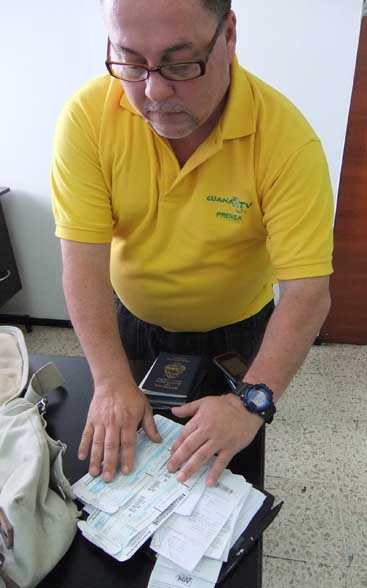 A.M.
Costa Rica/Andrew Rulseh Kasper
Óscar Mora displays
tickets and hotel reservations that he obtained for his planned trip to
the United States in February.information to reconcile the apparent punitive action of the vice consult with the official summary from Washington. The irony is that Mora said he only brought his own Costa Rican passport to serve as formal identification as he attempted to get the daughter's passport. He returned the next day from Guanacaste to finally obtain the girl's passport. Mora's wife accompanied him to the embassy, but the vice consul did not cancel her U.S. passport. Mora, is a Guanacaste businessman who has visited the United States frequently to purchase electronic goods. |
| British expat's appeal delayed by
recording problems in court |
|
|
By
the A.M. Costa Rica staff
An appeal hearing involving the trial court dismissal of a criminal allegation against a British citizen experienced an unexpected delay Friday when recording equipment failed to work. This is the case of Sheldon Haseltine and his lawyer, Horacio Mejias Portuguez. They were accused of forgery involving documents submitted in another case. The expat has been struggling to hang on to the five tracts near the Los Sueños development for the past 16 years. Haseltine reported that the lawyer Otto Giovanni Ceciliano Mora, the former Barva mayoral candidate, was present at the hearing in Puntarenas. The Judicial Investigating Organization detained Ceciliano Dec. 20 in a wave of arrests relating to marijuana smuggling and money laundering. He missed the initial hearing Jan. 10 because he was in preventative detention. Ceciliano works for the two persons who raised the forgery allegation. They are Armando González Fonseca, a well-known Costa Rican businessman, and Martha Sandoval, who lives on one of Haseltine’s properties. |
Haseltine said that the date for the
continued hearing is Feb. 2. He added that Ceciliano made the unusual request that he be allowed to prosecute the case privately as well as to be a witness. Both requests were denied at the initial hearing. A prosecutor, Dixiela Madrigal Mora, and the initial judge in the case, Yorleni Campos Campos, have said there is no substance to the allegation. The prosecutor conducted her own investigation of the allegation. The specific allegation in the case was that a document that simplified the management of Haseltine's corporation, Ivanhoe Investment S.A., was fake. The corporation is registered in Panamá, but administered in The Bahamas. The document required and got the seal of the Costa Rican consulate in The Bahamas. Haseltine needed the document so he could respond rapidly to a civil case involving ownership of the tract near Los Sueños. If the document were forged, he would lose that case as well for not having responded correctly to the civil allegations. That is the motivation of Ceciliano, González and Ms. Sandoval for pressing the criminal case. |
 |
| You need to see Costa Rican tourism information HERE! |
|
|
|
|
|
|
|
Food |
|
Jo
Stuart |
| What we published this week: | Monday | Tuesday | Wednesday | Thursday | Friday | Earlier |
| The contents of this page and this Web site are copyrighted by Consultantes Río Colorado 2011 and may not be reproduced anywhere without permission. Abstracts and fair use are permitted. Check HERE for details | ||||||
|
A.M.
Costa Rica's
Fourth news page |
 |
||||
| San José, Costa Rica, Monday, Jan. 23, 2012, Vol. 12, No. 16 | |||||
|
|
|
|
|
|
|
Food |
|
Jo
Stuart |
| La Niña appears to be growing
stronger in Pacific Ocean |
|
|
By
the Jet Propulsion Laboratory, news staff
Sea surface height data from NASA's Jason-1 and -2 satellites show that the milder repeat of last year's strong La Niña has recently intensified The image is based on the average of 10 days of data centered on Jan. 8. It depicts places where the Pacific sea surface height is higher than normal (due to warm water) as yellow and red, while places where the sea surface is lower than normal (due to cool water) are shown in blues and purples. Green indicates near-normal conditions. The height of the sea surface over a given area is an indicator of ocean temperature and other factors that influence climate. This is the second consecutive year that the Jason altimetric satellites have measured lower-than-normal sea surface heights in the equatorial Pacific and unusually high sea surface heights in the western Pacific. "Conditions are ripe for a stormy, wet winter in the Pacific Northwest and a dry, relatively rainless winter in Southern California, the Southwest and the southern tier of the United States," says climatologist Bill Patzert of the Jet Propulsion Laboratory. "After more than a decade of mostly dry years on the Colorado River watershed and in the American Southwest, and only two normal rain years in the past six years in Southern California, low water supplies are lurking. This La Niña could deepen the drought in the already parched Southwest and could also worsen conditions that have fueled recent deadly wildfires." NASA will continue to monitor this latest La Niña to see whether it has reached its expected winter peak or continues to strengthen. A repeat of La Niña ocean conditions from one year to the next is not uncommon: repeating La Niñas occurred most |
 NASA/JPL Ocean Surface Topography Team
The latest image of sea surface
heights in the Pacific Ocean from NASA's Jason-2 satellite shows that
the current La Niña (in blue) is peaking in intensity. recently in 1973-74-75, 1998-99-2000 and in 2007-08-09. Repeating La Niñas most often follow an El Niño episode and are essentially the opposite of El Niño conditions. During a La Niña episode, trade winds are stronger than normal, and the cold water that normally exists along the coast of South America extends to the central equatorial Pacific. La Niña episodes change global weather patterns and are associated with less moisture in the air over cooler ocean waters. This results in less rain along the coasts of North and South America and along the equator, and more rain in the far Western Pacific. The comings and goings of El Niño and La Niña are part of a long-term, evolving state of global climate, for which measurements of sea surface height are a key indicator. |
| At least nine persons die on nation's
highway over weekend |
|
|
By
the A.M. Costa Rica staff
A least nine persons died in weekend vehicle accidents, according to the Judicial Investigating Organization. In San Ramón a family from Grecia burned to death when their vehicle inexplicably burst in to flames and exploded. The family was traveling from a weekend in La Fortuna. Firemen suspect that something in the car ignited the gasoline tank. The explosion took place about 6 p.m. Sunday. At 5:30 a.m. Sunday a Nissan Sentra carrying four people collided with a bus heading from San José to Puntarenas. The bus had 52 people on board when the driver of the car presumably lost control while navigating a curve on Ruta 27 at kilometer 37 and collided head on with the bus. The driver of the car, who had the last name of Ramírez died. He was 22. The other occupants of the car, all between the ages of 20 and 21, were sent to medical centers in stable conditions. No one on the bus was injured. |
While a 51-year-old man was
attempting to cross the street Saturday in
Rincón de Arias, he was struck by an ambulance transporting two
patients from a hospital in Grecia to a hospital in Alajuela. The
victim, identified by the last name Rivera was taken to a hospital
himself but died shortly thereafter. At 1:30 a.m. Sunday two motorcyclists collided head on while driving in La Guácima Arriba. One of the drivers, 46, identified by the last name Porras, died as a result of the collision. The other driver, 29, identified by the last name Araya was brought to hospital San Rafael in Alajuela. Two men died in Alta Fresca in Puntarenas when the driver lost control of the Toyota Hilux pickup truck in which they were driving left the roadway, struck a public light post and flipped. The accident took place at 2 a.m. and both men died at the scene. They were construction workers, identified by the last names Madrigal and Mayorga. |
|
|
|
|
|
|
|
Food |
|
Jo
Stuart |
| What we published this week: | Monday | Tuesday | Wednesday | Thursday | Friday | Earlier |
| The contents of this page and this Web site are copyrighted by Consultantes Río Colorado 2011 and may not be reproduced anywhere without permission. Abstracts and fair use are permitted. Check HERE for details | ||||||
| A.M.
Costa Rica's Fifth news page |
 |
||||||||
| San José, Costa Rica, Monday, Jan. 23, 2012, Vol. 12, No. 16 | |||||||||
|
|
|
|
|
|
|
Food |
|
Jo
Stuart |
 |
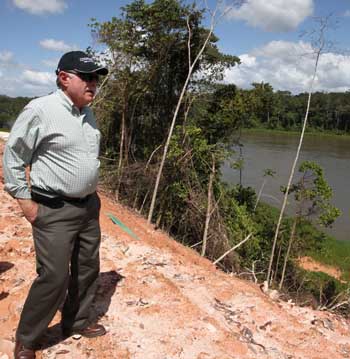 Casa Presdiencial photo
Vice President Luis
Liberman looks across the Río San Juan into Nicaragua during an
inspection trip along the northern border.Electrical power
comes
to northern community By
the A.M. Costa Rica staff
Electricity finally arrived at Tiricias de Cutris in the extreme north of the country. The power lines are part of a 120 kilometer project that will benefit 26 communities where about 1,200 persons live. Interest in the northern border area was sparked by the Nicaraguan invasion into the Isla Calero in October 2010. The electricity is provided by Coopelesca, a local cooperative. Alfio Piva Mesén and Luis Liberman, the two vice presidents of the country, were there to attend the inauguration Saturday. They also viewed a road being constructed along the south bank of the Río San Juan. The Nicaraguan central government has made the highway controversial and has accused Costa Rica of environmental damage. The south bank is the international border. Obama sees tourism as key to create many more jobs By
the A.M. Costa Rica wire services
U.S. President Barack Obama is urging Congress and the country to back his new initiative to boost tourism, which he says will create jobs. During his weekly address Saturday, Obama said he wants to make it easier for visitors to come and spend money in America. He presented the same theme a day earlier in Florida. World travelers complain that with increased security after the 2001 terror attacks on New York and Washington, entering the United States has become more difficult, unpleasant and time-consuming. Many of those frustrated tourists stopped coming. White House officials say the U.S. share of the global travel market fell by more than 30 percent between 2000 and 2010. To reverse that trend, the president is expanding the Global Entry Program, which he said protects America’s borders and makes life easier for frequent visitors who qualify. “Instead of going through long lines at immigration, we can scan your passport, your fingerprints, and you are on your way,” said Obama. Tourism is big business in the United States. The president said that in 2010, 60 million people visited America and spent $134 billion. Obama is calling on his secretaries of Commerce and Interior to develop a strategy to market U.S. tourist destinations overseas and increase those numbers. “So that is what this is all about - telling the world that America is open for business, making it as safe and as simple as possible to visit, helping our businesses all across the country grow and create jobs,” said the president. The administration estimates that 1.2 million U.S. jobs are generated by international tourism. Industry officials say increasing America’s share of the global tourism business could create another million jobs in 10 years. Obama says much of that growth could come from just a few countries. “Countries with rapidly growing economies, huge populations and emerging middle classes. Countries like China and India. And especially important here in Florida, Brazil,” he said at DisneyWorld. The president has ordered the number of U.S. tourist visas processed in China and Brazil increased by 40 percent this year. And worldwide, he wants applicants for tourist visas interviewed sooner. Obama’s appearance at Disney World promoted his main campaign message of creating middle-class jobs. Florida, the fourth most populous U.S. state, holds its Republican Party presidential primary on Jan. 31. It is expected to be one of the main battleground states in the November general elections. Arizona congresswoman will step down to recover By
the A.M. Costa Rica wire services
U.S. Rep. Gabrielle Giffords has announced she will resign from Congress, a year after she was seriously wounded in a shooting spree in her home state of Arizona. In a video statement posted on the Internet Sunday, Ms. Giffords said she is getting better, but that work remains for her recovery. She said she is stepping down for the good of the state she represents. Ms. Giffords said she plans to return to work for the state and the country again. Giffords was shot in the head and nearly died in the Jan. 8, 2011, attack, which occurred outside a grocery store where she was holding a meeting with her constituents. The 41-year-old Democratic congresswoman has made a remarkable recovery amid a long and intensive rehabilitation process, enabling her to return to Congress last August to cast a vote on legislation raising the federal government's debt ceiling. Six people were killed in the same attack, including a federal judge, a member of Ms. Giffords' staff and a nine-year-old girl. A dozen other people were wounded. The man charged in the shooting, Jared Loughner, has pleaded not guilty. It has been reported that he was diagnosed with schizophrenia, and he has been in jail since the crime. |
|
||||
| Some of our other titles: |
|||||
| A.M. Panama |
A.M. Colombia |
A.M. Guatemala |
A.M. Honduras |
A.M. Havana |
A.M. Nicaragua |
| A.M. Venezuela |
A.M. Central America |
A.M. Dominican Republic |
A.M. Ecuador | A.M. San Salvador |
A.M. Bolivia |
|
|
|
|
|
|
|
Food |
|
Jo
Stuart |
| What we published this week: | Monday | Tuesday | Wednesday | Thursday | Friday | Earlier |
| The contents of this page and this Web site are copyrighted by Consultantes Río Colorado 2011 and may not be reproduced anywhere without permission. Abstracts and fair use are permitted. Check HERE for details | ||||||
| A.M.
Costa
Rica's sixth news page |
|
|||||||||
| San José, Costa Rica, Monday, Jan. 23, 2012, Vol. 12, No. 16 | ||||||||||
|
|
|
|
|
|
|
Food |
|
Jo
Stuart |
 |
Latin America news |
to that of the mother Dear A.M. Costa Rica: Re: Tico visa canceled in embassy spat! Can anyone say “anchor babies”? The U.S. has between 20 & 30 million illegals with about 20 percent being anchor babies. Not my figures but that of the fine people from the U.S. immigration service. I find it very funny that Mr. & Mrs. Mora just happened to be traveling in the U.S. legally while his wife was so pregnant she had to deliver in Miami; not once but twice. How convenient. Once Mr. Mora has gone to the U.S., has children born there as anchor babies, he and children return to Costa Rica and then 13 years later the daughter wants to go back to the U.S. to vacation; and he expects to have the embassy stop everything to get his daughters passport paperwork completed at his convenience. All this with no intrusive questions asked. What gives? Well I have a couple of questions not only of Mr. Mora but also the staff of A.M. Costa Rica. 1. Are you people that out of touch with the immigration problems both with the US and Costa Rica; that no questions should or need to be asked. Just hand out carte blanche visas and passports. 2. Why did the Mora family twice have children in the U.S. one 15 years ago and then 13 years ago? What were their intentions for having done this? 3. Why would a pregnant women travel by air, car or boat that great a distance being that far along pregnant. Something not right with this scenario. 4. Has anyone read 14th Amendment’s definition of birthright citizenship? The status of the child born in United States should depend on the legal status of the mother. If the mother is a U.S. citizen, then the newborn becomes a U.S. citizen automatically. If the mother has a green card, then the child gets a green card. If the mother is illegally in the U.S., then the child is in the U.S. illegally. If the mother is in U.S. on a tourist visa, then the child should get a tourists' visa. How hard is this to understand. The civil rights act of 1866 and 14th Amendment of the US Constitution dealt with freed slaves and the American Indians who were born in the U.S. at the time that the 14th Amendment was written. It had nothing to do with future illegal immigrants or undocumented workers. Look what is happening in Costa Rica and its immigration problems. Jeff
Cain
Alabama & Costa Rica EDITOR'S NOTE: The 14th Amendment to the U.S. Constitution says this: All persons born or naturalized in the United States, and subject to the jurisdiction thereof, are citizens of the United States and of the State wherein they reside. No State shall make or enforce any law which shall abridge the privileges or immunities of citizens of the United States; nor shall any State deprive any person of life, liberty, or property, without due process of law; nor deny to any person within its jurisdiction the equal protection of the laws. We think that the U.S. Supreme Court has greatly enlarged the scope of this section to cover much more than slaves and Indians. We also note that U.S. citizens sometimes come to Costa Rica to give birth and obtain a residency status. |
|
|
|
| Costa Rican News |
AMCostaRicaArchives.com |
Retire NOW in Costa Rica |
CostaRicaReport.com |
|
|
|
|
|
|
|
Food |
|
Jo
Stuart |
| What we published this week: | Monday | Tuesday | Wednesday | Thursday | Friday | Earlier |
| The contents of this page and this Web site are copyrighted by Consultantes Río Colorado 2011 and may not be reproduced anywhere without permission. Abstracts and fair use are permitted. Check HERE for details | ||||||
|
An A.M. Costa
Rica editorial
U.S.
Embassy staff seems to be unaccustomed to oversight
|
|
| Most workers at the U.S. Embassy in
Pavas don't like to be questioned about their actions. They have made some blunders, but unlike most U.S. government employees, they do not have to account to anyone outside the closed embassy world. The degree of openness generally depends on the standards of who is working there at the time. There is a lot of turnover, and much of the continuity is provided by full-time Costa Rican staffers. Generally the U.S. employees there are not attuned to public relations. One of the basic rules of public relations is to always respond to criticism or to crisis situations. We have a situation now that President Barack Obama is pushing for more tourism. During his weekly address Saturday, Obama said he wants to make it easier for visitors to come and spend money in America, according to the A.M. Costa Rica wire services. Yet in Pavas a vice consul seems to have canceled a Costa Rican businessman's U.S. visa without adequate explanation. And the embassy does not want to explain to the individual or to the press. We would welcome an explanation as to why the vice consul took this action. We would have included that information in a Friday story, if the embassy could have responded quickly. Maybe she took the correct action. Or maybe she should be shipped out. We have no way of knowing when the embassy stonewalls. Embassy workers have a habit of hiding behind the U.S. Privacy Act. But there is plenty of wiggle room in the privacy act for providing urgent information to the public. Instead, embassy workers will spend taxpayer money to create an |
embassy newsletter that, we
suspect, will always say nice things about the embassy. Even though the U.S. government employees are overseas, we think they should be open to questions, such as why did they buy a $49,000 electric car from a Japanese firm and not a U.S. firm. And why have they never approached the press seeking help and publicity for the missing U.S. citizens in Costa Rica? The French ambassador has done everything short of standing on a soapbox in Parque Central to generate attention about his missing citizens. Where does the embassy stand on Costa Rican property fraud that frequently involves expats as victims? What actions have the embassy staff taken to raise the issue of increasing criminality that affects expats. They are big in handing out money to fight international drug trafficking. How about making some comments on the revolving justice at Costa Rican courts? One of the traditions of Anglo-American justice is the right to confront accusers. We do not think that the U.S. State Department has instituted an adequate appeals process for persons who are denied visas or, in the latest case, Óscar Mora who had his visa canceled. A young vice consul has just a few minutes to make a decision on a visa application. Have there never been mistakes made? How does a Costa Rican or U.S. citizen acting on behalf of a Costa Rican find out the reason for this rejection? We would like to see the embassy staff address some of these points in their new, spiffy newsletter. —
Jan. 23, 2012
|













 James
DeRoy
James
DeRoy