|
 |
Costa Rica Your daily |
 |
|
|
 |
|
|||||||||||||||||
 |
|||||||||||||||||
 |
|||||||||||||||||
|
|
||||||||||||||||
 |
 |
 |
| What we published this week: | Monday | Tuesday | Wednesday | Thursday | Friday | Earlier |
|
|
|
|
|
|
|
Food |
|
Jo
Stuart |
|
|
 |
| A.M. Costa Rica's Second news page | |||||||||
| San José, Costa Rica, Tuesday, Jan. 10, 2011, Vol. 12, No. 7 | |||||||||
|
|
|
|
|
|
|
Food |
|
Jo
Stuart |
 |
 |
 |
|
Justice minister
seeking OK
of loan for prison system By
Andrew Rulseh Kasper
of the a.M. Costa Rica staff A growing inmate population means Costa Rica’s prison system is now in dire need of an overhaul, including increased employees, more prison cells and upgrades to its infrastructure, according to Hernando París, minister of Justicia y Paz The Ministerio de Justicia y Paz oversees the country’s prisons through Adaptación Social, one of its agencies. To facilitate the overhaul of the system París said he is hoping the Asamblea Legislativa will approve a large loan of $132 million from Banco Interamericano de Desarrollo. Part of the money is to build new jail space and invest in other prison programs such as detoxification units and vehicles to allow prison work opportunities. He said he can’t imagine a scenario in which the legislature would not support proper financing of the reform system and said he had the support of President Laura Chinchilla. Communicados, sent from París to the Ministerio de Hacienda, the government’s fiscal arm, show that París requested additional funds earlier this year. He said he has yet to receive the support he believes the prison system warrants. He spoke at a press conference Monday. He said the prison system is also lacking guards and is far below proper staffing levels and hopes further monetary support from the central government will help the system shore up staffing shortfalls. Last week guards were unable to prevent a riot in La Reforma in Alajuela which resulted in the murder of two inmates. But a staffing shortage and inadequate facilities not only puts the inmates in danger but also guards, other prison personnel and visitors. In prison raids last week, conducted with the help of the Fuerza Pública and the Judicial Investigating Organization yielded hundreds of knives, drugs, alcohol, money in cash and cell phones were confiscated. security officials say the illicit telephones are used to orchestrate organized crime within the jail system. Statistics provided by the the Ministerio de Justicia y Paz said that in the past two years the prison population has grown 30 percent to 10,962 inmates total. In the past 10 years the population has nearly doubled. Including those who are part of the system but not locked away brings the total closer to 21,000. Overall, París claims the prison system is nearly 30 percent overpopulated with certain facilities listed as being 50 percent overpopulated. Officials attribute the increase in prison population correspondent to the increase in drugs, firearms, and a general spike in most crimes. Since the mid 1990s homicide rate has tripled in the country, according to the Judicial Investigating Organization. German development chief plans three-day visit here By
the A.M. Costa Rica staff
Costa Rica is one of two Latin American countries that Dirk Niebel, German minister of economic cooperation and development, will visit starting Wednesday. The other is Chile. During his three days here, Niebel will meet with President Laura Chinchilla Miranda, Enrique Castillo the minister of foreign affairs for Costa Rica, and with various organizations and corporations with German ties. He is here to discuss and show German interest in new energy, environment conservation and climate protection, according to the German Embassy. Niebel will be accompanied by a 27 person delegation made up of mostly German business people. . Germany is an important trading partner with Costa Rica, said Ernst Martens, German ambassador to Costa Rica. Costa Rica. Costa Rica exports about $106 million, mostly in bananas, coffee and pineapple. The German ambassador joked Monday that when he is in a market in his country there is no pineapple that does not come from Costa Rica. In 2010 there was about 50,000 German tourists who traveled to Costa Rica.
|
||||||||||||||||||||||||||||||||||||||||||||||
 |
|||||||||||||||||||||||||||||||||||||||||||||||
|
|
|
|
|
|
|
Food |
|
Jo
Stuart |
| What we published this week: | Monday | Tuesday | Wednesday | Thursday | Friday | Earlier |
| The contents of this page and this Web site are copyrighted by Consultantes Río Colorado 2011 and may not be reproduced anywhere without permission. Abstracts and fair use are permitted. Check HERE for details | ||||||
 |
 |
 |
| A.M. Costa Rica Third
News Page |
|
| San José, Costa Rica, Tuesday, Jan. 10, 2011, Vol. 12, No. 7 | |
|
|
|
|
|
|
|
Food |
|
Jo Stuart |
| First World castoffs can be had for
gigantic discounts at pacas |
|
|
By
Shahrazad Encinias Vela
of the A.M. Costa Rica staff The high prices of clothes in Costa Rica may come as a shock for most tourists, especially those coming from other parts of Central America where costs are far lower. But there is a secret to bargain retail shopping in this country, and that is to go to tiendas de ropa americana. These stores, better known in Central America as pacas, offer designer clothes for about 1,500 colons, approximately $3. Prices vary with stores, but there is always a rack or two that sells clothes for 400 colons, less that $1. Most products are used, but there are also brand new items. The concept of these stores are like the Goodwill and Disabled American Veterans stores in North America. There are high end designer clothes, but those are a little harder to find. To snag designer clothes such as Banana Republic, Calvin Klein, and Guess visitors can expect to dig through piles of clothes. Not just clothes are for sale. There also are shoes and purses. At the the bigger stores there are announcers, similar to the one’s at the grocery stores, who get on the microphone and promote the specials. Offers of brand new Nikes for 10,000 colons and a pair of Pumas for 15,000 colons (from $20 to $30) were heard in one store. The stores also carry bedding from sheets to pillow cases and comforters. All are used, but sold at a decent price. Although the clothes and other fabrics are clean and ironed, all items were bunched into black plastic garbage bags for |
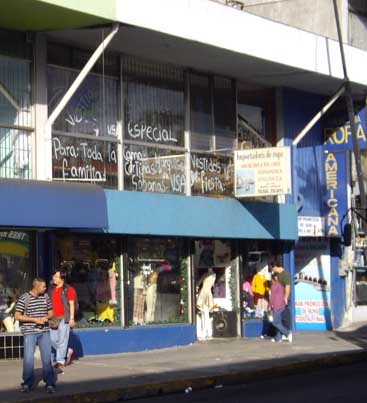 A.M.
Costa Rica/Shahrazad Encinias Vela
Most
stores only use point-of-sale advertising.
who knows how long. So washing is obligatory. The overly large bags full of clothes when delivered are called pacas. The clothes can be purchased at the tienda de ropa americana. The name is that because a lot of clothes that are popular in the United States such as Lucky Brand, Levi’s, Mudd Jeans, Wrangler and Route 66 become available in Costa Rica at far lower prices. |
| Escazú developer will combine
condos with reforestation |
|
|
By
the A.M. Costa Rica staff
A developer of an Escazú condo project will combine construction with reforestation. The project is Bosques de Escazú, which the developer, Grupo RC, calls the the biggest and most ambitious residential ecological project that has been seen in the country. Plans call for four condo towers, each with 28 units. The location is in Jaboncillo de Escazú, which is between the Country Day School and the Paco commercial center. The first tower is scheduled to be done by this time next year, according to a press release in the name of Fuad Farach Caldera, general manager. The project is in a mountainous area of some 23,000 square meters or about 5.7 acres. Two adjacent hectares will be reforested with the help of experts from the Universidad Nacional in Heredia, said the release. That's about five acres. Plans call for the use of solar energy, a modern sewage treatment plant for the project and the use of natural |
 Bosques de Escazú rendering
This is how the finished project
is designed to lookventilation to avoid the use of
air conditioners, said the firm.
Work on the first tower will start
in March, and the construction phase will take about two years, said
the firm.
|
 |
| You need to see Costa Rican tourism information HERE! |
|
|
|
|
|
|
|
Food |
|
Jo
Stuart |
| What we published this week: | Monday | Tuesday | Wednesday | Thursday | Friday | Earlier |
| The contents of this page and this Web site are copyrighted by Consultantes Río Colorado 2011 and may not be reproduced anywhere without permission. Abstracts and fair use are permitted. Check HERE for details | ||||||
|
A.M.
Costa Rica's
Fourth news page |
 |
||||
| San José, Costa Rica, Tuesday, Jan. 10, 2011, Vol. 12, No. 7 | |||||
|
|
|
|
|
|
|
Food |
|
Jo
Stuart |
| Now the Irazú volcano is hosting a
flurry of small earthquakes |
|
|
By
the A.M. Costa Rica staff
Another flurry of earthquakes took place Monday. This time the location was along the base of the Irazú volcano. The Observatorio Vulcanológico y Sismológico de Costa Rica at Universidad Nacional logged some 40 small quakes between 9:36 a.m. and noon, it said. There were more later in the day. The magnitude did not go over 2.4 for any quake, the observatory said. Such earthquake clusters are not unusual, said the observatory. In July there were 170 similar quakes, it said. Quakes are in the news because of a continuing series of earthquakes further to the south near the San José-Cartago provincial border. |
Those events were the topic of an
extensive new release Monday from
the Laboratorio de Ingeniería Sísmica at the
Universidad de Costa
Rica. The laboratory outlined major earthquakes that have taken place
in that area since 1842. One of the faults in the area generated the Santa Mónica quakes in 1910 that killed 300 persons and destroyed many buildings in the city of Cartago. The laboratory said the situation today is different than in Cartago in 1910 because there is more construction that anticipates earthquakes. The laboratory said that scientists cannot say if the flurry of quakes south of the Central Valley suggest a larger event may take place. That area is very active, it noted. The laboratory's report was full of academic citations and links. |
| Fishing ban in Belize fails to increase
fish species that eat algae |
|
|
By
the Wildlife Conservation Society
A 14-year study by the Wildlife Conservation Society in an atoll reef lagoon in Glover’s Reef, Belize, has found that fishing closures there produce encouraging increases in populations of predatory fish species. However, such closures have resulted in only minimal increases in herbivorous fish, which feed on the algae that smother corals and inhibit reef recovery. The findings will help researchers in their search for new solutions to the problem of restoring Caribbean reefs damaged by fishing and climate change. The study appears in an online version of Aquatic Conservation: Marine and Freshwater Ecosystems. The authors include: Tim McClanahan, N.A. Muthiga, and R.A. Coleman of the Wildlife Conservation Society. Specifically, the fishing prohibitions have resulted in the recovery of species such as barracuda, groupers, snappers, and other predatory fish. Herbivorous fish such as parrotfish and surgeonfish, however, managed only slight recoveries. This modest recovery of herbivorous fish has not been sufficient in |
reversing the degradation of the
reefs
by algae that have overgrown the reef and replaced the coral that once
occupied 75 percent, but now represent less than 20 percent, of the sea
floor cover. The authors note that a recent national-level ban by the Belizean government on the fishing of parrotfish — a widespread herbivorous species — may be the key to reef recovery, provided that the fishing ban is enforced and met with compliance. “The fishing ban in the fully protected portion of the lagoon was expected to result in an increase in predatory fish and — more importantly — herbivorous fish such as parrotfish that in turn reverse the degraded condition of algal dominance in this reef,” said McClanahan, lead author of the study and head of the society's coral reef research and conservation program. “What happened was a recovery of predatory fish, but not of the herbivorous fish, a finding that is forcing us to come up with a more effective model of reef management and recovery,” McClanahan said. “If the nationwide ban on parrotfish is successful, then we can see if this type of large-scale management is the only effective solution for protecting coral reefs.” |
|
|
|
|
|
|
|
Food |
|
Jo
Stuart |
| What we published this week: | Monday | Tuesday | Wednesday | Thursday | Friday | Earlier |
| The contents of this page and this Web site are copyrighted by Consultantes Río Colorado 2011 and may not be reproduced anywhere without permission. Abstracts and fair use are permitted. Check HERE for details | ||||||
| A.M.
Costa Rica's Fifth news page |
 |
||||||||
| San José, Costa Rica, Tuesday, Jan. 10, 2011, Vol. 12, No. 7 | |||||||||
|
|
|
|
|
|
|
Food |
|
Jo
Stuart |
 |
| Press
group seeks action in Mexican reporter's death Special
to A.M. Costa Rica
The Inter American Press Association Monday asked the Mexican authorities to conduct a prompt and exhaustive investigation into the recent death of a reporter in Nuevo León state so as to determine why he was killed, bring those responsible to justice and put an end to the impunity rampant in the country. According to local media, Raúl Régulo Garza Quirino, a reporter with La Última Palabra in the Nuevo León township of Cadereyta on the Mexico-United States border, was said to have been followed Friday afternoon by armed men traveling in another vehicle. He tried to flee in his car, but was shot by his pursuers. Garza Quirono, 30, also worked as a municipal employee of the social development ministry. The authorities are pursuing several theories, among them that it was attempted robbery or that he was mistaken for someone else. The chairman of the Inter American Press Association’s Committee on Freedom of the Press and Information is Gustavo Mohme. He declared, “Although in this case his death has not been linked to his work as a journalist, it is a theory that in our experience we cannot rule out, given the level of violence against journalists that is noted in Mexico.” Mohme, editor of the Lima, Peru, newspaper La República, expressed confidence that the authorities would carry out “a prompt and exhaustive investigation.” The Inter American Press Association has noted that 46 journalists have been killed and another 18 have gone missing between 2005 and 2011 in Mexico, a country regarded as the most dangerous in the Americas to be a journalist. The IAPA is a not-for-profit organization dedicated to the defense and promotion of freedom of the press and of expression in the Americas. The corporation that operates A.M. Costa Rica is a member. Bodies dumped in México in Calderon's home state By
the A.M. Costa Rica wire services
Officials in Mexico say police have found 13 bodies dumped near a gas station in the western state of Michoacan. The bodies were discovered Monday in the town of Zitacuaro, 160 kilometers (about 100 miles) west of Mexico City. The victims were all male, and had all been shot in the head. Michoacan, the home state of Mexican President Felipe Calderón, has been one of the worst-hit areas in a wave of drug-related violence that has left around 50,000 dead over the last several years. The state has been relatively calm since police killed the top boss of the cult-like La Familia cartel in December 2010. But remnants of the gang are still known to operate in the area. Voters in New Hampshire prepare for state's primary By
the A.M. Costa Rica wire services
Voters in the U.S. state of New Hampshire are preparing to cast ballots in the 2012 presidential race's first primary election, with front-runner Mitt Romney heavily favored to beat his Republican challengers. Social conservative Rick Santorum, who lost to Romney by only eight votes last week in the Iowa caucuses, said Monday he would be thrilled to come in second to the former Massachusetts governor. But the latest opinion polls suggest that second place may go to Ron Paul, a Conservative Texas congressman. Still, the Republican presidential hopefuls Monday had not given up on trying to dissuade voters from choosing Romney, intensifying their attacks during last-minute campaigning. Much of the criticism has centered around Romney's previous career running a private investment firm where he made millions of dollars. Many people say Romney's firm laid off hundreds of employees from companies it bought, while making large profits for the investors. And many political analysts think the primary election in South Carolina next week will reveal whether the moderate Romney can rally the support of conservative voters. All the candidates have been seeking to highlight their conservative credentials against the more liberal President Barack Obama, a Democrat. Two other major contenders for the Republican nomination are Texas Gov. Rick Perry and the former U.S. ambassador to China, Jon Huntsman. Neither of them is seen as likely to win a significant number of votes in the New Hampshire poll. New poll numbers released Monday show Romney with a 12-point lead in Florida, the next primary after South Carolina. But the Quinnipiac University poll also shows that more than 50 percent of Republican voters say they might change their minds and choose a candidate perceived as more conservative. New report examines coasts of Western Hemisphere Special
to A.M. Costa Rica
According to several studies and research over the past years, coastal regions are extremely vulnerable to the potential impacts of a warming climate. A new report seeks to find out what the situation is in the region. The study "Climate change impacts in the Latin American and Caribbean coastal regions: changes, trends and climate variability," was prepared by the Environmental Hydraulics Institute of the University of Cantabria, Spain. The report examines a coastal region of approximately 44,851 miles covering four geographic areas: North America, Central America, South America and the Caribbean islands. It is the first of a series of documents prepared as part of the "Regional Study on Climate Change Impacts in the Latin American and Caribbean Coastal Regions," financed by the Government of Spain through the Ministry of Foreign Affairs and Cooperation and the Ministry of the Environment and Rural and Marine Affairs. "This volume shows an atlas of the current physical conditions and changes detected in costal variables, such as the average sea level, surface temperature of the sea, salinity, swell, astronomical tide, air temperature anomaly, wind and hurricanes," states the document. "This knowledge is key to coastal and port engineering, the analysis of vulnerability of human settlements in coastal areas and the integrated management of the environment at the coast, among others," states the report. The possible future change trends of the different variables for 2040, 2050 and 2070 are also analyzed in the report, in addition to climate variability patterns year on year, such as the El Niño-Southern Oscillation phenomenon. Future documents relating to the regional study will be published this year. |
|
||||
| Some of our other titles: |
|||||
| A.M. Panama |
A.M. Colombia |
A.M. Guatemala |
A.M. Honduras |
A.M. Havana |
A.M. Nicaragua |
| A.M. Venezuela |
A.M. Central America |
A.M. Dominican Republic |
A.M. Ecuador | A.M. San Salvador |
A.M. Bolivia |
|
|
|
|
|
|
|
Food |
|
Jo
Stuart |
| What we published this week: | Monday | Tuesday | Wednesday | Thursday | Friday | Earlier |
| The contents of this page and this Web site are copyrighted by Consultantes Río Colorado 2011 and may not be reproduced anywhere without permission. Abstracts and fair use are permitted. Check HERE for details | ||||||
| A.M.
Costa
Rica's sixth news page |
|
|||||||||
| San
José,
Costa Rica, Tuesday, Jan. 10, 2011, Vol. 12, No. 7 |
||||||||||
|
|
|
|
|
|
|
Food |
|
Jo
Stuart |
 |
Latin America news |
more donors to meet needs By
the A.M. Costa Rica staff
The nation's health agency needs to find more blood donors, it said Monday. The agency, the Caja Costarricense de Seguro Social needs are least 50 more donors each day to meet its needs, said Sebastián Molina, a microbiologist at the Banco Nacional de Sangre. The average number each day is about 150 donors, which is an insufficient number, he said. There are 27 blood banks at hospitals in Costa Rica. Each healthy adult can donate blood about three times a year without problems, the Caja said. Officials are seeking companies where employees are willing to donate. Blood bank workers said that they would make visits. Country will host session on aging and equality Special
to A.M. Costa Rica
"Aging, Solidarity and Social Protection: Time to Move Towards Equality" is the central topic of the Third Regional Intergovernmental Conference on Aging in Latin America and the Caribbean, which will take place from May 8 to 11 this year in San José. The meeting is organized by the Economic Commission for Latin America and the Caribbean and the Government of Costa Rica. The sessions will examine the accomplishments of the international commitments made by countries in the region in the Brasilia Declaration adopted in 2007 during the Second Regional Intergovernmental Conference on Aging. It will also serve to identify key actions to implement in the next five years, specifically those that will strengthen national capacities to respond to major challenges and emerging issues relating to older persons, said the economic commission in a release. The conference will also define the regional contribution that will be presented before the Commission for Social Development of the Economic and Social Council in its 51st session, that will take place in February 2013. Japanese whaling crew will release three activists By
the A.M. Costa Rica wire services
Australia says Japan has agreed to release three anti-whaling activists who boarded a Japanese whaling support vessel two days ago. Australian Prime Minister Julia Gillard released a statement today saying a customs ship has been dispatched to rendezvous with the Shonan Maru 2 and pick up the men. The trio, members of the Australian environmental group Forest Rescue, boarded the Shonan Maru 2 as it was sailing off the coast of southwestern Australia Sunday. Canberra had been concerned the men could be taken to Japan to face charges. Ms. Gillard thanked the Japanese government for agreeing to release the men, but criticized the trio's actions, saying it “will be ultimately costly to the Australian taxpayer.” The prime minister said this agreement with Japan does not mean that individuals will not be charged for taking similar actions in the future. The activists were helped by the Sea Shepherd Conservation Society, which is tailing the Japanese whaling fleet as it heads towards the Southern Ocean. The Sea Shepherd has harassed Japanese whalers for years as part of a campaign to stop whale hunting in the Antarctic Ocean. Commercial whaling is banned under an international treaty, but Japan continues to hunt using a loophole that allows whaling in the name of science, a practice condemned by environmentalists and anti-whaling nations. Australia has filed a complaint against Tokyo at the International Court of Justice in the Hague. It is not the first time an activist has boarded the Shonan Maru 2. A Sea Shepherd activist boarded the ship in 2010 and spent five months behind bars in Japan before being convicted on a variety of charges and deported. |
|
Latin
American news feeds are disabled on archived pages.
|
|
| Costa Rican News |
AMCostaRicaArchives.com |
Retire NOW in Costa Rica |
CostaRicaReport.com |
|
|
|
|
|
|
|
Food |
|
Jo
Stuart |
| What we published this week: | Monday | Tuesday | Wednesday | Thursday | Friday | Earlier |
| The contents of this page and this Web site are copyrighted by Consultantes Río Colorado 2011 and may not be reproduced anywhere without permission. Abstracts and fair use are permitted. Check HERE for details | ||||||














 James
DeRoy
James
DeRoy