|
 |
Costa Rica Your daily |
 |
|
|
|
|
||||||||||||||||||
|
|
||||||||||||||||||
 |
 |
|
|
|
|
|
|
|
|
| What we published this week: | Monday | Tuesday | Wednesday | Thursday | Friday | Earlier |
|
|
| A.M. Costa Rica Second newspage |
 |
||||||||
| Home |
Tourism |
Calendar |
Classifieds |
Entertainment |
Real
estate |
Rentals |
Sports |
About
us |
|
|
|
|||||||||
 |
| Costa Rica Expertise Ltd http://crexpertise.com E-mail info@crexpertise.com Tel:506-256-8585 Fax:506-256-7575 |
 |
 Click HERE for
great
hotel discounts
|
|
 Ministerio de Gobernación,
Policía
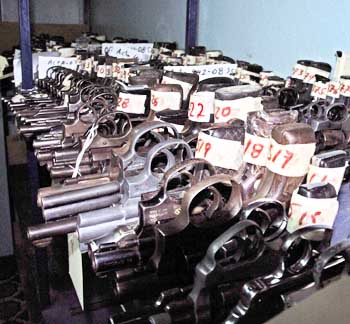
These are some of the 3,213 firearms the Fuerza
Pública y Seguridad Pública photo confiscated in the first 11 months of 2009. There even were 136 homemade weapons and five submachine guns. Officers confiscated more than 2,700 rounds of ammunition. U.N. health chief says swine flu is still a threat Special to A.M. Costa Rica
The moderate impact of the H1N1 pandemic is the best possible health news of the decade, but the head of the U. N. World Health Organization Tuesday warned that more people – particularly in the southern hemisphere – could become sick this season and that it would be premature to say the health risk is over. “It is too early for us to say that we have come to an end of the pandemic influenza worldwide,” said Margaret Chan, director general of the World Health Organization. She was speaking at a year-end press conference in Geneva. “There is no basis for any allegations that this is not a pandemic. We are seeing millions and millions of people infected with this new virus and we are fortunate that many of these people make recovery.” Ms. Chan added that it would be prudent for her organization and member states to continue to monitor the pandemic evolution for up to 12 more months. According to the agency, more than 6,000 people have died from the H1N1 since the outbreak began in April, compared with up to 500,000 who die annually from the regular flu. Pregnant women, children under 2 and people with underlying conditions such as respiratory problems are particularly vulnerable. Ms. Chan said that in a background of a fragile economy where many people suffer from chronic diseases, a severe instead of a moderate pandemic could have brought momentum for health development “to a grinding halt and reversed the hard-earned gains that the world collectively has achieved in the last 10 years.” She added that member states and World Health Organization partners have made steady but fragile progress in internationally-agreed goals in the past decade, and must work hard to maintain the momentum of progress and to catch up in areas that are lacking. Among the priorities for the next year, Ms. Chan called on countries to continue to push for progress on the Millennium development goals, eight ambitious anti-poverty targets with a 2015 deadline, especially in improving maternal mortality. She noted possible roadblocks caused by weak and insufficiently-funded health care systems. She also cautioned against threats from policies outside the direct control of the health sector, such as from the financial or the agricultural sectors.
|
||||||||||||||||||||||||||||||||||||||||||||
 |
|||||||||||||||||||||||||||||||||||||||||||||
| Home |
Tourism |
Place
classified ad |
Classifieds |
Entertainment |
Real
estate |
Rentals |
Sports |
About
us |
|
| What we published this week: | Monday | Tuesday | Wednesday | Thursday | Friday | Earlier |
| The contents of this page and this Web site are copyrighted by Consultantes Río Colorado 2001, 2002, 2003, 2004, 2005, 2006, 2007 and 2008 and may not be reproduced anywhere without permission. Abstracts and fair use are permitted. Check HERE for details | ||||||
|
| A.M. Costa Rica third newspage |
 |
||||||||
| Home |
Tourism |
Calendar |
Classifieds |
Entertainment |
Real
estate |
Rentals |
Sports |
About
us |
|
| San José, Costa Rica, Wednesday, Dec. 30, 2009, Vol. 9, No. 257 | |||||||||
|
Widow, 76, in Guanacaste is
victim of home invading trio
|
|
|
By the A.M. Costa Rica staff
Robbers in the community of Santa Rita near Liberia sneaked into the home of a 76-year-old widow Monday night, confronted her in her bed and tied her up. She still was bound Tuesday morning when a maid came to work and freed her. The woman, a U.S. citizen, lost money, two older television sets and her car that the robbers took, said a family member. One of the three men entered the home through a second -floor window that did not have security bars. Once inside, the man allowed his two partners to enter through the front door, the family member said. At least one was armed with a knife. The men wore ski masks and woke up the woman as she slept. Then they took what they wanted. The woman has been living in Costa Rica since 1998, |
according to the
family member who contacted A.M. Costa Rica. She was the victim of a
home invasion once before. That was in 2004, just two weeks after a
memorial service for her husband. Bandits at that time also used a
knife and spent three hours sacking the house and eating food in the
kitchen, said the family member. Earlier this year investigators detained a gang of bandits who invaded a number of Guanacaste homes. They had the name comelones because they took time to eat food in the homes they invaded. The name comes from the Spanish word comer, meaning to eat. The bandits Monday night appear to be from a different gang. The family member came forward because he thought that others should know about the crime. There was no police report released to the press. "There are many things we love about Costa Rica, however, these two incidents, as well as several other lesser-intense events have left us feeling less than enthusiastic about the country," said the family member in a telephone call from the United States. |
|
New U.S. ambassador was
significant Obama contributor
|
|
|
By the A.M. Costa Rica staff
Once again the U.S. ambassador to Costa Rica will be a political player instead of a career diplomat. The U.S. Senate has confirmed the nomination of Anne Slaughter Andrew of Indiana to be ambassador here. She is a Democrat and follows in the footsteps of a string of politically connected individuals, both Democrats and Republicans, who held the ambassador's post here. The position is filled by a nomination by the sitting president. The Senate must confirm the individual, according to the U.S. Constitution. At the same session Christmas Eve, the U.S. Senate confirmed Thomas Shannon to be ambassador to Brazil. He was well known in Costa Rica as an assistant secretary of State in both the George Bush administration and the first year of the Barrack Obama administration. He is a career diplomat. As is the case with many appointments, those who were confirmed agree to respond to requests to appear and testify before any duly constituted committee of the Senate. There was a long list of ambassadorial and U.S. attorney appointments confirmed. The Center for Responsive Politics on its OpenSecrets.org Web site said that Mrs. Andrew and her husband, Joseph J., have contributed about $88,000 mostly to Democratic candidates and fund-raising committees since 1989. It said |
that since 1960 about a third of
U.S. ambassadors were political
appointments, based on information from the American Academy of
Diplomacy. Both Andrews are lawyers and registered lobbyists. Joseph Andrew was an early supporter of Hillary Clinton for the U.S. presidency. He is a former national chairman of the Democratic National Committee. Before the Indiana primary Andrew switched his allegiance from Mrs. Clinton to Barack Obama. A Washington source said that even though Mrs. Clinton won Indiana, she did so with a small margin making her vulnerable. According to a biography released by the The White House, Mrs. Andrew currently is the principal of New Energy Nexus, LLC and advises companies and entrepreneurs on investments and strategies to capitalize on the new energy economy. She served as counsel at Bingham McHale and as co-chairperson of the environment/energy team at Baker & Daniels, and also served as a partner at the Washington, D.C. law firm of Patton & Boggs. The Center for Responsive Politics said that Federal Election commission records seem to indicate that the Andrews contributed $11,399 to Obama during the 2008 election cycle. Election commission records seem to show that Joseph Andrew contributed $2,299 to Obama, while Anne Slaughter Andrew contributed $9,100, the non-profit watchdog group said. |
 |
| You need to see Costa Rican tourism information HERE! |
| Home |
Tourism |
Place
classified ad |
Classifieds |
Entertainment |
Real
estate |
Rentals |
Sports |
About
us |
|
| What we published this week: | Monday | Tuesday | Wednesday | Thursday | Friday | Earlier |
| The contents of this page and this Web site are copyrighted by Consultantes Río Colorado 2001, 2002, 2003, 2004, 2005, 2006, 2007 and 2008 and may not be reproduced anywhere without permission. Abstracts and fair use are permitted. Check HERE for details | ||||||
| A.M. Costa Rica fourth news page |
 |
||||||||
| Home |
Tourism |
Calendar |
Classifieds |
Entertainment |
Real
estate |
Rentals |
Sports |
About
us |
|
|
|
|||||||||
 |
 |
|
|
| U.N.-backed container monitoring
program called success |
||
|
Special to A.M. Costa Rica
Latin American port authorities are seizing more drug consignments and counterfeit goods along container routes thanks to a United Nations-backed initiative that is showing growing success after its inception six years ago. Under the Container Control Programme – a joint project of the U.N. Office on Drugs and Crime and the independent, inter-governmental World Customs Organization – a newly established and trained Panamanian inter-agency profiling unit in the Pacific port of Balboa made their first seizures of containers carrying illicit goods. “In only three weeks, the unit, which started operations in November, seized four containers from China, destined for Chile and Venezuela,” the Office on Drugs and Crime said in a news release on the programme, which assists port authorities in establishing profiling systems and in using modern control techniques to detect illegal goods in containers without causing disruptions in the commerce of legal goods. “Inter-agency officials decided to inspect the respective containers because the declared goods were not consistent with the activity of the exporters. Large consignments of counterfeit T-shirts, fake branded shoes and towels were seized,” the agency said. Earlier, container monitoring officials in Guayaquil, Ecuador, seized 25 kilograms of cocaine worth $1.7 million in Belgium at the retail level from a container |
filled with
bananas. Tracking details showed
that the container was on its way back to Guayaquil because it had been
rejected in the port of Antwerp, Belgium. Further investigations showed that several other containers had been similarly rejected there and three additional ones were found with a total of 75 kilograms of cocaine, worth over $5 million, hidden in the refrigeration section of the containers. In September, three containers from the small town of El Carmen in Ecuador were seized with various amounts of cocaine. As a result, the Ecuadorian shipping line ordered inspections of all containers originating from El Carmen, which is allegedly harbouring Colombian drug traffickers. The programme was launched in 2003 to improve container security. While most containers carry legal goods, some are used to smuggle drugs, weapons and even people. Exchange of information by officials in participating ports have led to seizures in Antwerp and Hamburg, Germany, where cocaine busts have taken place. It is expected these seizures will increase thanks to the innovative ContainerComm intelligence system, developed by the World Customs Organization, which facilitates communication between ports and provides vital information for risk assessments and container profiling. Countries currently participating in the programme include Ecuador, Ghana, Pakistan, Panamá, Senegal and Turkmenistan. |
|
 |
| Home |
Tourism |
Place
classified ad |
Classifieds |
Entertainment |
Real
estate |
Rentals |
Sports |
About
us |
|
| What we published this week: | Monday | Tuesday | Wednesday | Thursday | Friday | Earlier |
| The contents of this page and this Web site are copyrighted by Consultantes Río Colorado 2001, 2002, 2003, 2004, 2005, 2006, 2007 and 2008 and may not be reproduced anywhere without permission. Abstracts and fair use are permitted. Check HERE for details | ||||||
| A.M. Costa Rica fifth news page |
 |
||||||||
| Home |
Tourism |
Calendar |
Classifieds |
Entertainment |
Real
estate |
Rentals |
Sports |
About
us |
|
|
|
|||||||||
 |
| Triple
dose of good news reported for U.S. economy By the A.M. Costa Rica wire services
The United States has received a triple dose of encouraging news on consumer confidence, business hiring, and home prices that suggests a fledgling economic recovery is gaining traction. Emerging from the deepest and longest recession since World War II, Americans' confidence in their nation's economy continues to rebound. The New York-based Conference Board's Consumer Confidence Index stands at 52.9, up from 50.6 a month ago, and a marked improvement from a 25.3 reading in February. "We have posted yet another moderate gain in December, primarily because people are more optimistic about the short-term outlook," said Conference Board researcher Lynn Franco. Fueling that optimism are signs that double-digit unemployment in the United States will recede in coming months. A survey of U.S. employers shows that 20 percent expect to hire full-time workers next year, up from 14 percent in 2009. Unemployment reached a high of 10.2 percent in October and currently stands at an even 10 percent. Although month-to-month fluctuations are possible, most economists expect the jobless rate to gradually decline in the coming year. Another welcome sign is a stabilization of U.S. home prices. A private reading of home prices edged up .4 percent in October for the fifth month in a row. Eleven of 20 U.S. metro areas showed gains, although housing prices remain significantly depressed from all-time highs recorded in 2006. David Blitzer of Standard and Poor's, helped compile the data. "We are seeing some small gains in home prices. Looking at the overall picture, home prices are back to where they were at about 2003," said Blitzer. "I think we will see continuing gains going forward." Most economists predict a lackluster U.S. economic recovery in 2010. But Jim O'Sullivan, chief economist at MF Global financial firm, says current data point to better times ahead. "The start of a real recovery," he said. "The question still, of course, is whether that will translate into positive job growth. And I think it will not necessarily immediately, not necessarily next week. But over the next few months we will see positive job growth. And as the year progresses, I think strength will start to feed on itself."
|
|
 |
| Home |
Tourism |
Place
classified ad |
Classifieds |
Entertainment |
Real
estate |
Rentals |
Sports |
About
us |
|
| What we published this week: | Monday | Tuesday | Wednesday | Thursday | Friday | Earlier |
| The contents of this page and this Web site are copyrighted by Consultantes Río Colorado 2001, 2002, 2003, 2004, 2005, 2006, 2007 and 2008 and may not be reproduced anywhere without permission. Abstracts and fair use are permitted. Check HERE for details | ||||||
| A.M. Costa Rica sixth news page |
|||||||||
| Home |
Tourism |
Calendar |
Classifieds |
Entertainment |
|||||
|
|
|||||||||
Latin American news Please reload page if feed does not appear promptly |
México
publishes edict for same-sex unions By the A.M. Costa Rica wire services
México City is enacting Latin America's first law permitting same sex marriage. Details of the new law to allow same sex couples to marry in the capital were published Tuesday in Mexico City's official register. Last week, legislators approved the measure, despite strong opposition from conservatives and the country's Roman Catholic Church. The measure changes the definition of marriage from a union between a man and a woman, to the free union of two people. It also grants homosexual married couples rights such as the ability to adopt children, apply for loans and share insurance benefits. The legislation replaces a 2007 law allowing civil unions and will take effect in March. Publication of the law's details comes one day after two Argentine men married each other in Latin America's first legal same sex marriage. Though gay marriage is not specifically recognized under Argentine law, the two were given the right to marry by the governor of the state of Tierra del Fuego. The HIV-positive couple had previously planned to marry in the Argentine capital, Buenos Aires, Dec. 1, World AIDS Day, but were stopped by city officials who cited conflicting judicial rulings regarding same sex marriage. Passenger jet returns By the A.M. Costa Rica staff
A Continental Airline passenger jet had to return to Juan Santamaría airport Tuesday morning after a control panel warning light went on some 45 minutes into the flight. There was no damage or injuries, but more than 100 U.S.-bound passengers were delayed. The light suggested a potential malfunction in the reverse thruster system of the engines that is used upon landing.
|
|
| Latin American news feeds are disabled on
archived pages.
|
||
| Home |
Tourism |
Place
classified ad |
Classifieds |
Entertainment |
Real
estate |
Rentals |
Sports |
About
us |
|
| What we published this week: | Monday | Tuesday | Wednesday | Thursday | Friday | Earlier |
| The contents of this page and this Web site are copyrighted by Consultantes Río Colorado 2001, 2002, 2003, 2004, 2005, 2006, 2007 and 2008 and may not be reproduced anywhere without permission. Abstracts and fair use are permitted. Check HERE for details | ||||||
|
|
Food, festivals, arts, entertainment, poker |
 |
|
|
|
|
|
|
|
|
| San José, Costa Rica, Wednesday, Dec. 30, 2009, Vol. 9, No. 257 | ||||||
|
Researchers find
that wine tastes
better when the light is correct By the University of Mainz news service
The background lighting provided in a room has an influence on how wine tastes. This is the result of a survey conducted by researchers at the Institute of Psychology at Johannes Gutenberg University Mainz, Germany. Several sub-surveys were conducted in which about 500 participants were asked how they liked a particular wine and how much they would pay for it. It was found that the same wine was rated higher when exposed to red or blue ambient light rather than green or white light. The test persons were even willing to spend in excess of one euro more on a specific bottle of Riesling when it was offered in red instead of green light. "It is already known that the color of a drink can influence the way we taste it," says Daniel Oberfeld-Twistel of the General Experimental Psychology division. "We wanted to know whether background lighting, for example in a restaurant, makes a difference as well." The survey showed, among other things, that the test wine was perceived as being nearly 1.5 times sweeter in red light than in white or green light. Its fruitiness was also most highly rated in red light. Accordingly, one conclusion of the study is that the color of ambient lighting can influence how wine tastes, even when there is no direct effect on the color of the drink. "The extreme lighting conditions found in some bars can undoubtedly influence the way a wine tastes," concludes Oberfeld-Twistel. He also recommends that serious wine tasting should be conducted in a neutral light color environment. Perhaps a partial explanation of why lighting influences the way humans taste wine is that in pleasant lighting conditions, individuals also regard the wine as being more pleasant too. Additional research is planned.  The many seeds can be removed easily Agricultural officials try to boost unappreciated papaya By
the A.M. Costa Rica staff
Agricultural officials are trying to give a boost to the unappreciated papaya to increase local consumption and exports. The Ministerio de Agricultura y Ganadería is promoting the fruit for its health benefits and said that there are about 1,000 hectares (about 2,500 acres) planted of the fruit in the country. Most of the production is in Pococí, Guácimo, La Fortuna de San Carlos, Paquera, Parrita and Orotina, the ministry said. The fruit has an unusual taste that grows on consumers like a good scotch whiskey. Pineapple and mango seem to be more preferred in a fruit plate, but papaya does not have the sharp taste. Dried papaya can be a sweet treat. The ministry touts the vitamins C and A that are contained within the fruit. The Universidad de Costa Rica has produced a new variety, payapa perfecta, that does not have a strong odor, and the tall papaya trees usually produce fruit of about the same size, perfect for marketing. The flavor is supposed to be better, too. Most papaya grown here is of this variety. The tree actually is a big herb. The fruit sells cheaply in the marketplace, and the ministry notes that it has been lauded for its aid to digestion. Papaya also can be used as a meat tenderizer. Some Costa Ricans wrap meat in papaya leaves. Commercially it is a powder sold as a tenderizer. The seeds can be eaten. Some cooks grind them and serve them like pepper for their sharp taste. Papaya now is exported to Canada, and the ministry hopes to increase exports to Europe. Papaya is believed to be native to Central America. Mexican residents were eating the fruit long before the rise of the great civilizations. Now the fruit is produced all over the tropical world. In Spanish it is called melón zapote, mamao, naimi, capaídso, fruta bomba, lechosa, mamón, mampucha, pucha and paque. In some countries papaya is not a word for mixed company, so substitutes have been created.  Photo courtesy of Henry
Karczynski
These vanilla pods still are on
the vineRare vanilla spice from Quepos produced in fully organic setting By Donna Norton Special to A.M. Costa Rica The farm got international notice when it was the recipient of the periodic "Longest Vanilla Bean" award in August 2008. An independent vanilla Web site awarded this honor to the farm, proclaiming it to be the ultimate organic vanilla producer. The farm produced beans from 9.5 to 10.5 inches or from 24.5 cm to 26.5 cm. The award is a way of highlighting top vanilla producers. Karczynski, a soft-spoken man and a U.S. expatriate with an MBA from Illinois, found his calling as a farmer while serving in the Peace Corps. "Happiness and success are not defined by one´s amount of financial wealth," he said. "I enjoy what I do, and I am fortunate that it also affords me and my family a living." After purchasing degraded pasture land in Quepos 23 years ago, Karczynski transformed the farm using agroforestry, permaculture and tropical biodynamic cultural practices. Permaculture is an approach to designing human settlements and perennial agricultural systems that mimic the relationships found in natural ecologies. The plantation is now also visited by students, researchers and practitioners of sustainable development, said Karczynski. The farm markets its spices under the Rainforest Spices label. The plantation offers a tour for visitors. The vanilla vines grow on a host tree and the dangling pods are filled with tiny edible seeds, said Karczynski. He notes that vanilla is the second most expensive spice in the world. The plant is a type of orchid. The pods have no flavor when they are picked, and it is the curing process that turns them into the highly demanded spice. On his Web site Karczynski notes that "the pod can be chopped finely or processed in a blender and used to flavor cakes, puddings, ice cream, milkshakes and many everyday sweet dishes. The whole pod can also be used to flavor custards and other liquids, taken out, dried carefully and used again up to three or four times. To flavor milk, allow one bean per 500 ml, bring to a boil and allow to stand for an hour. His two and a half hour spice plantation tour is topped off with a session of tasting of gourmet pastries and drinks made by his pastry chef. At the tasting, exquisite spice drinks and desserts are brought to the tourists one after the other while they relax at Villa Vanilla´s secluded mirador overlooking mountains and rainforest. A naturally sweet Ceylon cinnamon tea, vanilla/lime cheesecake, vanilla and/or cinnamon ice cream, and even farm grown and processed chocolate (cacao) for cookies and chocolate drinks are some of the offerings. According to Karczynski, his Villa Vanilla plantation is one of two places in the world, the other being India, where these types of quality organic spices can be purchased, and even ordered via his Web site, www.rainforestspices.com. Karczynski discovered on the farm ancient cacao artifacts used as tools in cracking cacao beans, including a large, egg-shaped stone, metate and mano in Spanish, and a rock mortar and pestle. Villa Vanilla actually uses the large rock mortar and pestle artifact to help in the production of cacao nibs, edible pieces of pure cacao. It is clear that the pre-Colombian native inhabitants valued cacao plants. too.  Two
large shrimp crown lasaña de chile pimienton.
Heredia' chef's signature dish is lasagna without the pasta Special
to A.M. Costa Rica
Chef Ruben Naranjo at the recently remodeled Bar Restaurant Alex Seth Friends in Santa Barbara de Heredia has as his signature dish lasaña de chile pimienton. A former soccer player turned chef (he was formerly with the Hotel Parador in Manuel Antonio), Ruben said “Well, this lasagna does not have cheese or pasta, so it is a bit different. In fact it is based on sweet red chiles, avocados and shrimp.” Directions: Wash two sweet red chiles and bake in preheated oven for 25 minutes until skin is blistered. Immerse in cold water and remove skin, reserve. Take a ripe, large Haas avocado and cut into small cubes and put in mixing bowl with the juice of two Mesino limes (yellow flesh without seeds), white onion finely chopped, cilantro, the skin of half a tomato finely chopped with salt and pepper to taste. Take eight pinky shrimp and two jumbo prawns and clean and place in bowl. Take a frying pan and saute the shrimp in olive oil with a bit of finely chopped white onion, a tablespoon of brandy and a tablespoon of white wine until liquid burns off. Set aside. Assemble the lasagna on a plate by placing one red chile on bottom and spooning on the guacamole mix with four pinky shrimp; make another layer and on top put a red chile or two with nothing on it. Take the two jumbo prawns and skewer them to the top with toothpicks and green pimiento olives. Great as an appetizer or side dish. A.M. Costa Rica invites recipes from chefs at other food establishments and from readers. Photos are great, too. Send them to editor@amcostarica.com.  Ministerio de Agricultra y Gandería
photo
White layer around the seed is
what the fuss is all about.Seasonable fruit makes inroads in commercial production here By
the A.M. Costa Rica staff
Some 400 producers of mamón chinos have about 800 hectares (nearly 2,000 acres) planted in the fruit. The country has become the largest exporter of the product in Central America, according to the Ministerio de Agricultura y Ganadería. Seven years ago the ministry was encouraging the planting of the fruit in the southern zone as a barrier to citrus diseased that might come in from Panamá. Now that area and the Caribbean coast
There are two types of mamón chino in the country. The more traditional one is called chupachupa. This is not a freestone variety, and some say the fruit is not sweet. A new variety is a freestone, and the edible pulp pulls from the pit easily. The ministry had distributed more than 40,000 saplings of this type over the last five years, and officials are encouraging farmers to substitute the more marketable variety for what they might now have. The fruit is about as big as a golf ball, but a lot easier to nibble. Vendors sell both the red and yellow varieties from July through November. The mamón chino is called rambutan in Asia. The Latin name is Nephelium lappaceum. The spiky, red or yellow fruit is held between the fingers and the top is bitten just enough to remove the hard outer shell. Inside is a sweet, pulpy mass surrounding a big seed. The seed is edible but usually should be roasted first. It is the pulp that the casual nibbler seeks. Throughout the downtown and elsewhere in Costa Rica mamón chino-lovers can be seen walking along chomping at the fruit. Purdue University reports that the roasted seeds are said to be narcotic. The fruit can be made into a syrup or canned, but most are eaten fresh. Costa Rican officials fear that the introduction of the citrus disease leprosis will cause great economic loss to the country. So they have established a line of control along the frontier of Panamá and seek to eradicate completely citrus trees inside this area adjacent to the border. The mamón chino is one of the alternatives, the ministry said. The fruit can be grown from seed, but someone doing this runs the risk of lavishing effort on male trees that do not produce fruit. Montero recommends that farmers use cuttings and grafting to maintain a high quality of fruit.  Cardiologists do not recommend the editor's bacon and garlic Cartago potato medley. For recipe, see below. Cartago shows off complexities of its cusine with contest By the A.M. Costa Rica staff There is a lot more to the Provincia de Cartago
than potatoes, and
cooks of the communities have joined together to prove that.
The event last month was another of the culture ministry's efforts to capture the nation's traditions. When most Costa Ricans think of Cartago, the words chilly and potatoes leap to their minds. The province, centered around the Canton of Cartago is generally higher than communities in the Central Valley. Cartago itself at 1,435 meters is 274 meters (about 900 feet) higher than the bulk of San José. That may be bad for sunbathing, but the weather is great for temperate vegetable crops, including the potato, carrot, onions and even the chayote. And these work their way into the area's traditional menus. There are seven other cantons, La Unión, Jiménez, Turrialba, Oreamuno, Alvarado, El Guarco and Paraíso. Each has developed their own variations on food. After all, they have had plenty of time. Cartago was founded in the middle of the 16th century, and Spanish settled in the region due to the healthy climate. The city was the nation's capital until 1823. The region is also known for its conservatism,
so one can expect that
the Spanish tradition will be a strong influence on the local foods.
Garlic Cartago potatoes By popular demand (Well, we got some e-mails, anyway), we include the editor's famous garlic potato medley shunned by cardiologists the world over. Ingredients: 2 cans of Imperial (or similar) beer half pound bacon (200 grams más o menos) 1 large onion 12 toes of garlic (more or less) 12 small (golf ball size potatoes or six tennis ball size) Cartago potatoes cup of olive oil Whatever extra seasonings you like such as Italian or Mexican or maybe you like parsley, thyme, bay leaves, or cilantro. Procedure Open and start drinking the first can of beer. Cut into smaller pieces and start frying bacon in large fry pan. In a few minutes combine chopped onion and chopped garlic in the frying pan. Put in the seasoning you like now. Add about half the oil. Keep heat moderate to let the tastes meld. Don't forget the beer. Wash and clean the small Cartago potatoes. Nuke them in a microwave for from 5 to 7 minutes. Then chop them into sixths or eighths. Don't forget the beer. Put the potatoes in the same frying pan with the onions, bacon, and garlic for a few minutes. Sprinkle with the rest of the oil. Then after a few minutes transfer the entire dish to a metal or glass baking dish and stick in a pre-heated oven. Depending on the time for dinner, cover with foil to keep garlic, onions and bacon from burning. Make sure to remove the foil during the last 10 minutes to make the potatoes slices crisp. Reward yourself with the second beer. (This is really a beer-type dish. But port after dinner goes well, too.) Serve with beer and meat of your choice, perhaps a pork roast.  A.M. Costa Rica/Saray Ramírez
Vindas
Vitamin on the half shell to eat out of hand or in drinks.From left, a seedy grandilla, a naranjilla
with dark interior, a guava,
starfruit and a piece of snowy white guanabana A few thousand colons provides
a bounty of delicious fruits By Saray Ramírez Vindas
of the A.M. Costa Rica staff Delights from star fruit to guavas to the prickly guyabana and the delicate naranjilla are on the market now, and you can get your daily dose of vitamin C with little trouble. In water, milk or cocktails, the fruits give up their delicious tastes. The rainy season brings pure water to revitalize the earth and improve the environment. It also gives a boost for some fruits. And this is a good time to explore fruity options. Costa Rica has a long list of delicious tropical varieties rich in vitamins A, B1, B2, B6, and C. Blending fruits with water to make a refresco is common in Costa Rican homes. Water is preferred for its lower costs, but the daring can try milk and even cream for some of the fruit. Watch out for seeds if a blender is to be used. A reporter went to the Mercado Central with a few thousand colons to seek out fresh fruit. Another option is the ferias del agricultor, but many markets are just one day a week. At the central market there were at least guayabas, maracuyas, carambolas, naranjillas and guanabanas. Here is what they are: The guayabas or guavas are 1,100 colons a kilo, about $1.93. The baseball-size green fruit has five small protrusions on the flower end. Some fruits have up to 500 seeds but they can be eaten. They are Mexican or Central American natives now found all over the world. The carambola is the starfruit now grown locally and available in most North American supermarkets but not at 600 colons a kilo, or a bit more than $1. The whole fruit, including skin, can be eaten. The maracuyá is the passion fruit or what is called grandilla here in Costa Rica. They are available for 850 colons a kilo, about $1.50. The fruit can be several colors, but most here are yellow. There are plenty of seeds. They can be eaten but some folks like to strain them for juice. The naranjillas (1,500 colons per kilo) are like tiny oranges, with lots of seeds and a dark interior. They can be eaten out of hand, and the juice is green. Unripe fruits are sour but can be eaten with sprinklings of salt. The guanabana is the soursop, a giant fruit that frequently is cut up to be sold. It runs 1,200 a kilo ($2.10) at the market. The creamy meat of the plant is eaten out of hand or juiced. The black seeds, about the size of those in a watermelon, are not eaten. Each of these fruits can be the subject of its own monograph. But the wise shopper will try new fruits and in different ways. Some can end up in jam as well as drinks. Others can be reduced to a sweet syrup. Some fruits have a reputation as a medicine or a cure. But that is a whole different article. Pigs with the right genes sought for the best tasting meat By the University of the West of England Press Office How can pigs be produced that provide healthy
and yet good tasting meat?
Meat eating quality and healthiness are closely
related to the amount and type of fat. During the last decade there has
been extensive selection towards leaner genotypes which has resulted in
reduction of not only undesirable subcutaneous fat, but also in a
dramatic decrease in desirable intramuscular fat (commonly known as
“marbling” fat).
Intramuscular fat has the key input in meat tenderness and juiciness and a low level of intramuscular fat is associated with dry and unpalatable pork. The challenge which the pig producing industry is facing now is how to increase intramuscular fat without increasing subcutaneous fat? A project which has recently started at the Institute of Biosensing Technology in collaboration with the Centre for Research in Biomedicine at the University of the West of England (UWE) aims to identify the genes controlling subcutaneous and intramuscular fat deposition. The end-aim of this work is to provide data which could form a basis for developing a genetic test for intramuscular fat and which could assist pig breeders in genetic selection. The project is undertaken by Duncan Marriott, a doctoral student with a amster's degree in meat science and five years experience as a research technician at the University of Bristol's School of Clinical Veterinary Science. “Pigs need to be leaner to produce healthy meat
but to carry
sufficient intramuscular fat to maintain good eating quality," Marriott explaind. "The project will be conducted on a number of commercial pig breeds, which differ in intramuscular fat content. My challenge is to identify the genes controlling both the intramuscular and subcutaneous fat content in different breeds.”  A.M. Costa Rica
photo
The first step is to half the palm nutsEditor's favorite soup is easy
and very much Costa Rican By Jay Brodell
editor of A.M. Costa Rica Here's the lowdown on the editor's favorite soup. One serving is about a zillion calories, so Weight Watchers can tune out now. The beauty of pejibaye soup is that it is easy to make, tastes great and is uniquely Costa Rican. The fruit have been grown here since long before Columbus. Pejibayes are those palm nuts found in the vegetable sauna at the grocery. They range from orange to green and resemble large, bobbing acorns. When they are hot, they are easier to peel. Purdue University in Indiana says that one average pejibaye fruit contains 1,096 calories. They are the perfect junk food: low in protein, high in fat. Of course they're high in fat, they are the product of a palm tree. One palm tree can produce more than 140 pounds of nuts in a year. So they are far from endangered. The biggest challenge in making pejibaye soup is in forcing yourself not to eat the peeled halves. They make a nice hor d'oeuvre topped with mayonnaise. Another challenge might be in getting someone else to peel and halve the fruit. There is a pit that must be removed. (Hey, Honey, can you give me a hand for a minute . . . . ?) The soup is a snap. Drip a little oil in a saucepan and make tender chopped onions, garlic and maybe even jalapeños. Then drop in about a dozen pejibaye halves . Or two dozen. It really makes no difference because you can cut the soup with milk or cream to make it the consistency you desire. Add a cup or two of water and begin breaking up the pejibaye. Or you could run the whole mixture through a blender. Add milk or cream to reach the consistency of soup. Serve hot and season to taste. A little experimentation will show that the pejibaye mixture is perfect for a sauce over traditional foods. And they say fermented pejibaye will knock your socks off.  A.M. Costa Rica
photo
A quick snack of green mango
Time for a sour green fruit
that's loaded with vitamin C By the A.M. Costa Rica staff
Among the more underrated offerings of the Costa Rican produce markets is the green mango. Most expats know about ripe mangos and have enjoyed the drippy, juicy fruit with its unique flavor. They may also have used it in blended drinks or as a flavor for ice cream or soda. Less respected is the green mango. This can be found prepared in the little baggies offered by street vendors. Included in the bag with the strips of mango is a bit of lemon and salt. Nice vendors also will add special ingredients, like chili, upon request. This is street finger food. The long mango strips are bitter and an acquired taste. And that's about all the average Tico sees of green mangos. The inhabitants of India and some Asian countries have a 4,000 to 5,000 year head start on using the fruit. Chutney, the condiment identified with the British Empire and India, has a mango base. Green mangos can hold their own in any taste test, and the addition of sea salt, chili, chilero or black pepper can cater to the desires of the consumer. A real treat is a green mango salad. There are an infinite number of recipes. The basic salad contains either grated or strips of mango. From there on in, the choices are many. One version uses baked coconut and various nuts, bean sprouts and basil. Those who want to add fire to the sour treat can create a mango-jalapeño salad, heavy on lime or lemon and pepper. The fruit is so accommodating that a chef can hardly go wrong. The salad can become a main course with the addition of chicken or shrimp. The mango also contains all sorts of healthful compounds, including vitamin C and fiber. The only downside is the large seed in the middle that sometimes can be a challenge. Freestone versions of the fruit exist, but they are foreign to Costa Rica.
Take the Chinese liquor plunge and drink that mystery elixir By Arron O'Dell
Special to A.M. Costa Rica China is a country known for the Great Wall, temples, big cities, big culture, a billion people and their seeming love to eat anything. If it grows out of the ground, walks, crawls, slithers, swims, flies or does any combination, the people of China have found a way to kill it, cook it, eat it and enjoy it. However, the liquor traditions of China seldom come up in conversation. There are more Chinese than you can shake a stick at around the globe and not one beer that is popular around the world. This is the sort of thing not to be taken lightly. There must be a good reason for it. Most Chinese joints here don't even sell an Asian beer and, if they do, it's almost always Thai or Japanese. You will never here a Chinese expat say something like "Yeah, this Pilsen is okay but you should try this beer I use to drink back home." What the Chinese did bring with them was liquor, high octane, burn-on-the-way-down, glorious liquor. You haven't seen the stuff at Hipermás, any of the big mercados or your local super, because it is not there. You cannot find it in any of the places you frequent for your standard shopping needs. The only way to track down Chinese liquor is to search out the small shops around town with the Chinese characters on the front. These shops are here. You can find them. When you fall into one of these places you hit gold because of the strange and exotic smells. A good shop will have two or three shelves of bottles in a variety of shapes sizes with red and gold labels and writing that means nothing unless you read Mandarin. My friend and I have found the best way to pick the best one is by style. The first bottle we took home was chosen this way and still remains a favorite. It was a short and fat bottle shaped like an oversize pineapple hand grenade with a colorful label. When my friend saw it, he said something like 'I've got to have that bottle. It looks cool!' He was that excited about this new elixir we had found. With bottle in hand we quickly made our way to the closest place to home that sold beer and yanked several six packs off the shelf and darted home at a near run. With two open cans and empty shot glasses in front of us we stared admiring the bottle for a moment. Then with stupid giddy expressions on our faces we poured. After the straight shot, we felt compelled to try it every way we could come up with until there was no more. We sipped it, drank it on ice, with soda, chased it, used it as a chaser for beer. This tasting was was done very scientifically. It was very similar to Jägermeister without the bite on the front, and for 2,000 colons it was a superb deal. Somewhere around around the bottom of the bottle it occurred to us it might be nice to have a name to put to this wonderful concoction. We studied every character that The People's Republic of China felt necessary to put on the ornate paper label on that fine, cheap bottle, and all of it was in some form of Chinese. When we inquired of the proprietor of the local Chinese restaurant, he told us that it was an “export-only” liquor from mainland China. How fortunate for us that they chose to export this fine elixir! |
 |
||||
| These spaces are reserved for the country's better restaurants |
|||||
Take your gourmet cooking to
the
next level!
5234-cb17
World's finest 5-star restaurant secret
recipes
Discover the secret recipes from the world's finest restaurants and
cook 5-star dinners at home for a fraction of the cost! Make your
friends and family go all wild and gaga over your food at the next
bash, party or gathering. HERE!5232-cb15
Top ten candy recipes.
Learn how to cook some of the best tasting candy recipes in less than
an hour. Any recipe can be fixed in less than an hour with no more than
eight ingredients! All of these candy recipes have been perfected to a
point where even people who dislike major ingredients in some candies
can't get enough of our unique taste and flavors! HERE!5233-cb16
Make your own GREAT beer!
Did you know that it REALLY is pretty easy to make a great tasting home
brewed beer in your own kitchen? You might find it hard to
believe
after the bad experiences you might have had or heard about from your
friends. Learn how to brew your own beer with the BeerEasy.com video
training series. Training includes videos on extract brewing, all grain
brewing, original home brewing recipes, Brew your own beer today for a
lot less than what C ervercería Costa Rica charges for Imperial
Visit BeerEasy.com!5235a-cb18
Food- and entertainment-related events and
times are eligible for placement here at the usual classified rates.
See how to place a classified HERE!
|
|||||
| The
plantain is a fruit that has triple flexibility in kitchen |
|
|
By the A.M. Costa Rica staff
The culinary landscape of pre-conquest America lacked some of the foods taken for granted today. There was no sugar. That was imported by Columbus on his second voyage. The delicious mango did not grow here. And the banana did not come to the Americas until the 16th century. Even the ubiquitous rice plant is a colonial import. Despite being imported, these plants flourished here. And no Costa Rican meal is complete without rice. The plantain, called plátano, also makes up a flexible part of the diet. The flexibility is in the use of green plantains as a starchy potato or rice substitute and the use of the mature fruit in ways to take advantage of its sweetness. The plantain is larger than the typical table banana. Its uses differ depending on the maturity. The green plátano can be cooked like a potato, grated into flour or fried to make chips. The patacone, a double-fried disc of plantain traditionally is decorated with refried beans, mayonnaise and avocado dip. Compared to the rest of the world, Costa Rica is fairly conservative in using the plátano. Asian cooks are far more creative. For most, the mature, almost black-skinned plátano comes fried as one of the regulars in the luncheon casado. They are called maduros and give off their sweetness when fried in hot oil. Nutritional content varies slightly depending on the maturity of the plantain. A green plantain, about 220 grams or about half a pound, is about 360 calories with no calories from fat. A ripe fruit is slightly less, about 340 calories. The 2 gram sugar content of the green fruit increases to about 10 grams in the mature plantain. Both are reported to be a good source of potassium, dietary fiber, vitamin A and vitamin C. The non-fat label is a bit misleading because many of the great plantain recipes call for deep frying. A good source of recipes is the Turbana cooperative Web site. The company features dishes for all three plátano stages. |
 Typical display of green plátanos
Among these are plantain pancakes, mashed green plantains, fried plantains and several desserts. Those who love patacones should know that some gourmet stores sell a press to make uniform discs. Others sell a product to fabricate a small plátano shell into which condiments can be spooned. At home, the once-fried quarters of plantain can be pressed with the bottom of a bottle or some other hard object. They need to be reduced to about a quarter inch before deep frying again. |
| Chemical
seen leaching from polycarbonate bottles to humans |
|
|
By the Harvard School of Public Health
news service
Researchers have found that persons who drink from polycarbonate bottles have a higher level of chemical bisphenol A , which is used in producing the containers. Exposure to bisphenol A, used in the manufacture of polycarbonate and other plastics, has been shown to interfere with reproductive development in animals and has been linked with cardiovascular disease and diabetes in humans. The researchers were led by Jenny Carwile, a doctoral student in the department of epidemiology at Harvard School of Public Health, and Karin B. Michels, an associate professor of epidemiology. Researchers recruited Harvard College students for the study in April 2008. The 77 participants began the study with a seven-day washout phase in which they drank all cold beverages from stainless steel bottles as a control. Participants provided urine samples during the washout period. They were then given two polycarbonate bottles and asked to drink all cold beverages from the bottles during the next week. Urine samples were also provided during that time. The results showed that the participants' urinary bisphenol A concentrations increased 69 percent after drinking from the |
polycarbonate bottles. The study
authors noted that concentrations in
the college population were similar to those reported for the U.S.
general population. Previous studies had found that bisphenol A
could
leach from polycarbonate bottles into their contents. This study is the
first to show a corresponding increase in urinary concentrations in
humans. One of the study's strengths, the authors note, is that the students drank from the bottles in a normal setting. Additionally, the students did not wash their bottles in dishwashers nor put hot liquids in them. Heating has been shown to increase the leaching of Bisphenol A from polycarbonate. Canada banned the use of bisphenol A in polycarbonate baby bottles in 2008 and some polycarbonate bottle manufacturers have voluntarily eliminated the chemical from their products. With increasing evidence of the potential harmful effects of Bisphenol A in humans, the authors believe further research is needed on the effect of Bisphenol A on infants and on reproductive disorders and on breast cancer in adults. In addition to polycarbonate bottles, which are refillable and a popular container among students, campers and others and are also used as baby bottles, bisphenol A is also found in dentistry composites and sealants and in the lining of aluminum food and beverage cans. In bottles, polycarbonate can be identified by the recycling number 7 |
|
|
|
|
|
|
|
|
| What we published this week: | Monday | Tuesday | Wednesday | Thursday | Friday | Earlier |
| The contents of this page and this Web site are copyrighted by Consultantes Río Colorado 2001, 2002, 2003, 2004, 2005, 2006, 2007 and 2008 and may not be reproduced anywhere without permission. Abstracts and fair use are permitted. Check HERE for details | ||||||