Your daily
English-language
news source
Monday through Friday

| |
|
|
Your daily |
|
|
|
|
|
|
|
|
|
|
|
|
|
||||||||||||||||||
|
|
||||||||||||||||||
 |
| A.M. Costa Rica Second newspage |
 |
||||||||
| Home |
Tourism |
Calendar |
Classifieds |
Entertainment |
Real
estate |
Rentals |
Sports |
About us |
|
| San José, Costa Rica, Friday, Dec. 29, 2006, Vol. 6, No. 258 | |||||||||
 |
| Costa Rica Expertise Ltd http://crexpertise.com E-mail info@crexpertise.com Tel:506-256-8585 Fax:506-256-7575 |
 |
 Click HERE
for great
hotel discounts
|
 Ministerio de Gobernación,
Policía
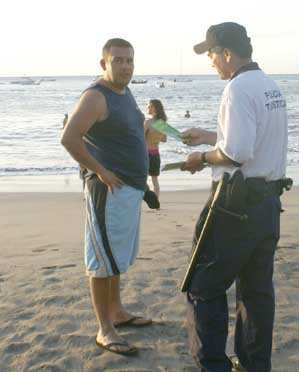
Agents opened these sealed compartments to find the suspected
drugs (inset).y Seguridad Pública photo Cocaine packages built
into bodies of launches By the A.M. Costa Rica staff
Investigators used drills and power saws Thursday to cut through the structure of two launches that had been confiscated Dec. 17. They were rewarded with 1,770 one-kilo packages of cocaine. The two boats are believed to be from Colombia, and the cocaine was built right into the crafts. A police helicopter pilot spotted one of the craft Dec. 17 and gave chase. The two men on the boat were able to evade a surface craft and beach the boat on Playa Bejuco in Parrita. This was the "Diana." A second craft was found abandoned on Playa Bandera in Aguirre by the Sección de Vigilancia Aérea of the Ministerio de Gobernación, Policía y Seguridad Pública, officials said. Because of the suspicious circumstances, agents began to cut into the boats Thursday and removed the packages of suspected cocaine. They had been stored at the Guardacostas facilities in Quepos. Thousands turned back at border with Nicaragua By the A.M. Costa Rica staff
Costa Rican immigration agents and police are trying to stop a flood of illegal persons from entering the country from Nicaragua. Officials reported Thursday that they had turned back some 5,135 persons, 3,265 men, 1,457 women and 413 children. Some of these showed up at immigration checkpoints with faulty papers. Nicaraguans now need passports and visas to enter the country. Others were grabbed by police units as they tried to cross into the country in rural areas through rivers and fields. The immigration checkpoint at the Nicaraguan border in Peñas Blancas continues to be crowded with long delays likely. Not all of the illegal would-be immigrants were Nicaraguan, said officials. Fuerza Pública officers beefed up their numbers in the area Dec. 18. Officers with rifles are on guard along the border overlooking key illegal entry points. Other units are roving along creeks and streams seeking out groups of illegal immigrants. Officials said they expected to continue the show of force until Jan. 8 when the Christmas rush winds down.
|
|
|
||||
|
Are
you considering doing business with a burglar alarm company?
If so, you should contact me first for my opinion prometheusthegreek@gmail.com |
 |
|
on our real estate page HERE! |
| A.M. Costa Rica third newspage |
 |
||||||||
| Home |
Tourism |
Calendar |
Classifieds |
Entertainment |
Real
estate |
Rentals |
Sports |
About us |
|
| San José, Costa Rica, Friday, Dec. 29, 2006, Vol. 6, No. 258 | |||||||||
 |
 |
| Trip downtown leads to the discovery of reasonable food |
|||
| I know that in the
United
States the day after Christmas is a busy day in the cities. The
stores are full of people exchanging gifts and taking advantage of the
newly advertised bargains — and perhaps there will be even more
people buying since President George Bush said he wished they
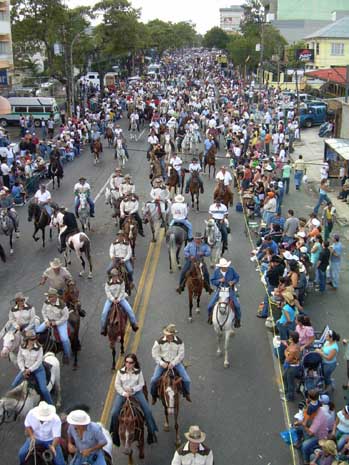
would shop more. There were certainly crowds of people in downtown San Jose, but not many of them were shopping. The day after Christmas is the day of the tope and most people were lining the streets along Paseo Colón to almost the Museo Nacional on Avenida 2. Thousands of riders on high stepping, even dancing horses jammed the streets. There were riders of every stripe in costumes as varied as the riders. I even saw a Chinese cowboy — hat, chaps, fringe and all. Some people were riding in horse-drawn carriages and there was plenty of music and laughter, something Costa Ricans seem to do very well. What amazed me the most was how well the horses seemed to get along with each other in such close quarters. Still protective of my arm, I decided to quit the crowds and walk along some avenues where there were no crowds. San José during Christmas week is nearly deserted. Although some stores were open and some people were carrying shopping bags, the streets were not busy. There is a restaurant on Avenida 1 that I have passed over the years. It is called La Flor and is across from the Banco Nacional near the Hotel Morazán. It used to serve fruit and ice cream dishes mainly and there seldom were more than a couple of people in there no matter what time of day. I often worried about all of the fruit that decorated the place. It must spoil before they sold it. Lately the place has been crowded and humming with people seemingly at all times of the day. They have changed their menu. A sign half fills one of the large windows proclaiming “Good food at Tico Prices” and below is the menu in both English and Spanish. I decided to try it. The menu is typically Tico from breakfast of gallo pinto and eggs (1,300 colons) to platos fuertes of meat, fish or chicken with beans, salad, rice, vegetables, a drink and dessert for 1,500 colons. (Figure that 518 colons equals $1) If you are hungry it is indeed a bargain. I chose a pork cutlet, beans, platanos (plantains), salad (no rice, thank you.). My plate was overflowing and more than I could finish, although it was good, especially the platanos. It came with a fruit drink and dessert, which was a small scoop of strawberry ice cream topped with strawberry jello. The combination of ice cream and jello is quite popular here and is, I am sure, unique to Costa Rica. But don’t turn up your nose until you try it. I found it very good and mentioned to my friend Sandy, who exclaimed. “I love Jello.” Well, I happen to, too. So we may add that to our tradtional perros calientes dinners. They also serve a Gringo breakfast of bacon and eggs, toast and juice for 2,500 colons. And they have hamburgers for 1,500 colons. They still serve fruit salad and fruit with ice cream (1300 -–1700 colons). |
 A.M. Costa Rica/José Pablo
Ramírez Vindas
Crowd at the tope TuesdayThe most expensive dish on the menu is jumbo
shrimp with garlic at
5,000 colons. The service people are very nice, and sitting near
a
window is almost like being in a sidewalk café. We are not
talking
gourmet dining, but if you like a busy café with reasonable
prices and
lots of typical Costa Rican food, give it a try. As upscale
restaurants are getting more and more expensive, this was an
easy-on-the-pocketbook change. They are open from 7 a.m until 10
p.m.
Next door is the Two Gringos Restaurant, and from the sign outside, it looks like their prices are competitive. They were not nearly as busy, but are worth a try next time I’m downtown. But "expensive" is relative. I recently ordered corvina encrusted with macadamia nuts and a light lemon sauce at the Grano de Oro. It was 7,500 colons which I thought rather expensive — until I heard on the news that Hillary Clinton’s order of filet of sole at the Four Seasons in New York cost $56. Buses were still running on the side streets, so I ventured back to riding buses . I just love the view from buses. It looks this year as if everyone didn’t go to the beach for the holidays. |
||
| Lawyer
for Villalobos backers disputes concept of penalty |
|
|
By the A.M. Costa Rica staff
A lawyer for those who await the coming of Luis Enrique Villalobos Camacho says a Dec. 19 news story in A.M. Costa Rica was erroneous. The lawyer, Jose Miguel Villalobos Umaña, said in a private opinion provided to the United Concerned Citizens & Residents that those who drop their legal claims against Villalobos and his brother Oswaldo will not be "punished by the judge for the withdrawal of their accusation, as the article erroneously states." The United Concerned Citizens is a group that seeks to have those who filed criminal and civil actions against the Villalobos Brothers to drop their charges. They and like-minded Villalobos creditors have been campaigning for years and have been successful in encouraging a number of victims to drop their charges. The statement by Lawyer Villalobos was sent by e-mail. In a subsequent response to a question, the lawyer wrote that he came up with his opinion without looking at the file on the case. The news article said: "Former Villalobos investors who filed cases against the fugitive financier and his brother and then dropped the complaints may be in for a shock. "Costa Rican law allows the judge in the case to assess damages and attorney fees in favor of the former defendant. These damages can be a percentage of the original amount claimed and can be significant." In contrast, Lawyer Villalobos wrote in a translation provided by the United and Concerned Citizens:: Articles 118 and 78 of the Criminal Procedural Code establish that in the case of a desist, those who filed the accusation in the civil action will cover the corresponding costs as agreed upon with their lawyers or determined by the judge, in accordance with the amount of work performed on the matter by the professional. It has no reference whatsoever to a penalty for damages or suffering, as the article seems to imply, and whose intention seems to be to desperately frighten the remaining filers into not withdrawing their charges. Of course, those who have withdrawn their charges should rightfully pay their lawyers for the work performed and that amount should be settled between them. It should be clear that they will not be punished by the judge for the withdrawal of their accusation, as the article erroneously states, as it is their right to continue ahead or not, and in any case the only person affected by the accusation and the only one who could be offended by it is! Lawyer Villalobos is the former minister of Justicia y Gracia in the Abel Pacheco administration who started his own political party and ran unsuccessfully for president earlier this year. The United Concerned Citizens say on their Web site that they have paid him $139,350 as of March 26. Although the organization does not appear to be legally constituted, Villalobos seems to have a contract with the group's board of directors. |
Withdrawing a claim is called desistimiento
in Spanish. Other
lawyers have said in interviews and in a letter to the editor that
someone who withdraws a claim certainly can have a financial obligation
to the person who was the defendant. However, no one appears to have gone to the courthouse to look at the file, which is restricted to just lawyers and litigants, and now the courthouse is closed until Jan. 8. The Dec. 19 article suggested that some judgments might already be assessed against some of those who dropped their claim. Lawyer Villalobos said he did not have to examine the file to render his opinion. He also suggested that he should not examine a file if he were not the lawyer of one of the parties in the case. He also said that the contents of the file had no bearing on the questions involved. The statement by Villalobos suggests that someone who withdraws a claim only has to pay his or her own lawyer. But Article 78 of the Código Procesal Penal says that the plaintiff can drop their claim at any point. But in that case he or she will be responsible for his or her own costs and remain subject to the general decision dictated by the tribunal, unless the parties agree otherwise. The law also says that claimants can drop their case simply by not following up on the legal process. This is called tácitamente desistida or tacit or implied withdrawal. Article 118, one of the two sections cited by Lawyer Villalobos, specifically says that when a plaintiff is declared desistimiento, he will be penalized to pay the costs that his action has provoked. A lot of Villalobos creditors outside Costa Rica may have failed to follow up on their original claim or their lawyers might have been less than aggressive. In such a case they may already have implicitly withdrawn. The creditors who still trust the Villalobos Brothers are anxious for the start of a February trial of Oswaldo Villalobos. They think that if Oswaldo is not convicted on allegations of fraud, money laundering and illegal banking, his brother will come out of hiding. Others suggest that the two cases are different and that a decision in the Oswaldo Villalobos case will have no effect on the Luis Enrique Villalobos case. Oswaldo Villalobos ran the Ofinter money exchange houses. He is expected to maintain that he had no connection with the high interest operation run by the brother that paid investors from 2.8 to 3 percent a month. Prosecutors plan to claim otherwise based on documents discovered in a raid on both Oswaldo's and Luis Enrique's adjacent offices July 4, 2002. More than 6,000 persons, many of them North Americans, gave money to Luis Enrique Villalobos in anticipation of high interest. Many had moved to Costa Rica to be near their money. They were shocked when he closed his Mall San Pedro office Oct. 14, 2002, and vanished. He had about $1 billion on his books at that time, an amount the faithful believe has grown to more than $3 billion. |
| You need to see Costa Rican tourism information HERE! |
| A.M. Costa Rica fourth news page |
 |
||||||||
| Home |
Tourism |
Calendar |
Classifieds |
Entertainment |
Real
estate |
Rentals |
Sports |
About us |
|
| San José, Costa Rica, Friday, Dec. 29, 2006, Vol. 6, No. 258 | |||||||||
 |
| Chávez
says he'll pull plug on TV station that opposed him |
|
|
By the A.M. Costa Rica wire services
Venezuelan President Hugo Chávez warns that he will not renew the license of a television station he accuses of backing a failed coup against him in 2002. Chavez said in a speech Thursday to the military that the concession for Radio Caracas Television will end in March. Earlier, the information minister, William Lara, said the broadcaster's license would expire next May. |
Chávez also said he will not
tolerate any media outlets that
support efforts to remove him from power. There was no immediate
response from the Caracas-based station. President Chávez has repeatedly denounced RCTV and other pro-opposition broadcasters for what he says is overly critical coverage of his government. The press rights group Reporters Without Borders has urged Venezuela to end its efforts to shut down RCTV. |
| U.S.
grabs $700,000 in deposit certificates bought for ex-president
Alemán |
|
|
By the A.M. Costa Rica wire services
U.S. officials have seized $700,000 worth of certificates of deposit purchased on behalf of former Nicaraguan President Arnoldo Alemán. Immigration and Customs Enforcement officials in Miami, Florida, said Wednesday the certificates were bought with money stolen from the Nicaraguan government. |
Aleman was convicted and sentenced
in Nicaragua to 20 years for money laundering and embezzlement in 2003. U.S. officials say his wife flew to Miami in 2002 and requested the certificates of deposit be transferred to members of her family. Immigration and Customs Enforcement then seized the CDs. The agency says the funds will be deposited into the U.S. Treasury Forfeiture Fund. |
 |
|
| News from
the BBC up to the minute |
BBC sports news up to the minute |
| BBC news and sports feeds are disabled on archived pages. |
|
| A.M. Costa Rica Sports news local and from the wires |
 |
|
|
|
|
|
|
|
|
| San José, Costa Rica, Friday, Dec. 29, 2006, Vol. 6, No. 258 | ||||||
|
Sporting Event Needs Assistance
FlagMag.com Flag Football magazine will be hosting an International
Flag Football Tournament, Jan. 26-29th in Santa Ana. Men and
women teams from Canada, U.S.A., Mexico, Venezuela, Honduras and
Panamá will take part. We are seeking host families and
volunteers for the event. Anyone interested, please contactJim Zimolka at 506-336-3437 or e-mail at JimZimolka@Flagmag.com
|
| The latest top sports news |
Sports news from VOA |
| News and sports feeds are disabled on archived pages. |
|
|
|
|
|
|
|
|
|
| What we published this week: | Monday | Tuesday | Wednesday | Thursday | Friday | Earlier |
|
Check HERE for more details |