|
 |
Your daily |
 |
|
|
|
|
|||||||||||||||||||
|
|
|||||||||||||||||||
 |
|
|
|
|
|
|
|
|
| What we published this week: | Monday | Tuesday | Wednesday | Thursday | Friday | Earlier |
|
|
| A.M. Costa Rica Second newspage |
 |
||||||||
| Home |
Tourism |
Calendar |
Classifieds |
Entertainment |
Real
estate |
Rentals |
Sports |
About
us |
|
| San José, Costa Rica, Friday, Nov. 13, 2009, Vol. 9, No. 225 | |||||||||
 |
| Costa Rica Expertise Ltd http://crexpertise.com E-mail info@crexpertise.com Tel:506-256-8585 Fax:506-256-7575 |
 |

Click HERE for
great
hotel discounts
|
|
Cold front brings shivers to Central Valley Ticos By
the A.M. Costa Rica staff
A cold front from the north is moving in, and Costa Ricans may soon be wearing ski caps and heavier coats in the Central Valley. Even at the beaches the mercury is expected to drop lower during the nights. This is normal at this time of year, and northern hemisphere snowbirds are likely to be mystified by the concern over cold weather. Central Valley residents will see temperatures in the mid-teens, perhaps 17 C. in San José. That's a moderate 63 degrees F, except for Costa Ricans who prefer warmer nights. The temperature at 1:30 a.m. Friday was 18 degrees C in north San José. That's 64.4 F. Beach dwellers will continue to have hot days over the weekend, but temperatures will be in the low 20s C during the nights. That is around 72 degrees. Big game is Saturday for World Cup berth By
the A.M. Costa Rica staff
All eyes will be on the Estadio Saprissa Saturday as the Costa Rican national team takes on the best from Uruguay in a match that may be the key to joining the elite squads that participate in the World Cup matches next year in South Africa. Costa Rica has the home field advantage in a stadium with artificial turf. This has worried some visitors, and Costa Rica continues to dominate the play in its home stadium. The United States team, already a World Cup qualifier, tied the Costa Rican team in the last few seconds of play Oct. 14 and pushed it into fourth place after Honduras. The fourth place team has to scramble to win a ticket to South Africa. The stadium is sold out and the game will be televised. Uruguay has been training on an artificial surface in Guatemala to prepare for the game. A second match is in Uruguay later in the week. Veteran ceremony Sunday at church in Guachepelín By
the A.M. Costa Rica staff
Residents here will mark Remembrance Day, also known as Armistice Day, Sunday at 5 p.m. in the International Baptist Church in Guachepelín, Escazú. Although the official date is Nov. 11, the commemoration of the sacrifices of members of the armed forces has been moved to this Sunday. Representatives from the U.S., British and Canadian embassies are expected to attend along with military veterans. More information is available at 2258-2025 or 8395-9653. Armistice Day used to mark the end of World War I, but it has expanded to mark the sacrifices of all war veterans. 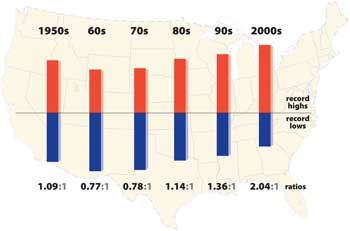 National Center for Atmospheric Research
graphic
The ratio of record daily highs
to lows from 1950 to 2009 at 1,800 U.S. weather stations.Record highs
outpace lows
in U.S. weather analysis By
the National Science Foundation
Spurred by a warming climate, daily record high temperatures occurred twice as often as record lows over the last decade across the continental United States, new research shows. Results of the research by authors at the National Center for Atmospheric Research in Boulder, Colorado, Climate Central, The Weather Channel, and the National Oceanic and Atmospheric Administration has been accepted for publication in the American Geophysical Union journal Geophysical Research Letters. "Climate change is making itself felt in terms of day-to-day weather in the United States," says Gerald Meehl, the lead author at the National Center for Atmospheric Research. "The ways these records are being broken show how our climate is already shifting." If temperatures were not warming, the number of record daily highs and lows being set each year would be approximately even. Instead, for the period from Jan. 1, 2000, to Sept. 30, 2009, the continental United States set 291,237 record highs and 142,420 record lows, as the country experienced unusually mild winter weather and intense summer heat waves. A record daily high means that temperatures were warmer on a given day than on that same date throughout a weather station's history.
|
|||||||||||||||||||||||||||||||||||||||||||||||||||||
 |
||||||||||||||||||||||||||||||||||||||||||||||||||||||
| Home |
Tourism |
Place
classified ad |
Classifieds |
Entertainment |
Real
estate |
Rentals |
Sports |
About
us |
|
| What we published this week: | Monday | Tuesday | Wednesday | Thursday | Friday | Earlier |
| The contents of this page and this Web site are copyrighted by Consultantes Río Colorado 2001, 2002, 2003, 2004, 2005, 2006, 2007 and 2008 and may not be reproduced anywhere without permission. Abstracts and fair use are permitted. Check HERE for details | ||||||
| A.M. Costa Rica third newspage |
 |
||||||||
| Home |
Tourism |
Calendar |
Classifieds |
Entertainment |
Real
estate |
Rentals |
Sports |
About
us |
|
|
|
|||||||||
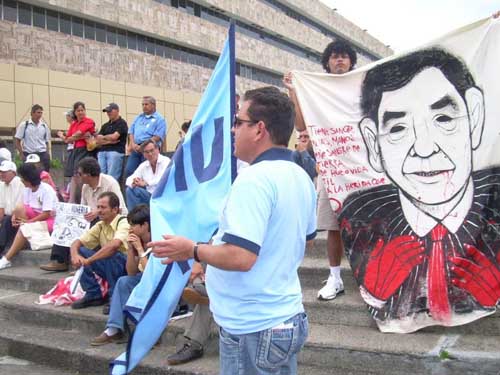
Cruictas protest Opponents of an open pit mine in northern Costa Rica congregated at the Corte Suprema de Justicia Thursday while lawyers inside argued the case in an open hearing. The Sala IV will make a decision on multiple appeals in a month. That's Óscar Arias Sánchez characterized with blood on his hands by the none-too-subtle protesters. |
 A.M. Costa Rica/Saray Ramírez Vindas
|
|
Comment by Arias
concerns hemispheric press group
|
|
|
By
the A.M. Costa Rica staff
The hemisphere's press organization said it wonders if President Óscar Arias Sánchez plans to change the Costa Rican Constitution to restrict press freedoms. The organization expressed its concern in a summary of press freedoms on Costa Rica as part of its annual general assembly last week in Buenos Aires, Argentina. The organization, the Inter American Press Association, said that during his term of office Arias "has swung in and out of spats with the press, accusing the country’s two major media outlets of pursuing scandals with a Watergate-like ferocity. The organization noted that due to a crackdown on corruption that started five years ago, Arias (and the administration that preceded him) lost dozens of cabinet members and department heads, because of – in his opinion – lengthy articles in the newspapers or incriminating talk shows. The press group was particularly concerned with this statement by Arias last Aug. 27: “The contemporary media does much more: not only do they inform, but they also influence, decisively and always deliberately, people’s political opinion. It does so through its editorial, treatment given to the news, and with the inevitable task of selecting the news.” The organization noted that Arias finishes his term in May and that none of the leading presidential candidates have expressed interest in constitutional reform. An eight-year-old media bill continues to languish in the |
legislative assembly, the press
association noted. This measure would
provide some protection for newspeople and their outlets when they are
accused of defamation. The bill would institute a rule that would force
those bringing the case to show that newspeople acted with reckless
disregard of the truth or with knowledge that the information they
published was not true. "Another threat exists -- stemming not from controlling politicians or disparaged officials – but from a sharp increase in organized crime," said the organization. "With a near doubling of murder rates since 2006 and an 800 percent increase in drug-related cases from 1997 to 2007, the country is dealing with a real security problem, which is recognized by the current administration and presidential candidates. Organized crime not only presents a physical threat to journalists, but media outlets may engage in a certain degree of self-censorship to avoid risk, analysts say." The summary also noted that the new electoral code eliminated a ban on alcohol at election times and did not include a proposal to assess criminal penalties for editors and news directors who publish the results of polls shortly before elections. The organization did pass formal resolutions critical of press freedoms in these countries: Argentina, Aruba and the Netherlands Antilles, Bolivia, Chile, Colombia, Cuba, Dominican Republic, Ecuador, El Salvador, Guatemala, Guyana, Honduras, Mexico, Nicaragua, Panama, Paraguay, Puerto Rico, Trinidad and Tobago, and Venezuela. *The parent company of A.M. Costa Rica is a member of the Inter American Press Association. |
| Oasis of hamburgers and french fries
sprouts up in Pavas |
|||
| I grew up eating
meatballs, not hamburgers, and pastas instead of french fries, so I
don’t have a nostalgic addiction for some of the dishes considered
all-American food. But a good number of my friends do, so for
their sakes I should tell them that “Sneaky Pete’s American Diner” has
recently opened in the plaza opposite the U.S. Embassy in Pavas.
Pete makes old-fashioned hamburgers, fresh potato salad, Cuban
sandwiches, french fries with skins and more. His homemade killer
desserts sit under glass on his diner’s counter. The owner is the cook and is doing what he loves — and you can tell he loves what he is doing. He mentioned he might expand to hot dogs (somewhere in my youth I did eat them) and if he can also make glazed donuts (very similar to what are called Krispy Kremes today), then I will be a regular. That’s the good news. Just as much a part of the American scene, it seems, are mass murderers. The most recent has been Major Nidal M. Hasan who apparently acted alone in the killing of 13 people and wounding 30 others at Fort Hood. On the same day as the memorial for the dead soldiers and support personnel, John Allen Muhammad was executed for his killing spree as a sniper, leaving at least 10 people dead in 2002. In between these killings there have been other mass murderers. The first one I recall (other than the Manson Family) was of ex-Marine Charles Whitman who holed himself up in a tower at the University of Texas in 1966 and killed 14 people, wounding 22. And, of course, in 2007 the massacre of 32 people, before the shooter, 23-year-old Seung-Hui Cho, committed suicide. All mass killings are not acts of terrorism. In many cases, after the fact, there are writings that warning signs were missed, and the shooters are labeled as psychopathic or psychotic, or (based upon autopsies) brain-damaged. But seldom is the perpetrator’s religion mentioned or blamed or has his affiliation to an organization been more than briefly considered. Killings at one’s place of employment or school are not uncommon. It is also not uncommon for a psychologist or a psychiatrist to struggle with his or her own emotional/mental problems. It is one reason they are attracted to the discipline. Unfortunately, in the case of the Major Hasan, these possibilities have been given short shrift by the media because above all he is a Muslim. And we are in a War |
against Terror — not a war against mass murders. It
is a war specifically against radical Muslim terrorists and those who
encourage them. And to add to the problem is the fact that,
just as in Vietnam, we will again find ourselves supporting with lives
and money, a corrupt president and government that is not supported by
its own people. |
||
 |
| You need to see Costa Rican tourism information HERE! |
| Home |
Tourism |
Place
classified ad |
Classifieds |
Entertainment |
Real
estate |
Rentals |
Sports |
About
us |
|
| What we published this week: | Monday | Tuesday | Wednesday | Thursday | Friday | Earlier |
| The contents of this page and this Web site are copyrighted by Consultantes Río Colorado 2001, 2002, 2003, 2004, 2005, 2006, 2007 and 2008 and may not be reproduced anywhere without permission. Abstracts and fair use are permitted. Check HERE for details | ||||||
|
| A.M. Costa Rica fourth news page |
 |
||||||||
| Home |
Tourism |
Calendar |
Classifieds |
Entertainment |
Real
estate |
Rentals |
Sports |
About
us |
|
|
|
|||||||||
 |
 |
|
For your international reading pleasure: News of Nicaragua News of Central America News of Cuba News of Venezuela News of Colombia News of El Salvador News of Panamá |
| Election
Tribunal backs off slightly from its ad blackout |
||
|
By
the A.M. Costa Rica staff
The Tribunal Supremo de Elecciones has decided that state banks are not subject to the publicity blackout it ordered for the February elections. The blackout was challenged by Mario Rivera Turcios, manager of Banco de Costa Rica. So the Tribunal was forced to revisit its pronouncement that banks and other state institutions be restricted in their advertisements. The Tribunal did not originate the rule. This is another of those situations where aides in the legislature draw up a measure with unintended consequences and lawmakers pass it without thinking the measure through. The new election code is specific in saying that institutions of the executive branch, state companies, decentralized administration, mayors and municipal councils are prohibited from distributing by any medium of |
communication
publicity about any public works realized once the
election has been called. Typically that is in October, so the
prohibition runs until February. The idea is to keep state agencies
from promoting the candidate of the party in power. The election code is a law, so the Tribunal has to figure out a reason for exempting banks, which need publicity to do their daily business. The Tribunal came up with the idea that state banks are businesses and are in competition with private banks. None of this is in the election code, but the concept gave the Tribunal enough wiggle room to exempt banks as long as they do not praise the current government or promote candidates. In addition to the Banco de Costa Rica, the ruling covers Banco Nacional de Costa Rica, Banco Crédito Agrícola de Cartago y Banco Popular y de Desarrollo Comunal. |
|
| Spanish
language umpire gets train station as new home |
||
|
By the A.M.
Costa Rica staff
The Academia Costarricense de la Lengua has been given the Estación al Atlántico as a new home. The organization is part of the Academias de la Lengua Española network that arbitrates usage in the Spanish language. The Costa Rican organization also participates in other cultural activities and gives an award each year of books published on its central theme. This year the award went to "El Español de Costa Rica, según los ticos" by Carla Victoria Jara. The publisher is the Universidad de Costa Rica press. |
The train
station in northern San José previously was occupied by
the Museo de Formas, Espacios y Sonidos, but that museum has
been closed for several years. The academy was founded in 1923 and has not had a permanent location since, officials noted. At times it was housed in the Biblioteca Nacional. On its Web site the academy says it is organized for the protection, diffusion and study of the linguistic and literary heritage. Most countries with a majority Spanish-speaking population have a similar organization. The network is affiliated with the well-known Real Academia Española. |
|
 |
| Home |
Tourism |
Place
classified ad |
Classifieds |
Entertainment |
Real
estate |
Rentals |
Sports |
About
us |
|
| What we published this week: | Monday | Tuesday | Wednesday | Thursday | Friday | Earlier |
| The contents of this page and this Web site are copyrighted by Consultantes Río Colorado 2001, 2002, 2003, 2004, 2005, 2006, 2007 and 2008 and may not be reproduced anywhere without permission. Abstracts and fair use are permitted. Check HERE for details | ||||||
| A.M. Costa Rica fifth news page |
 |
||||||||
| Home |
Tourism |
Calendar |
Classifieds |
Entertainment |
Real
estate |
Rentals |
Sports |
About
us |
|
| San José, Costa Rica, Friday, Nov. 13, 2009, Vol. 9, No. 225 | |||||||||
|
|
 |
 |
| Home |
Tourism |
Place
classified ad |
Classifieds |
Entertainment |
Real
estate |
Rentals |
Sports |
About
us |
|
| What we published this week: | Monday | Tuesday | Wednesday | Thursday | Friday | Earlier |
| The contents of this page and this Web site are copyrighted by Consultantes Río Colorado 2001, 2002, 2003, 2004, 2005, 2006, 2007 and 2008 and may not be reproduced anywhere without permission. Abstracts and fair use are permitted. Check HERE for details | ||||||
| A.M. Costa Rica sixth news page |
 |
||||||||
| Home |
Tourism |
Calendar |
Classifieds |
Entertainment |
Real
estate |
Rentals |
Sports |
About
us |
|
|
|
|||||||||
Latin American news Please reload page if feed does not appear promptly |
New use for
old material may improve e-books Special
to A.M. Costa Rica
Johns Hopkins materials scientists have found a new use for a chemical compound that has traditionally been viewed as an electrical conductor, a substance that allows electricity to flow through it. By orienting the compound in a different way, the researchers have turned it into a thin film insulator, which instead blocks the flow of electricity, but can induce large electric currents elsewhere. The material, called solution-deposited beta-alumina, could have important applications in transistor technology and in devices such as electronic books. The discovery is described in the November issue of the journal Nature Materials and appears in an early online edition. “This form of sodium beta-alumina has some very useful characteristics,” said Howard E. Katz, a professor of materials science and engineering who supervised the research team. “The material is produced in a liquid state, which means it can easily be deposited onto a surface in a precise pattern for the formation of printed circuits. But when it’s heated, it forms a solid, thin transparent film. In addition, it allows us to operate at low voltages, meaning it requires less power to induce useful current. That means its applications could operate with smaller batteries or be connected to a battery instead of a wall outlet.” The transparency and thinness of the material (the hardened film is only on the order of 100 atoms thick) make it ideal for use in the increasingly popular e-book readers, which rely on see-through screens and portable power sources, Katz said. He added that possible transportation applications include instrument readouts that can be displayed in the windshield of an aircraft or a ground vehicle. The emergence of sodium beta-alumina as an insulator was a surprising development, Katz said. The compound, known for decades, has traditionally been used to conduct electricity and for this reason has been considered as a possible battery component. The material allows charged particles to flow easily parallel to a two-dimensional plane formed within its distinct atomic crystalline arrangement. “But we found that current does not flow nearly as easily perpendicular to the planes, or in unoriented material,” Katz said. “The material acts as an insulator instead of a conductor. Our team was the first to exploit this discovery.” The Johns Hopkins researchers developed a method of processing sodium beta-alumina in a way that makes use of this insulation behavior occurring in the form of a thin film. Working with the Johns Hopkins Technology Transfer staff, Katz’s team has filed for international patent protection for their discovery. |
| Latin
American news feeds are disabled on archived pages.
|
|
| Home |
Tourism |
Place
classified ad |
Classifieds |
Entertainment |
Real
estate |
Rentals |
Sports |
About
us |
|
| What we published this week: | Monday | Tuesday | Wednesday | Thursday | Friday | Earlier |
| The contents of this page and this Web site are copyrighted by Consultantes Río Colorado 2001, 2002, 2003, 2004, 2005, 2006, 2007 and 2008 and may not be reproduced anywhere without permission. Abstracts and fair use are permitted. Check HERE for details | ||||||