|
 |
Costa Rica Your daily |
 |
|
|
 |
 |
|||||||||||||||||||||
|
|
||||||||||||||||||||
 |
|||||||||||||||||||||
 |
|||||||||||||||||||||
|
|
||||||||||||||||||||
 |
 |
 |
|
|
|
|
|
|
|
|
| What we published this week: | Monday | Tuesday | Wednesday | Thursday | Friday | Earlier |
|
|
 |
| A.M. Costa Rica's Second news page | |||||||||
| Home |
Tourism |
Calendar |
Classifieds |
Entertainment |
Real
estate |
Rentals |
Sports |
About
us |
|
| San José, Costa Rica, Friday, Nov. 4, 2011, Vol. 11, No. 219 | |||||||||
 |
 |
 |
|
 Museo Nacional photo
Some of the objects in the
exhibitNew museum
exhibit shows
some of Minor Keith collection By
the A.M. Costa Rica staff
The Museo Nacional has put 152 pieces from the Minor Keith collection on display. These are from the 981 archaeological pieces returned to Costa Rica by the Brooklyn Museum. The museum here is calling the exhibit De Vuelta a Casa or “return to home.” The museum expects to get a total of 3,000 pieces returned. The Brooklyn Museum is keeping 1,000. All of the ceramics were legally shipped to the United States by Keith, the man who built the Atlantic railroad and founded what became the United Fruit Co. There were no laws restricting export of such pieces before the turn of the century as there are today. The Instituto Nacional de Seguros paid $44,000 for shipping costs to bring home the first lot by sea in 10 wooden boxes. They include vases, pots, incense burners and even an ocarina. They had been in the United States for more than 100 years, said the museum. Most are in the museum warehouse in Pavas. In all, Keith has about 16,000 archaeological pieces in one of the largest collections of its kind. At his death the objects were dispersed to museums all over the world. Many of the pieces came from discoveries while the railroad was being built. One of these was the Las Mercedes site which also has been explored by modern archaeologists. That site was occupied for 2,000 or more years. A modern exploration uncovered two stone roads. More work is planned there starting next February. Our reader's opinion
Driving is very difficult,and signs are hard to see Dear A.M. Costa Rica: I would like to address the issue and speeding in Costa Rica. While the majority agrees that the fines are huge and grossly out of line, driving in Costa Rica is a lot of times difficult at best. Driving into San José from the airport, one will find a large amount of buses on the road. The right hand lane is dedicated to these buses, and a lot of the time, while you are watching the road, you will not be able to see the speed limit sign. The buses will simply be blocking one's view of the sign. The same goes for when it is raining and especially at night. Driving under adverse conditions, with motorcycles weaving in and out of traffic, slow drivers in the fast lane, lane division striping that does not exist, or at best, is hard to see, makes watching for the speed limit signs very difficult. They are easy to miss. On the same stretch of highway between the airport and San José, the speed limit will jump from 60 kilometers per hour to 90. Then after a short span of road, drop back down to 60, and then back up to 90, and then back down to 60. With those same buses blocking signs, crazy drivers, and adverse driving conditions, many of us who are not speeders, will have no idea where we stand as to what the speed limit is. Can you imagine, being a first time driver in Costa Rica as a tourist? Driving in Costa Rica can be an adventure and an unpleasant experience. The odds are stacked against the tourist in negotiating the roads and being aware of the speed limits at the time. I am also a user of the bus system in Costa Rica, which I believe is wonderful and inexpensive. Many times while driving, under white-knuckle conditions, I wished that I was on the bus. So let's put everything in proper perspective, and lower the fines for speeding. Larry
Rubenstein
El Cajon de Grecia
|
|||||||||||||||||||||||||||||||||||||||||||||||
 |
||||||||||||||||||||||||||||||||||||||||||||||||
| Home |
Tourism |
Place
classified ad |
Classifieds |
Entertainment |
Real
estate |
Rentals |
Sports |
About
us |
|
| What we published this week: | Monday | Tuesday | Wednesday | Thursday | Friday | Earlier |
| The contents of this page and this Web site are copyrighted by Consultantes Río Colorado 2011 and may not be reproduced anywhere without permission. Abstracts and fair use are permitted. Check HERE for details | ||||||
| A.M. Costa
Rica's Third newspage |
 |
||||||||
| Home |
Tourism |
Calendar |
Classifieds |
Entertainment |
Real
estate |
Rentals |
Sports |
About
us |
|
| San José, Costa Rica, Friday, Nov. 4, 2011, Vol. 11, No. 219 | |||||||||
| French firm will study possiblity of
urban tram system |
|
|
By Andrew Rulseh Kasper
of the A.M. Costa Rica staff San José municipal officials are taking a serious look at the possibility of an urban tram system in the heart of the city to address the ever-growing problem of congestion. City officials, including Mayor Johnny Araya Monge, who has been a vocal proponent of a tram system, reached an agreement Thursday with French transportation engineering company SYSTRA to begin a plausibility study, which will take into consideration multiple factors, including costs and operations associated with implementation of such a transportation system. The study will begin Monday and is expected to be completed early next year. More than $600,000 for the study was provided by the French government. But the study is only the initial cost realized in the five-year undertaking of installing a tram system whose final expenditures could be in the hundreds of millions of dollars. 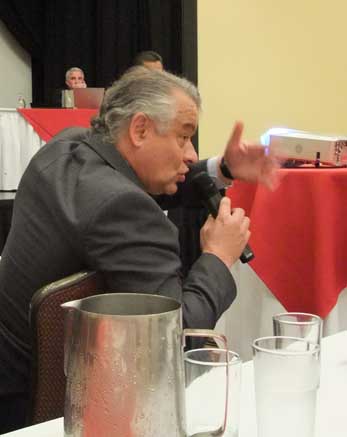 A.M. Costa Rica/Andrew Rulseh Kasper
French Ambassador Fabrice
Delloye tries to ease the concerns of bus company operators who were in
the audience. |
Tram systems are common in many
major metropolitan areas around the world as a viable means of urban
transport, running on electricity and efficiently moving large numbers
of people without the byproduct of fumes. But the viability of a tram
system in San José was not fully embraced by all those
present at the forum. Although Rodrigo Rivera Fournier agreed that something needed to be done to address insufficient transportation systems of San José and its surrounding areas and called the proposal of a tram modern and interesting, he said the final infrastructure plan may have to integrate many approaches and consider the fiscal component. He is a vice minister of Obras Públicas y Transportes “It's not only if I like the idea of a tram or not, it's whether or not we can afford to do it and people will use it,” Rivera said. “The cost is huge to consider.” He said the study will be the first of many steps in considering such a plan, that could cause complications with everything from synchronizing a tramway with stop lights, installing the tracks and coordinating with local transportation systems already in place. Some present at the forum raised concerns that the new system would have an adverse affect on bus companies and their ridership. But the French ambassador to Costa Rica, Fabrice Delloye, tried to ease their concerns that the tram would shut the buses out of the transportation equation. “I believe it's a national project,” Delloye said. “It is not possible to have a tram in the city of San José without the help or the involvement of public bus drivers. It is impossible to do it another way.” There are also other projects in the mix. A presentation given by Miguel Carabaguías Murillo promoted a regional electric, inter-urban train system with two lines, one on the north and one in the south, roughly 75 kilometers long total and connecting 13 different cantons from Cartago to Alajuela. Carabaguías said the project would mostly use existing infrastructure and coexist with traditional trains. He is executive president of the Instituto Costarricense de Ferrocarriles that runs the trains. He said the downtown is paralyzed with traffic when all the people from the surrounding areas converge for work or commerce. He said this regional system could be integrated with other types of public transportation. |
| There are some points of agreement on
climate change |
||
| There are some statements involving
climate change on which most individuals can agree. • The earth is getting warmer. Yep, it has been for 10,000 years. The two kilometers of glaciers covering parts of North America, Europe and Asia have pretty well vanished. • The sea level is rising. Yep, it has been for 10,000 years. Some scientists estimate the rise at 200 feet. Others say 50 percent more. • The possible benefits of this warming have been understated. Yep, if the estimates of warming are correct, wheat farmers in Canada and Russia probably will benefit by having more land for agriculture. • The earth has experienced ice ages and warm periods repeatedly, and it will continue to do so. Yep, this is in the geological record. • Costa Rica is far behind in making any plans to cope with the inevitable and continuing sea level rise. Yep and double yep. • Predicting disaster and doom is great for scientists who get grants and the mass media who attract readers and viewers. • Scientists as a class are generally chicken about reporting findings that go against the conventional wisdom. Thomas Kuhn discussed this in his 1962 work “The Structure of Scientific Revolutions.” Yep, they go along to get along: promotions, grants and publications. The key area of dispute is the contribution of humans to the change in the planet's temperature. Proving causation in science is difficult. Earth scientists generally present findings of an increase in the earth's temperature and assume that the reason is human activity. Seldom do most scientists embarrass themselves the way four Central American presidents, including Laura Chinchilla Miranda, did in a joint statement Oct. 25 when they blamed recent storm activity on the industrial revolution and said that First World countries should pay for the recent damage. A.M. Costa Rica cited a report that said the most damaging Caribbean storm was in 1780. Unfortunately, the Chinchilla administration is so tied up in trying to make the country so-called carbon neutral that logic and facts sometimes are disregarded. The Instituto |
Meteorológico Nacional has had on its Web site for years a study on sea level rise and its effect on Puntarenas Centro. Or should we say Puntarenas Island? The report no longer is accessible on the institute's Web site, but a news story is available. Some who are suspicious of the current global warming orthodoxy also see a giant scam that involves the transfer of wealth from the First World to developing nations. Certainly the four Central American presidents would back that scheme. Being behind the curve is standard procedure for Costa Rica. The country's leadership rejects reasonable actions in the name of environment. Because some trees will have to be cut, an open pit gold mine has been wrapped up for years in legal tangles. Also tangled is a U.S. firm that wants to explore for petroleum in northern Costa Rica. A plan for offshore exploration in the Caribbean is a dead duck. Ms. Chinchilla says she would support drilling for natural gas but not petroleum. Presumably, when the oil bubbles up, the company will have to find a way to force it back down into the rock. The current administration would prefer to enact a ruinous tax plan instead of accepting the payments from producing gold and oil companies. Meanwhile, some really serious environmental problems go unattended. The Central Valley's raw sewage continues to flow into the Río Grand de Tárcoles and into the gulf of Nicoya while a $130 million pledge from Japan to support a modern sewer system and treatment plant is on hold. In the Pacific sharks are killed by the thousands for their fins, and Costa Rica has done little to halt this outrageous trade. At the end of the day, politicians find it convenient to speak in abstract terms about global warming instead of taking concrete action on a clearly defined problem. Editor's Note: Jo Stuart is taking the week off. |
|
 |
| You need to see Costa Rican tourism information HERE! |
| Home |
Tourism |
Place
classified ad |
Classifieds |
Entertainment |
Real
estate |
Rentals |
Sports |
About
us |
|
| What we published this week: | Monday | Tuesday | Wednesday | Thursday | Friday | Earlier |
| The contents of this page and this Web site are copyrighted by Consultantes Río Colorado 2011 and may not be reproduced anywhere without permission. Abstracts and fair use are permitted. Check HERE for details | ||||||
| A.M.
Costa Rica's Fourth news page |
 |
||||||||
| Home |
Tourism |
Calendar |
Classifieds |
Entertainment |
Real
estate |
Rentals |
Sports |
About
us |
|
| San José, Costa Rica, Friday, Nov. 4, 2011, Vol. 11, No. 219 | |||||||||
| Tiny fossils are first clue to dinosaur
era mammals in Americas |
|
|
By
the University of Louisville Today staff
Imagine an animal that is about the size of a shrew – 4 to 6 inches long – and with extremely long canine teeth, a narrow muzzle and a short, rounded skull. It is unlike any mammal today because it lived more than 100 million years ago when dinosaurs roamed the earth. University of Louisville paleontologist Guillermo Rougier doesn’t have to imagine the animal. He and his team found it — or at least two skulls — in South America. Their discovery breaks a roughly 60-million-year gap in what is known about South American mammals and their evolution. Nature published details of the find Thursday. Sebastián Apesteguía of Argentina’s Universidad Maimónides and doctoral student Leandro C. Gaetano are co-authors with Rougier on the article. The team named the new critter Cronopio dentiacutus. It is a dryolestoid, an extinct group of animals distantly related to today’s marsupials and placentals. “It looks somewhat like Scrat, the saber-toothed squirrel from ‘Ice Age,’ ” said Rougier, who is professor of anatomy and neurobiology. “The new dryolestoid, Cronopio, is without a doubt one of the most unusual mammals that I have seen, extinct or living,” said John R. Wible, curator of mammals at the Carnegie Museum of Natural History. But even before they knew what it might look like, Rougier, Apesteguía and Gaetano realized the importance of the discovery when they found the fossils in 2006. The skulls were embedded in rock in a remote area of northern Patagonia, about 100 miles from the city of Allen in the Argentinian province of Rio Negro. It took the team several years of patient lab work to remove the specimens from the rocks. “We knew it was important, based on the age of the rocks and because we found skulls,” Rougier said. “Usually we find teeth or bone fragments of this age. Most of what we know of early mammals has been determined through teeth because enamel is the hardest substance in our bodies and survives well the passage of time; it is usually what we have left to study. “The skull, however, provides us with features of the biology of the animal, making it possible for us to determine this is the first of its kind dating to the early Late Cretaceous period |
 University of Louisville /Jorge Gonzalez.
Artist's rendering of how the
small mammals might have appeared.in South America,” he said. “This time period in South America was somewhat of a blank slate to us. Now we have a mammal as a starting point for further study of the lineage of all mammals, humans included.” The prospects for further investigation on the southern continents are exciting. “… Until now, all we have had are isolated teeth and a few jaw fragments … which don't really help much in deciphering broader relationships,” said Rich Cifelli, presidential professor of zoology at the University of Oklahoma and a researcher, who, like Rougier, has spent his career discovering and identifying mammal remains. “The new fossils provide a sort of rosetta stone for understanding the genealogy of early South American mammals, and how they fit in with those known from northern land masses,” said Cifelli. “Now,” he said, “the burden is on the rest of us to find similarly well preserved fossils from elsewhere, so that the broader significance of Rougier’s finds can be fully placed in context.” |
| Home |
Tourism |
Place
classified ad |
Classifieds |
Entertainment |
Real
estate |
Rentals |
Sports |
About
us |
|
| What we published this week: | Monday | Tuesday | Wednesday | Thursday | Friday | Earlier |
| The contents of this page and this Web site are copyrighted by Consultantes Río Colorado 2011 and may not be reproduced anywhere without permission. Abstracts and fair use are permitted. Check HERE for details | ||||||
| A.M.
Costa Rica's Fifth news page |
|
|||||||||
| Home |
Tourism |
Calendar |
Classifieds |
Entertainment |
Real
estate |
Rentals |
Sports |
About
us |
||
| San José, Costa Rica, Friday, Nov. 4, 2011, Vol. 11, No. 219 | ||||||||||
 |
| Central America continues to stagger from storms Special
to A.M. Costa Rica
With an estimated 1.2 million people in Central America affected by severe floods, the United Nations is mobilizing resources to provide life-saving assistance to those in need. A senior U.N. relief official visiting Nicaragua Thursday described the situation in the country as a real disaster. “When you have close to 10 per cent of your geographic area under water, I would say that is a disaster,” said Catherine Bragg, the assistant Secretary general for humanitarian affairs, who will also visit El Salvador starting today. “I have been seeing areas where the poorest people were affected and now they have moved to drier land. There is the immediate response that has to happen. The level of the lake that surrounds Managua is still rising, which is a permanent threat,” she said when she visited the flood-affected Domitila Lugo area, a low-lying part of the Tipitapa municipality, about 19 kilometers from the capital of Managua. The U.N. Population Fund, meanwhile, reported that many medical facilities in El Salvador, Guatemala, Nicaragua and Honduras have been damaged or are inaccessible after the flooding that has followed weeks of torrential rainfall blamed on a tropical depression in the region. In El Salvador, where over 300,000 people have been affected by floods, the fund has deployed two mobile health centers to cater to 150,000 people, including 50,000 who have sought refuge in shelters. More than 5,000 hygiene kits were distributed to families by fund partners at the onset of the crisis. The kits include hygiene items such as soap, sanitary pads and towels. An additional 5,000 kits will be distributed in the coming weeks. The U.N. has issued a flash appeal for $15.7 million to provide emergency assistance to an estimated 300,000 people affected by the disaster in El Salvador, and a separate appeal for $14.3 million for 134,000 affected Nicaraguans. In Guatemala, the fund is helping to coordinate health units made up of doctors and nurses who will travel to the most affected communities to provide emergency maternal health care and conduct epidemiological surveillance. In Nicaragua, the fund is focusing on preventing gender-based violence in shelters for those displace by the floods and on providing assistance to survivors of sexual violence. Psychosocial assistance is also being provided to women in Guatemala through the training of 50 local psychologists on post-traumatic stress management. Cuba will inaugurate a real estate market By
the A.M. Costa Rica wire services
Cuba says it will allow people to buy and sell homes for the first time in more than 50 years. Cuba's Granma, the official newspaper of the Communist Party, announced the move Thursday, saying it applies to Cuban citizens and permanent residents. The new law, set to take effect next Thursday, is part of a series of reforms President Raúl Castro has undertaken in an effort to boost the Communist-led island's economy. Under the new rules, Cubans will be able to own one main residence and one secondary home. Before, they were banned from selling their homes, making complex swap arrangements the only legal way to exchange property. The restrictions also led many into black-market deals. The move to open up housing sales follows Cuba's legalization in October of buying and selling cars. Granma says property sales will be subject to taxes. The paper says the new rules will allow people to sell, exchange, donate and pass on their houses to heirs. New book documents plastic taking over ocean By
the A.M. Costa Rica wire services
The United Nations estimates that each human uses nearly 140 kilograms of plastic each year. At least 6.4 million metric tons of that plastic has ended up in the oceans. Environmental activist Capt. Charles Moore has found that in some areas, plastic outweighs zooplankton - the ocean's food base - and is entering the food chain. Moore calls this 'the age of plastic.' “Between 250 and 300 million tons of plastic are produced every year," said Moore. "To get that into terms you can understand, every two years we make enough plastic to be the equivalent of the weight of the 7 billion people on earth.” In his new book, “Plastic Ocean,” Moore says less than 5 percent of all plastic is recycled and nearly 3 percent of world production is dumped into the ocean. That debris kills millions of sea creatures every year, he said. “We know over 100,000 albatross chicks are dying every year with their stomachs full of plastic. We have evidence that about 100,000 marine mammals die every year being tangled in plastic," he said. Moore has spent his life on the ocean, and witnessed its transformation. In his book he tells about his 1997 voyage, discovering tons of plastic, floating in an endless spiral. In what is now known as the Great Pacific Garbage Patch, plastic outweighs plankton, by a factor of six to one. Moore created the Algalita Marine Research Foundation and began to collect samples from the world's oceans. He says plastic waste flows into oceans from rivers, beaches and ships. “Not only all the navies of the world but all the merchant vessels of the world, until the 1980s were routinely dumping all their garbage at sea," said Moore. Moore says today ships of all flags and functions continue to ignore international agreements, dumping their trash into the ocean, synthetic chemicals, pesticides, nuclear waste, nerve and mustard agents. He says he is upset by the destruction of his own habitat. ”Whether I am surfing, whether I am sailing, whether I am swimming, I am touching, seeing, running into persistent waste that will be there longer than any of our children, any of our grand children. It will be there for centuries, it doesn’t go away, we are adding to it," said Moore. The pollution expert carries with him a bag of sand, collected from a beach in Hawaii. He had it analyzed. It is more than 90 percent plastic. Captain Moore has worked with environmental filmmaker Bill Macdonald to document the plastic takeover of the oceans. “There is not a lot of beauty in a river full of trash, I see herons that are frightened by Styrofoam floating around them," said Macdonald. "I see sea gulls trying to eat rubber gloves and all sorts of animals foraging around in what used to be natural debris is now contaminated with synthetics.” And so the campaign continues. In “Plastic Ocean,” Moore calls plastic pollution more damaging than climate change, and issues a call to protect the oceans, where life began, for future generations. |
|
| What we published this week: | Monday | Tuesday | Wednesday | Thursday | Friday | Earlier |
| The contents of this page and this Web site are copyrighted by Consultantes Río Colorado 2011 and may not be reproduced anywhere without permission. Abstracts and fair use are permitted. Check HERE for details | ||||||
| A.M.
Costa
Rica's sixth news page |
|
|||||||||
| Home |
Tourism |
Calendar |
Classifieds |
Entertainment |
Real estate |
Rentals |
Sports |
About us |
||
| San José, Costa Rica, Friday, Nov. 4, 2011, Vol. 11, No. 219 | ||||||||||
 |
Latin America news |
to Christmas watchtowers By
the A.M. Costa Rica staff
Fuerza Pública officers will be back up in there Christmas towers this year, and the force is expanding the program to Cartago, Heredia and Alajuela. The towers are the lookout points for police officers. There will be five in downtown San José this year. They will be erected at high traffic areas, said the police. One point is the Plaza de la Cultura. Another is near Hospital San Juan de Dios. The towers give police a 10-foot advantage in keeping an eye on the crowds. A total of 44 towers will be put in service this year, said the Fuerza Pública director general, Juan José Andrade Morales. All the towers should be in operation by the end of this month. That will be in time to keep an eye on criminality associated with workers getting their Christmas bonus or aguinaldo. Each employee receives an extra month's pay at Christmas and crooks try many ways of getting the money, including picking pockets, scams and simple street robberies and thefts. Police in towers can see these acts and radio for help. Andrade said that the citizenry welcomes the towers and that there were good results from the pilot project in downtown San José last year. Speed trap cameras to go dark for at least six months By
the A.M. Costa Rica staff
The on-again, off-again speed trap highway cameras are off again. The Consejo Nacional de Vialidad said that it is suspending for six months the system and that no speeding fines would be assessed. Consejo officials said that there was uncertainty over the legalities involving the cameras. The system, which awards fines of more than $600 automatically, is the subject of many appeals to the Sala IV constitutional court. Among other complaints, citizens say that the fines are disproportionate. The Consejo also said that motorists who already have fines will not be charged for them when they seek to renew their marchamo or road use tax before Jan.1 The Instituto Nacional de Seguros will begin collecting the marchamo Nov. 14. Of course other fines will be collected, as usual. Banco Nacional plans cleanup on gulf island By
the A.M. Costa Rica staff
Volunteers working with Banco Nacional plan a cleanup of the Isla Venado in the gulf of Nicoya starting at 8 a.m. Saturday. The work is in conjunction with the Asociación de Desarrollo, the Colegio Telesecundaria and the Asociación de Jóvenes of the island. The island is a tourist location but the gulf gets all the trash from the Central Valley. The Municipalidad de Puntarenas will process the collected trash, said the bank. |
|
Latin
American news feeds are disabled on archvied pages.
|
|
| Costa Rican News |
AMCostaRicaArchives.com |
Retire NOW in Costa Rica |
CostaRicaReport.com |
| Home |
Tourism |
Place
classified ad |
Classifieds |
Entertainment |
Real
estate |
Rentals |
Sports |
About
us |
|
| What we published this week: | Monday | Tuesday | Wednesday | Thursday | Friday | Earlier |
| The contents of this page and this Web site are copyrighted by Consultantes Río Colorado 2011 and may not be reproduced anywhere without permission. Abstracts and fair use are permitted. Check HERE for details | ||||||














 James
DeRoy
James
DeRoy