|
 |
Your daily
English-language |
 |
|
|
|
|
|
|
|
|
|
|
|
|
|||||||||||||
|
|
|||||||||||||
|
Second news page |
 Click HERE for photo tour of 526 properties for SALE or RENT in Escazú, Ciudad Colón, Santa Ana, Rohrmoser, Curridabat, Heredia and the Pacific Coast. |
|
|
|
|
|
|
|
|
|
|
 |
| Costa Rica Expertise Ltd http://crexpertise.com E-mail info@crexpertise.com Tel:506-256-8585 Fax:506-256-7575 |
 |

|
|
due to new storm By the A.M. Costa Rica staff
Though the emergency commission only has the Caribbean on yellow alert, it seems that side of the country may be due for a thorough drenching at the hands of Tropical Storm Beta. Thursday evening the storm was off the coast of Nicaragua south of Colombia's San Andreas island moving north at 2 miles per hour. Beta's sustained winds were 65 miles per hour. That's only 8 miles per hour short of hurricane status. San Andreas is a popular tourism destination with Ticos. Forecasters with the United States National Hurricane Center predict the storm will keep moving north until tonight when it will shift west near San Andreas. Forecasters with the Instituto Meteorológico Nacional predict the storm will become a hurricane at that time. By Saturday, Beta should be making landfall on Nicaragua's northern Caribbean coast. By Tuesday, the storm should be lapping at the eastern edge of El Salvador. The hurricane center says Beta is expected to dump nearly 10 inches of rain across western Panama, Costa Rica, northeastern Honduras, Nicaragua, San Andres and another Colombian island, Providencia. Colombia has issued a hurricane warning for San Andres and Providencia. A hurricane watch is in effect for Nicaragua's entire Caribbean coast. The weather institute predicts rain of variable intensity on the central and southern Pacific Coast today. The northern Caribbean should also receive rain as well as the Central Valley, especially in Cartago, the institute said. Striking water workers backed by defensora By the A.M. Costa Rica staff
Now that the Juzgado de Trabajo del II Circuito Judicial has declared the strike of workers at the national water company legal, the Defensoría de los Habitantes is urging the government as well as the employees of the Instituto Costarricense de Acueductos y Alcantarillados to find common ground. The thrust of the strike is that the water company workers are not receiving the minimum pay they are entitled to under Costa Rican law, and in this regard, Lisbeth Quesada Tristán, the defensora, is firmly on the side of the workers. “How is it possible that we can sleep at night when we know that, for years, we haven't paid the workers even the minimum salary. It's an embarrassment,” the ombudswoman said. The strike is driven by the fact that workers receive less than other public works employees. The government has offered a raise of approximately 8 percent. The workers are asking two or three times that. Most administrative activities, connections, repair of leaks and shutoffs have not been done, although for the most part, the water is still flowing in the Central Valley. Defensora Quesada asked the Ministerio de Trabajo as well as the president of the water company to remain informed about the situation so that the workers' rights are respected and also contingency plans are adopted. This, so that when the inevitable problems arise due to lack of worker attention, the citizenry who use the water aren't affected drastically. However, Robert Clarke of San Antonio, Puriscal wrote A.M. Costa Rica Thursday concerned that his water had been turned off as a result of the strike. After repeated calls to the water company there, a spokesman said that the shutoff was a result of repair work. Clarke's water was off from at least 7 a.m. until 3 p.m., he said. He said that usually repairs only take an hour or so. The government seems to be giving ground to the strikers. The Autoridad Reguladora de los Servicios Públicos approved connection tariffs for new water services after the water company solicited the raises due to rising operation and installation costs. Workers have been striking since early this month and say they will continue until their demands are met. They have the capacity to cut off the flow of drinking water. German string quartet to play here Nov. 4 By the A.M. Costa Rica staff
The German string musician quartet, Cuarteto de Cuerdas Mandelring, will play one concert of pieces by Schubert, Brahms and Ligeti in the Teatro Nacional Nov. 4. at 8 p.m. The group has toured throughout the world playing in such locales as Amsterdam, Holland; Brussels, Belgium; London, Madrid, Spain; Milan, Italy; Paris, Vienna, Austria, New York, Vancouver and Sao Paulo, as well as more exotic locations such as Beirut, Lebanon; Damascus, Syria, and Pyongyang, North Korea. The quartet is composed of violinists Sebastian and Nanette Schmidt, cellist Bernhard Schmidt and violinist Roland Glassl. Ticket prices range from 2,000 colons to 7,000 colons. Students and senior citizens get a 10 percent discount. For reservations or ticket sales, call the Teatro Nacional ticket office at 221-5341 or 221-1329 ext. 214 Monday through Friday from 9 a.m. to 4 p.m. Seven illegal travelers caught near La Cruz By the A.M. Costa Rica staff
Fuerza Pública officers arrested seven undocumented South Americans in Santa Elena de La Cruz near the Nicaraguan border, they said. The seven individuals, two Bolivians and five Ecuadorians between 19 and 27 years of age, had entered the country illegally through Panama with the help of smugglers and were planning to continue north to the United States, police said. |
|
||||||||||||||||
 |

|
||||||||||||||||
| PRECONSTRUCTION
& INVESTMENT OPPORTUNITIES from only $35K in Playa del Coco
& Limon. Loft Condos from $80K. Walk to
Beach! Easy Financing. Low $ Down. Many Homes & Townhomes available IN ALL AREAS for IMMEDIATE OCCUPANCY. 954-245-7245   SKIP4848SKIP@AOL.COM WWW.COSTARICAHOMESWEETHOME.COM |
|
with the observations of Dr. Lenny Karpman Click HERE! |
 |
|
Third news page |
 |
| Home | Calendar | Place
a classified ad |
Classifieds | Real estate | Food | About us | |
|
|
|||||||
 |
 |
| The best way to be in a hospital is as a visitor |
|||
| This week hospitals
have
loomed large in my life. My friend Sandy was back at Clinica
Biblica for more repair work on her shoulder. And a new
acquaintance, Doug, was also there getting complications from an
injured Achilles heel fixed. It is nice visiting a hospital instead of being visited, although you don’t get to lie down while you chat. Both patients had nothing but praise about Biblica, its doctors and nurses. I then had to tend to some of my own business at Hospital México, setting up the appointments for examinations my doctor has ordered. I think I must be getting a little strange because I actually enjoyed the search required to complete the forms and find the locations so that these appointments could be written down in the various little books by the secretaries in each of the departments. I also got a good two kilometers of walking accomplished. Hospital México looms large because it is huge. But what was once a confusing and overwhelming maze I can now see laid out in my mind’s eye. I still haven’t figured out the tramites of the system, though. In one case, I went downstairs to the TAC department (previously known to me as Catscan). I was told to go back upstairs and find a certain doctor in the X-ray deptartment. A person from his office sent me down the hall to the sonogram department. There a young woman took me in hand and said, “Follow me.” We retraced my steps to the doctor’s office. As she knocked on the door I confided that I had already been there and they had sent me to her department. “Oh, really?” she said, and told me to wait there for her. Whatever she did, when she returned, I was on my way back down to TAC to set up my appointment. This past the week I also got a flu shot in what has |
become my favorite
farmacia – the one on the corner near the downtown Auto Mercado. There
has been a lot said and written about the many-strained and
ever-changing flu from the Spanish flu that killed so many at the same
time World War I was killing people, to the avian or bird flu now on
the horizon. Mostly it has resulted in one more thing to fear.
Now I
read that flu shots are not all that effective for older people (this
is for the ordinary run-of-the-mill flu we expect each year).
That is,
it doesn’t actually protect them against getting the flu, but it does
help avoid some of the complications that can lead to death. |
||
| The casado is the backbone of the Costa Rican menu |
|||
| This column is in
praise of the casado, the Tico midday blue plate special as
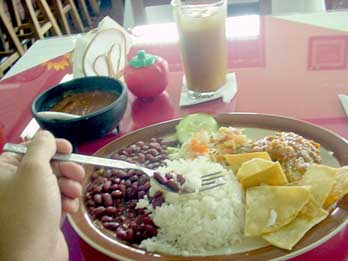
A.M. Costa Rica food writer Dr. Lenny Karpman calls it. The typical casado has rice, beans, the meat of your choice, usually beef, fish, a pork chop or chicken and a
Casado, of course, means married in Spanish, and the midday casado is just that, a marriage of the food groups, except the beer food group which is available separately. One has to wander a bit from the usual tourist restaurants to find a casado, although some upscale restaurants have it on the lunch menu because Costa Ricans demand it. They call a small restaurant here a soda, and every soda has its own version of the casado, frequently extolled on a small sign or chalkboard at the entry to the establishment. Although many North Americans worry about the sanitation in such places, an inspection of the kitchen usually shows it is about as clean as in a normal household. After all, the owner, the cook and the wait staff are eating there, too. A bad sign at some San José restaurants is when the waiters duck out and bring back a McDonald's burger or Taco Bell Grande for themselves. The focus on the casado is prompted by Dr. Lenny Karpman's column last week about cheap places to eat. He will be back next week. But the newspaper did get some responses to suggestions of where expats could eat cheaply. |
 A.M. Costa Rica
photos/Saray Ramírez Vindas
The typical midday meal, a casado
One such place is La Vasconia on Avenida 1 in San José, a place already known to many foreigners living on a budget. Although the place looks like a working class bar, the menu is a full one. One A.M. Costa Rica favorite is the tripe soup, which is more tripe than soup. Another acquired taste. Bill Carey of Curridabat suggests Mama's Place, also on Avenida 1 two blocks east of the Correos de Costa Rica main post office. Mama's closes early, about 6:30 p.m., but the lunchtime pasta is legendary and with good service. Glenn Tellier, the owner of the new Roadhouse Bar north of San José on Route 32, wrote to suggest his own place as a reasonable alternative for expats. His place, too, is a full-service bar, but the menu also includes full meals. But there are some other low-cost suggestions. Although one does not think supermarket when considering dining options, both Hypermas and Mas x Menos have cafeterias in some of their stores. Mas x Menos on Avenida Principal between calles 11 and 13 redid the entire cafeteria about a year ago and moved it from the back of the store to a sun--filled location near the entry. Another clean cafeteria is in Mas x Menos across the Autopista General Cañas from the Hotel Tryp Corobici west of Parque la Sabana. Hypermas in San Sebastian next to the circumvalación also has a fine cafeteria, staffers here report. — Jay Brodell
|
||
 |
 |
|
Fourth news page |
Are you still
spending 70 percent You need to fill this space ASAP! |
||||||
| Home | Calendar | Place
a classified ad |
Classifieds | Real estate | Food | About us | |
|
|
|||||||
| Baptish church planning festival for kids Saturday |
|
|
Special to A.M. Costa Rica
Members of International Baptist Church have been busy this week preparing for activities for their Fall Festival that will be taking place tomorrow at the church in Guachipelín. The festival is an event for the children and youth of the church and neighboring communities to come and enjoy the food and fun. In addition to hot dogs and chips, there will be booths with games such as a fishing pond, a cake walk, clowns and more, with lots of prizes and candy. Last year’s festival was attended by about 200 people of all ages, and this year’s festival is expected to attract an even larger attendance. Everyone (whether the native tongue is English or Spanish) is invited to come and enjoy the activities which are free and will take place Saturday from 10 a.m. to 12:30 p.m. Children are invited to wear costumes, but not those representing witches, ghosts, goblins or similar scary characters. The church is located in Guachipelín, west of Multiplaza on the north side of the Santa Ana highway. Visitors should take the Guachipelín exit, go 25 meters and turn at the first right onto a gravel road. Then take the first left. The church is 100 meters north on the left. For more information call 215-2117, 821-3594, or 365-1005. |
 International Baptist
Church photo
Rylie Geohegan sponges a young festival worker during last
year's event |
| All-Latino Team announced at last World Series game |
|
|
Special to A.M. Costa Rica
HOUSTON, Texas — Major League Baseball has announced that 12 active and former players have been named to the first "All-Latino Legends" all-star baseball team. The team, selected on ballots in English and Spanish by baseball fans around the world, were announced Wednesday at Minute Maid Park here before the Chicago White Sox won the World Series for the first time in 88 years, sweeping the Houston Astros in four straight games. The fans selected eight position players -- one at each infield position and three outfielders -- as well as three starting pitchers and one relief pitcher. The members of the team are: catcher Ivan Rodríguez of Puerto Rico, first baseman Albert Pujols of the Dominican Republic, second baseman Rod Carew of Panama, shortstop Alex Rodríguez of the Dominican Republic, third baseman Edgar Martínez of Puerto Rico, outfielder Roberto Clemente of Puerto Rico, outfielder Manny Ramírez of the Dominican Republic, outfielder Vladimir Guerrero of the Dominican Republic, starting pitcher Pedro Martínez of the Dominican Republic, starting pitcher Juan Marichal of the Dominican Republic, starting pitcher Fernando Valenzuela of Mexico, and relief pitcher Mariano Rivera of Panama. Major League Baseball Commissioner Bud Selig said players of Latin American heritage have a "deep passion for the game of baseball, and have made immense contributions to the national pastime." Selig explained that an all-Latino team was created "to reflect those contributions and to honor the indelible mark they have left on the game." More than 1.6 million votes were cast for the team, both online and at car dealerships around the United States. Fans selected the team from 60 Latino players, representing seven countries and territories. Rod Carew, the 18-time all-star second baseman for the Minnesota Twins and the California Angels, said former Latino players like himself set the table for current Latin players and, hopefully, "they can set the table for a lot of the other young kids coming up." Juan Marichal, the first player from the Dominican Republic to enter baseball's Hall of Fame, said being named to the team "is an honor for all of us," adding: "Latinos have made a big contribution to baseball." Marichal, known for his distinctive high leg kick when pitching, won 243 wins in his career for the San Francisco Giants. He pitched 52 shutouts – games in which the opposing team scored no runs. Major League Baseball said that, as of the 2005 opening day of the baseball season on April 3, 204 players born in Latin American countries were on major league rosters, accounting for nearly one-quarter of major league team rosters. The Dominican Republic had 91 players, followed by Venezuela with 46 and Puerto Rico with 34. Luis Clemente, the son of the late Pittsburgh Pirates outfielder Roberto Clemente, said his father would be very proud to have been named to the team. "He would probably try to include everybody who was not included because he was so fair to everyone," said Luis Clemente. "This is a great day for Latinos in baseball." Roberto Clemente, a 12-time major league all-star selection and 12-time Gold Glove winner for his fielding prowess, won four batting titles in the 1960s. He also helped the Pirates claim the 1971 World Series. He died in a plane crash in 1972 while delivering relief supplies to Nicaraguan earthquake victims. |
How the voting went
First Base (Top Vote-getter) 1. Albert Pujols, Dominican Republic 64,952 2. Orlando Cepeda, Puerto Rico 28,672 3. Tony Pérez, Cuba 17,986 4. Andrés Galarraga, Venezuela 15,654 5. Rafael Palmeiro, Cuba 13,247 Second Base (Top Vote-getter) 1. Rod Carew, Panama 69,868 2. Roberto Alomar, Puerto Rico 37,545 3. Alfonso Soriano, Dominican Republic 25,753 4. José Vidro, Puerto Rico 3,761 5. Juan Samuel, Dominican Republic 2,998 Third Base (Top Vote-getter) 1. Edgar Martínez, Puerto Rico 57,550 2. Bobby Bonilla, Puerto Rico 24,068 3. Vinny Castilla, Mexico 23,577 4. Adrián Beltre, Dominican Republic 20,468 5. Edgardo Alfonzo, Venezuela 13,011 Shortstop (Top Vote-getter) 1. Alex Rodríguez, Dominican Republic 70,890 2. Luis Aparicio, Venezuela 24,951 3. Miguel Tejada, Dominican Republic 23,369 4. Dave Concepcíon, Venezuela 16,470 5. Omar Vizquel, Venezuela 6,308 Catcher (Top Vote-getter) 1. Ivan Rodríguez, Puerto Rico 80,167 2. Tony Peña, Dominican Republic 25,164 3. Javy López, Puerto Rico 12,435 4. Benito Santiago, Puerto Rico 11,432 5. Manny Sanguillen, Panama 10,885 Outfield (Top Three Vote-getters) 1. Roberto Clemente, Puerto Rico 100,955 2. Manny Ramírez, Dominican Republic 66,830 3. Vladimir Guerrero, Dominican Republic 62,895 4. Sammy Sosa, Dominican Republic 39,344 5. Bernie Williams, Puerto Rico 23,842 6. Tony Oliva, Cuba 20,722 7. Carlos Beltrán, Puerto Rico 20,646 8. Felipe Alou, Dominican Republic 17,207 9. Moises Alou, Dominican Republic 14,774 10. Minnie Minoso, Cuba 13,863 11. José Cruz Sr., Puerto Rico 9,048 12. Juan González, Puerto Rico 8,184 13. Rico Carty, Dominican Republic 5,452 14. Luis González, Cuba 5,175 15. George Bell, Dominican Republic 4,786 Starting Pitcher (Top Three Vote-getters) 1. Pedro Martínez, Dominican Republic 93,118 2. Juan Marichal, Dominican Republic 68,199 3. Fernando Valenzuela, Mexico 49,616 4. Luís Tiant, Cuba 36,610 5. Johan Santana, Venezuela 32,952 6. Bartolo Colón, Dominican Republic 22,226 7. Lefty Gómez, Mexico 22,016 8. Dennis Martínez, Nicaragua 18,168 9. Livan Hernandez, Cuba 11,264 10. Joaquín Andujar, Dominican Republic 9,127 11. Mike Cuellar, Cuba 7,845 12. José Rijo, Dominican Republic 6,347 13. Camilo Pascual, Cuba 5,757 14. Martín Dihigo, Cuba 4,393 15. Dolf Luque, Cuba 2,066 Relief Pitcher (Top Vote-getter) 1. Mariano Rivera, Panama 107,710 2. José Mesa, Dominican Republic 9,389 3. Roberto Hernández, Puerto Rico 8,230 4. Willie Hernández, Puerto Rico 8,127 5. Armando Benítez, Dominican Republic 7,431 |
| Cuban government accepts offer of U.S. hurricane aid |
|
|
By the A.M. Costa Rica wire services
The Cuban government, in an apparently unprecedented move, has accepted in principle a U.S. offer of emergency aid following Hurricane Wilma. A U.S. damage assessment team will visit the Caribbean nation. Officials here are not suggesting that the development has major political significance. But they do say that for the first time in memory, Cuba has responded positively to a U.S. offer of disaster assistance. The United States said earlier this week it was prepared to provide emergency aid to Cuba, after the island was raked by Hurricane Wilma. The storm, which caused major damage in Mexico and later in Florida, forced the evacuation of some 700,000 Cubans and caused flood damage to historic buildings in downtown Havana. State Department spokesman Sean McCormack said the United States sent a diplomatic note to Cuba Tuesday formalizing the offer and that Cuba accepted the offer in a message the following day. The spokesman said a three-member team from the U.S. Agency for International Development is preparing to go to Cuba to assess needs and make recommendations to the U.S. aid agency about what material help the United States might provide: "These teams, typically, what they do is they provide assessments of a country's needs and if necessary recommend assistance that the United States can effectively provide," said Sean McCormack. "In the |
case of Cuba, any
assistance would be provided through independent, non-governmental
organizations. In early September, Cuba offered to send 1,600 doctors to the southern United States to help victims of Hurricane Katrina. The State Department said the Cuban help was not needed because an ample number of U.S. health workers had offered their services. After Hurricane Dennis struck Cuba in July, causing a number of deaths and more than $1 billion in property damage, Cuban leader Fidel Castro rejected a U.S. government offer of $50,000 in immediate disaster aid. He said Cuba was grateful for the offer, but said his government would not accept American assistance as long as the 40-year-old U.S. economic embargo of Cuba remained in place. The Bush administration has been a persistent critic of the Castro government's human rights record. The State Department Thursday congratulated the Cuban rights-advocacy group "Damas de Blanco" for winning the European parliament's Sakharov Prize for Freedom of Thought. The group of wives and mothers of political detainees has held peaceful, silent protests every Sunday since the March 2003 crackdown on dissidents by the Castro government. A written statement from spokesman McCormack said the group has braved regular harassment and abuse by Cuban security forces. He reiterated the U.S. call for the release of all Cuba prisoners of conscience. |
|
Fifth news page |
Are you still
spending 70 percent You need to fill this space ASAP! |
||||||
| Home | Calendar | Place
a classified ad |
Classifieds | Real estate | Food | About us | |
|
|
|||||||
| Traditional skills are on display at Indian gathering |
|||
|
By Selleny Sanabria Soto
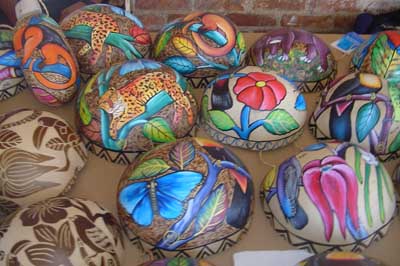
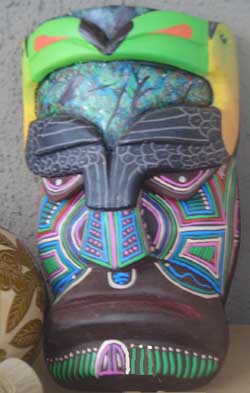
of the A.M. Costa Rica staff The gathering is about as close as one can get to an Indian market in Costa Rica. There are folk medicines, masks and other centuries-old goods on sale. Plus at noon today Devil dancers will show their stuff. They were scheduled for Thursday but were caught in bad roads, organizers said. All this is in Parque España, just west of the Centro Nacional de Cultura and just south of the towering building occupied by the Instituto Nacional de Seguros. Representatives of eight indigenous communities of Costa Rica are attending the event that began with lectures Wednesday. An Indian woman, Soraida Hernanez, has a natural medicine shop. She came from the Indian community of Quitirrisí west of Ciudad Colón. She is selling products alone, but her community makes folk medicines and for many diseases, including anemia, slow blood circulation, and asthma, all with age-old techniques and organic plants. The medicines are on sale in little bottles or the natural plant is available, too, depend on the preference of the buyer. The plant version works the same way but needs to be cooked up. “We made medicines since we were 5 years old," said Ms. Hernanez. "Grandparents taught us to know the plants in the mountains and taught us how to do it.” Workers from the Universidad de Costa Rica and the Lutheran church went to the community to show the Indians how to process plants and presented cerftificates. Some other products are soaps at 500 colons and ointments made from eucaliptus at 1,000 colons. Another vendor shows masks representative of the Boruca and Rey Curré communities. He is Rafael Gonzalez Leiva, and he said that masks are very important for his community. In colonial times, the under equipped Indians used satanic and evil masks in an effort to scare the Spanish soldiers. Now they are popular with tourists. |
The Devil dancers are from this community, and the dance is yet another version of the continual struggle between good and evil. Another Indian group is the Maleku community, which is located in the Northern zone of Costa Rica in Alajuela province at the border with Nicaragua. David Elizondo Marín is a Guatuso indian and said that members of his community made art since they were children. They made bows and arrows like colonial weapons. He sells drums made with wood and with diferent pictures signifying gods and special animals. “This is a tradition we had since we were 3 or 4 years old, and it pass to each generation, said marín. The Maleku community always had good relationships with wild animals, and one of their rules is to have a special regard for nature. For that reason their products are fabricated in animal shapes to honor them. Another woman, Olga Sánchez Sánchez, came from the Guitirrisi of Huetar Norte, to sell crafts made from palm, like purses, bags, hats and ornaments for houses. They will be there today to at least 5 p.m. near the Ministerio de Cultura, Juventud y Deportes |
||
|
For a long-running masked
party, try Paraíso de Cartago this weekend
|
|
|
By the A.M. Costa Rica staff
Oct. 31, this Monday, is the Dia Nacional de las Mascaradas, proclaimed in 1996 by then-president José Figueres Olsen, and Costa Ricans like to celebrate it with a big festival in different communities each year, according to the activities organizers. These activities are part of the Costa Rican cultural tradition that were well developed in the 1920s and 1930s when the grandparents used to dedicate the day to the patron saint of the community in which they lived. The tradition dates from at least 1820. This year, the festival is in Cartago province in honor to the Virgin de los Angeles, a patroness of the country. Involved in sponsoring the festival is the Colegio Universitario de Cartago. The event is called the IV Encuentro de la Mascarada Tradicional |
Costarricense. Another
sponsor is the Municipalidad de Paraíso de Cartago where the
event is being held. Rodrigo Muñoz Azofeifa, director of the colegio, said that the objective is to rescue the old traditions in the country that some years ago the church thought were not good for the Catholic religion. For in addition to a festival, there is an academic and historical dimensions. Sunday at 10 a.m., some participants will present the Diablitos dance. Also present will be the end result of some 50 workshops producing traditional garb and, of course, masks. The Devil dance comes from the Boruca Indian community. The finale comes at 6 p.m. Monday when some 700 persons participate in a masked gathering and party. |
| Will the real Óscar Arias Sánchez please stand
up? |
|
|
By the A.M. Costa Rica staff
Opponents of the free trade treaty had a great idea: Why not get Óscar Arias Sánchez to say some words on television in opposition to the agreement with the United States and other Central American countries. They couldn't get Óscar Arias Sánchez, the former president and Nobel Prize winner. He happens to be running for president on the Partido Liberación Nacional ticket. And he is four-square in favor of the treaty. So they did the next best thing. They found a man living in Guanacaste with the same name to lend his identify to a 60-second television spot dominated by a rolling green background identical to the Liberation flag former president Arias uses. The commercial opens with the phrase: "Words of |
Óscar Arias
Sánchez to the Costa Rican people." At the bottom of the
screen in tiny, unreadable letters is the name and cédula number
of the
Guanacaste Sánchez. "Óscar Arias Sánchez thinks that to say NO to the TLC is to say YES to Costa Rica," the white letters say in Spanish, using the abbreviation in that language for the free trade treaty. Now those running the campaign opposing the free trade treaty are screaming censorship because the commercial and public television stations will not run the misleading commercial. The stations accepted the commercial but suspended putting it on the air when they saw the content. Free trade opponents now have another commercial: a procession of people named Óscar Arias Sánchez from all over Costa Rica saying their name and hometown in a second minute-long commercial. That one isn't being aired either. |
|
|
|
|
|
|
|
|
| What we published this week: | Monday | Tuesday | Wednesday | Thursday | Friday | Earlier |
|
|