Your daily English-language news
source
Monday through Friday
|
|
|
Your daily English-language news
source
|
|
|
|
|
|
|
|
|
|
|
|
|
|
|
|||||||
|
|
|
|
|
|
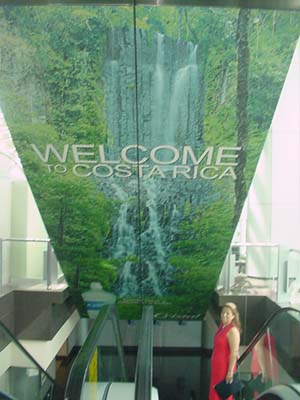
Epsy Campbell, a legislative deputy, wants to know how the government financial watchdog could permit tourism officials to spend 300 million colons on a Web page. And she is not too happy that the job went to a foreign company. The issue came up in the legislature Thursday afternoon. The contracted company is a U.S. consortium," Ms. Campbell pointed out. "Here there are a great quantity of national companies. Is it not preferable to pick a Costa Rican company for this type of service," she asked. The Web page for the Instituto Costarricense de Turismo was the topic of a news story June 18 in A.M. Costa Rica. Before and after that publication owners of tourism locations have expressed private concern about the cost of the Web page. However, this is the first official criticism. Ms. Campbell asked how the Contraloría General de la República could have approved such a contract. The deal was the result of public bidding by firms that agreed to meet the elaborate specifications of the tourism institute. The bidding closed in Feb. 2002, and the Contraloría had to review the contract before it was finalized. The corporation she mentioned is Soluciones Globales del Norte S.A. which signed an agreement with the tourism institute Aug. 7, 2002, in which it |
agreed to have the Web page operating
in six months.
However, the company probably should not be characterized as a totally U.S. company. The Soluciones Globales is a consortium of Despegar.com, a major travel
agency in Latin America, and Global Bay, Inc., a New Jersey Web developer.
The total contract, which runs for two years, is valued at $833,900, although
other services are offered besides the Web page.
The Web page itself cost $216,000 to design, according to the contract, In addition, the company collected $2,000 a month for maintaining the site and $2,000 a month for hosting. The company also agreed to handle calls about tourism with a call center and also to field e-mail messages. The Web page is www.visitcostarica.com. The site also is supposed to be a way for tourists to make reservations for trips to Costa Rica. Ms. Campbell said she expected replies from the tourism institute and the Contraloría. She also said she expected to review the bids other companies presented in a futile effort to obtain the contract. The Web page is still not complete. a number of hotels do not have photos to go with their listings. Among these is the Hotel Costa Rica Marriott, which is one of the country’s top locations. |
| Pacheco defends
Tico competitiveness By the A.M. Costa Rica staff President Abel Pacheco said that he is confident in the competitiveness of Costa Ricans and their ability to compete in the world market. Pacheco linked his comments to a criticism of a march Monday that was opposed to a free trade treaty. "How is it possible that there are people who throw themselves into the street to ask that we close this country with four padlocks because, according to them, Costa Ricans are incapable of triumphing before the world," said Pacheco. He was speaking at the Intel Corp. facilities in Santa Ana where the company formally announced that it would invest some $110 million in facilities to produce a new generation of chipsets, a computer component. Pacheco said that he interpreted this decision to invest as recognition of the quality of the technicians and professionals that Intel has experienced for years here. Union members and employees of the Instituto Costarricense de Electricidad, the telecommunications monopoly, took to the streets Monday along with leftist university students to criticize a possible free trade treaty. On the other hand, Pacheco has said the treaty with the United States is necessary to maintain the economy here. Negotiations are expected to be completed by Christmas. Intel will hire about 600 additional Costa Rican employees for the new project. The preparations to produce the chipsets will be ready by the middle of the year, Pacheco was told. Intel, the major manufacturer of microprocessors in the world, came here in 1998 and has operated an assembly and testing of microprocessors. U.S. Senate rejects
By the A.M. Costa Rica wire services WASHINGTON, D.C. — Defying a veto threat from President Bush, the Republican-led Senate joined the House of Representatives in approving a measure aimed at easing restrictions on U.S. travel to Cuba. The Senate voted to bar the use of government money to enforce travel restrictions to Cuba. "It is not constructive at all to try to slap around Fidel Castro by imposing limits on Americans' right to travel," said Sen. Byron Dorgan, a North Dakota Democrat, who is a key sponsor of the measure. Supporters argue that more contacts between American and Cuban citizens will help spur democratic change in the Communist-ruled island nation. The legislation was contained in an amendment to the Transportation and Treasury Department bill. A similar measure was approved by the House last month. Once the Senate votes on the overall bill, differences will have to be reconciled with the House version before a final bill is sent to President Bush. But Bush has signaled he would veto the legislation, if it contains the Cuba language. Reflecting administration concerns, Sen. Ted Stevens, the Republican chairman of the Appropriations Committee, said changing U.S. policy now would amount to rewarding Fidel Castro's government for its recent crackdown on dissidents. "It is essential to maintain sanctions and travel restrictions, to deny economic resources to the brutal Castro regime," he said. Current law allows some travel to Cuba by Americans, particularly scholars and journalists. The Bush administration estimates as many as 200,000 Americans visit Cuba legally each year. But thousands of other Americans travel there illegally, by way of third countries, including Costa Rica, risking thousands of dollars in fines and imprisonment. Many in the Cuban-American community in Florida have long pressed the Bush administration to take a tougher approach to the government in Havana. Florida could be a crucial state for Bush's re-election bid next year. Pinochet will keep
By the A.M. Costa Rica wire services SANTIAGO, Chile — Chile's Supreme Court has rejected a petition to lift the immunity of former military dictator Augusto Pinochet so he can be tried on human rights charges. The court's decision Wednesday effectively ends a challenge to Pinochet's immunity by the Chilean Communist Party. The Communists want the former ruler to stand trial on charges that he is responsible for the disappearance and possible death of 10 of their fellow party members in 1976. Pinochet overthrew democratically elected President Salvador Allende in 1973 and relinquished power to an elected civilian government 17 years later. Delta restricts
By the A.M. Costa Rica staff Delta Airlines is restricting the number of bags and types of luggage passengers may carry or check on flights during the Christmas season. The rules are in effect from Nov. 15 to Jan. 15 on flights to Latin America. The airline limits luggage to two checked pieces and one carryon, it said in a news release. For passengers with more luggage, the company suggests the use of a commercial shipper, such as Fed Ex, the U.S. Postal Service or United Parcel Service. If you use a box, it must be the original that the item was packed in. Delta flies daily between San José and Atlanta, Georgia, as well as less frequent trips to Daniel Oduber International Airport in Liberia. Uruguay welcomes
By the A.M. Costa Rica wire services MONTEVIDEO, Uruguay — President Jorge Battle says he is ready to allow Bolivia to ship its natural gas through his country, avoiding a controversial proposed route through Chile. Battle made the statement to reporters Wednesday here after returning from a foreign trip. Under his proposal, Bolivian gas would be shipped to the United States by way of Uruguay and Argentina. Bolivia suspended a plan to ship its natural gas through Chile earlier this month after mass protests that forced the resignation of the Bolivian president. Critics of the project said it would not benefit Bolivia's impoverished majority. Observers also cited a historical mistrust of Chile, a country to which Bolivia lost its coastal regions and access to the sea in a late 19th century war. |
Chavez supporters
see new plot by U.S. By the A.M. Costa Rica wire services CARACAS, Venezuela — A group of lawmakers who support President Hugo Chavez have presented what they call evidence of a U.S.-backed plot to overthrow the government. The members of parliament, led by Nicolas Maduro, spoke to reporters Wednesday here. They presented video footage, which they said showed U.S. agents teaching Venezuelan police and military officers ways of creating civil unrest. The Bush administration has had tense relations with President Chavez, who has been friendly to Cuba, Libya and former Iraqi leader Saddam Hussein. But the White House has denied it is involved with any plot to overthrow the Venezuelan leader. Chavez took office in 1999. He successfully fought off a coup attempt in April, last year. Quake felt in Nicoya By the A.M. Costa Rica staff A 3.1 magnitude earthquake rattled the southern Nicoya Peninsula about
1:50 p.m. Thursday. The location was 9 kms. (some 5.5 miles) southwest
of Cóbano. The shock, the product of a local fault, was felt in
at least nearby Mal País, according to the Observatorio Vulcanológico
y Sismológico de Costa Rica.
|
|
|
|
|
WASHINGTON, D.C. — Failures of government such as weak democratic institutions, official corruption, and poor health and education services, as well as narcotics trafficking, HIV/AIDS, and a despotic regime in Cuba are among the threats to security in the Western Hemisphere, says Paula Dobrianski, under secretary of State for global affairs. In remarks Monday to the Inter-American Defense College, Ms. Dobrianski outlined the broad and specific security threats facing the Americas. U.S. policy toward the Western Hemisphere, she said, focuses on promoting democracy and human rights, strengthening democratic institutions, advancing trade and investment as engines for growth and jobs, and poverty reduction through strengthening education, health and other services. Other regional priorities she identified include fighting corruption and protecting citizens from terrorists, drug traffickers and international crime organizations. Ms. Dobrianski said that such a broad U.S. hemispheric policy is needed because the failures of governments to address these individual issues directly affect national and regional security. The problems of poverty, weak institutions, official corruption, narcotics trafficking, health-related issues and other concerns, she explained, build on each other and undermine stability. As a result, Ms. Dobrianski said, these individual problems must each be viewed as integral to national security and stability. |
"We have gone from a world where
we assess our safety based on how we handle one large danger to one in
which we must handle numerous, individual concerns," she said.
Addressing specific threats confronting the hemisphere, Ms. Dobrianski said illegal narcotics trafficking is among the most significant. She said that there is a clear link between terrorists, drug traffickers, and other criminal groups, and noted that the United States spends approximately $1 billion annually on counter-narcotics assistance, much of it focused on the Western Hemisphere. Trafficking in persons and the related illegal sex trade were also among the specific threats cited by the State Department official. She noted that federal U.S. law enforcement agencies are cooperating with counterparts in other countries to address these trans-border crimes. Ms. Dobrianski observed that the spread of HIV/AIDS also jeopardizes security, since infectious disease respects no borders. Accordingly, she said, a new Office of the Global AIDS Coordinator has been created at the State Department to oversee all U.S. international assistance to support prevention efforts, treatment programs, and care initiatives. Another menace to the hemisphere identified by Dobrianski is Cuba, which she said "has been active in exporting terror throughout the Americas." Echoing President Bush, she said that Cuba must change, and stressed that the United States is undertaking new initiatives to hasten Cuba's transition to democracy. |
|
|
|
|
|
|
ATLANTA, Ga. — As he was laid to rest nearly 3,300 years ago, Ramesses I could scarcely have imagined that his voyage through the netherworld would take him by way of Niagara Falls, New York and Atlanta, Georgia. But nearly 150 years after his peripatetic post-mortem wanderings brought him to America, the ancient Egyptian ruler is returning home. In a ceremony here today officials from Emory University's Carlos Museum are handing over the mummy, generally believed to be that of Ramesses I, to Zahi Hawass, Egypt's foremost archeologist and secretary general of Egypt's Supreme Council on Antiquities. "In these troubled times, it is particularly appropriate that in friendship the people of Atlanta are giving back this mummy to the people of Egypt as a reminder of the great cultural debt all the world owes to the Middle East and the common heritage we all share," said Peter Lacovara, curator of ancient Egyptian, Nubian and Near Eastern art at the Carlos Museum. For his part, Hawass remarked, "I am pleased to escort a king that left Egypt more than 150 years ago. We will roll out the red carpet for him, and I believe that the Michael C. Carlos Museum will be remembered because of their gift to us. I hope that other museums will do the same." The ancient Egyptian ruler has his last U.S. photo op this morning. He then travels to the airport for the official transfer of ownership and boards a plane for the journey back home. Delta Airlines and Air France are providing the pharaoh with complimentary travel. Hawass was on hand Wednesday evening for a lecture entitled, "The Secrets of the Pyramids." He also took the opportunity to sign copies of his new book, "Secrets of the Sands: My Search for Egypt's Past." Egyptian officials will welcome Ramesses home in a ceremony Sunday at the Egyptian Museum in Cairo. Afterwards, the pharaoh will embark on the final leg of his journey to Luxor, formerly the Greek city of Thebes, from where he ruled the Kingdom of Upper and Lower Egypt from 1293-1291 BC. He will be reenthroned in the Luxor Museum as part of an exhibit studying Egypt's military history. A final resting place in the military exhibit is appropriate given the circumstances surrounding Ramesses' ascension to the throne. The founder of Egypt's 19th dynasty was born Paramessu, son of a judge and troop commander, in the Nile Delta city of Avaris. |
He rose through the ranks of the
military to
become the most trusted advisor of the army commander Horemheb. At this time, the royal family was in disarray, and the military chief assumed control. Upon his death, Horemheb, who had no heir, appointed his confidant, Paramessu, as king. Paramessu assumed the royal name Ramesses, meaning "eternal is the strength of Ra, Ra has fashioned him." Ra was the sun god, the most powerful deity in the Egyptian pantheon. Ramesses I only ruled for two years before his death around 1291 BC. However, he ushered in one of the most illustrious dynasties in Egypt's New Kingdom. The dynasty is perhaps best known for the grandson of Ramesses I, known as Ramesses II or Ramesses the Great, who ruled Egypt for more than 70 years. The whereabouts of Ramesses I's mummy were uncertain until recently. Grave robbers pillaged his tomb in ancient times, and evidently his mummy was removed by the high priests and stored with a large cache of royal mummies around 930 BC. In the mid-19th century, residents in the locality of Deir El-Bahri near Luxor found the cache and proceeded to sell artifacts from it on the international market until government officials got wind of the sales and moved to protect the remaining items. In the meantime, however, numerous pieces were lost, among them the mummy of Ramesses I, whose empty sarcophagus was found in the cache upon its official opening in 1881. In the meantime, Thomas Barnett, an entrepreneurial museum owner in Niagara Falls, New York, had sent his son to Egypt to acquire artifacts for his "Niagara Falls Museum and Daredevil Hall of Fame." Around 1860, the younger Barnett returned with a mummy. More than a century later, German Egyptologist Arne Eggebrecht viewed the mummy and suggested that it might be that of Ramesses I. Emory University's Carlos Museum acquired the Niagara Falls Museum's entire collection of Egyptian artifacts in 1999. The museum and the university then began to study the mummy with all of the technology at their disposal. Based on evidence regarding the age of the body, the position of the limbs and the specific mummification procedures as well as physical comparisons with the bodies of the late king's son and grandson, who lie in the museum in Cairo, it was finally determined that this must in fact be the lost mummy of Ramesses I. |
|
| What we published this week: | Monday | Tuesday | Wednesday | Thursday | Friday | Earlier |
|
|