|
 |
Your daily |
 |
|
|
|
|
|
|
|
|
|
|
|
|
|||||||||||||||||
|
|
|||||||||||||||||
 |
| A.M. Costa Rica Second newspage |
|||||||||
| Home |
Tourism |
Calendar |
Classifieds |
Entertainment |
Real
estate |
Rentals |
Sports |
About us |
|
|
|
|||||||||
 |
| Costa Rica Expertise Ltd http://crexpertise.com E-mail info@crexpertise.com Tel:506-256-8585 Fax:506-256-7575 |
 |

Click HERE for
great
hotel discounts
|
|
shelters for exploited kids By the A.M. Costa Rica staff
The Sala IV constitutional court ordered the nation's child welfare agency to create shelters to treat children who have been abused sexually, involved in commercial sex or who have been in a situation where they were at risk. In addition, the court said that the agency, the Patronato Nacional de la Infancia, should set up alternate means of protection and prevention for this population group. The decision gave Mario Alberto Víquez Jiménez, executive president of the Patronato, 18 months to set up the shelters. The appeal to the court was brought by an unidentified minor. The court ordered that in this case the child should get immediate help with physical problems and psychological ones. The summary of the decision gave no additional details about the case. This time it's the wife who goes to prison By the A.M. Costa Rica staff
A woman in San Rafael de Desamparados has been ordered to jail for a month of preventative detention while prosecutors investigate the case in which her husband suffered two stab wounds Sunday night. The Poder Judicial said that both the man and the woman had been drinking Sunday when neighbors heard the man calling for help. He suffered a knife wound in the back and stomach, said the Poder Judicial. The man was hospitalized. Multiplaza robber gets five years in prison By the A.M. Costa Rica staff
Another robber who agreed to a speedy handling of his case has been sent to prison. The man, Luis Fernando Vega Portilla, got five years in prison for the armed robbery of a young couple near Multiplaza in Escazú Oct. 5. Vega was accompanied by two minors, and two young suspects were turned over to a juvenile prosecutor. Vega held a gun to the head of the woman to force compliance with his demands, said the Poder Judicial. He also was sentenced to six months preventative detention while a higher court examines the case. This is another sentence out of the Tribunal de Flagrancia, which was set up Oct. 1 to handle cases where criminals were caught red-handed. Vaccinations are ordered for the nation's youngsters By the A.M. Costa Rica staff
The Sala IV constitutional court ordered the nation's health officials to provide vaccination against rotovirus and pneumococcus to youngsters. The appeal was brought by a minor identified as Tannya Moreno Vargas against the Caja Costarricense de Seguro Social and the Comisión Nacional de Vacunación y Epidemiología, which is headed by the health minister, María Luisa Ávila Agüero. The Caja was ordered to purchase the appropriate vaccines in 2009 and embark on a universal program of vaccinations. Rotovirus causes diarrhea, and pneumococcus bacteria is a cause of meningitis in children. Friday is day to save water and visit ExpoAgua By the A.M. Costa Rica staff
The water company would appreciate it if those living here did not take showers Saturday or at least took short ones. That's the Día Nacional de Ahorro, as in saving water. The water company, the Instituto Costarricense de Acueductos y Alcantarillados is taking the day serious. Never mind that it's still the rainy season. The slogan is to save 24 liters on the 24th during 24 hours. A liter is about 2.1 U.S. pints. The water company is also holding a three-day event a the Antigua Aduana on Calle 23 in northeast San José to celebrate water. The ExpoAgua begins Friday and ends Sunday. The various shows and demonstrations are interspersed with information about water including a magician who works with water. Some serious themes will be addressed also, including a project to protect the Río Frio, said the water company.
|
 |
 |
| A.M. Costa Rica third newspage |
|||||||||
| Home |
Tourism |
Calendar |
Classifieds |
Entertainment |
Real
estate |
Rentals |
Sports |
About us |
|
|
|
|||||||||
| How else could you reach thousands of North Americans every morning? A.M. Costa Rica |
 |
 |
| This
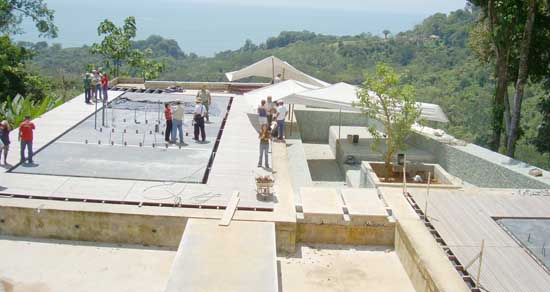
enormous site at Hermosa Arriba de Osa near Dominical was shut down
Tuesday by inspectors, who said the project far exceeded its permits. |
 Tribunal Ambiental Administrativo
photos
|
|
Environmental sweep shuts
nine projects on its first day
|
|
|
By the A.M. Costa Rica staff
Government enforcers of environmental laws closed down nine construction sites in the Canton de Osa Monday, and inspections elsewhere are scheduled all this week. Some of the projects appear to be in the million dollar range, and many are owned by foreigners. One project, which is now an elaborate foundation and concrete slabs was built with a permit for 500 square meters (5,381 square feet) but is now covering 3,500 square meters (37,673 square feet), according to José Lino Chaves, president of the Tribunal Ambiental Administrativo. The property also invades a forest zone, he added. The owner was identified as Sawadi S.A., but there is no corporation registered by that exact name in Costa Rica. That project was in Playa Hermosa Arriba near Dominical. Officials posted stickers at the various sites saying that they had been closed down. Some projects had unobstructed views of the Pacific Ocean. Roberto Dobles Mora, the minister of Ambiente, Energía y Telecomunicaciones, said that officials had to apply the full weight of the law to prevent even more serious environmental damage. In addition to correct permits, the tribunal inspectors look for intrusions into forested land, construction on steep slopes, extensive movement of earth and other activities that might provoke wholesale erosion. One concern is that sediment will damage coral and other creatures when disturbed soil runs off into the sea. With Dobles and the inspectors was the defensora de los habitantes, Lisbeth Quesada. She said that she was going to cite Alberto Cole, the mayor of the canton to explain what has been taking place in the Canton de Osa and to bring officials paperwork on the permits issued by the municipal office. There is a clear violation of the laws that is damaging the area, Ms. Quesada said, adding that her office will talk to the nation's chief prosecutor and the Corte Suprema de Justicia to see if an environmental judge can be appointed full time for the area. Tribunal President Chaves was more emotional. "The mountains of Osa are bleeding," he said. "The terracing, the construction and the lumbering continues to advance. Zones of protection are not being respected, and what is more grave is that the water resources and the cycle of natural life are being affected." This is the second trip by the tribunal to the area this year. This visit is in force because the inspectors had the |
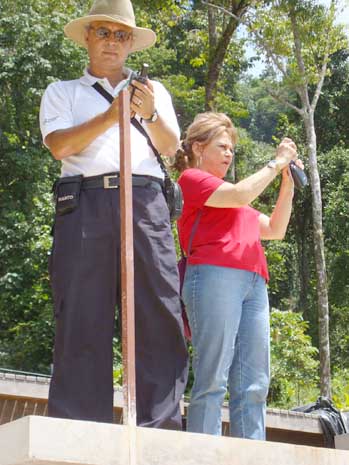 Jorge Bonilla, vice president of the Tribunal Ambiental, and Lisbeth Quesada, defensora de los habitantes, establish the exact location of an Osa project. 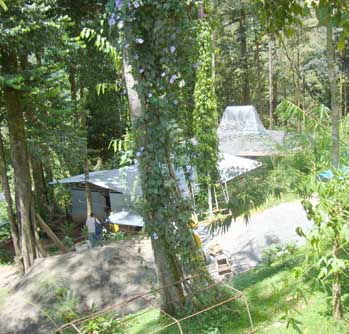 Another project that was closed down, according to the tribunal. benefit of photographs from the air that showed mazes of roads in the mountains and soil runoff going into the sea. In some cases, the owners of projects had municipal permits but they did not have permits from the environmental ministry to cut trees or redirect waterways. |
|
Kids of former sex workers
get scholarships to break cycle
|
|
|
By Elyssa Pachico
of the A.M. Costa Rica staff Tuesday 50 children of former sex trade workers were awarded 10 million colons worth of scholarship money from Scotiabank. The funds, about $18,200,went to Fundación Rehab, a Christian non-profit that supports families involved in Costa Rica's legalized sex trade. “Education is key,” said the bank's regional director, Carlos Ortiz, who presented the check in a brief ceremony at the foundation's headquarters in San José. A former sex trade worker who now works at a private national reserve, Leslie (who asked not to be identified by last name) said that while she was happy her two children, ages 11 and 15, were receiving such support for their education, Costa Rican society also needed education about the dark realities of the sex trade. “People think that women in the sex industry like the easy life,” she said. “I don't think there's a life that's more difficult.” Since Rahab's creation in 1997, it has provided over 600 former prostitutes with group therapy, personal counseling and other support services. Its executive director and founder, Mariliana Morales, said that while it is usually assumed that women go into prostitution because of socioeconomic reasons, the reality is more complicated. “There are three factors of vulnerability here,” she said. “Poverty, domestic violence and lack of education and self-esteem. When these three are mixed, you have a time bomb.” Yessima, an immigrant from Nicaragua who has been visiting Rahab for two months, said she went into prostitution in order to afford basic groceries for her three children, a pair of twins, age 4, and a 13-month-infant. |
“Next year when the kids are 5 I
guess they'll be getting the same
scholarship and going into — what is it called? Kindergarten? Primary?”
she said. “There's a lot I don't know, but I know what's good for my
kids.” Leslie, who worked in the sex trade for 10 years before she decided to seek counseling at Rahab following a spiritual epiphany, said that it wasn't always socioeconomic necessity or a lack of education that forced a woman into prostitution. “The root of the problem is something that breaks a woman very early in her life, some kind of violence or abuse that affects her relationship with men,” she said. “There's a lot of machismo in Costa Rican society, but it's a problem that has two faces. There's men who don't recognize a woman's value, and then there's women who don't recognize their own value.” Rahab also provides women with professional support, running workshops in computer literacy, sewing, arts and crafts, baking and beauty services. Nidia, a mother of four who first became involved in Rahab in 1999, said that she now makes her living making beaded purses, which Rahab helps her market and distribute. “They get sold all the way in Chicago,” she said. Ms. Morales hopes to expand the foundation. There are already sister branches in Jacó and Limón, each one currently providing services to 250 women. There is also talk of creating another branch that would assist male and transgender prostitutes. While the non-profit is rooted in Christian beliefs, hosting Bible studies alongside group therapy sessions, Ms. Morales said that homosexual prostitutes would not be treated as though their sexuality were sinful. “We want to provide kindness and charity,” she said. “Here, nobody is going to criticize.” |
| You need to see Costa Rican tourism information HERE! |
| A.M. Costa Rica fourth news page |
|
||||||||
| Home |
Tourism |
Calendar |
Classifieds |
Entertainment |
Real
estate |
Rentals |
Sports |
About us |
|
|
|
|||||||||
|
Panama's Torrijos coming here
to finalize free trade treaty
|
|
|
By the A.M. Costa Rica staff
President Martín Torrijos Espino will be in San José Friday to sign documents that will bring into force a free trade treaty between his Panamá and Costa Rica. The Asamblea Legislativa approved the agreement Oct. 15. The agreement allows free access to about 92 per cent of the estimated 1,500 products and services offered by Costa Rica. Marco Vinicio Ruiz, the minister of Commercio Exterior, said the agreement guarantees Costa Ricans privileged access to the Panamanian market. Among these duty-free products are medicines, paints, fertilizer, pipes, tires, paper, plastic, beauty preparations, refrigerators and stoves, pipes, textiles, shoes, bacon, milk products, plants, flowers, fresh fruits, tea, flour, cereals, fruit juices, food seasonings and sauces, alcoholic drinks and cigarettes, according to the ministry. Other industrial products will have a period of from five to 11 years as the customs duties gradually diminish. Some agricultural products will have schedules for reduction of duties as long as 16 years. Coffee, rice, sugar, potatoes, onions and chicken thighs are subject to limited exclusions, as are pork, ham and palm |
oil. These products will
have duty-free quotas, according to the Ministerio de Comercio Exterior. In 2007 Costa Rica imported about $224 million in goods from Panamá and exported an estimated $327 million. Under terms of the agreement that was released more than a year ago, the Costa Rican telecommunications companies will be able to compete in Panamá. In addition, firms from Panamá will be able to offer telecommunication services in Costa Rica. As of now, the only telecommunications company is the Instituto Costarricense de Electricidad. But the free trade treaty with the United States and other Central American countries and the Dominican Republic opens the door to private firms. Each of the countries involved in the U.S. free trade treaty agreed to negotiate separately with Panamá to determine which goods and services could be imported or exported there, said the ministry. Costa Rica began the negotiations in April 2006. Insurance, sold in Costa Rica by the Instituto Nacional de Seguros, was not addressed in the Panamá agreement, in part because Costa Rica is changing the rules here to allow private companies. However, the countries have agreed to discuss the issue again after the treaty enters into force, according to the ministry. |
|
Lawmakers approve treaty for
unified Isthmus system of mortgage registrations
|
|
|
Special to A.M. Costa Rica
Costa Rica’s Asamblea Nacional has ratified a treaty creating a common standard for mortgage registration among the countries of Central America and the Dominican Republic. The intention is stated as the eventual creation of electronic links between each property registry in the region. The initiative is part of the Central American Integration System, which commits the countries of the isthmus to streamline their internal relations and integrate government functions like sanitary registries and border controls. Costa |
Rica has been dragging its feet on
some aspects of the agreements. For
example, since 2006 citizens of the four northern Central American
countries can travel freely across borders with just a national
identification card. Costa Rica with its higher standard of living
attempts to keep its northern border controlled. Among the legislature’s stated goals is to provide opportunities for banks to expand lending, noting that “the mortgage market in Costa Rica is calculated at 21 percent of GDP while in the United States it’s 67 percent.” Given recent events on the international stage, the suggestion that information exchange might lead to a secondary market in mortgages may be slow to come to pass. |
 |
|
| News from
the BBC up to the minute |
BBC sports news up to the minute |
| BBC news and sports feeds are disabled on archived pages. |
|
| A.M. Costa Rica fifth news page |
|
||||||||
| Home |
Tourism |
Calendar |
Classifieds |
Entertainment |
Real
estate |
Rentals |
Sports |
About us |
|
|
|
|||||||||
|
high, U.N. official says Special to A.M. Costa Rica
A senior U.N. health official warns that governments must better prepare themselves to fight an influenza pandemic should one break out. Citing a new World Bank report that says the economic price tag of an influenza outbreak could top $3 trillion, the official, David Nabarro, said international cooperation is vital. Five years ago avian flu began spreading across Asia, Europe and Africa killing poultry, wild birds and then humans. Since then, the U.N. says there have been some 245 human deaths in 15 countries. Nabarro, a physician, is the U.N. influenza coordinator. He warns that while many governments have plans in place to fight an influenza outbreak, such as bird flu, they have not been thoroughly tested and could fail when an outbreak actually starts. He said that while the threat of an avian flu pandemic has decreased, the danger posed by other influenza viruses has not. "The threat of influenza pandemic is still as it was three or four years ago," said Nabarro. "And this is because although we are very concentrating on one particular bird flu virus that we worry may be the cause of the next influenza pandemic, the fact is unfortunately, any influenza virus could cause a pandemic and we just cannot say for certain when the next pandemic will come, where it will start, or even how severe it will be." Nabarro said the statistics show bird flu to be a much milder threat now than it was just three years ago. "When we look at the situation now compared with then, we see that the number of countries that have been newly infected is greatly reduced, the number of outbreaks that occur is greatly reduced, and the overall situation — with the exception of a small number of countries — is much lighter than it was in 2005," he said. Nabarro said the avian flu virus is still entrenched in two countries — Indonesia and Egypt — and it continues to resurface periodically in Pakistan, parts of China, Bangladesh, India, Thailand, Laos, Vietnam and South Korea. He also expressed some concern about Nigeria, which recently announced its first bird flu outbreak in nearly 10 months, and Togo, which has also had a recent outbreak. Saturday Egypt is convening an international meeting on both avian and human influenza. The conference is intended to review pandemic preparedness and assess what more needs to be done to improve an international response. |
|
|
|
|
|
|
|
|
| What we published this week: | Monday | Tuesday | Wednesday | Thursday | Friday | Earlier |
|
|