|
||
|
A.M. Costa Rica
Your daily English-language news source Monday through Friday |
||
 |
 |
 |
|
|
 |
|||||||||||||||||||||||
|

|
||||||||||||||||||||||
 |
|||||||||||||||||||||||
 |
|||||||||||||||||||||||
|
|
||||||||||||||||||||||
 |
| What we published this week: | Monday | Tuesday | Wednesday | Thursday | Friday | Earlier |
|
|
|
|
|
|
|
Food |
|
Jo
Stuart |
|
|
| A.M. Costa Rica's Second news page | |||||||||
| San José, Costa Rica, Wednesday, Sept. 26, 2012, Vol. 12, No. 192 | |||||||||
|
|
|
|
|
|
|
Food |
|
Jo
Stuart |
 |
 |
 |
|
$400 million for highway By
the A.M. Costa Rica staff
China is prepared to loan Costa Rica $400 million to widen Ruta 32 from Río Frio to Limón Centro. The Costa Rican government said the deal was negotiated by Vice President Luis Liberman who traveled to China. The highway is now two lanes. The project will bring the lanes to four. The project does not include work on the mountainous section north of San José where the tall cliffs are collapsing on the roadway. The government said that the financing was initiated by President Laura Chinchilla during her trip to China in August. The loan would be for 20 years with a 3.5 interest rate. Liberman was quoted by Casa Presidential saying that the loan would be submitted to the Asamblea Legislativa. The route is about 106 kilometers or about 66 miles. That makes the job about $6 million a mile. Bridges would have to be reconstructed to accommodate the widening. This highway is the main route from San José to Limón and return. It also will be getting traffic from a new highway across the northern part of the country. Gunplay on major highway leaves two men murdered By
the A.M. Costa Rica staff
Two cars chased by men in a pickup collided near Siquirres Tuesday afternoon and pursuers were able to gun down both drivers. The Judicial Investigating Organization said the killings happened on heavily traveled Ruta 32 near the Río Hondo bridge. Two passenger cars were being chased by men in a pick-up when one car collided with the rear of the other and the vehicles crashed into the bridge. The drivers were able to get out of the wrecks, but then the men in the pick-up arrived and began shooting multiple times, said agents. One victim was a 30-year-old man with the name of Rodríguez, and the second victim had not been identified, said the Judicial Investigating Organization.
|
||||||||||||||||||||||||||||||||||||||||||
 |
|||||||||||||||||||||||||||||||||||||||||||
|
|
|
|
|
|
|
Food |
|
Jo
Stuart |
| What we published this week: | Monday | Tuesday | Wednesday | Thursday | Friday | Earlier |
| The contents of this page and this Web site are copyrighted by Consultantes Río Colorado 2012 and may not be reproduced anywhere without permission. Abstracts and fair use are permitted. Check HERE for details | ||||||
 |
 |
| A.M. Costa Rica Third News Page | |
| San José, Costa Rica, Wednesday, Sept. 26, 2012, Vol. 12, No. 192 | |
|
|
|
|
|
|
|
Food |
|
Jo Stuart |
| Costa Rica leads hemisphere in rate of
robberies, OAS says |
|
|
By
Aaron Knapp
of the A.M. Costa Rica staff Costa Rica has the highest rate of robberies by far in the entire Western Hemisphere, according to a report released by the Organization of American States. Although the total number of robberies was lower than in countries like Brazil and the United States, in 2010 there were 943 robberies per 100,000 people in Costa Rica. However, with regards to murder, the report also showed Costa Rica to be the 10th safest country out of the 37 in the hemisphere that same year. The results are based on data from 2010, when Costa Rica had a murder rate of 11.4 per 100,000 people. More recent data from the Poder Judicial's Sección de Estadística shows that the rate went down in 2011 to 10.3. That's 527 murders in 2010 and 474 in 2011. Read more HERE! The "Report of Citizen Security in the Americas" is released annually. This year's 164-page report relied largely on data collected by police and crime investigation organizations in all countries throughout the hemisphere. According to the report, more than 43,000 robberies took place here in 2010. That translates to 943 victims per 100,000 people. That rate is distantly followed by Mexico's rate of 670. However, the report has some inconsistencies. Between the years of 2006 and 2007, the number of robberies nearly doubled from 23,000 to 41,000 with no indication of how such a large increase might have occurred. In addition, the report did not include data for the past two years from Argentina, which has historically had the highest robbery rate in the hemisphere. The report says that nearly 358,000 robberies occurred in the United States, which translates to a rate of 123 per 100,000. Costa Rica was the safest country in Central America in terms of homicides. It's murder rate was 11.4 in 2010 and 10.3 in 2011. Nicaragua was a close second with a rate of 13.5 in 2010 and 12.6 in 2011. However, the number of violent deaths has doubled over the past decade in Central America and the Caribbean. Honduras and El Salvador were by far the most dangerous countries in the hemisphere, and their murder rates have skyrocketed over the past decade. The rate in Honduras went from 81.9 per 100,000 in 2010 to 91.6 in 2011. In El Salvador the increase was from 64.7 per 100,000 in 2010 to 69.2 in 2011. In terms of numbers, Brazil led with nearly 41,000 homicides in 2010. That's a rate of 21.0. Mexico with around 21,000 and Colombia with about 17,000 distantly followed. |
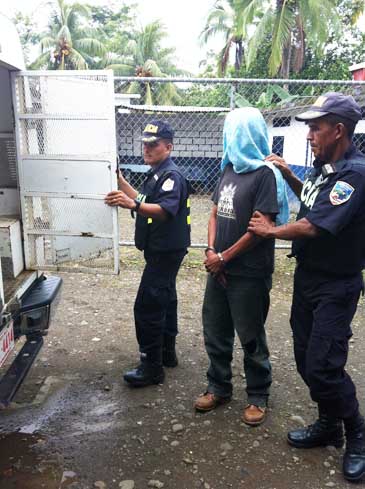 Ministerio de Gobernación,
Policía y Seguridad Pública
This person is not in the
statistics yet. He was detainedTuesday in Upala shortly after armed men stuck up a vegetable store and took, among other things, bananas and cash. The aggregate number of murders committed in Brazil and Colombia in 2010 nearly equaled those committed in North America, Central America and the Caribbean combined. Those numbers were 58,000 for Brazil and 59,000 for Colombia. Just over 14,000 people suffered violent deaths in the United States in 2010 at a rate of 4.6 per 100,000 people. Both numbers are decade lows. The rate was also the third lowest in the hemisphere, following Canada and Chile. In countries that collected this data, the majority of murders were committed with guns and most of the victims were males. In 2009, Costa Rica had a suicide rate of 6.1, a rape rate of 36.8, a theft rate of 104, a motor theft rate of 134 and an assault rate of 162 all per 100,000 people. As of 2006, there were 148,000 registered firearms in Costa Rica at a rate 3,367 guns per 100,000 people, according to the Organization of American States. Crimes other than murder are underreported in Costa Rica and many other countries because victims do not expect results from the police. |
Software can develop a map of the metro area or other areas in the country and identify the location of crimes that have been committed there. |
 Ministerio de Gobernación,
Policía y Seguridad Pública/Jorge Alonso Alvarez v
|
| Law enforcement officials say mapping
software will cut crime |
|
|
By
Kayla Pearson
of the A.M. Costa Rica staff Crime fighters have a new tool that maps illegal events and allows them to identify areas that need more attention. The Instituto Costarricense sobre Drogas and the security ministry have the new system called AGEPOL The system provides timely analysis of geospatial information, and in the future will allow the two agencies to pinpoint patterns and predict crimes, said Celso Gamboa Sánchez, vice minister of Seguridad Pública. He spoke Tuesday. AGEPOL is an acronym for Sistema de Análisis Geospacial para la Policia. It generates color coded maps according to the type of incident and geographical region. Information from all crimes including type, nationality of the persons involved and region will be placed in the system. Maps can be searched by specific dates, years and months. It can also be seen in real time, said the vice minister. According to officials, the technology is a free software and doesn't require technical knowledge to operate. Each police force will have its own personalized version of the map. |
With the technology, the police can
create models of future crimes and formulate theories. They can
also develop strategies with other institutions. Later, the security ministry will be able to evaluate the effectiveness of policing in each community and verify that resources are being used efficiently. The goal is to control drug trafficking and reduce crime. With this tool crimes in San José can be decreased by 20 percent, and the national-level crimes against property and killings decreased by 19 percent, Gamboa said. The Dirección de Migración y Extranjeria has also implemented a mapping software that pinpoints the different concentrations of immigrants. It will be used in the future to formulate immigration programs. One program already started by the immigration in February is Rutas de Integración. It allows public officials to learn about migration issues that address different populations while providing these communities with access to information about public service. Currently the program is in San Carlos, Upala, Jacó, Siquirres, and the metro area. Next year officials will begin work in Guanacaste and the southern part of the country. |
 |
| You need to see Costa Rican tourism information HERE! |
|
|
|
|
|
|
|
Food |
|
Jo
Stuart |
| What we published this week: | Monday | Tuesday | Wednesday | Thursday | Friday | Earlier |
| The contents of this page and this Web site are copyrighted by Consultantes Río Colorado 2012 and may not be reproduced anywhere without permission. Abstracts and fair use are permitted. Check HERE for details | ||||||
 |
|
||||
| A.M. Costa Rica's Fourth News page | |||||
| San José, Costa Rica, Wednesday, Sept. 26, 2012, Vol. 12, No. 192 | |||||
|
|
|
|
|
|
|
Food |
|
Jo
Stuart |
 |
| Caribbean residents seeking to overturn
negative court ruling |
|
|
By
Kayla Pearson
of the A.M. Costa Rica staff Members of the southern Caribbean came together Tuesday to support Ley 18.207, which recognizes the property rights of the inhabitants of the region by shrinking the size of a national wildlife refuge. The Sala IV declared the proposed law unconstitutional Friday. Opponents of the decision said the court did so with only listening to the side of interest groups in San José. Now it's time to hear their story, they said. “This is not an environmental issue, it's a social issue,” said Enrique Joseph Jackson, president of a Talamanca development organzation. The bill traces the history of Afro-Caribbean residents beginning with their 19th century colonization in the coastal towns of Cahuita, Puerto Viejo, Punta Uva, Manzanillo and Punta Mona. The settlers came as fishermen and farmers bringing with them seeds and knowledge, the document says. In 1978, the idea was proposed to develop the land and create a wildlife refuge. In 1985, according to Decree No. 16614-MAG, the Refugio Nacional de Vida Silvestre Gandoca-Manzanillo. was declared. |
All this was done without
consultation of those who lived in the region. The court decree also is filled with inconsistencies that include naming the town of Manzanillo as part of the refuge but later excluding it along with Gandoca, Mata de Limón, San Miguel and Puerto Viejo, said proponents of the bill. Later, in article five, all these excluded areas are listed in a certification program and called part of the refuge, the proponents said. The proposed law would give the rights to all the inhabited lands back to the people. “The object of the bill is to recognize the legitimate rights of the community Afro-descendant and the coastal towns of the south Caribbean, which have been ignored up to the moment, plunging these populations and territories and their management organizations and development into complete helplessness and paralysis because of the legal uncertainty resulting from such disrespect,” says the opening statement of the law. According to Joseph, this law would keep the government from controlling their businesses and properties and the people would no longer have to live in fear. “That would mean legal security for us,” he said. |
| Popular herbal remedy does not improve
memory, study says |
|
|
By
the University of Hertfordshire, news staff
Taking gingko biloba supplements does not improve memory, attention or problem solving in healthy individuals, according to researchers from the University of Hertfordshire. The paper, published in Human Psychopharmacology: Clinical and Experimental, is the first meta-analytic review examining the effects of Gingko Biloba on healthy people across all age groups. The researchers led by Keith Laws found zero impact on the cognitive functions whatever the age of the people, the dose taken or the length of time of taking gingko biloba supplements. Gingko biloba, the oldest tree living species, has been used extensively in traditional Chinese herbal medicine for thousands of years. Today, it is one of the most widely used plant-based products available without prescription in Europe and North America, where it is marketed as a dietary supplement to treat blood disorders and, more specifically, to |
enhance memory both for healthy
individuals and also for those trying to ward off Alzheimer’s disease. Laws, professor of psychology, said: “Gingko biloba has been widely used for a number of years to reduce the mental decline associated with aging. But more recently it has been marketed as a memory enhancing supplement for healthy individuals – and it is crucial to establish the validity for such claims. “Our findings show that taking gingko biloba supplements at any age to boost memory have no impact at all – and may be a waste of time and money.” The paper, “Is Gingko Biloba a cognitive enhancer in healthy individuals? A meta-analysis,” examines the published research of 13 randomised control trials of over 1,000 healthy individuals across all ages. Other recently published studies have also shown that there is no evidence to support taking gingko biloba supplements to protect against developing Alzheimer’s. |
|
|
|
|
|
|
|
Food |
|
Jo
Stuart |
| What we published this week: | Monday | Tuesday | Wednesday | Thursday | Friday | Earlier |
| The contents of this page and this Web site are copyrighted by Consultantes Río Colorado 2012 and may not be reproduced anywhere without permission. Abstracts and fair use are permitted. Check HERE for details | ||||||
| A.M.
Costa Rica's Fifth news page |
 |
||||||||
| San José, Costa Rica, Wednesday, Sept. 26, 2012, Vol. 12, No. 192 | |||||||||
|
|
|
|
|
|
|
Food |
|
Jo
Stuart |
|
| Vietnam,
biggest exporter, seeks more coffee quality By
the A.M. Costa Rica wire services
When most people think of coffee they do not usually think of Vietnam. But, this year the Southeast Asian nation surpassed Brazil as the world's biggest coffee exporter. Almost all are robusta beans, a lower quality, higher-caffeine variety used to make espresso and instant coffee. Vietnam's largest coffee company, Trung Nguyen, wants to change the country's reputation as a cheap coffee bean supplier. Chairman Dang Le Nguyen drinks 10 cups a day and wants others to do the same to raise low domestic consumption and coffee culture. "We have the quantity and quality of robusta, which is number one in the world. But, we are lacking one thing that is the packing industry, display industry, and storytelling industry, to make the world understand exactly what the world needs," he explained. "Vietnam should be a great nation, not only in quantity." Vietnam's style of coffee preparation was influenced by the French, who introduced the bean to the former colony. But the industry has only taken off in the past few decades and its coffee culture is relatively unknown abroad. American English teacher John Owens has come to enjoy the strong flavor of the local drip brew. "I had never heard about it until I came here," Owens says. "I do not think they market it, or they brand it. I think they put it with other coffee." Trung Nguyen is trying to change that by marketing unique coffee products and is also working with its coffee farmers to try to improve quality and efficiency. Ma Chuong, who has been farming coffee beans for more than 30 years, says a company-financed drip irrigation system saves on water and labor and is more productive. "In the first year before we had this system our productivity was only 800 kilograms per hectare. But, in the second year after installing this system, productivity went up to 1,400 kilograms per hectare," she explains. "Last year, from our notes from start to end of harvest, productivity was 2,040 kilograms." But according to Le Ngoc Bau, director of Vietnam's Western Highlands Agro-Forestry Scientific and Technical Institute, Vietnam's coffee production and exports may soon peak. He thinks the country's status as number-one coffee exporter will not last. "Firstly, Vietnam's government has no policy to expand the area for coffee," he notes, "In August of 2012 the minister of agriculture made the decision to approve the master plan to develop the coffee industry to the year 2020 and our vision up to the year 2030. For this master plan to the year 2020 the total area of coffee in Vietnam will be reduced to 500,000 hectares." In the meantime, coffee industry insiders say that while exports may level off, they can still work to improve quality. Honduran leader cites shared role against crime Special
to A.M. Costa Rica
U. N. member states have a shared responsibility to combat organized crime, particularly illegal drug trade, the president of Honduras, Porfirio Lobo Sosa, told the U.N. General Assembly Tuesday. He called on countries to work together to address this issue. Activities such as money laundering, bribery, drug trafficking, forgery, piracy, as well as arms and human trafficking are “dangerously polluting our societies and governments and constitute an international threat that must be analyzed, comprehended and fought against by every member of the United Nations,” Lobo said in his statement to the 67th UN General Assembly’s General Debate, which began Tuesday. “The fight against illegal trafficking, particularly of drugs and its related activities, is a shared responsibility,” he added. Scores of the world’s heads of state and government and other high-level officials are expected to present their views and comment on issues of individual national and international relevance at the Assembly’s General Debate, which ends Oct. 1 In his statement to the gathering, the Honduran President stressed that organized crime has sparked an increase in violence in his country, and underlined that measures need to be taken not just by countries that are being affected by this type of violence, but also by those who are creating demand for these illegal activities. “My country and our citizens are victims of the bottomless appetite for drugs in developed countries, and of the greed of producers and traffickers that enrich themselves with enormous profits stained with the blood of innocent people,” he said, adding that that even though Honduras is not a drug consumer or producer, it citizens continue to die because of organized crime. “But Honduras has not ignored this grave problem,” he continued. “In spite of our limited economic resources we are facing challenges with the necessary determination to provide integral solutions to this situation.” Two optimistic are hinting at improved U.S. economy By
the A.M. Costa Rica wire services
Two new reports are pointing to an improving U.S. economy. A research group, the Conference Board, reported Tuesday that consumer confidence in the U.S. jumped this month, reaching a seven-month high. Rising home values and stock prices may have helped boost the key barometer. Increased confidence in the U.S. economy could signal that American consumers are inclined to spend more. That is an important factor in the world's largest economy, 70 percent of which is driven by personal purchases, whether for food, computers, household needs or other items. A separate report by Standard & Poor's and Case-Shiller showed that U.S. housing prices rose 1.2 percent in July from a year earlier, the biggest yearly gain in nearly two years. It was the third consecutive month that housing prices in all 20 cities in the survey had increased. Despite the advances, unemployment remains high in the U.S., above 8 percent for 43 straight months. Later this week, the government is releasing its latest estimate of how fast the U.S. economy is growing, showing whether it is advancing more than the 1.7 percent pace it earlier disclosed for the April-to-June period. |
|
||||
|
|
|
|
|
|
|
Food |
|
Jo
Stuart |
| What we published this week: | Monday | Tuesday | Wednesday | Thursday | Friday | Earlier |
| The contents of this page and this Web site are copyrighted by Consultantes Río Colorado 2012 and may not be reproduced anywhere without permission. Abstracts and fair use are permitted. Check HERE for details | ||||||
| A.M.
Costa Rica's sixth news page |
|
||||||||
| San José, Costa Rica, Wednesday, Sept. 26, 2012, Vol. 12, No. 192 | |||||||||
|
|
|
|
|
|
|
Food |
|
Jo
Stuart |
 |
Latin America news |
 Costa Rica's foreign minister, Enrique Castillo, got to pose with President and Mrs. Barack Obama at the United Nations Tuesday. Castillo spoke Monday and Obama spoke Tuesday during the traditional speeches of foreign leaders. The U.S. Embassy posted the photo to its Web site, and the Costa Rican foreign ministry quickly sent out reminders to the press. Region's tourists estimated at 14 million by 2020 By
the A.M. Costa Rica staff
An expert from Panamá said that Central America will see 14 million tourists by 2020. He is Domingo Latorraca, who is with the consulting firm Deloitte Panamá. He also has served as a vice minister there. Latorraca was speaking to the Congreso Nacional de Turismo at the Hotel Costa Rica Marriott in Belén, He said Central America would receive about 3.5 percent of the world's tourists by 2020. The region needs to work in infrastructure, including roads, airports and seaports as well as training, laws and security, he said. The Costa Rican government proudly boasts of hosting more than 2 million tourists in recent years, but an examination of the statistics show that many come from Nicaragua and are not likely to be big spenders. Others have noted that many other arrivals in Costa Rica are incorrectly classified as tourists. That includes the so-called perpetual tourist who leaves the country and return every 90 days. Two sessions scheduled to promote foreign trade By
the A.M. Costa Rica staff
Foreign trade governing organizations will host two conferences about how Costa Rican businesses can take advantage of economic opportunities with international partners. The first is today at the Ministerio de Comercio Exterior. This conference will focus on business opportunities in Colombia that local entrepreneurs can explore after the free trade agreement between the two countries is completed. The event starts at 10 a.m. and is open to the public, but registration is preferred. The second event is a related event sponsored by the Promotora del Comercio Exterior de Costa Rica. This event will deal with the same topic, but it will instead focus on opportunities for business with Canada under the newly negotiated free trade agreement. This event begins at 9 a.m. Thursday at the ministry building. |
|
Latin
American news feeds are disabled on archived pages.
|
|
| Costa Rican News |
AMCostaRicaArchives.com |
Retire NOW in Costa Rica |
CostaRicaReport.com |
|
|
|
|
|
|
|
Food |
|
Jo
Stuart |
| What we published this week: | Monday | Tuesday | Wednesday | Thursday | Friday | Earlier |
| The contents of this page and this Web site are copyrighted by Consultantes Río Colorado 2012 and may not be reproduced anywhere without permission. Abstracts and fair use are permitted. Check HERE for details | ||||||