|
 |
Costa Rica Your daily |
 |
|
|
|
|
|||||||||||||||||||||
 |
||||||||||||||||||||||
|
|
|||||||||||||||||||||
 |
|
|
|
|
|
|
|
|
| What we published this week: | Monday | Tuesday | Wednesday | Thursday | Friday | Earlier |
|
|
 |
 |
|||||||||
| A.M. Costa Rica's Second news page |
|||||||||
| Home |
Tourism |
Calendar |
Classifieds |
Entertainment |
Real
estate |
Rentals |
Sports |
About
us |
|
| San José, Costa Rica, Monday, Sept. 20, 2010, Vol. 10, No. 185 | |||||||||
 |
| Costa Rica Expertise Ltd http://crexpertise.com E-mail info@crexpertise.com Tel:506-256-8585 Fax:506-256-7575 |
 |
 |
|
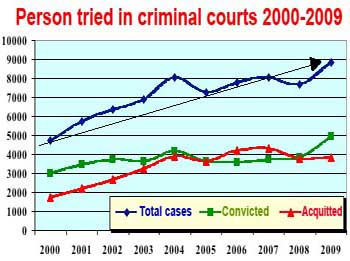 Sección de Estadística
of the Poder Judicial
Graphic shows the 10-year trend
Prosecutors batting at .564
in gaining convictions By the A.M. Costa Rica staff
Prosecutors had a 56.4 percent conviction rate in 2009, according to statistics released Friday by the Poder Judicial. The statistics show that 4,977 persons were convicted but that 43.6 percent were acquitted. The court system has had a better than 50 percent record in convictions in seven of the last 10 years, the statistics said. The report was prepared by the Sección de Estadística of the Poder Judicial. Some 13.3 percent of those convicted were foreigners, including 444 Nicaraguans and 78 Colombians. The number of persons brought into court and either convicted or acquitted was overwhelmingly male. Of those convicted, 90.9 percent or 4,969 were men. The crime associated more often with men was robbery. Women were more likely to be involved in the sale of drugs. Some 27.9 percent of those brought into court in 2009 had been there before, the report said. $500 million enters nation through World Bank deal By the A.M. Costa Rica staff
Although identifying one factor in the decline of the U.S. dollar against the colon is difficult, the county is awash in dollars. Added to that is a credit of $500 million given the country by the Banco Internacional de Reconstrucción y Fomento of the World Bank. The money is to be used for public finances and external debt. The money is to remain in U.S. dollars in the appropriate accounts of the Banco Central de Costa Rica, which noted that the legislature had approved this credit line. The Banco Central said the temporary nature of the money would not allow it to spend it for other purposes, including defending the colon, but the bank already has said it will be purchasing $60 million in dollars each month through Christmas 2011. The idea is to allow the country to pay down its foreign debts with low-interest money. Meanwhile the dollar will buy fewer than 500 colons today, a situation that probably will result in the Central Bank intervening. Aftershocks continue at Nicoya quake site Special to A.M. Costa Rica
Aftershocks from Thursday’s 5.3 magnitude earthquake continued over the weekend, with one 4.8 on the Richter scale Saturday afternoon, according to reports from the Universidad Nacional’s volcanology and seismology institute. The temblor and aftershocks were all from a single point 15 kilometers southeast of Cóbano on the southern Nicoya Peninsula. That point is just offshore from Montezuma The initial quake was felt over most of the country, while Thursday saw another six aftershocks ranging from 2.7 to 4.6 magnitude. Counting movements over 2.0, 65 aftershocks were registered on seismographs. The difference between 5.3 and 4.8 on the Richter scale is about five times the force released, so the latter would unlikely be felt far from the epicenter. Minor damage the result of the original quake occurred in Cóbano.
|
|||||||||||||||||||||||||||||||||||||||||||||||
 |
||||||||||||||||||||||||||||||||||||||||||||||||
| Home |
Tourism |
Place
classified ad |
Classifieds |
Entertainment |
Real
estate |
Rentals |
Sports |
About
us |
|
| What we published this week: | Monday | Tuesday | Wednesday | Thursday | Friday | Earlier |
| The contents of this page and this Web site are copyrighted by Consultantes Río Colorado 2001, 2002, 2003, 2004, 2005, 2006, 2007 and 2008 and may not be reproduced anywhere without permission. Abstracts and fair use are permitted. Check HERE for details | ||||||
 |
| A.M. Costa Rica third newspage |
 |
||||||||
| Home |
Tourism |
Calendar |
Classifieds |
Entertainment |
Real
estate |
Rentals |
Sports |
About
us |
|
| San José, Costa Rica, Monday, Sept. 20, 2010, Vol. 10, No. 185 | |||||||||
 |
| Airports and hidden guns do not mix, two travelers discover |
|
|
By the A.M. Costa Rica staff
Being a near celebrity appears to be helpful when police find guns in your luggage. But a Colombian man trying to smuggle out a weapon in a pressure cooker did not have as much luck. The almost celebrity is Spencer Pratt, who appeared on an MTV show and has been a talk show staple. He has been trying to get his wife to cancel divorce proceedings, and the gossip and movie magazines have been following their every breathe lavishing forests of slick paper and oceans full of ink. The wife is named Heidi Montag. Pratt claimed in a series of semi-coherentweets that he was jailed in Costa Rica, writing: "Thanks to jail, I finally have something in common with Gandhi, Nelson Mandela, and that Lohan chick!" There was no mention of the case in the daily reports from police last week. but the Los Angeles media picked up the story. Pratt and his beauty conscious wife were in Costa Rica since mid-August. She is 24 and was said to be here to checkout plastic surgeons. Briefly, the story is that he tried to bring two pistols out of the country in his luggage. He was traveling on a private jet. He spent some time talking to airport police, and then was let go. Pratt is a first-class self-promoter, so the tale may or may not be accurate. But the report of the Colombian who tried to smuggle out a weapon is right from the Policía Aeroportuaria of the |
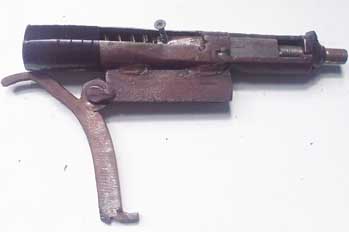 Ministerio de Gobernación,
Policía
Someone spent a lot of time crafting this weapon that was
confiscated in Heredia.y Seguridad Pública photo Ministerio de Gobernación, Policía y Seguridad Pública. Police did not name the man, who has Costa Rican residency, but they did say that they confiscated a 9-mm. handgun and a magazine with 15 bullets. They said the pressure cooker was wrapped up and sealed. The man was presented to the local prosecutor and later freed, they said. Fuerza Pública officers confronted more threatening situations involving firearms Friday. They picked up two minors and an adult with what police said were homemade weapons. The trio were loitering near a small supermarket, police said. And there was the discovery of three weapons, including a shotgun, in a coffee plantation in Santo Tómas de Heredia, police said. Officers said they got a telephone tip. |
|
When it comes to
methamphetamine, eonomic rules
|
|
|
By Dennis Rogers
Special to A.M. Costa Rica Methamphetamine as a recreational drug is a major scourge in the United States with accompanying crime, child abuse, and family disruption. Despite most production now in Mexico from where it could spread, it does not seem to be an imminent danger in Costa Rica. The drug in its present form has been around for at least a century, and Adolf Hitler was reputed to be a user. In the 1990s it became a major factor in U.S. drug use with small clandestine labs producing the illegal substance from legal precursor chemicals, mostly ephedrine and pseudoephedrine. Increased law enforcement and control of precursors have pushed most production to Mexico or in California with the participation of major Mexican crime syndicates. Somewhat different from other addictive drugs like cocaine, meth’s impact has been strongest in rural areas. Use of drugs as payment for support services provided to smugglers by locals results in the drugs ending up on local markets, as is the case with cocaine in Costa Rica. Since most meth is produced in western Mexico, that factor is evident in how use is higher in Tijuana than in Cuidad Juárez. Juárez is further east on the border and now the scene of bloody battles between smuggling cartels over control of cocaine traffic to the eastern United States. Meth can be swallowed, injected, smoked, snorted, or used as a suppository. Intravenous injection carries the same risks with needle sharing to transmit HIV or other blood-borne infections. Kimberly Brouwer of the University of California at San Diego has lead studies to document drug use and HIV risk among sex workers in the Mexico-United States border. Ms. Brouwer and colleagues documented the difference |
between Tijuana and Juárez,
with anecdotal reports of addicts crossing
to El Paso to obtain meth as it was easier to get there. Even in
Tijuana, and particularly elsewhere, the main illegal drugs were
marijuana and cocaine, with injection users preferring heroin. A Mexican government survey of drug treatment facilities in the state of Chiapas on the Guatemalan border did not find methamphetamine use as of 2008. Another similar look at a limited number of interventions in Guatemala and El Salvador found no meth in El Salvador and two cases in Guatemala. Controls on chemicals used in production is one of the principal mechanisms for fighting methamphetamine production. The days of bringing pseudoephedrine to Mexico in barrels seem over, but shipments involving hundreds of thousands of pills from the generic drug industries of India and Bangladesh are still found. Recent seizures in Guatemala and Honduras suggest Costa Rica could be part of that pipeline. Pseudoephedrine is still legal in Costa Rica, though Mexico, Honduras, Guatemala, and most recently Colombia have banned it completely. The Costa Rican pharmacists association did not reply to requests for information on local management of precursor chemicals. The U.S. Drug Enforcement Agency considers Costa Rica’s mechanisms for control of precursors adequate. Ultimately it may be the pervasive presence of cocaine on Costa Rica’s streets that protects citizens from the threat of methamphetamine. A dose of meth in Tijuana costs the better part of $2 while crack in San Jose is about $1 per hit. While supply and demand of a prohibited substance are naturally affected by the costs of interdiction, which would be low coming from Mexico, it appears simple economics favor cocaine. |
 |
| You need to see Costa Rican tourism information HERE! |
| Home |
Tourism |
Place
classified ad |
Classifieds |
Entertainment |
Real
estate |
Rentals |
Sports |
About
us |
|
| What we published this week: | Monday | Tuesday | Wednesday | Thursday | Friday | Earlier |
| The contents of this page and this Web site are copyrighted by Consultantes Río Colorado 2001, 2002, 2003, 2004, 2005, 2006, 2007 and 2008 and may not be reproduced anywhere without permission. Abstracts and fair use are permitted. Check HERE for details | ||||||

| A.M. Costa Rica fourth news page |
 |
||||||||
| Home |
Tourism |
Calendar |
Classifieds |
Entertainment |
Real
estate |
Rentals |
Sports |
About
us |
|
| San José, Costa Rica, Monday, Sept. 20, 2010, Vol. 10, No. 185 | |||||||||
| Captured U.S. citizen is
escorted under heavy guard for his plane ride to San José after
he surrendered Saturday. |
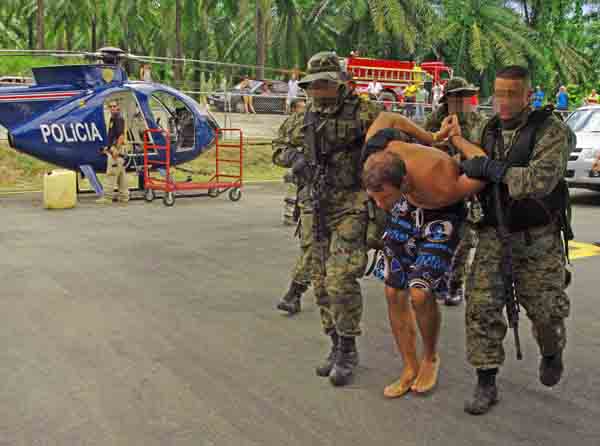 Ministerio de Gobernación,
Policía y Seguridad Pública photo
|
| U.S. fugitive manages to dodge police
for 12 hours |
||
|
By the A.M. Costa Rica staff
A U.S. citizen wanted on an underage sex charge in Pennsylvania broke away and managed to hide from police Saturday in Manuel Antonio. The security ministry mobilized a small army with air and sea support until the man, identified as John Pearson Jr., surrendered. The man had been handcuffed and put in a police car by local agents of the International Police Agency. But he somehow broke loose, managed to remove handcuffs that held his hands behind his back and took off, police said. |
Pearson was
described as very athletic and a one-time professional
football player. He had been working as a gym instructor at a Manuel
Antonio hotel. Agents fired at the man as he fled. Pearson spent more than 12 hours hiding in the mangroves and heavy vegetation as police set up extensive roadblocks. The security ministry said that a pilot of one of its Alajuela-based helicopters saw the man from the air. Other reports said that the man was surrendering. Police took no chances that he would escape again. He was taken under heavy guard by airplane to San José. |
|
| Home |
Tourism |
Place
classified ad |
Classifieds |
Entertainment |
Real
estate |
Rentals |
Sports |
About
us |
|
| What we published this week: | Monday | Tuesday | Wednesday | Thursday | Friday | Earlier |
| The contents of this page and this Web site are copyrighted by Consultantes Río Colorado 2010 and may not be reproduced anywhere without permission. Abstracts and fair use are permitted. Check HERE for details | ||||||
| A.M. Costa Rica fifth news page |
|
|||||||||
| Home |
Tourism |
Calendar |
Classifieds |
Entertainment |
Real
estate |
Rentals |
Sports |
About
us |
||
| San José, Costa Rica, Monday, Sept. 20, 2010, Vol. 10, No. 185 | ||||||||||
 |
 |
| Home |
Tourism |
Place
classified ad |
Classifieds |
Entertainment |
Real
estate |
Rentals |
Sports |
About
us |
|
| What we published this week: | Monday | Tuesday | Wednesday | Thursday | Friday | Earlier |
| The contents of this page and this Web site are copyrighted by Consultantes Río Colorado 2001, 2002, 2003, 2004, 2005, 2006, 2007 and 2008 and may not be reproduced anywhere without permission. Abstracts and fair use are permitted. Check HERE for details | ||||||
| A.M. Costa
Rica sixth news page |
|||||||||
| Home |
Tourism |
Calendar |
Classifieds |
Entertainment |
Real estate |
Rentals |
Sports |
About us |
|
|
|
|||||||||
Latin American news Please reload page if feed does not appear promptly |
International effort
saved ozone layer, study says By the A.M. Costa Rica wire services
A new report says international efforts to protect the ozone layer are a success and have stopped additional ozone losses. The joint World Meteorological Organization and U.N. Environment Program report is the first comprehensive update in four years. The ozone layer protects life on Earth from harmful levels of ultraviolet rays. Scientists say the shield was thinning during the latter part of the 20th century because of ozone depleting chemicals, such as chlorofluorocarbons found in refrigerants and aerosol sprays. To save the ozone layer, the international community signed the Montreal Protocol on Substances that Deplete the Ozone Layer, which went into effect in 1989. The treaty calls for phasing out production and consumption of ozone depleting substances. World Meteorological Organization Research Department Director Len Barrie says the treaty is working. "It has protected us from severe ozone depletion over the past decade, global ozone, including ozone in the polar regions," Barrie said. "It is no longer decreasing, but not yet increasing. There is, secondly, new information about the two-way link between ozone depletion and ozone processes, et cetera, and climate change. This is a very important advancement in our knowledge." The report says many substances that deplete the ozone layer also are potent greenhouse gases. Therefore, it says, the Montreal Protocol has provided substantial benefits by reducing climate change. Geir Broothen, atmospheric research senior scientist of the World Meteorological Organization, says the ozone layer is projected to return to 1980 levels by the middle of this century. "This most recent assessment, this 2010 assessment, actually predicts a bit earlier recovery than we foresaw in the 2006 assessment," Broothen said. "And this is linked to this climate change impact, and that increased amounts of greenhouse gases like CO2 and so on in the upper stratosphere will actually speed up the recovery at least in middle latitudes." The report says the Montreal Protocol also has direct benefits for public health. It says that without the treaty, ozone depleting substances had the potential to increase ten-fold by 2050. And, this in turn, might have led to up to 20 million more cases of skin cancer and 130 million more cases of cataracts. In addition, the report says, the thinning ozone layer would have caused damage to human immune systems, wildlife and agriculture. |
| Latin American news feeds are disabled on
archived pages.
|
|
| Home |
Tourism |
Place
classified ad |
Classifieds |
Entertainment |
Real
estate |
Rentals |
Sports |
About
us |
|
| What we published this week: | Monday | Tuesday | Wednesday | Thursday | Friday | Earlier |
| The contents of this page and this Web site are copyrighted by Consultantes Río Colorado 2001, 2002, 2003, 2004, 2005, 2006, 2007 and 2008 and may not be reproduced anywhere without permission. Abstracts and fair use are permitted. Check HERE for details | ||||||