|
 |
Your daily |
 |
|
|
|
|
|
|
|
|
|
|
|
|
||||||||||||||||
|
|
||||||||||||||||
 |
| A.M. Costa Rica Second newspage |
|||||||||
| Home |
Tourism |
Calendar |
Classifieds |
Entertainment |
Real
estate |
Rentals |
Sports |
About us |
|
|
|
|||||||||
 |
| Costa Rica Expertise Ltd http://crexpertise.com E-mail info@crexpertise.com Tel:506-256-8585 Fax:506-256-7575 |

Click HERE for
great
hotel discounts
|
|
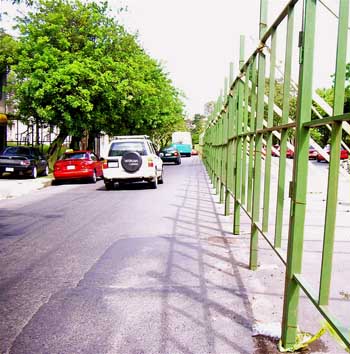 A.M. Costa Rica/Saray Ramírez
Vindas
Traffic is reduced to two lanes just west of the
Estación al Atlántico on Avenida 3. Workmen are fixing
pavement, but some residents think the job has to do with the
relocation of Casa Presidencial to the area.Arias will channel more to the poorest in 2009 By the A.M. Costa Rica staff
The government will put more emphasis on the poor during the remaining 20 months of the Óscar Arias administration. This was the conclusion after Arias and his ministers met Saturday in a retreat in Alajuela. Next year's budget will dedicate 45 percent of the money toward these ends, Casa Presidencial said. Arias has not had the term as president that he had hoped. When he took office, he announced that priority would be given to the free trade treaty with the United States and other Central American countries. He estimated that passage would take place in a couple of months. Now it is nearly 28 months into his term, and the details of the agreement still are crawling through the legislature. Then the country, as well as the world, was hit with skyrocketing petroleum prices. That knocked holes in the budgets of many agencies and institutions. Economic problems elsewhere also have affected the country's tourism and exports. The current year's budget dedicated about 41 percent to programs for the poor. The proposed 2009 budget will go to the legislature this week. The Avancemos program that gives direct grants to school kids and their parents will see a 52 percent increase, Casa Presidencial said. Arias also will continue his program of hiring more policemen. The new budget calls for 1,000 more. Howard updates his book on living, investing in Panamá By the A.M. Costa Rica staff
Retirement expert Chris Howard has come out with a 416-page expanded second edition of his "Official Guide to Living and Investing in Panama." Howard said the book offers invaluable assistance to anyone
"It guides you step by step and shows how to live on a budget; 100s of sure-fire tips, valuable contacts business resources; how to stay busy and happy; the best places to live in Panama; retirement tours; how to acquire residency; trustworthy real estate contacts; time proven shortcuts for learning Spanish; how to take advantage of the many tax savings for foreign residents, how to make the break from the rat race and start a new exciting life; and even how and where to find quality people for companionship." More information is available HERE!
|
|||||||||||||||||||||||||||
 |
High
season is coming. Do you know where your ad dollars are? They should be here |
 |
 |
 |
|
| A.M. Costa Rica third newspage |
|||||||||
| Home |
Tourism |
Calendar |
Classifieds |
Entertainment |
Real
estate |
Rentals |
Sports |
About us |
|
|
|
|||||||||
 |
 |
 |
|
Contraloría report
pans immigration for lack of controls
|
|
|
By the A.M. Costa Rica staff
The nation's watchdog reports that the immigration department is fraught with inconsistencies and that the current system has many weaknesses that limit effective control of foreigners here. The watchdog, the Contraloría General de la República, issued a 38-page report that became available to the public Monday. The country does not have a formal immigration policy sufficient to assess the objectives of the Dirección General de Migración y Extranjería, the report said. In addition, the government never has set up a series of regulations to go along with the 2005 immigration law, it said. When President Óscar Arias Sánchez took office, he quickly submitted to the legislature a revision of the 2005 law. But that draft has been stalled in the Asamblea Legislativa for two years. Arias said that the updated law passed in the administration of his predecessor, Abel Pacheco, was too harsh. Meanwhile, as the report noted, regulations implementing the law depend on a series of flyers and bulletins that come from the chief of immigration or his designates. The report said that: • foreigners stay in the country for periods longer than the law permits; • there is not an effective mechanism to guarantee that foreigners leave the country when they are supposed to do so even when denied residency; • Individuals who are deported frequently slip back into the country sooner than the law allows them to do so; • There are inconsistencies in the data base of immigration movements that compromise the integrity; • the country lacks a computer system to keep track of visas |
that have
been issued outside the country by the nation's consulates, and • many foreigners who live in the country carry expired cédulas. Much of this is not new to expats here who have to fight to obtain appointments to seek residency status. However, the Contraloría ordered the executive branch, the Ministerio de Gobernación, Policía y Seguridad Pública and the immigration agency to establish a formal policy. It also said that the agencies should review and set up an effective control of immigration. Like any government, Costa Rican agencies draw up regulations that translate the law into day-to-day policies. And a series of regulations have been written for the immigration agency, but they have not been published because the administration is expecting the passage of the new law that will result in changes and perhaps additional regulations. Among such regulations would be the government policy toward so-called perpetual tourists, residents who live in Costa Rica by coming and going to renew 90-day tourism visas. The Contraloría report said that in August 2007, some 848 persons remained in Costa Rica at least 30 days after the expiration of their visas. Only 149 persons had the benefit of an extension that the immigration department can award, it said. The report also noted that foreigners have received the benefit of two one-year automatic extensions of their cédulas, and that only one was done by presidential decree. The second one came from a circular signed by Mario Zamora, the immigration chief, it noted. Zamora has had his troubles with the department. His priority, he said when taking the job, was to reduce corruption. But he also had trouble with the machinery that produces cédulas. The report noted that the department handled nearly 600 appointments a day and that it would need two years to handle a year's worth of work at that rate. |
|
Arias will take a 12-day trip
to Europe to discuss the trade negotiations there
|
|
|
By the A.M. Costa Rica staff
President Óscar Arias Sánchez is off to Europe Sunday for a 12-day trip that is being billed as discussions about a trade accord between the European Union and Central America. Sept. 3 Arias will give a speech before the European Union's Parliament in Brussels. He also will meet that day with the president of the European Socialist Party, said Casa Presidencial. |
Sept. 5, Arias will travel to
England to have lunch with Charles, the prince of Wales, at Balmoral
Castle, Sept. 8 he will be in Cádiz, Spain, for the end of an exposition by a Costa Rican ceramic artist. Sept. 10 he and the Costa Rican delegation will be the guest of the Spanish monarch and his queen at the royal palace in Madrid. |
|
Four juveniles are being held
to face murder charges in two separate cases
|
|
|
By the A.M. Costa Rica staff
Four juveniles are facing murder charges in two separate cases in juvenile court. One case involves three minors, two 17-year-olds and one 16-year-old. The three suspects were detained Friday in the murder of 25-year-old Eduardo Mauricio López López. They are being evaluated by the Juzgado Penal Juvenil, reported Maria Isabel Hernández Guzmán of the Poder Judicial. The murder occured June 8 when the victim was riding in a |
vehicle with
two other men. A motorcycle approached their vehicle and riders
shot
on various occasions, hitting López in the thorax and killing
him. The
two other men, one 38 with the last names of Badilla and a 22-year-old
man with the last name of Camacho, were considerably injured and taken
to Hospital San Juan de Dios. The second case involves a 16-year-old who is believed to have shot and killed a Nicaraguan guard by the name of Julio César Miranda. Miranda was shot in Paso Ancho Aug. 12 and died six days later on Aug. 18. The boy was also wounded and is also at the hospital under police protection. |
| You need to see Costa Rican tourism information HERE! |
 |
| A.M. Costa Rica fourth news page |
|
||||||||
| Home |
Tourism |
Calendar |
Classifieds |
Entertainment |
Real
estate |
Rentals |
Sports |
About us |
|
|
|
|||||||||
| Location of the Panama Canal Basin and other basins in southern Central America. |
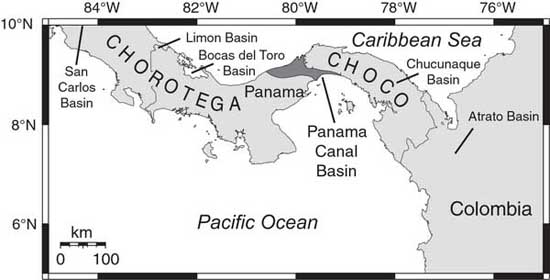 University of Florida graphic
|
|
New study concludes that Central America was a peninsula
|
|
|
By the University of Florida news service
Contrary to previous evidence, a new University of Florida study shows the Isthmus of Panama was most likely formed by a Central American peninsula colliding slowly with the South American continent through tectonic plate movement over millions of years. The study, co-authored by Florida Museum of Natural History researchers Michael Kirby, Douglas Jones and Bruce MacFadden, was published in the July 30 issue of PLoS ONE, the online journal of the Public Library of Science. The study uses geologic, chemical and biologic methods to date rocks and fossils found in sides of the Gaillard Cut of the Panama Canal. The results show that instead of being formed by rising and subsiding ocean levels or existing as a string of islands as scientists previously believed, the Isthmus of Panama was first a peninsula of southern Central America before the underlying tectonic plates merged it with South America 4 million years ago. “Scientists knew Panama was a North American peninsula, possibly as early as 19 million years ago because fossils that are closely related to North American land mammals, such as rhinos, horses, peccaries and dogs have been found in the Panama Canal during ongoing maintenance,” said Kirby, lead author of the study. “But we were not certain when this peninsula first formed and how long it may have existed.” The canal’s maintenance also exposes sediment layers and marine animal fossils, as well as strata of rocks and clay specific to numerous environments, including lagoon, delta, swamp, woodland and dry tropical forest. Previous studies placed marine sediment as the youngest layers, suggesting the peninsula was submerged before finally joining with South America. The current study revises the time order of strata, however, and concludes that the Panamanian peninsula joined with South America roughly 4 million years ago. Deep-sea deposits in one sediment layer suggest a short-lived strait may have existed across the Panama Canal Basin between 21 and 20 million years ago,” said Jones, director of the Florida Museum of Natural History. “However, these short-lived straits probably had little |
impact on the long-term evolution of Central America’s flora and
fauna.” Kirby explained that because of numerous geologic faults resulting from tectonic plate movement that continues today, there is no area in Panama that allows a full view of the strata making up the land. “We realized there was a problem with our previous understanding of the stratigraphy, or layering of sediments, in Panama,” Kirby said. The authors used alternative methods such as strontium isotope dating of fossils and re-analysis of vertebrate fossils to better determine the geologic sequence of the canal. “There’s always missing information, like pages out of a book, when it comes to figuring out which layers came first and which were formed later,” Kirby added. Anthony Coates, a staff scientist emeritus at the Smithsonian Tropical Research Institute in Panama who has extensively studied the geological history of the rise of the Central American isthmus, said the study brings together a diverse array of geologic evidence that convincingly suggests Central America was a peninsula and not a group of islands. “They have made an important contribution to the land-based geologic evidence of the plate tectonic history of the formation of the Isthmus,” said Coates, who did not participate in the study. “Their results have important consequences for the nature of the global change engendered by the rise and closure of the isthmus.” One of the major effects of the formation of the Isthmus of Panama was the intensification of the Gulf Stream in the Atlantic Ocean. While the area that is now Panama was still a peninsula, ocean currents moving north along the north coast of South America spilled over to the Pacific Ocean through the wide Central American seaway, also called the Atrato Seaway. As tectonic plate movement joined the peninsula with South America to form the present-day Isthmus of Panama, equatorial ocean currents between the Atlantic and Pacific were cut off, forcing water northward into the Gulf Stream current. “The strengthened Gulf Stream, in turn, delivered enough moisture to allow the formation of glaciers across North America,” Kirby said. |
 |
|
| News from
the BBC up to the minute |
BBC sports news up to the minute |
| BBC news and sports feeds are disabled on archived pages. |
|
| A.M. Costa Rica fifth news page |
|
||||||||
| Home |
Tourism |
Calendar |
Classifieds |
Entertainment |
Real
estate |
Rentals |
Sports |
About us |
|
|
|
|||||||||
 |
 |
|
Coffee pot for astronauts
has scientific uses, too By the A.M. Costa Rica staff Two students, Daniel Rozen and Josué Solano, have invented the first space infuser that will let astronauts drink brewed coffee in space. The students began this project in
The space infusor also could be used for medical purposes, such as the investigation and development of new medicines, said the university. It could even contribute to other technologies including the transfer of heat, fluids in space, and extracting supercritical fluids, said the university summary. The machine could be used to make coffee in the tradicional Costa Rican style called chorreando. Chorreando is a technique where hot water is poured into a cloth holding the coffee grounds and a cup is placed underneath to catch the instant coffee. Free speech advocates ask for Olympic rights pledges By the A.M. Costa Rica wire services
Human rights groups in the United States say the Chinese government did not live up to its promises to respect free speech and human rights during the Beijing Games, and they want the International Olympic Committee to insist on free-speech guarantees from the host of any future Olympics. Activists, gathered outside New York's City Hall, included some of the eight Americans who were arrested in Beijing, interrogated at length and then expelled from the country at the same time the games' closing ceremonies were taking place in the Chinese capital. Tom Grant, a film-maker and a supporter of the group Students for a Free Tibet, says he and his companions were not staging a protest but were leaving a restaurant in Beijing when police arrested them. The young activists said they were held separately, interrogated for eight to 10 hours a day and refused permission to contact anyone. |
|||
| A.M. Costa Rica Sports news local and from the wires |
 |
|
|
|
|
|
|
|
|
|
|
||||||
|
| The entire running team came
back on the race course to escort Vilma Lisac to the finish
line. |
 Photos by Dani Morales and Monica
Morales
|
|
Racing is more than a
competition, it's a Costa Rican culture
|
|||
|
By Melissa Hinkley
of the A.M. Costa Rica staff I read that running is the fourth most popular sport in Costa Rica with soccer coming in first, second and third. After running my first race in Costa Rica, I couldn't agree more. I competed in the Fifth Reto Powerade race Sunday in the Centro Comercial la Ribera, Belén. There were actually two races going on, the 21 K (half marathon) and the 10.5 K (6.2 miles). I contemplated running in the half marathon because
Once a week, they have group sessions where they train together as a team. I trained with them last Saturday, which was actually my first encounter with formal running in Costa Rica. We started at 6 a.m., which seems to be very common in Costa Rica because of the heat, and then ran 15 kilometers (almost 10 miles). We ran as a team, although slightly spread out, weaving through the mountainside and passing coffee plantations, small neighborhoods and curious observers. I got a very unique tour through the rural parts of the western Central Valley that I would otherwise never have seen. I noticed several things on that 15K run as I was surrounded by beautiful scenery and great companionship. I figured out that running for Costa Ricans is not just about the competition. Ticos value the time spent together as friends, as relatives and as fellow runners. Running is something that bonds them together and gives them a passion to share. The support they show not only for team members, but also fellow competitors, is amazing. |
At the Powerade race many
participants were running simply because
they enjoy running. Others were there to lose weight and stay in
good
physical condition. And, of course, there were people there who
were
training for other marathons, and they were ready to win the race. This
combination of people made for a lively atmosphere, considering there
were 2,500 people running, plus family and other personnel. There
were people everywhere bouncing around in their short shorts, sneakers
laced
up, and sweat beginning to drip. The sun was shining, the music
was
loud and upbeat, and the race was about to begin. The actual race itself was somewhat uneventful for me. I ran the 6.2 miles in around 50 minutes, so that was just a small detail when thinking about the whole experience. The run was a cool experience though, because there were so many people along the way cheering runners on, handing out water and Powerade, and squirting participants with hoses. I wasn't quite sure if they were squirting us to cool us off or because they thought it was funny. Either way it just added to the experience. When I finished the race, there were many on the team who were still running. Most people went and refreshed themselves with complimentary drinks and fruit, but as members from my team would finish, they would stay around and cheer as their teammates crossed the finish line. My host mom here in Costa Rica just started running about a year ago, and she is training for the Chicago Marathon in October. During this race she was running the half marathon. Although she is not as fast as some of the other speedy runners, she is a trooper. As the organizers were taking down their booths and picking up trash, she was still running. She didn't finish the race alone though. No, she finished the race in 2 hours and 45 minutes with her entire team following behind her for support. My new favorite phrase is “Ya lo tiene”, which basically means, “you can do it!” So, as I have been thrown head first into the culture of running, I have realized that running in Costa Rica is so much more then just running. It is not hard to become involved in the culture. All that is necessary is a pair of sneakers, a good attitude, and a friend to squirt you with the hose. There is a race nearly every weekend somewhere. To see results from past races and to check out upcoming races, those interested can visit Ticomania.com. |
||
|
||||
|
|
|
|
|
|
|
|
| What we published this week: | Monday | Tuesday | Wednesday | Thursday | Friday | Earlier |
|
|