|
||
|
A.M. Costa Rica
Your daily English-language news source Monday through Friday |
||
 |
 |
 |
|
|
 |
||||||||||||||||||||||||
|

|
|||||||||||||||||||||||
 |
||||||||||||||||||||||||
|
|
|||||||||||||||||||||||
 |
| What we published this week: | Monday | Tuesday | Wednesday | Thursday | Friday | Earlier |
|
|
|
|
|
|
|
Food |
|
Jo
Stuart |
|
|
| A.M. Costa Rica's Second news page | |||||||||
| San José, Costa Rica, Tuesday, July 24, 2012, Vol. 12, No. 146 | |||||||||
|
|
|
|
|
|
|
Food |
|
Jo
Stuart |
 |
 |
 |
|
Work begins for new policy
covering foreigners here By the
A.M. Costa Rica staff
Representatives from more than a dozen government agencies met Monday to begin drafting an integrated immigration policy. The new Consejo Nacional de Migración has as a priority the formulation of such a policy, in part to address the number of illegal immigrants here. There were no reports of definitive action at the meeting Monday, but there have been working groups that met individually in the past on certain topics. The work is being furthered by international agencies, non-profit organizations and religious groups in Costa Rica. The Dirección General de Migración y Extranjería already has offered an amnesty to four categories of foreigners here. Among these are persons who have children born in Costa Rica. Among the goals of a new immigration law that went into effect two years go is an effort to integrate foreigners into Costa Rican society and culture. That was one reason legal residents were required to affiliate with the Caja Costarricense de Seguro Social. However, a majority did not. Anti-drug police are met with stones from neighbors By the
A.M. Costa Rica staff
Anti-drug police said they were met with hostile neighbors when they tried to make arrests Monday in Barrio Corazón de Jesús in San José. Neighbors pelted the agents with rocks, and the Fuerza Pública had to be called in to control the situation. Anti-drug agents managed to detain three men and confiscated marijuana. Despite the rock-throwing, agents said that they had received eight complains from persons in the neighborhood about the men. Italian murder suspect detained in Naranjo By the
A.M. Costa Rica staff
Judicial agents said Monday that they had detained an Italian national who is sought in his country to answer a murder charge. Agents said the man was 33 years of age, but they did not name him. The murder took place in Italy more than a year ago on April 30, 2011, said the Judicial Investigating Organization. The man entered the country from Canada at Juan Santamaría last April 3. He was detained in Dulce Nombre de Naranjo, agents said.
|
||||||||||||||||||||||||||||||||||||||||
 |
|||||||||||||||||||||||||||||||||||||||||
|
|
|
|
|
|
|
Food |
|
Jo
Stuart |
| What we published this week: | Monday | Tuesday | Wednesday | Thursday | Friday | Earlier |
| The contents of this page and this Web site are copyrighted by Consultantes Río Colorado 2012 and may not be reproduced anywhere without permission. Abstracts and fair use are permitted. Check HERE for details | ||||||
A.M. Costa Rica Third News Page |
 |
| San José, Costa Rica, Tuesday, July 24, 2012, Vol. 12, No. 146 | |
|
|
|
|
|
|
|
Food |
|
Jo Stuart |
| Agencies ordered to fix the Ruta 1856
environmental disaster |
|
|
By
the A.M. Costa Rica staff
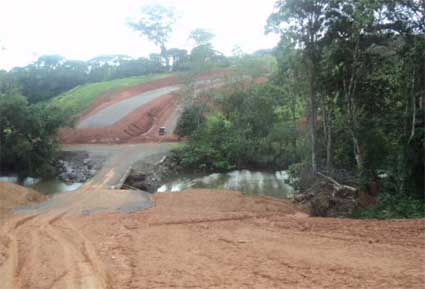
The nation's environmental enforcement agency has added another layer of errors and damage to the growing scandal that is Ruta 1856 along the Río San Juan. The agency, the Tribunal Ambiental Administrativo, has given a handful of public agencies 10 days to come up with a plan to fix the many environmental problems that observers found during a tour of just 49 kilometers, less than half the route. Experts and two judges from the Tribunal said they found evidence that there was extensive cutting of trees for the lumber. They also said that wetlands were damaged and that grading was in some places eight times as wide as the 10-meter highway. The project, which was done as an emergency, is the subject of criminal investigations, and every day brings news of some error that is affecting the route. For example, five bridges have collapsed, and transport officials have installed in one place a bailey bridge. Contractors used metal shipping containers in some places and covered them with wood to make bridges. Some of the wood was from protected species, said the Tribunal. President Laura Chinchilla ordered the roadway to be installed as a response to the invasion of some of the country's land by Nicaraguan troops. The highway was planned to provide as means of travel other than the adjacent river that is fully in Nicaraguan territory and under that country's control. Costa Rica is involved in a complex case in the International Court of Justice over the border dispute with Nicaragua. That country also has filed a case alleging that dirt from road construction has collapsed into and damaged the river. The Tribunal said it could find no evidence that this has happened. The Tribunal order is against the Consejo Nacional de Vialidad, the Comisión Nacional de Emergencias, the Sistema Nacional de Áreas de Conservación and the water, geology and mines sections of the Ministerio de Ambiente y Energía. The plan that is demanded is supposed to cover mitigation of the damages, repair and compensation. The Tribunal has the power to issue fines. The Tribunal also wants a list of dates when the various work that is promised will be done. In addition, the Sistema Nacional de Áreas de Conservación was ordered to assemble a team of 20 forestry experts and biologists to assess the impact of the road on the environment. The Tribunal also wants any wood that has been cut to be collected and protected so that the material cannot be sold. A report released Monday said that there were logs on the ground ready for the sawmill. The environmental agency also seeks the Colegio Federado de Ingenieros y Arquitectos and the Laboratorio Nacional de Materiales y Modelos Estructurales at the Universidad de Costa Rica to provide copies of reports on damage they have made. The Tribunal is the agency that has halted private construction work on both coasts because of danger to waterways and some trees. It has never issued a report with so much obvious environmental damage. |
 sedimentation and fill.  The Tribunal considered the width of this clearing to be excessive for the size of the road. The report said that wetlands were affected by extraction of materials, the dumping of fill, blockages, diversions and sediment. Waterways also were diverted, blocked or otherwise tampered with. Some work encroached on private land or protected biological corridors, according to the report. Specifically the Tribunal said that only in the first 49 kilometers, its experts found 10 wetlands damages and at least seven rivers or streams that also suffered damage. The new road is 160 kilometers or about 99 miles. The tribunal expressed surprise that some much grading had been done for the highway. It said in some cases a swath 80 meters wide (a bit more than 260 feet) was graded for the 10-meter-wide (33-foot) road. To do the grading, the land was cleared of trees. The report said that many of the trees cut were almendro or mountain almond. This is the same species that led to the closing of the La Crucita open pit gold mine near San Carlos because the tree is protected. These and many other trees were cut without permission, said the report. The nation's prosecutors are investigating a number of allegations involving the road, including the payment of bribes to inspectors from the Ministerio de Obras Públicas y Transportes and the issuing of contracts to companies with no experience in road building. The route was built as an emergency measure without competitive bidding. |
| Country prepares for another major
holiday Wednesday |
|
|
By
the A.M. Costa Rica staff
Wednesday is the celebration of the Anexión del Partido de Nicoya a Costa Rica. This is a paid holiday in Costa Rica, according to the Ministerio de Trabajo y Seguridad Social. Employees who work are supposed to be paid double. President Laura Chinchilla already is in Guanacaste with ministers and vice presidents. The formal meeting will be in Santa Cruz Wednesday with a fiesta to follow in Nicoya. But Central Valley residents do not have to go to Guanacaste to celebrate. This is a big holiday because by gaining the Guanacaste territory 188 years ago, the country also captured the culture, which is similar to the cowboy traditions of the U.S. West. So the holiday is celebrated here with folk dances, traditional |
hats
and food. A lot of private clubs have scheduled celebrations, and some
of the downtown casinos already are decked out in Guanacaste gear. The
notes of the marimba soon will be heard. The Museo Nacional has scheduled its celebration for Sunday, starting at 10 a.m. A Guanacaste musical group has been invited, and typical food will be available. There also will be presentations of Guanacaste bombas, similar to epigrams and generally humorous. The Banda de Conciertos de San José also is scheduled to be there. The Ballet Folclórico Iriria also is on the agenda. Bombas always are introduced with the word “Bomba!” They usually are four-line refrains with a final punchline but the form is flexible. The transport ministry has suspended downtown license plate restrictions for the day. |
 |
| You need to see Costa Rican tourism information HERE! |
|
|
|
|
|
|
|
Food |
|
Jo
Stuart |
| What we published this week: | Monday | Tuesday | Wednesday | Thursday | Friday | Earlier |
| The contents of this page and this Web site are copyrighted by Consultantes Río Colorado 2012 and may not be reproduced anywhere without permission. Abstracts and fair use are permitted. Check HERE for details | ||||||
 |
|
||||
| A.M. Costa Rica's Fourth News page | |||||
| San José, Costa Rica, Tuesday, July 24, 2012, Vol. 12, No. 146 | |||||
|
|
|
|
|
|
|
Food |
|
Jo
Stuart |
| Most of the quakes that take place here
are not felt by humans |
|
|
By
the A.M. Costa Rica staff
Earthquakes reported last week were no big deal, the experts said. From July 13 to last Thursday there were 149 quakes counted, but only eight were strong enough to be felt by humans, said the Observatorio Vulcanológico y Sismológico de Costa Rica. The quakes averaged 21.2 a day, the Observatorio said. There were three more felt quakes Monday. The largest was at 4:48 a.m. about 47 kilometers northwest of Peñas Blancas on the country's border with Nicaragua. The magnitude was estimated at 3.6. The estimated epicenter was just north of Riva, Nicaragua. There was a 2.8 magnitude quake at 2:42 a.m. 7.3 kilometers west southwest of Orosi de Paraiso and a 3.0 quake at 1:01 p.m. 13 kilometers southwest of Estero Garita de Aguirre de Puntarenas. The epicenter was estimated to be in the Pacific Ocean. |
 Observatorio Vulcanológico y
Sismológico graphic
Red dots represent the
quakes that ook place from July 13to last Thursday. Both the Observatorio Vulcanológico y Sismológico de Costa Rica and the Laboratorio de Ingeniería Sísmica are doing a better job of keeping the public informed, so the number of quakes being reported are more numerous than previous years. |
| New Centro Costarricense exhibit features
nature and harmony |
|
|
By
Kayla Pearson
of the A.M. Costa Rica staff Costa Rican artist Christian Wedel will present his fourth exhibit “Naturaleza, Patrones y Armonia” at the Centro Cultural Costarricense Norteamericano. Wedel's paintings use emotion, personification and symbolism, to unite natural Costa Rican landscapes and shapes with a global perspective. “Nature, humans and the relationship we share has always inspired me much,” said Wedel. In this new exhibition, I attempt to create worlds in that man and nature are one. I love relating images to microscopic landscape and trying to create compositions. It is interesting too as we live in a world in the can see a tree full of leaves, see the leaf more close in our hands, and even, see the leaf through a microscope, and all exist at the same time.” He has observed nature, microorganisms, crystals, water and air, and related them to physical and scientific nature. “Through this exhibition, the artist introspectively explores his thematic resources and organizes all these elements that symbolically translate his concerns, concepts and sketches into creations that are images so suggestive with indefinite atmosphere, and that question the time, the rhythm of this and the theme of reference: the universe around integrated frame of creative possibilities,” said Juan Diego Roldán, coordinator of visual arts at the Sophia Wanamaker gallery. The San José native has been painting for the last eight years. Currently, the 26-year-old is finishing his thesis in advertising design at Universidad Veritas. Wedel's goal is to transfer all the images in his head to paper. “Since childhood I always liked drawing, coloring, create objects and toys,: he said. When I was 19, I started to become more seriously interested in painting and studied artists who influenced me much at that time. Since then I've been trying |
 The
artist titled this 'Paisaje 8'
to represent the ideas that fill
the mind and let them flow with the
painting and drawing.”
The artist has been featured in individual exhibits since 2007. His first, entitled “False Awakening,” was hung in El Farolitio in the Centro Cultural Español. His exhibit called “Inner Nature” was on display at the Galeria Sasso Sasso at Universidad Veritas in 2009, and in 2011 he had a solo exhibition at Shakespeare bar and gallery and Sala Garbo. This recent exhibit will be in the Sophia Wanamaker Gallery until Aug. 22 and is free to the public. Patrons can deeper explore the world through Wedel's paintings. The Centro is in Los Yoses “All the paintings that work for this exhibition attempts to represent the incredible thing that is the universe for us and the positive way in which what we have explored or played,” Wedel said. |
|
|
|
|
|
|
|
Food |
|
Jo
Stuart |
| What we published this week: | Monday | Tuesday | Wednesday | Thursday | Friday | Earlier |
| The contents of this page and this Web site are copyrighted by Consultantes Río Colorado 2012 and may not be reproduced anywhere without permission. Abstracts and fair use are permitted. Check HERE for details | ||||||
| A.M.
Costa Rica's Fifth news page |
 |
||||||||
| San José, Costa Rica, Tuesday, July 24, 2012, Vol. 12, No. 146 | |||||||||
|
|
|
|
|
|
|
Food |
|
Jo
Stuart |
 |
| Some of our other titles: |
|||||
| A.M. Panama |
A.M. Colombia |
A.M. Guatemala |
A.M. Honduras |
A.M. Havana |
A.M. Nicaragua |
| A.M. Venezuela |
A.M. Central America |
A.M. Dominican Republic |
A.M. Ecuador | A.M. San Salvador |
A.M. Bolivia |
|
|
|
|
|
|
|
Food |
|
Jo
Stuart |
| What we published this week: | Monday | Tuesday | Wednesday | Thursday | Friday | Earlier |
| The contents of this page and this Web site are copyrighted by Consultantes Río Colorado 2012 and may not be reproduced anywhere without permission. Abstracts and fair use are permitted. Check HERE for details | ||||||
| A.M.
Costa
Rica's sixth news page |
|
|||||||||
| San José, Costa Rica, Tuesday, July 24, 2012, Vol. 12, No. 146 | ||||||||||
|
|
|
|
|
|
|
Food |
|
Jo
Stuart |
 |
Latin America news |
the starry nighttime sky By
the A.M. Costa Rica wire services
The starry nighttime sky is disappearing from view for most of the planet’s population. Rampant artificial light in many parts of the world has become another urban pollutant, erasing our view of the night sky, blinding ground-based telescopes and threatening the health of humans and the planetary ecosystem. The vanishing night sky is the subject of “The City Dark,” a documentary written and directed by Ian Cheney. “The film begins with a very simple question," Cheney says. "What do we lose when we lose the night and the darkness and the night sky?” That’s both a personal and a global question for Cheney, who spent his childhood stargazing on his family’s farm in the rural northeastern state of Maine, and came to miss the night sky after moving to New York as a young man. "Most kids in the world are now growing up without being able to see the Milky Way galaxy, this band of light that represents the hundreds of millions, the billions, of stars in our home galaxy that our sun is one of," Cheney says. "And we will see, as our people evolve, what that means, whether that means we have fewer scientists, or fewer poets or fewer philosophers. But I certainly think there is no end to the inspiration you can gain from a beautiful view of the night sky.” Along with inspiration, there is scientific knowledge to be gleaned, as astronomers look to space for clues about the origins of the universe. But direct observation has become nearly impossible in big cities as their light bounces off the dust in the atmosphere and creates a diffuse pinkish glow that can drown out all but a dozen or so of the brightest stars. “We’re limited to how far deep in space we can go," College of Staten Island astronomy professor Irving Robbins says in the documentary. "When you look at the sky, it’s like I have a beautiful painting, very nice. But now I come along and erase all of it. I just leave a few spots. That’s what light pollution does.” Cheney believes shielding outdoor lights so they illuminate only the street below is less intrusive and more efficient. And while city lights help humans see where they are going at night, they actually cause many animal species to lose their way. For example, migrating birds seem to have a star map encoded in their brains that helps them navigate as they fly north in the spring and south in the fall. When birds fly over cities, they often confuse the artificial lights below with the stars aboveand run into glass. A zoologist estimates that perhaps a billion birds a year die that way. Too much light also interferes with human circadian rhythms, which depend on 24-hour cycles of darkness and light. Epidemiologist Richard Stevens at the University of Connecticut Health Center says there is evidence linking rising rates of breast cancer in the industrializing world with the growing number of women working night shifts under artificial light. Lighting manufacturers are responding to growing demand for bulbs that mimic natural light, and efforts are under way around the world to establish “dark sky preserves,” where light pollution is at a minimum. “The City Dark” filmmaker Cheney is hopeful the night sky can be saved. “There is something comforting and esthetically pleasing about our city lights,” he says, “we just have to find a way to have them and our stars, too.” |
|
Latin
American news feeds are disabled on archived pages.
|
|
| Costa Rican News |
AMCostaRicaArchives.com |
Retire NOW in Costa Rica |
CostaRicaReport.com |
|
|
|
|
|
|
|
Food |
|
Jo
Stuart |
| What we published this week: | Monday | Tuesday | Wednesday | Thursday | Friday | Earlier |
| The contents of this page and this Web site are copyrighted by Consultantes Río Colorado 2012 and may not be reproduced anywhere without permission. Abstracts and fair use are permitted. Check HERE for details | ||||||