|
||
|
A.M. Costa Rica
Your daily English-language news source Monday through Friday |
||
 |
 |
 |
|
|
 |
||||||||||||||||||||||||||||||||||||||||||||||||
|

|
|||||||||||||||||||||||||||||||||||||||||||||||
 |
||||||||||||||||||||||||||||||||||||||||||||||||
|
|
|||||||||||||||||||||||||||||||||||||||||||||||
 |
| What we published this week: | Monday | Tuesday | Wednesday | Thursday | Friday | Earlier |
|
|
|
|
|
|
|
Food |
|
Jo
Stuart |
|
|
| A.M. Costa Rica's Second news page | |||||||||
| San José, Costa Rica, Monday, July 23, 2012, Vol. 12, No. 145 | |||||||||
|
|
|
|
|
|
|
Food |
|
Jo
Stuart |
 |
 |
 |
|
Exporters chamber planning
session against bond issue By the
A.M. Costa Rica staff
The Cámara de Exportadores de Costa Rica plans to hold a press conference today at 3 p.m. in the Asamblea Legislativa to express the organization's opposition to a proposed bond issue that is being considered by lawmakers. The title translated into English is “How will Costa Ricans pay the bill for public expenditures that grow without limit.” The exporters group members receive their payments in dollars, so they are sensitive to the rate of exchange with the colon. Spokespersons have said in the past that a bond issue would bring many more dollars into the country and further reduce the value of the dollar against the colon. They also are concerned about unemployment. Luis Loría, director general of the exporters chamber, said that some firms will be forced to close if the bond issue is passed. Robbers seeking fertilizer kill elderly security guard By the
A.M. Costa Rica staff
A 71-year-old security guard died early Sunday when robbers gunned him down on the banana plantation where he worked. The dead man was identified by the last name of Maltes. The Judicial Investigating Organization said that men in a truck came to the plantation storage shed in Saborio in Matina, presumably in search of chemical fertilizer. During the subsequent confrontation, the guard suffered three bullet wounds. The robbers took his cell telephone and his money but did not take any fertilizer, said agents. Fire produces plume seen all over valley By the
A.M. Costa Rica staff
A late morning fire in a pulpería in San Antonio de Escazú destroyed the small store and also three adjacent homes Sunday. The plume from the fire was visible in much of the Central Valley. Fire fighters got the call shortly before 11 a.m., but the wooden structures were enveloped in flames when trucks arrived, they said.
|
||||||||||||||||||||||||||||||||||||||||
 |
|||||||||||||||||||||||||||||||||||||||||
|
|
|
|
|
|
|
Food |
|
Jo
Stuart |
| What we published this week: | Monday | Tuesday | Wednesday | Thursday | Friday | Earlier |
| The contents of this page and this Web site are copyrighted by Consultantes Río Colorado 2012 and may not be reproduced anywhere without permission. Abstracts and fair use are permitted. Check HERE for details | ||||||
A.M. Costa Rica Third News Page |
 |
| San José, Costa Rica, Monday, July 23, 2012, Vol. 12, No. 145 | |
|
|
|
|
|
|
|
Food |
|
Jo Stuart |
| Stolen cell phone blacklist expanding to
cover Latin America |
|
|
By
the A.M. Costa Rica staff
Costa Rican cell telephone providers block an average of 285 mobile devices a day, mostly at the request of their owners after the phone has been lost or stolen. Since April, cell telephone companies here have been creating a blacklist of telephones that may not be reconnected, and now the concept is being formalized in other Latin American countries. That was the report from the government's Superintendencia de Telecomunicaciones after a meeting of cell telephone executives in Panamá last week. Thirteen Latin American mobile operator groups pledge to work together across the region to block the use of stolen devices, according to GSMA Latin America, which represents 800 mobil communication operators in the world. Cell telephone thefts or robberies are big business, and there are firms in San José that stay open 24 hours a day in order to handle the purchase of the devices from crooks. These operations have ways of fixing the telephones so they can be put in the marketplace for buyers who are not bothered by their possible history. In fact, Fuerza Public officers detained a man over the weekend who was selling cell telephones to passers-by on the downtown pedestrian mall. Cell phones have unique identification numbers that make them easy to track. Although participation in the blacklist is optional for phone companies, all of those approved for service in Costa Rica have agreed to check the numbers on phones before hooking them up. Most of the major service providers are expected to do likewise elsewhere. GSMA said its member operators are committed to connect to the stolen handset database and to implement measures to block stolen terminals in all countries where they operate in Latin America. They are: América Móvil, Antel, Cable & Wireless Panama, Corporacion Digitel, Entel Bolivia, Entel Chile, The Instituto Costarricense de Electricidad, Tigo Colombia, |
Nextel/NII Holdings, Nuevatel PCS
Bolivia, Orange Dominican Republic, Telecom Italia and
Telefónica. The agreement, full implementation of which is expected to conclude in March 2013, covers more than 500 million mobile connections throughout the region, said the agency. GSMA said it will continue working to promote the adoption of these guidelines to all GSMA member companies in Latin America through the signing of memorandum of understandings among operators on a country-by-country basis. Javier Delgado said that: “This joint effort by all regional operators to be part of this initiative will help regulators in our countries to face and address this scourge.” He is chairman of the Chief Regulatory Officers Group for Latin America, which held the Panamá meeting. This coordinated action by mobile operators is already showing results in Central America, where industry and telecommunications regulators in Costa Rica, El Salvador, Guatemala, Honduras and Panamá are aligning their efforts to facilitate the identification and blocking of stolen devices, he said. “The idea is to build upon the experience of collaboration between telecom operators and governments carried out in Central America and expand it country-by-country throughout the region over the next six months,” said Delgado. The creation by the Inter-American Telecommunication Commission of the Regional Front to Fight against the Theft of Mobile Terminal Devices was a key element of the resolution approved in 2011 by the commission's advisory committee . Among the proposals of this resolution, it recommended regulating at the regional level the exchange of blacklisting databases and blocking their unique identification codes to prevent the activation and use of cell phones stolen in other markets and helping to control illegal trafficking of devices among the region’s countries. In many cases, local telephone service providers have their own blacklist data base that automatically sends the numbers to the regional lists. The blacklist is updated every 24 hours, said the Superintendencia. |
| Caja official pleased at results of
anti-dengue old tire campaign |
|
|
By
the A.M. Costa Rica staff
The nation's public health system is backing a campaign to eliminate old tires because they can be breeding grounds for the mosquito that carries dengue. The Caja Costarricense de Seguro Social reported last week that already there have been 3,711 persons diagnosed with dengue this year. The bulk of the infections are on the Atlantic coast and the central Pacific and Guanacaste. The old tire campaign is being conducted by the vehicle inspection firm, Riteve SyC S.A. and Geocycle of the Grupo Holcim. The vehicle inspection stations are accepting the tires |
in Lagunilla de Heredia,
Alajuelita and in San Luis de SantoDomingo de Heredia. There are plans
to extend the campaign to Cartago. The large containers that were set up to hold the tires have had to be replaced because there have been so many brought to the stations. Marylene Quesada Quesada, coordinator of the campaign for the Caja said that this proves that people will act if given options with solid wastes. The Caja with its clinics and hospitals spends millions of dollars each year to treat dengue cases. The disease causes severe pains and causes a rash on the body of a sufferer. A second infection with a related virus can be fatal. |
 |
| You need to see Costa Rican tourism information HERE! |
|
|
|
|
|
|
|
Food |
|
Jo
Stuart |
| What we published this week: | Monday | Tuesday | Wednesday | Thursday | Friday | Earlier |
| The contents of this page and this Web site are copyrighted by Consultantes Río Colorado 2012 and may not be reproduced anywhere without permission. Abstracts and fair use are permitted. Check HERE for details | ||||||
 |
|
||||
| A.M. Costa Rica's Fourth News page | |||||
| San José, Costa Rica, Monday, July 23, 2012, Vol. 12, No. 145 | |||||
|
|
|
|
|
|
|
Food |
|
Jo
Stuart |
Yet another big wall Construction is under way at Paquera on the Nicoya peninsula of a 90-meter (295-foot) retention wall along Ruta 160. The 80 million-colon ($160,000) project is expected to be finished in the first week of August. The road that also services Tambor and Cóbano is an important tourist route. |
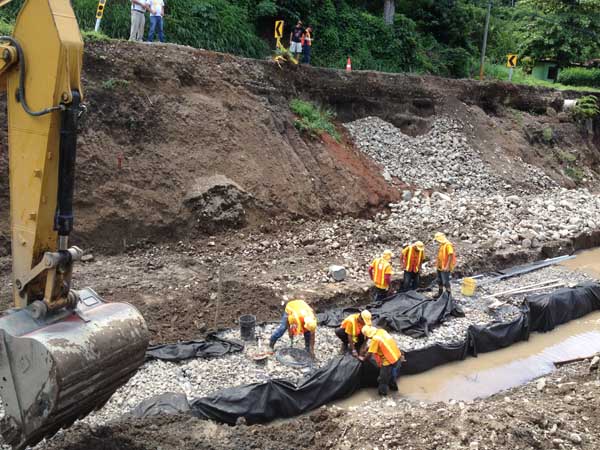 Consejo
Nacional de Vialidad photo
|
| Consumer agency says it won case backing Banco Nacional fine | |
|
By
the A.M. Costa Rica staff
The consumer protection agency says that Banco Nacional has lost its legal fight to avoid being fined for stonewalling a monopoly investigation. The agency, the Comisión para Promover la Competencia, said it fined Banco Nacional 10 million colons, about $20,000 because the bank officials would not provide the data the agency sought. The commission is part of the Ministerio de Economía, Industria y Comercio. Banco Nacional officials challenged the fine in court and raised a number of issues, including that providing the information would violate bank secrecy. |
The commission said Friday that the
bank lost as have other entities
that raised many of the same issues before the Sala IV constitutional
court. Banco Nacional took the 2010 fine to the Tribunal Contencioso
Administrativo and later to the Sala Primera of the Corte Suprema de
Justicia. The commission was investigating bank practices of tie-in loans where a customer only could receive a loan if there was an agreement to use other bank services. There was no statement in the release from the commission that Banco Nacional actually was guilty of such practices, just that bank officials did not want to surrender documents. The legal appeal centered on the commission's right to seek such information. The right to impose a fine is contained in the law that created the agency. |
| Quake experts differ on magnitudes of
Sunday shakers |
|
|
By
the A.M. Costa Rica staff
The Laboratorio de Ingenieria Sismica reported a 4.0 magnitude earthquake took place 12.4 kilometers southeast of Pavon de Golfito at 4:46 p.m. Sunday. It was the largest of four quakes that took place Sunday. The Laboratorio estimated the epicenter a few miles inland on the border with Panamá. The Observatorio Vulcanológico y Sismológico de Costa Rica, also based at the Universidad de Costa Rica, estimated the quake at a 4.4 magnitude and placed the estimated epicenter offshore in the Pacific. |
There also was a 3.5 magnitude quake
Sunday at 12:02 p.m. 24 kilometers northwest of Zapotillal de Santa
Cruz in northwest Costa Rica, said the Obervatorio. Other Sunday quakes
were less than
3.0, according to the Observatorio. However, the Laboratorio estimated
one at 5:01 a.m. about 11 kilometers (about 7 miles) south southeast of
Orosi de Paraiso at 3.0 and one at 4:13 a.m. in Santo Domingio de
Heredia at 3.2 magnitude. Both agencies have revised their reporting policies, and the Laboratorio now provides real time emails of earthquakes that appear to have been felt by humans. The Observatorio has updated its Web page with running information on quakes. |
|
|
|
|
|
|
|
Food |
|
Jo
Stuart |
| What we published this week: | Monday | Tuesday | Wednesday | Thursday | Friday | Earlier |
| The contents of this page and this Web site are copyrighted by Consultantes Río Colorado 2012 and may not be reproduced anywhere without permission. Abstracts and fair use are permitted. Check HERE for details | ||||||
| A.M.
Costa Rica's Fifth news page |
 |
||||||||
| San José, Costa Rica, Monday, July 23, 2012, Vol. 12, No. 145 | |||||||||
|
|
|
|
|
|
|
Food |
|
Jo
Stuart |
 |
| Arkansas
farmers seek days of slow, steady rain By
the A.M. Costa Rica wire services
One of the worst hit drought zones in North America is Arkansas, where lack of rain threatens livestock and crops in almost every corner of the southern state. Farmers are selling off cattle and desperately hoping for a sustained period of rain to undo the damage that has been done. Arkansas still looks very green. But the grass is short and there is not much good for animal feed. Even as temperatures soar over 40 degrees C (104 F), big white clouds float in the sky. Occasionally they produce a downpour. A burst of rain is very welcome here, but experts say it is not enough. Meteorologists say more than 38 centimeters (about 15 inches) of slow, steady rain would be needed in some areas to bring them up to normal. Lack of grass has forced cattle producers like Karen Haralson to spend more on expensive feed, and she says a recent rain has not helped. "It put just a little bit of green in the grass, but all it gave it was color, it didn't give it any growth," she said. She has had to reduce her herd from more than 250 to around 150, leaving her with too few cattle to operate effectively in the year to come. "To run the farm, I am going to have to have more cows than I have, so when I go to replace them there will be limited replacement, so the price will be much higher. So it is kind of a vicious circle," she said. In nearby Atkins, farmers gather in the Atkins International Cafe at lunchtime and reveal their woes to waitress Cindy Johnson. "The early crops that went in, they spent on the fertilizer and all, the yields were low. There is no moisture to put anything back in on the second round, everything is just dry and drought," she said. In Faulkner County, extension agent Hank Chaney says yields on most row crops, like soy beans, rice and corn, are going to be well below 50 percent this year unless rain comes soon. "We need at least three or four days of good, slow, steady rainfall. It would be nice, of course, if we could get a week of it, but at least that to help us soak up and for the ground to recharge," he said. Chaney says around 30 percent of the farmers in his area have an edge on Mother Nature because they have ground water they can tap for irrigation. These center-pivot irrigation systems are expensive to buy and operate. But Chris Schaefers, whose family owns eight of them, says they get their money back in better yields and better credit at the bank. "It sure does make them feel better, when you go to your lending officer to know that you have irrigation behind you, especially in years like this," he said. The Schaefers will benefit from the high commodity prices that are bound to result from this year's dry conditions. For farmers who can count on their own irrigation system, it will be a little easier to get through this drought, but everyone else is going to have to rely on Mother Nature. U.N. agency issues bulletin on soaring price of food By
the A.M. Costa Rica wire services
A 20-percent spike in maize and wheat prices in just the past three weeks is raising concerns with the United Nations Food and Agriculture Organization. Agency economist Shukri Ahmed said the increase in price was sharp and sudden. He said that until May, experts were hoping for a huge increase in worldwide maize production. The Food and Agriculture Organization's Global Information and Early Warning System issued a bulletin Friday saying that drought in the United States is helping push up prices, while hot, dry weather in the Black Sea region is affecting wheat. Ahmed says the price increase will put pressure on national budgets in countries that depend on imports for their domestic food needs. "Northern African countries, Middle Eastern countries, some countries even in Asia and Africa, who actually depend for more than 30 to 70 percent of their consumption needs on imports," said Ahmed. Add the threat of rising food prices to the list of troubles in Syria. "Near Eastern countries, whether it is Iraq or Syria or others, actually import from the international market. So, if these prices persist as they are, it will have implications on the countries that import much," said Ahmed. Ahmed said that price increases will strain national budgets in countries that depend on imported grain, forcing them to make difficult choices. |
|
||||
|
|
|
|
|
|
|
Food |
|
Jo
Stuart |
| What we published this week: | Monday | Tuesday | Wednesday | Thursday | Friday | Earlier |
| The contents of this page and this Web site are copyrighted by Consultantes Río Colorado 2012 and may not be reproduced anywhere without permission. Abstracts and fair use are permitted. Check HERE for details | ||||||
| A.M.
Costa
Rica's sixth news page |
|
|||||||||
| San José, Costa Rica, Monday, July 23, 2012, Vol. 12, No. 145 | ||||||||||
|
|
|
|
|
|
|
Food |
|
Jo
Stuart |
 |
Latin America news |
based on stone spheres By
the A.M. Costa Rica staff
The Canton of Osa, the home of the pre-Columbian stone spheres, is getting world class promotion from a Spanish astrologer. The Spaniard plans a six-day event in October centered on the spheres, which he calls the greatest archaeological enigma in the world. “It will be a magical and unforgettable event,” he said on a Web site. Archaeologists are uncertain about why the spheres were made. The current best guess is that they were symbols of power placed near the homes of leaders. The astrologer, Vicente Cassanya, says the stones are symbols of unity, eternity and perfection. Although archaeologists at the Museo Nacional might be a bit uncertain about the project, called "Proyecto Esferas. Osa, lugar de encuentro," Cassanya is so taken with the area and Costa Rica that he writes extensively on his own Web site about the natural beauty, the animals and the climate. The museum is developing a companion museum in Palmar Norte on land it owns there, and the spheres are being considered for inclusion in the U.N. world heritage list. The spheres have been the subject of many bizarre theories, including that they were made by residents of Atlantis and/or space aliens. Cassanya stops short of such concepts and says one of the goals of the session here will be to increase the visibility of the spheres in the world. Among those coming, according to Cassanya, are Carmen Thyssen, widow of Baron Thyssen-Bornemisza, and Fernando Berrocal, the former security minister who is identified as the encounter's legal director. Also on the list of invitees is Ivar Zapp, the academic who authored "Atlantis in América.” Death of woman in Tibás considered to be murder By
the A.M. Costa Rica staff
Agents consider the death of a 30-year-old woman in Tibás to be murder. The women, identified by the last name of Herrera, was found by a boyfriend in a pool of blood in her rented apartment. She appeared to have been stabbed in the neck. She was found at mid-morniing Sunday, but police theorize that she had been dead for at least six hours. The woman was separated from her husband, and was reported to be two months pregnant. |
|
Latin
Aemrican news feeds are disabled on archived pages.
|
|
| Costa Rican News |
AMCostaRicaArchives.com |
Retire NOW in Costa Rica |
CostaRicaReport.com |
|
|
|
|
|
|
|
Food |
|
Jo
Stuart |
| What we published this week: | Monday | Tuesday | Wednesday | Thursday | Friday | Earlier |
| The contents of this page and this Web site are copyrighted by Consultantes Río Colorado 2012 and may not be reproduced anywhere without permission. Abstracts and fair use are permitted. Check HERE for details | ||||||