|
||
|
A.M. Costa Rica
Your daily English-language news source Monday through Friday |
||
 |
 |
 |
|
|
 |
|||||||||||||||||||||||||
|

|
||||||||||||||||||||||||
 |
|||||||||||||||||||||||||
|
|
||||||||||||||||||||||||
 |
| What we published this week: | Monday | Tuesday | Wednesday | Thursday | Friday | Earlier |
|
|
|
|
|
|
|
Food |
|
Jo
Stuart |
|
|
| A.M. Costa Rica's Second news page | |||||||||
| San José, Costa Rica, Friday, July 20, 2012, Vol. 12, No. 144 | |||||||||
|
|
|
|
|
|
|
Food |
|
Jo
Stuart |
 |
 |
 |
|
Construction chamber cites
increase in approved projects By
the A.M. Costa Rica staff
Prospects are looking better for the construction industry when compared to the bleak times two and three years ago. The construction chamber said Thursday that approved projects were up 13.5 percent in the first half of the year, and more than half were homes. Employment in the industry was up about 13 percent, too, said the Cámara Costarricense de la Construcción. Still, the chamber expressed some concerns, including that $640 million approved by international development banks for roads have not been put to work. The chamber also said that reorganization was necessary for the Instituto Costarricense de Acueductos y Alcantarillados, the water company, and also the Consejo Nacional de Vialidad, the road agency. The chamber also said that it was concerned with problems the middle class has in getting access to housing. The chamber said that the province of San José had 31.2 percent of the square meters of construction that was approved. Other provinces had fewer square meters, and Cartago, Limón and Guanacaste were each in the 7 to 8 percent range. In all, 357,824 square meters were approved for construction in the first half of the year. That does not mean all the projects were started. However in San José at least there are four major multi-storied condo projects being built and one large office complex west of Mall San Pedro. However, most of these received approved before the first of the year, so they are not counted in the current statistics. Judicial agents will give warnings to job seekers By
the A.M. Costa Rica staff
Mall San Pedro will host a job fair this weekend, and judicial police will be there to urge caution by job seekers. The Judicial Investigation Organization said that there are unscrupulous persons who pretend to offer jobs to take advantage of job seekers. Last year judicial investigators handled 23 cases that included 39 victims of sexual exploitation, labor exploitation or other aspects of trafficking in persons, the agency said in a release. This year there have been 13 arrests and 44 victims, about half listed as victims of sexual exploitation, said the agency. That includes dancers at a strip club who complained that there were being exploited. Agents will be distributing information Friday, Saturday and Sunday. They are doing so at the invitation off the job fair organizers. Agents point out that job seekers, particularly the young, are vulnerable to deceitful employment offers, including some in newspaper ads.
|
||||||||||||||||||||||||||||||||||||||||
 |
|||||||||||||||||||||||||||||||||||||||||
|
|
|
|
|
|
|
Food |
|
Jo
Stuart |
| What we published this week: | Monday | Tuesday | Wednesday | Thursday | Friday | Earlier |
| The contents of this page and this Web site are copyrighted by Consultantes Río Colorado 2012 and may not be reproduced anywhere without permission. Abstracts and fair use are permitted. Check HERE for details | ||||||
A.M. Costa Rica Third News Page |
 |
| San José, Costa Rica, Friday, July 20, 2012, Vol. 12, No. 144 | |
|
|
|
|
|
|
|
Food |
|
Jo Stuart |
Workman is dwarfed by the gash in the side of Ruta 140 at San Miguel de Sarapiquí. The area faced heavy rains Wednesday night and early Thursday that resulted in the slide. |
 Consejo
Nacional de Vialidad photo
|
| Another landslide will require
restrictions on vehicle travel |
|
|
By
the A.M. Costa Rica staff
Road workers are battling another landslide that undermined a highway at San Miguel de Sarapiquí while the weather forecast says there is a high probability of more rain overnight in the northern zone and on the Caribbean coast. There also is a probability of rain in the southern part of the country near the border with Panamá, said the Instituto Meteorológico Nacional. Once again, winds from the north will keep heavy rains out of the Central Valley, according to the |
forecast. There is a possibility of
strong winds in the valley, in
Guanacaste and in the northern zone, said the weather institute. The Consejo Nacional de Vialidad, the road agency, said that travel will be restricted at Ruta 140 in San Miguel de Sarapiquí Road workers are going to have to construct a retaining wall to support the highway at the point where the slide took place, they said. This means that travel will be restricted from 6 a.m. to 5 p.m. until the beginnings of August. The road connects San Miguel with Río Cuarto. |
| La Carpio quilt project is transformed into a short stage
play |
|
|
By
the A.M. Costa Rica staff
That quilt the women of La Carpio stitched together as a literary project two years ago is coming to the stage this weekend. The “Voices of the Quilt” is a collection of short monologues that developed from the work the women put into the original quilt with the help of the Fundación Humantaria Costarricense headed by Gail Nystrom. The women in the low-income community west of the downtown were asked to create a quilt panel that told a story. From the result, a playwright constructed the sequence that will be presented starting tonight. The saga of the quilt is just one of five short works that will be presented. The English production is directed by Annette Hallett, “Productions that feature one act or short plays are becoming an increasingly popular format for theater companies these days” she said. “The audiences enjoy the variety, and the actors enjoy the opportunity it offers to explore a expanded repertoire of roles.” The show will be performed this and next weekend with performances Fridays and Saturdays at 7:30 p.m. and a Sunday matinee at 2:30 p.m. All plays are at the Teatro Laurence Olivier on Avenida 3 at Calle 28. More information is available HERE! |
 |
| After lunch is a good time to check out the new Chinatown |
|||
| A
couple of weeks ago I said that the Italian restaurant Il Ritorno had
moved to the suburbs in the west. I was wrong. Tony, who
was chef of Il Ritorno, has moved there and opened a new restaurant. Friends, Jorge and Doug, and I had lunch at Il Ritorno recently. The restaurant is alive and well and still in the Casa Italia on 8th Avenue. And it is still serving lunch and dinner prepared by the new chef, Marco, who has kept many of the recipes that were so deliciously prepared by Tony, and doing a great job of recreating them in his own image. We didn’t sample many dishes, but when the food arrived, the conversation stopped. What I like too, is that the restaurant has retained its quaint Italian decor and Antonio, the waiter who has been there for a very long time, is still there to greet you as warmly as ever. So, my apologies to Chef Marco. Il Ritorno is open every day but Monday. You can call 2253-6239 for reservations. Today is a good day to go. Being a shameless Josephino, let me suggest something else you can do in the city this evening after dinner (or a late lunch) at Il Ritorno. Drive across town to the Teatro Laurence Olivier on Avenida 2, Calle 28 in time for the 7:30 curtain and the opening night of the new play, or rather a set of playlets, entitled “My Life as a Crazy Quilt,” directed by the multitalented Annette Hallett. A hint for getting there: you will make it in no time if you take Avenida 8 as far as you can go. It is the fastest route through town from east to west and the least used by taxis, |
which seem to proliferate on the north side of town at the busy going home hours. After lunch I wanted to check out a pedestrian street that looked interesting and had some pretty little storefronts. It is often very difficult to go around the block in San José, so we parked as in a parqueo on Avenida Dos, but before we could find the street I was too tired to keep looking. (I haven’t started training to climb Mt. Kilimanjaro or walk for any good cause in the near future.) Most of what used to be Paseo de los Estudiantes is totally dug up in preparation for creating a Chinatown. Right now it looks like they are digging to China to find one they can transplant. It should be an interesting section of town, and I plan to stock up on my Chinese condiments and vinegars when they do. Besides it will be as close to China as I will ever get. I think the little street was near the Church la Soledad. If so, it is probably an extension of Avenida 4, which is a very attractive boulevard for strollers and shoppers. It is best, if you are like me, to start at the west end and walk east. It is almost all downhill that way. (See my earlier comment about Kilimanjaro). There is a huge MacDonald's on the corner of Calle 5. It competes in size with the one in my neighborhood facing the northwest corner of the stadium, and I can see the big red M from my office window. How lucky can a city girl get. |
||
 |
| You need to see Costa Rican tourism information HERE! |
|
|
|
|
|
|
|
Food |
|
Jo
Stuart |
| What we published this week: | Monday | Tuesday | Wednesday | Thursday | Friday | Earlier |
| The contents of this page and this Web site are copyrighted by Consultantes Río Colorado 2012 and may not be reproduced anywhere without permission. Abstracts and fair use are permitted. Check HERE for details | ||||||
 |
 |
||||
| A.M. Costa Rica's Fourth News page | |||||
| San José, Costa Rica, Friday, July 20, 2012, Vol. 12, No. 144 | |||||
|
|
|
|
|
|
|
Food |
|
Jo
Stuart |
| New Mayan discovery links dynasty with
god of the Sun |
|
|
By
the Brown University news service
A team of archaeologists led by Brown University’s Stephen Houston has uncovered a pyramid, part of the Maya archaeological site at El Zotz, Guatemala. The ornately decorated structure is topped by a temple covered in a series of masks depicting different phases of the sun, as well as deeply modeled and vibrantly painted stucco throughout. The team began uncovering the temple, called the Temple of the Night Sun, in 2009. Dating to about 350 to 400 A.D., the temple sits just behind the previously discovered royal tomb, atop the Diablo Pyramid. The structure was likely built after the tomb to venerate the leader buried there. Houston says that through this find, much of it pristinely preserved, researchers are gaining a significant amount of new information about the Maya civilization. “The Diablo Pyramid is one of the most ambitiously decorated buildings in ancient America,” Houston says. “The stuccos provide unprecedented insight into how the Maya conceived of the heavens, how they thought of the sun, and how the sun itself would have been grafted onto the identity of kings and the dynasties that would follow them.” This latest discovery was made public earlier this week during a press conference in Guatemala City, hosted by the Instituto de Antropologia e Historia de Guatemala, which authorized the work. Houston says the team is still in the beginning stages of the temple’s excavation, with more than 70 percent still to be uncovered. The Maya later built additional levels on top of the original structure, which helped to preserve the stuccos, but this also makes excavation more difficult. While excavating the tomb in 2009, Houston and his team discovered a small portion of the carvings peeking out from looter’s tunnels that had been dug several decades earlier. The archaeologists have only been able to clear narrow tunnels around the building to get a look at the masks and other carvings. There are several sections, including whole sides, an area of the roof, and the base still to be excavated. To get a better idea of what the building would have looked like in its original form, Houston is working with a team from the Center for Advanced Spatial Technologies at the University of Arkansas, which uses photogrammetric techniques to create 3-D images of the stuccos. Houston is using those images, as well as hundreds of color photographs taken during the excavation, to create drawings of the building. Renderings indicate that a large solid platform made up the base of the pyramid, which consisted of two or three narrower terraces with the temple sitting at the top. The previously discovered tomb sits just beneath the main platform. A sanctuary was eventually built on top of the tomb to offer protection to the space. Houston says that at one time most of the temple would have been covered in ornate stuccos and that it is possible much of it has survived. The excavation of the El Zotz site became more important last year when it was named one of the World Monuments Fund’s 67 international cultural heritage sites at risk. The site is known for one of the very few carved wooden lintels with hieroglyphic text to have survived from pre-Colombian Mesoamerica. The team is learning much more about the temple’s purpose. |
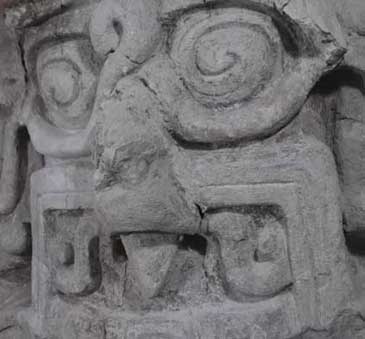 Brown University photo
One of the pristine basks that
decorated the building.Sitting on a high escarpment overlooking the main part of El Zotz, an ancient Maya city, the pyramid would have been a spectacular presence 1,600 years ago, according to Houston. Painted a saturated red, the temple was intended to announce its presence and the power of the ruling dynasty. It would have been at its brightest during the rising and setting of the sun and visible up to 15 miles away. The stucco masks on the walls of the temple appear to depict several celestial beings, including the sun, which the Maya thought of as a god. Standing 5 feet tall, several of the masks illustrate different phases of the sun as it moves from east to west in the sky over the course of the day. One mask displays fish-like characteristics, a representation of the rising sun on the horizon, which the Maya associated with the Caribbean to the east. Jeweled bands running between each mask contain archaic representations of Venus and other planets acting as the sky in this solar representation. “The sun was a key element of Maya rulership,” Houston says. “It was an icon which they linked very deliberately to royal lines, royal identity, and royal power. It’s the most dominant celestial feature. It’s something that rises every day and penetrates into all nooks and crannies, just as royal power presumably would. This building is one that celebrates this close linkage between the king and this most powerful and dominant of celestial presences.” The structure was built during a challenging time in the Maya world. The people of El Zotz and Tikal, another large Maya city nearby, were, for the first time, experiencing contact with and intrusions from the people of Teotihuacan, ancient America’s largest metropolis located near modern-day Mexico City. The pyramid may have been erected to signal local power at a time of intrusion and political turbulence. Another finding indicates that the Maya saw the building as a living being rather than just simply a physical structure. At one point, possibly when the Maya were preparing to add new construction to the existing building, the nose and mouths of the masks, as well as identifying glyphs on the forehead diadems, were systematically mutilated, according to Houston, as a way to deactivate the building. Despite the obvious care that was taken in constructing the building, it wasn’t used for long. Houston says evidence at the site shows that the building was abandoned sometime in the A.D. 400s, possibly because of a break in the dynastic order. |
|
|
|
|
|
|
|
Food |
|
Jo
Stuart |
| What we published this week: | Monday | Tuesday | Wednesday | Thursday | Friday | Earlier |
| The contents of this page and this Web site are copyrighted by Consultantes Río Colorado 2012 and may not be reproduced anywhere without permission. Abstracts and fair use are permitted. Check HERE for details | ||||||
| A.M.
Costa Rica's Fifth news page |
 |
||||||||
| San José, Costa Rica, Friday, July 20, 2012, Vol. 12, No. 144 | |||||||||
|
|
|
|
|
|
|
Food |
|
Jo
Stuart |
 |
| Republicans
in U.S. Senate quash law of sea treaty By
the A.M. Costa Rica wire services
U.S. business groups are expressing disappointment over dimmed chances that the United States will ratify a decades-old global maritime pact. At least 34 Republican senators have declared their opposition to the United Nations Convention on Law of the Sea, denying supporters the two-thirds Senate vote they would need for ratification. Maritime defense, shipping, and natural resources extraction are but a few of the endeavors covered by the Law of the Sea Convention, which governs how nations use the world’s oceans. Among major industrialized nations, only the United States has yet to join. The treaty must be confirmed by the Senate for the U.S. to have any say in how it operates. But the Obama administration's hopes for a Senate vote were dashed this week because of growing Republican opposition to the pact. “This is something that is not going to happen this year," says Sen. James Inhofe."There are some 35 members and many more, I might suggest, that would vote against it, should it come up.” Inhofe says the treaty would erode U.S. sovereignty. “It would, for the first time in the history of this country, authorize the United Nations to have taxing authority over the United States of America,” he added. The Obama administration says the treaty does not allow any U.N. taxes. U.S. business groups support ratification, saying the treaty will expand opportunities for American companies and protect their maritime interests. The Senate opposition is disappointing to Joe Cox, who heads a group representing America’s commercial shipping industry. “It is extremely frustrating, because the way we view the sovereignty issue is the U.S. would actually be expanding its sovereignty capabilities by acceding to the treaty,” he said. Mosquito bacteria made to fight malaria parasites By
the A.M. Costa Rica wire services
In the battle against malaria, doctors may one day have a microscopic ally. New research suggests that genetically modifying a bacterium commonly found in the gut of mosquitoes that harbor the malaria-causing parasite can make the mosquitos less likely to carry the disease. And if scientists can find a way to spread these bacteria in the wild, they could help end malaria’s deadly reign in the tropics. Malaria kills approximately one million people every year, mostly African children under the age of 5. Molecular biologist Marcelo Jacobs-Lorena, said, "It’s a very serious problem. It’s one of the three deadliest infectious diseases." And, he said, it’s one that is very hard to control. "We have just drugs that kill the parasite in humans, and we have insecticides that kill the mosquito vector. And the parasite rather quickly acquires resistance to drugs, and the mosquitoes are acquiring resistance to insecticides. So the situation doesn’t get better," he said. Jacobs-Lorena is part of a team at Johns Hopkins and Duquesne Universities that is exploring an entirely new way to fight malaria. He says the key to success is choosing the right battleground. In this case, that battleground is inside the mosquito. "Typically a mosquito ingests a couple thousand parasites. Then the parasite changes into a form called “ookinetes” that has to cross the midgut. Of the couple of thousand parasites that were ingested, only a few — about five or so — reach that stage where they cross the midgut. As you see, there’s a very strong bottleneck of parasite numbers in the midgut. That’s why it’s such a good target," he said. To take aim at the malaria parasites, Jacobs-Lorena and his colleagues gave weapons of a sort to bacteria that often live in a mosquito’s digestive system. "So what we did is genetically engineer the bacteria to produce several antimalarial compounds,. . . . ," he said. When the newly-armed bacteria reached the mosquitoes’ midguts, they thrived. And Jacobs-Lorena says that they excelled in their new role as anti-parasite fighters. "In the laboratory, it works extremely well. Up to 98 percent of the parasites killed. So it is quite efficient," he said. Space shuttle Enterprise takes its spot at museum By
the A.M. Costa Rica wire services
Thursday marked the beginning of a new mission for the U.S. space shuttle Enterprise, as it went on public display at the Intrepid Sea, Air and Space Museum in New York City. The nation's first space shuttle is housed in an inflatable dome, suspended about 300 centimeters (about 13 feet) in the air above the deck of a refurbished World War II-era aircraft carrier, allowing visitors a chance to walk under underneath the huge vehicle, which boasts a 23-meter (75.5-foot) wingspan. Enterprise was built in 1976 as a test vehicle to demonstrate the spacecraft's ability to fly and land like an airplane, paving the way for the five shuttles that eventually flew into space during the shuttle's 30-year history. Enterprise was flown to New York in April on top of a 747 jumbo jet, thrilling residents as it flew over the Manhattan skyline and past the Statue of Liberty on its way to John F. Kennedy's International Airport. The shuttle was transported to the museum by barge last month. Enterprise was housed at the National Air and Space Museum in Washington, D.C. before it was moved to New York and replaced by the space shuttle Discovery. The space shuttle Endeavour is now displayed at the California Science Center in Los Angeles, while space shuttle Atlantis is on display at the Kennedy Space Center in Florida. The other two space shuttles were destroyed during flight, Challenger in 1986, and Columbia in 2003. |
|
||||
|
|
|
|
|
|
|
Food |
|
Jo
Stuart |
| What we published this week: | Monday | Tuesday | Wednesday | Thursday | Friday | Earlier |
| The contents of this page and this Web site are copyrighted by Consultantes Río Colorado 2012 and may not be reproduced anywhere without permission. Abstracts and fair use are permitted. Check HERE for details | ||||||
| A.M.
Costa
Rica's sixth news page |
|
|||||||||
| San José, Costa Rica, Friday, July 20, 2012, Vol. 12, No. 144 | ||||||||||
|
|
|
|
|
|
|
Food |
|
Jo
Stuart |
 |
Latin America news |
 Museo de Arte y Diseño
Contemporáneo photo
Adán Vallecillo adjusts
one of his pieces.Artist creates
his Utopia
as a sociological commentary By
the A.M. Costa Rica staff
In the search for the perfect Utopia, Honduran artist Adán Vallecillo has created a model city out of everyday materials he manufactured and assembled together. What he creates allows viewers to reflect on symbolism, as well as political and ideological components related to Central American. Vallecillo has questioned codes and taxes and used his research to design a model of a city that he proposes as an option for Latin American counties. The Museo de Arte y Diseño Contemporáneo will feature 15 pieces of Vallecillo's vision in an exhibit called “Charter City” that will be available until Sept. 1. “In the fate of the alleged disadvantage and economic dependence of the countries heading to development, engaged in an unequal exchange between raw materials and manufactured goods, the artist is a reflection of the same process within these, in the inability of governments to create an equitable coexistence where, in response, generate neighborhoods or villages isolated by their poverty or their opulence,” said the museum. Vallecillo, 35, was born in Honduras and received a sociology degree from la Universidad Nacional Autónoma de Honduras in 2010. Before that, he studied at Escuela de Artes Plásticas in San Juan, Puerto Rico, and the Escuela Nacional de Bellas Artes in Tegucigalpa. The artist has traveled around the world doing exhibitions and workshops in in Europe, Latin America, the Caribbean and the United States. His work has received several awards including first prize in anthology of the plastic arts of Honduras in 2007. His artwork has also been showcased in many exhibits in many cities such as New York, Brazil and San José. The museum is inside the Centro Nacional de la Cultura that is just east of Parque España at Avenida 7 in San José. |
|
Latin
American news feeds are disabledon archived pages.
|
|
| Costa Rican News |
AMCostaRicaArchives.com |
Retire NOW in Costa Rica |
CostaRicaReport.com |
|
|
|
|
|
|
|
Food |
|
Jo
Stuart |
| What we published this week: | Monday | Tuesday | Wednesday | Thursday | Friday | Earlier |
| The contents of this page and this Web site are copyrighted by Consultantes Río Colorado 2012 and may not be reproduced anywhere without permission. Abstracts and fair use are permitted. Check HERE for details | ||||||