|
 |
Your daily |
 |
|
|
|
|
|
|
|
|
|
|
|
|
|||||||||||||||
|
|
|||||||||||||||
 |
 |
| A.M. Costa Rica Second newspage |
|||||||||
| Home |
Tourism |
Calendar |
Classifieds |
Entertainment |
Real
estate |
Rentals |
Sports |
About us |
|
|
|
|||||||||
 |
| Costa Rica Expertise Ltd http://crexpertise.com E-mail info@crexpertise.com Tel:506-256-8585 Fax:506-256-7575 |

Click HERE for
great
hotel discounts
|
|
interest rate by one point By Jeremy Arias
of the A.M. Costa Rica staff The board of the Banco Central Thursday increased the bank's lending interest rate to 9 percent by a majority decision that went into effect the same day. The bank's overnight deposit rate also increased from 4.25 percent to 5.25 percent with the board action. By shifting the annual rate of interest on loans from 8 to 9 percent, the bank seeks to combat the decrease in currency value caused by inflation and negative real interest rates. In layman's terms, the central bank, acting as the government financial institution, is attempting to strengthen the value of the colon, simultaneously combating inflation. The move will also slow down lending by making them less profitable. National banks had been sitting on loan files for weeks in anticipation of the interest rate change. The overnight deposit rate is commonly referred to as the inter-bank loan rate. As the government bank, the Banco Central is adjusting the rate on loans to private banks from the nation's reserve, which will in turn affect the customers of private banks and local financial behavior. By increasing the rates as mentioned, private banks that borrow money from the central bank will be forced to increase the rates on future loans for their clients in turn, leading to a decrease in the incentive to borrow money and reinforcing the purchasing power of the colon. Decree on traffic curbs finally makes La Gaceta By the A.M. Costa Rica staff
Thursday was the first day of expanded vehicle restrictions in the Metropolitan core, but if a motorist got a ticket in the morning, there was a reason to complain. A presidencial decree creating the restriction did not appear in the online version of La Gaceta, the official newspaper, until 9:30 a.m., according to a reader. A.M. Costa Rica stopped monitoring the Web site at 4:30 a.m. when the previous day's papers still were visible. A paper version of the La Gaceta was not immediately available Thursday to see if an updated decree had been published. The decree that finally appeared correctly said that the hours of restriction would be from 6 a.m. to 7 p.m. Those are the hours when vehicled with certain last digits on the license plate are forbidden to enter the zone. Today, for example, the unlucky plate digits are 9 and 0. Monday the numbers will be 1 or 2. The restrictions do not apply on weekends. Printers must have been frustrated because transit officials at the last minute changed the period of restrictions from 24 hours a day to just 13 hours. This is the administration's plan to free up downtown traffic and to cut down on fuel use and contaminated air. The restricted zone is from the Circunvalación on the south and east to Calle Blancos on the north and La Uruca on the west. In addition to the license rule, vehicles of six tons or more have other rules regarding which highways they can travel and at what times. Raids at five junk yards yield state property By the A.M. Costa Rica staff
A joint task force seeking state property arrested one man and raided five junk yards in Desamparados Thursday. Officers confiscated train track rails, traffic signals, telephone cables, electric and water meters and other items clearly linked to government operations. The man who was detained operates a junk yard in San Juan de Dios de Desamparados that has been closed by the muncipality and reopened illegally three times, according to the Judicial Investigating Organization. Limón port chief resigns By the A.M. Costa Rica staff
The man in charge of the Limón ports resigned Thursday after little more than three months on the job. He cited a declining health as a reason. He is Álvaro Rodríguez, executive president of the Junta de Administración Portuaria y de Desarrollo Económico de la Vertiente Atlántica. the resignation is effected a week from today.
|
 |
 |
|
 |
 |
|
| A.M. Costa Rica third newspage |
|||||||||
| Home |
Tourism |
Calendar |
Classifieds |
Entertainment |
Real
estate |
Rentals |
Sports |
About us |
|
|
|
|||||||||
 |
 |
 |
| Half-sister of abductee says aggression claims are untrue |
|
|
By the A.M. Costa Rica staff
The older daughter of a U.S. citizen demonized by Costa Rica's women's minister and a La Nación columnist has come to his defense. The daughter is Brenda J. Cyprian, 28, of Fort Worth, Texas. She presented herself in an e-mail as an eyewitness to the three-year period when her father, Roger Cyprian, was supposed to be physically abusing Chere Lyn Tomayko. Instead, she said, the two had almost no contact. Ms. Tomayko is about to be extradited to the United States to face a charge of parental child abduction. As part of her defense, family members here and legal representatives have said she was a victim of abuse and that is why she fled Texas contrary to a joint custody order involving her daughter Alexandria. She was on the F.B.I.'s most wanted list. The drumbeat of abuse was picked up by Jeannette Carrillo Madrigal, executive president of the Instituto Nacional de Mujer, and Julio Rodríguez, a columnist for La Nación. Ms. Carrillo, in an opinion piece Sunday, characterized Cyprian as a violent aggressor and said the woman might be murdered if she were returned to the United States. Rodriquez said incorrectly Monday in his En Vela column that if Ms. Tomayko were extradited that she would be remanded to the claws of her aggressor. Instead, she will be in U.S. custody. Neither writer spoke with Cyprian or appear to have acquainted themselves with the legal case in Texas. Ms. Carrillo, an Arias administration appointee, has not returned e-mails to a reporter. Rodríguez in his column said that Ms. Tomayko fled the United States from the claws of a man with a long history of aggression. Rodríguez said in an e-mail that the case was simply one of humanity over law. The columns appear to be a last-ditch effort by Friends and family of Ms. Tomayko to frustrate her extradition. Some 10 months of court appeals have been unsuccessful. Among other legal efforts, Ms. Tomayko tried at one time to obtain political refugee status in Costa Rica based on the aggression claim. She has been successful in winning the support of many other persons, mostly women, with her |
claims of physical aggression. Some supporters
were employees at the U.S. Embassy where officials did not move against
her until her daughter turned 18. The only problem with the aggression claim, according to Brenda Cyprian, is that her father was nowhere near the woman for the three years before Ms. Tomayko fled with her young daughter to Costa Rica. That was in 1997. The couple severed their romantic relationship in 1994, Brenda Cyprian said. In a lengthy e-mail, Brenda Cyprian said, in part: "Ms. Tomayko has continuously claimed abuse and fear for her life. There is no such evidence of this as being fact, other than Ms. Tomayko’s accusations. I was present at the time, and I am saying these accusations are false. "This, however, is not the only point I would like to mention. During the custody battle for Alex, all the court needed to grant Ms. Tomayko full custody was some sort of evidence. A police report, pictures, testimonies from witnesses; any of these would have given Ms. Tomayko leverage to prove her case against my father, but none was delivered. "If Ms. Tomayko was in fact afraid for her life, why was there never any police reports filed? If there was in fact abuse going on, why did Ms. Tomayko not take advantage of the U.S. justice system? There are several procedures that protect victims of abuse: restraining orders, protective orders, supervised visitations among others. Why were none of these utilized to protect Ms. Tomayko, Chandler and Alexandria from the alleged 'abuse'?" Chandler is an older child of Ms. Tomayko. Alex is more correctly Alexandria Camille Cyprian, the woman who was the object of the 1997 joint custody order when she was 7. Ms. Tomayko now has two younger children born here while she was a fugitive. Brenda Cyprian characterized herself as a victim who has been robbed of the companionship of Alexandria. " I, too, lost a sister who I have cherished since she entered the world on July 14, 1989," she said. "I lost someone who prior to her disappearance was shaping up to be one of the best friends I’ve ever had." |
| U.S. father arrested after two-year vacation here with his son |
|||
|
By the A.M. Costa Rica staff
Agents arrested a U.S. man in Guadalupe Thursday on a charge of kidnapping his 5-year-old son. The man had been
|
Agents
arrested Albanese as he was getting into a taxi with his Costa Rican
girlfriend near his home in Alto de Gaudalupe, said a police
spokeswoman. Albanese had made several recent trips to the beach
with a woman companion, said a report from the security ministry. Albanese lived in various houses while he was in Costa Rica, one in Bello Horizonte, Escazú, according to the police report. Officers from the International Police Agency and the Grupo de Apoyo Operativo of the Fuerza Pública participated in the arrest, according to police. The child is now in the custody of the national children's institution. Officials from the institution are coordinating with the Federal Bureau of Investigation to get the child back to the United States, said a spokesman. Meanwhile at least two U.S. mothers accused of kidnapping their children are still awaiting extraction in prison. Nicole Kater, arrested in April 2008 and Chere Lyn Tomayko arrested in September 2007, are both in Buen Pastor prison, according to spokespersoins.. |
||
| On going where nothing will be the same as it used to be |
|||
| When this column appears, I
will be in the United States on my way to Jamestown, New York, to
attend the memorial for my mother, who died last month. She would
have celebrated her 100th birthday July 14. It has been a long time since I have been back to the States, and I imagine I will experience some culture shock. Part of that shock will be the changes in my family and relatives, some of whom I have not seen in many years and probably won’t recognize, and some I have never met. I am looking forward to it all. Especially, I am looking forward to seeing my sister, Annetta, because it has been so long since we have been together. Since adulthood our relationship has been mostly by mail, but it has been constant and important to both of us. Although we have chosen different ways of life (I’m a gypsy, and she establishes roots), we share the love of cooking and that special tie that sisters have — after they outgrow the competition and disdain of younger years. Unfortunately, Donnetta, the youngest of us three, is not able to make it. My children, Justin and Lesley, will be there, too. The rare times the three of us have been together in recent years have been memorable for me. And if we can squeeze in the time, I am eager to show them Mayville, the village where I grew up, and where, almost ironically, the house I grew up in is an historical site — or at least it was when my brother and I visited it some years ago. (We both had high hopes and expectations for ourselves, and as it turns out it is our modest home that is remembered.) Then there is also Chautauqua Lake and the summer community of Chautauqua. Once again, after going through slow times, Chautauqua is blooming. It is sort of a summertime Paris of the 50s. Writers, musicians, philosophers, actors and students spend the summer there. Big bands, opera and theater, poetry readings, as well as lectures on many subjects are part of the summer program. At least that is the way it used to |
be. But nothing is the way it used to be, as the writer Dinaw
Mengestu said in an article in the Wall Street Journal. He was
writing about Paris of the 50s, of a city of sidewalk
cafes and bistros filled with writers, artists and philosophers —
many
of them Americans — talking and arguing and philosophizing, and how
today Paris has become like the rest of the world where “commerce and
not culture is the dominant social factor.” |
||
| You need to see Costa Rican tourism information HERE! |
 |
| A.M. Costa Rica fourth news page |
 |
||||||||
| Home |
Tourism |
Calendar |
Classifieds |
Entertainment |
Real
estate |
Rentals |
Sports |
About us |
|
|
|
|||||||||
|
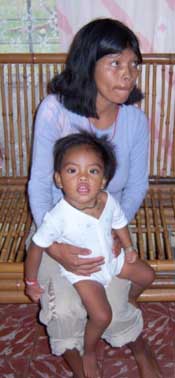
Cabécar child finally has a date with some physicians
|
|||
|
By Elise Sonray
of the A.M. Costa Rica staff Two doctors visited baby Priscilla this week. The 2-year's
At first leaders at the mission believed Blanca Rosa and her |
baby
Priscilla were from the nearest Cabécar village about a day's
journey away by foot. Now it is thought the woman is from another
village farther away and nearer to Panamá, said Ms.
Hancock. Blanca Rosa made the trip with her baby and her mother Roxana, said Ms. Hancock. The three are now staying with a local Cabécar family who live near the mission, said Ms. Hancock. When Priscilla is placed in Hospital de Nacional de Niños, Blanca Rosa will stay with a local expat, said Ms. Hancock. Ms. Hancock said Blanca Rosa is worried about the trip and has never seen a city. Blanca Rosa saw a car for the first time Tuesday, said Ms. Hancock. After an article published last Friday, the mission has received numerous donations totaling about $500, said Ms. Hancock. Ms. Hancock made contact with two doctors who agreed to see baby Priscilla with no charge, she said. One of the doctors estimated the baby may have to stay in the hospital for two months, but that she would eventually walk. Neither doctor diagnosed Pricilla's condition, said Ms. Hancock. “Priscilla is almost 2 and is severely underdeveloped. She cannot walk or crawl, is not trying to talk at all and has a hard time focusing,” said Ms. Hancock. Also one of Priscilla's hands is constantly clenched in a fist, but can be easily held open, said Ms. Hancock. |
||
|
39 experts warn of extinction threat to world's coral reefs
|
|
|
By the A.M. Costa Rica wire services
Experts say one-third of the oceans' coral reefs face extinction by the middle of the century if nothing is done to save them. The reefs are home to a vast array of sea creatures, which experts say would also be endangered by the loss of the reefs. A group of 39 leading coral experts from around the world sounded the alarm in the first-ever global assessment of coral reefs. Corals are tiny sea creatures that lay their skeletons down to form large reefs that have been built over millions of years. Kent Carpenter of Old Dominion University in Virginia led the study, published this week in the journal Science, on the threat to the world's coral reefs, which are produced in tropical and sub-tropical seas in coastal waters. Carpenter says steps must be taken now to reduce greenhouse gas emissions and stop over-fishing and pollution of the oceans. "If we do not do those things, then, at the current level of how things are going, we will probably lose our coral reefs by the middle of this century," said Kent Carpenter. "So, 2050 is the date that many people are predicting that coral reefs will cease to exist." Carpenter says, as ocean temperatures rise, corals throw off algae attached to them that are essential for their survival. |
"Normally, when you see a coral, it's tan or green or some colorful
color," he said. "But when they expel their algae inside of them, then
they become white. And this is a phenomenon known as bleaching.
Another consequence of higher temperatures is increased disease, and
this can cause mass die off." Carpenter says the coral reefs at greatest risk of extinction are the most common, the branching or staghorn coral. According to the report, the Caribbean has the greatest number of threatened coral species. The report also lists corals within the Pacific's Indo-Malay-Philippine Archipelago as threatened because of large concentrations of people. Experts say more than 25 percent of marine species depend upon the reefs for their survival. Carpenter says humans also depend upon coral reefs. "They are important for food and important for other types of livelihoods," said Carpenter. "So, if we lose the ecosystems, we lose not only the biodiversity, but we also lose the capability of people to obtain income and food from coral reefs." However, Carpenter says he and other marine biologists believe the coral reefs can be rescued through targeted conservation efforts and a cut in greenhouse gas emissions. Earlier this week, a U.S. government report said nearly half of coral reefs in U.S. government territory are in poor or fair condition. |
 |
|
| News from
the BBC up to the minute |
BBC sports news up to the minute |
| BBC news and sports feeds are disabled on archived pages. |
|
| A.M. Costa Rica fifth news page |
|
||||||||
| Home |
Tourism |
Calendar |
Classifieds |
Entertainment |
Real
estate |
Rentals |
Sports |
About us |
|
|
|
|||||||||
 |
 |
|
Bush signs wiretap law expanding surveillance By the A.M. Costa Rica wire services
U.S. President George Bush has signed legislation expanding the government's surveillance powers. The measure also protects telecommunication companies from lawsuits stemming from assistance they provide to help track potential terror suspects. One day after the bill cleared Congress, the president signed it into law. "Today I am pleased to sign landmark legislation that is vital to the security of our people," he said. The measure is the most extensive revision of U.S. surveillance law in 30 years. It is designed to enable intelligence agencies to move quickly to monitor communications involving terror suspects, in some cases without a special court warrant. The bill would require government authorities to obtain individual court orders to wiretap Americans who are outside the United States and require a special court to give advance approval to the government's procedures for wiretapping operations. The president says it will give the United States a much-needed tool to track terrorists abroad while respecting liberties at home. "It is essential that our intelligence community knows who our enemies are talking to, what they are saying and what they are planning," he added. This new law was the result of months of negotiations and bickering between the White House and Congress, and it is considered a big victory for the president. It includes a controversial provision that he has deemed essential: legal immunity for telephone companies that have voluntarily cooperated with such wiretaps since the Sept. 11, 2001, attacks on the United States. "This law will ensure that those companies whose assistance is necessary to protect the country will themselves be protected from lawsuits from past or future cooperation with the government," he explained. It was the immunity provision that dominated most of the debate on the bill in Congress. In the end, most members of the legislature acknowledged that without the grant of immunity, telephone companies would be reluctant to cooperate with further emergency wiretaps. Chávez to shop for arms in a visit to Russia By the A.M. Costa Rica staff
Venezuelan President Hugo Chávez is expected to buy more military equipment when he visits Russia later this month. The government of Venezuela announced Thursday that Chávez will meet with Russian President Dmitri Medvedev July 22, when he begins a five-day European tour. The statement said Chávez plans to buy new military hardware, including tanks. Venezuela has already purchased $3 billion in Russian fighter jets, helicopters and guns. |
| A.M. Costa Rica Sports news local and from the wires |
 |
|
|
|
|
|
|
|
|
|
|
||||||
|
||||
|
|
|
|
|
|
|
|
| What we published this week: | Monday | Tuesday | Wednesday | Thursday | Friday | Earlier |
|
|