|
 |
Your daily |
 |
|
|
|
|
|
|
|
|
|
|
|
|
|||||||||||||||
|
|
|||||||||||||||
 |
 |
| A.M. Costa Rica Second newspage |
|||||||||
| Home |
Tourism |
Calendar |
Classifieds |
Entertainment |
Real
estate |
Rentals |
Sports |
About us |
|
|
|
|||||||||
 |
| Costa Rica Expertise Ltd http://crexpertise.com E-mail info@crexpertise.com Tel:506-256-8585 Fax:506-256-7575 |

Click HERE for
great
hotel discounts
|
|
Our readers' opinion
Bike paths are expensive,bicycle fan calculates Dear A.M. Costa Rica: Regarding your article on proposed bike paths Wednesday, while this initiative is great, obviously neither the Ministerio de Obras Públicas y Transportes nor your reporter is very good at math. "The Ministerio de Obras Públicas y Transportes has announced plans to encourage the public use of bicycles among commuters and students, likely stemming from concerns over increased gas prices. "A ministry release outlined the proposed construction of up to 167 kilometers (more than 100 miles) of bike paths ... "The proposed bike path initiative could amount to $100,000 per kilometer, according to the release. Officials are seeking a $1 million grant from the Banco Interamericano de Desarrollo and $1 million more from the World Bank, although initial money will come from the local budget." Doing the simple math, 167 kms. at $100,000 means they need $16.7 mil. Since no public works project ever comes in under budget, they'll probably need more. Asking for $2 mil means that this is designed to fail. I'm an avid cyclist. And that is one of the reasons I spend less and less time there. I've cycled in over 60 countries and, in my opinion, Costa Rican roads are some of the worst in the world for cyclists Jeffrey H Vogel
Chiang Mai, Thailand and Escazú Reader says he's suspicious of motives of casino rules Dear A.M. Costa Rica: Consistent with a general suspicion I have of governments' motives and a disdain for excessive government intervention in our personal lives, commonly known in non-conformity circles as the government's "Protecting us from ourselves" policies, I am dumbfounded at the recent government decree putting limitations on the operating hours for casinos in the country, reducing them from 24 hours to 12, more precisely from 6 p.m.. to 6 a.m. The government wanted eight hours, but in a negotiated deal with the casino owners, 12 was the agreed on number. The decree is not only senseless and ineffective, but has the aroma of something Shakespearean: "Rotten in Denmark." Let me say right up front I am not a gambler — never have been, don't plan to be one- — and the number of times I have being in a casino can be counted on your fingers, each time out of curiosity, nor do I have a financial interest in casinos, so don't accuse me of being a mouthpiece for casino owners with what I am about to say. The government's pretext for limiting casino operating hours is the obligation it has to us citizens to help us fight against our illness of "ludomanía," that's compulsive gambling translated to plain English — by reducing the harmful effects it produces on the out-of-control gambler and those who depend on him or her. Please note the emptiness of that pretext. If there was a real concern about such things, the government would eliminate casinos all together, as well as bars. Compulsive drinking is a bigger problem than gambling. But they don't, they want to reduce the time you can be "compulsive" to 12 hours. I would think you could be pretty compulsive in that time, so it's hard to see just how this decree is to have an effect. Knowing how governments operate, it would not be outside of reason that another decree is to follow, which will limit bets to 100 colones max. With that, casino owners pack up and move on. In an industry — it's more than just a business — that gives jobs of all kinds to thousands of Ticos, captures a lot of tourist dollars, plus is a significant contributor to government coffers, all of which are good for the economy, something doesn't make sense about this decree that in no way will reduce the number of ludomaniácos. Could it be that some government insider(s) wants to pick up the crumbs of that sweet tasting pie when the foreigners are gone? Robert Nahrgang S.
Escazú Bill against spanking called crazy by reader Dear A.M. Costa Rica: I read an article the other day in The Tico Times regarding a bill that was introduced in the Legislature banning spanking of children in Costa Rica. According to the article Arias is expected to sign this into law this year. How crazy is that? Besides the obvious observation that this bill will be impossible to enforce, with the crime prevalent there, i.e.: stealing, armed robberies, and burglaries, how is this supposed to alleviate children becoming young criminals? If parents can't discipine their children there, Costa Rica's high crime rate will only become worse (if that's possible). Your newspaper needs to have a more active role in voicing opinions (via editorials) other than articles regarding criminal activities taking place there. Or is that not possible in Pura Vida? Donald Thom
Richardson, Texas EDITOR'S NOTE: Although The Tico Times, a local weekly, may have just found out about the anti-spanking bill, we have written about it extensively and pointed out that there are really no penalties in the measure. Our first report, a humorous look, was in September 2003. Like most politicians, the Costa Rican legislature likes to pass bills that sound good but have little effect.
|
 |
 |
|
 |
 |
|
| A.M. Costa Rica third newspage |
|||||||||
| Home |
Tourism |
Calendar |
Classifieds |
Entertainment |
Real
estate |
Rentals |
Sports |
About us |
|
|
|
|||||||||
 |
 |
| Ex-presidential
candidate Rolando Araya leaves Liberación |
|
|
By the A.M. Costa Rica staff
In a strongly worded public letter politician Rolando Araya Monge, the brother of the current mayor of San José and former presidential candidate, left the Partido Liberación Nacional. He accused President Óscar Arias Sánchez of destroying the original socialist values of the party and buying votes for the free trade agreement with the United States. The letter was addressed to Luis Ayala in Greece, the secretary general of Socialist International, a worldwide group of socialist political parties. Rolando Araya, who was the president of Socialist International or Internacional Socialista for Latin America and the Caribbean, renounced his position, since he will no longer be affiliated with a political party, he said. Rolando Araya wrote that he was proud of the Partido Liberación Nacional's early achievements, but now he is disillusioned. Araya has not yet said if he will join another political party. Araya, the Liberación presidential candidate in 2002, publicly denounced the free trade treaty. His brother, on the other hand, Johnny Araya Monge, mayor of San José, continues to be a member of the Partido. |
Liberación Nacional and many
see him as a future candidate for president. Other possible candidates for the Partido Liberación Nacional include Fernando Berrocal Soto, former minister of security, Vice President Laura Chinchilla Miranda, and Rodrigo Arías Sánchez, brother of the President and minister of the presidency. Rolando Araya, former mayor of San José in 1979, wrote that President Arias had basically ruined the entire party and hurt the people of Costa Rica. “The people of Costa Rica, virtually defenseless, were faced with the most colossal and most powerful machinery ever seen to impose TLC with the United States. Indeed, the government succeeded in combining the Legislature, the Judiciary, the Tribunal Supremo de Elecciones, the business chambers, the most powerful medias of press, radio and television, transnational corporations and even the White House.” TLC is the Spanish acronym for the free trade treaty. The letter was greeted with praise from Mariano Figueres Olsen, who left the party in 2005. He is the son of former president José Figueres Ferrer, who helped found the party. The support is found on the Frente Social Demócrata Web site. |
| Phone
company says it will reward those who pay their bills on time |
|
|
By the A.M. Costa Rica staff
The phone company will hand out prizes for the next three months in order to encourage customers to pay their bills on time, said a spokesperson for the company. The contest which began Monday will run until Oct. 1, said the spokesperson for Instituto Costarricense de Electricidad. Prizes include a vehicle, cards from Servibanca and |
Periclub, cell phones and MP4 music
players, said the spokesperson. Customers who wish to participate must pay their phone bill on time. They will then receive monthly e-mails with a ticket number. There will be three drawings for the months of August, September and October. The final drawing will be held on T.V., said the spokesperson. Customers can register and get more information at the www.grupoice.com Web site. |
 |
 |
 |
| You need to see Costa Rican tourism information HERE! |
 |
| A.M. Costa Rica fourth news page |
|||||||||
| Home |
Tourism |
Calendar |
Classifieds |
Entertainment |
Real
estate |
Rentals |
Sports |
About us |
|
|
|
|||||||||
|
Colombian military frees 15
hostages held by leftist rebels
|
|
|
By the A.M. Costa Rica wire services
Colombian officials say they have rescued 15 hostages held by leftist rebels, including a former presidential candidate Ingrid Betancourt and three U.S. defense contractors. Colombia's Defense Minister Juan Manuel Santos said the hostages were in good condition following the operation in the southeastern department of Guaviare. Santos said the rescue involved intelligence officials who had infiltrated the rebel unit in charge of the hostages. He said the rescue operation was launched when the Fuerzas Armadas Revolucionarias de Colombia were planning to transport the hostages by helicopter. Santos said the hostages include Ingrid Betancourt, three Americans and 11 members of Colombia's security forces. Betancourt was seized in 2002, while she was campaigning in rural Colombia where rebel forces were known to be active. One year later, rebels seized the three Americans — Marc Gonsalves, Thomas Howes and Keith Stansell — after their plane crashed during a drug surveillance flight south of Bogota. The governments of France and Venezuela recently launched new efforts to negotiate with rebels for the release of Betancourt and other high-profile hostages. This year, Venezuela's President Hugo Chávez helped win the release of six Colombian politicians, including former vice presidential candidate Clara Rojas, who was seized along with Betancourt. Betancourt and the three Americans were among some 40 high-profile hostages the rebels were holding in an effort to negotiate a prisoner exchange with Colombia's government. President George Bush called Uribe to congratulate him. Florida International University professor Eduardo |
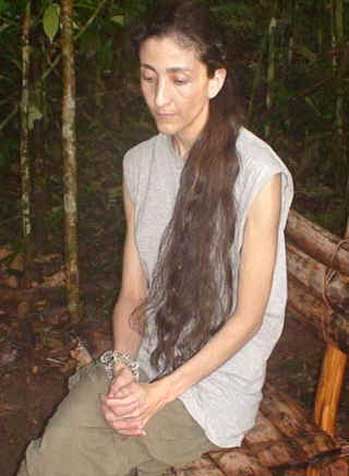 Photo courtest of www.4ingrid.com
Ms. Betancourt in famous photo while still a hostageGamarra says the rescue operation is a major blow to the leftist group. "It demonstrates two things," said Eduardo Gamarra. "One that the FARC appears to be really in a state of disarray, and, two, it reflects the degree of preparation and intensity the Colombian government has put into this." U.S. defense officials say the Colombians "planned, led and executed" the rescue, but the United States helped transport the freed hostages to Bogota after the operation. |
|
Ms. Betancourt was highest
profile hostage held by rebels
|
|
|
By the A.M. Costa Rica wire services
French-Colombian politician Ingrid Betancourt became the international face of Colombia's hostage crisis when she was kidnapped while campaigning for the Colombian presidency. She was the highest-profile captive held by the rebel Fuerzas Armadas Revolucionarias de Colombia. The rebels, Latin America's oldest insurgency, captured Betancourt and her vice presidential runningmate, Clara Rojas, in southern Colombia in February 2002. Rojas, who had a child while in captivity, was released early this year in a deal that Venezuelan President Hugo Chávez arranged. Concerns about Ms. Betancourt's health grew last year when authorities released a rebel video that showed her appearing gaunt and depressed. She was reported to be suffering from hepatitis B and a skin disease caused by insect bites. The rebels often chained her to keep her from trying to escape. |
Ms Betancourt's mother, Yolanda
Pulecio, met with Pope Benedict at the
Vatican and with Chavez in an effort to secure her daughter's
release. Ms. Pulecio had said she hoped Colombian President Alvaro Uribe would agree to negotiate with the rebels and end military operations that she said further endangered the hostages. France made Betancourt's release a priority and sent a mission to Colombia to see her, but the rebels denied access to her. The 46-year-old Betancourt was among some 40 high-profile hostages the rebels were holding in an effort to negotiate a prisoner exchange with Colombia's government. The rebels said they would not free Betancourt or any other captives until a deal was struck to free the guerrillas in prison. The rebels are believed to be holding at least 700 people hostage in the Colombian jungle. |
 |
|
| News from
the BBC up to the minute |
BBC sports news up to the minute |
| BBC news and sports feeds are disabled on archived pages. |
|
| A.M. Costa Rica fifth news page |
Are
you
still
spending 70 percent You need to fill this space ASAP! |
||||||||
| Home |
Tourism |
Calendar |
Classifieds |
Entertainment |
Real
estate |
Rentals |
Sports |
About us |
|
|
|
|||||||||
 |
 |
|
Starbucks a coffee
customer, will close 600 U.S. stores By the A.M. Costa Rica wire services
U.S.-based coffee chain Starbucks has announced plans to close 600 stores in the United States in the next year due to the weak U.S. economy. The Seattle, Washington-based coffee seller announced the move Tuesday during a conference call with reporters. The company says about 12,000 employees, or 7 percent of its global workforce, will lose their jobs because of the closures. It says it will open fewer than 200 stores in 2009. Starbucks uses a substantial amount of Costa Rican coffee and also pays top dollar for the product. Starbucks' Chief Financial Officer Peter Bocian said many of the stores being closed were located near other Starbucks stores. Because of the company's aggressive expansion practice, it is not uncommon in the United States to see two of the shops within blocks of or even across the street from each other. The company also has been expanding worldwide, operating in 45 countries. Cuba says U.S. diplomats are encouraging dissent By the A.M. Costa Rica wire services
Cuba has accused U.S. diplomats in Havana of encouraging dissenters to organize demonstrations to mark July 4, which is Independence Day in the United States. Havana's Foreign Ministry published a statement in Cuba's official Granma newspaper Wednesday saying diplomats in the U.S. Interests Section have been encouraging dissidents to carry out what Cuba calls "provocative actions in public streets." The foreign ministry said U.S. diplomats have hosted teleconferences between U.S. citizens and Cuban dissidents, including one with U.S. Secretary of Commerce Carlos Gutierrez, a Cuban-American involved in U.S. policy on Cuba. The statement also said U.S. officials have visited the homes of dissident leaders and given them access to the Internet, cell phones, and other communication supplies. There was no immediate response from Interests Section officials. A State Department spokesman says Cuba is one of the few places on earth where simply having a meeting is deemed a threat to the government. He said, without elaborating, that the Cuban statement is an indication of the kind of repressive regime that exists in Cuba. |
| A.M. Costa Rica Sports news local and from the wires |
 |
|
|
|
|
|
|
|
|
|
|
||||||
|
||||
|
|
|
|
|
|
|
|
| What we published this week: | Monday | Tuesday | Wednesday | Thursday | Friday | Earlier |
|
|