|
 |
Your daily |
 |
|
|
|
|
|
|
|
|
|
|
|
|
|||||||||||||||
|
|
|||||||||||||||
 |
 |
| A.M. Costa Rica Second newspage |
|||||||||
| Home |
Tourism |
Calendar |
Classifieds |
Entertainment |
Real
estate |
Rentals |
Sports |
About us |
|
|
|
|||||||||
 |
| Costa Rica Expertise Ltd http://crexpertise.com E-mail info@crexpertise.com Tel:506-256-8585 Fax:506-256-7575 |

Click HERE for
great
hotel discounts
|
|
an 18.85 percent raise By the A.M. Costa Rica staff
Rice producers got an 18.85 percent raise, according to the Corporación Arrocera Nacional and the Ministerio de Economía, Industria y Comercio. A 73.6 kilo (162.3) sack of rice that sold wholesale for 17, 981 ($34.85) will now sell for 21,370 ($41.42), said the announcement Friday. The government agencies said the price adjustment was due to the higher cost of fertilizers, agrochemicals and other necessities in the production of rice. Hardly any meal in Costa Rica does not feature rice in some form. Marco Vargas Díaz, the minister of Economía, Industria y Comercio, said that the higher prices would stimulate rice production, and such stimulation is consistent with the administration's national food plan. Officials have been concerned because of the increase in basic food products at the international level. For example, the world price of corn has increased due to flooding in the U.S. Midwest. The controlled price of rice still is below the world market price, the officials noted, but they blamed the higher world prices in part on speculation. The world price is about 10 cents per kilo higher. The officials said that there was no need to issue a decree increasing the price of rice to the consumer because there were sufficient supplies in storage at the lower price, they said. However, other sources suggested that retail price increase was inevitable. Three held after robbery at airport of Canadian visitor By the A.M. Costa Rica staff
Airport police arrested three men suspected of trying to take luggage from a Canadian tourist in Juan Santamaría International Airport Friday. Two Costa Ricans, identified by the last names of Álvarez Montero and Zamora López, along with a Nicaraguan with the last names of Velásquez Torres were detained, and two firearms were confiscated, according to a Ministerio de Gobernación, Policía y Seguridad Pública release. Our reader's opinion
He does not welcome construction carpetbaggers Dear A.M. Costa Rica: The peace and quiet of my neighborhood was disrupted this week by new construction. This isn’t someone building their dream house that they can make their home and be a member of the community. They are building more condos so they can make a buck. They tore down every tree on the lot and left the entire hillside bare and ready for soil erosion in the middle of rainy season. The trucks and backhoes start work at 7 a.m. and have turned the streets into a muddy mess. If you are a property owner in Costa Rica doing construction, have some common sense and please remember to respect the community and the neighbors near your construction zone. Don’t start work until 8 a.m. Don’t make the roads worse with your dump trucks and backhoes. Don’t make everything a noisy, muddy and dusty mess. Don’t violate nature for your own personal gain. Give back something to your community. Make sure your employees and construction crew respect the community as well. And don’t work on Sundays. Can’t we have one day of peace and quiet? If you are in Costa Rica to build responsibly and contribute to growing a better community, then you will be welcome. If you’re here to just to make a buck, then you are basically a carpetbagger and you should go back to where you came from. Jerry Hallstrom
Esterillos Oeste
|
 |
 |
|
 |
 |
|
| A.M. Costa Rica third newspage |
|||||||||
| Home |
Tourism |
Calendar |
Classifieds |
Entertainment |
Real
estate |
Rentals |
Sports |
About us |
|
|
|
|||||||||
 |
 |
 |
 A.M. Costa Rica/Jeremy Arias
Volkswagen fan has plenty of subjects to catch with the camera |
|
| The legend of the Beetle lives on, thanks to local clubs |
|
|
By Jeremy Arias
of the A.M. Costa Rica staff The smell of exhaust filled the air and the roaring of engines echoed off the walls of the Universidad Latina garage Sunday as hundreds of Volkswagens of all kinds crowded in for the fifth Central American Volkswagen club gathering. Costa Rican clubs members and private fans of the iconic German-designed car tallied the highest in attendance, but several spectators and participants came from all over the Americas. One car even had California plates and a “It's not a car . . . it's a Volkswagen” sticker. “It's very interesting,” Edgar Loria Muñoz said, “There are people here from Nicaragua and Guatemala.” Muñoz was attending the meeting for the first time to show off his 1975 model Beetle. His 2 year-old son, Isaac, joined in the fun, sitting on the motorcycles on display and playing with one of several remote-control VW toys zooming around the garage. Non-Volkswagen displays were also in attendance: a row of Ford Mustangs and a vintage Cadillac parked near the entrance. According to Luis Hernández, whose family has been in the Volkswagen club for more than 10 years, it's all part of the fun having different cars present. “There are also Chevrolets, some Mercedes-Benz and, I think, a Porsche as well,” he said, “They were invited also. It's open to many cars.” |
Norbet Cháves presented his yellow 1960 model Fiat 600, for instance.
The box-frame coupe had been remade to look like the MK IV British Leyland Mini 1000 driven by the popular British comedy character Mr. Bean. “My name is Norbert, but if you say 'Mr. Bean' they will know me,” Cháves said, commenting on his vehicle's unique look, “It's the only model in Costa Rica!” The car is parked next to a poster featuring pictures of the car frame before and after his work, which the man proudly points out to the crowd. There were 1985 model VW Westfalia camper vans, 1984 model Transporters with truck beds and more souped-up Beetle models to count, including a few “Herbie” look-alikes complete with racing stripes and the number 53 painted on the white frame, inspired by the Walt Disney movie “The Love Bug.” Spectators walked from one display to the next, taking photos with cell phones and cameras while club members on a loudspeaker announced unique exhibits and even a few prize winners for different cars. The atmosphere was open and friendly as veteran VW club members mingled with newcomers to the local VW craze. “I've been a member for longer than I can remember,” Minor Picado said standing next to his blue 1965 model Beetle convertible, “Always.” |
 A.M. Costa Rica/Jeremy Arias
Mr. Bean's car . . . . . . a Bugatti from another era . . . . . . and a Volkswagen bride!
|
|
| Children's agency decides to file formal complaint in missing boy case |
|
|
By Elise Sonray
of the A.M. Costa Rica staff The mother of little Winston Esteban Vargas is facing a complaint of abusing him, said an official from the nation's children's institution. Now, three months after the disappearance of little Vargas, the institution is filing a case against his mother. Vargas and his brother had been living in a children's home in Naranjo when the 8-year-old disappeared March 14 from his school playground. The director of the Judicial Investigating Organization in San Ramón, Ronald Montero, said last week, the case is still being investigated and that agents believe the boy is being transferred between family members in Upala, Alajuela. Judicial agents continue to work with the children's institution, the Patronato Nacional de la Infancia in the case, said Montero. Not true, said Mauricio Medrano, technical director of the children's institution. “The investigations the judicial organization conducts are not very deep,” said Medrano. “Sadly we did not get positive results and had to bring things to another level.” Medrano said the Patronato was exasperated and frustrated with the judicial investigation. So the Patronato Nacional de la Infancia hired its own private investigator, said Medrano. After what they believed to be a thorough investigation, the children's organization decided to press a complaint against the parents of Vargas, said Medrano. “We have reasonable suspicions that the parents participated in the disappearance of the boy,” said Medrano. Like the Judicial Investigation Organization agents, the childen's institution workers believe the boy is being hidden by relatives in Upala. |
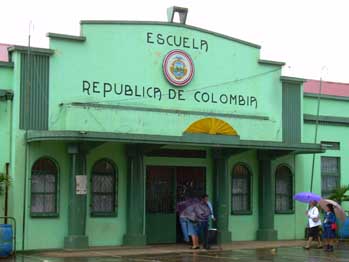 A.M. Costas Rica/Elise Sonray
School in Naranjo where the boy vanishedAlthough the parent's of Vargas live in downtown Alajuela, not Upala,
the children's institution representative believe they are impeding the
investigation and helped organize the capture of their son, said
Medrano. The Fiscalía de Naranjo will investigate the allegations and
hopefully be able to find new evidence, said Medrano. “It's possible
that they will investigate more,” said Medrano who emphasized that was
one of the principal goals in filing the charges.
Young Vargas disappeared from the playground, Escuela República de Colombia in downtown Naranjo. The school's playground is fenced off by high metal bars. The boy's teacher noticed he wasn't in class after the morning recess, said Eladio Torres Mesén, director of the Fuerza Pública in Naranjo at the time. The mother of Vargas had been charged with physical abuse against both of her sons, said Medrano. |
 |
| A.M. Costa Rica fourth news page |
|||||||||
| Home |
Tourism |
Calendar |
Classifieds |
Entertainment |
Real
estate |
Rentals |
Sports |
About us |
|
|
|
|||||||||
|
Cocoa growers betting on creation of new, resistant trees
|
|
|
By the A.M. Costa Rica wire services
Climate change and diseases are ravaging cocoa bean crops in many parts of the world, eroding production and raising prices of the essential ingredient used to make chocolate. A U.S.-based candy company is teaming up with agricultural researchers to fight the threat. In the mid-1980s, Brazil was the world's third-largest grower of cocoa beans. That was before the emergence of two strains of fungus that attacked and decimated the country's cacao trees from which cocoa beans are harvested. Today, Brazil is a net importer of cocoa beans, and most of the world's remaining production is centered in African countries like Ivory Coast and Asian nations like Indonesia. Today, drought threatens cocoa bean production in West 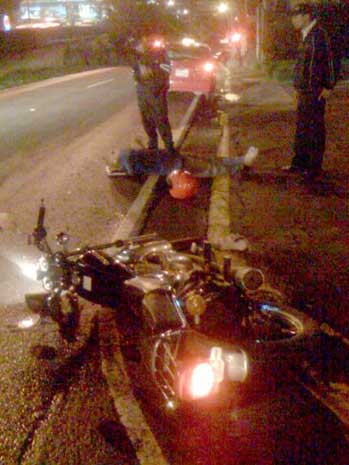 A.M. Costa Rica/Manuel Antonio Ramírez Corrales
Motorcyclist Gustavo Miller, 30, lies in the highway in San
Pedro after he was knocked down by a hit-and-run vehicle Friday
evening. He went to Hospital Calderón Guardia. |
Africa. And even
though the fungus strains that wiped out Brazil's cacao plantations
have yet to migrate beyond the Americas, researchers believe it is only
a matter of time before they do so. Raymond Schnell is a geneticist for the U.S. Department of Agriculture, working from the agency's subtropical horticulture research facility in Miami, Florida. "The two diseases do not exist in Africa or Asia. And Africa and Asia are the main production areas at this time, not Central and South America anymore. So if the diseases were to move, as diseases tend to do, it would cause major problems in these production areas, because all the material [cocoa beans] being grown in Africa and Asia now is susceptible to these two diseases," explains Schnell. The solution? Develop cacao trees that are resistant to fungus and that can better withstand drought and other adverse climate conditions. For nearly 10 years, U.S.-based candy giant Mars has helped fund Department of Agriculture projects to probe cacao's genetic code. Schnell says sufficient progress has been made to take the project to the next level: the sequencing and analysis of the plant's entire genome. "What we have now are markers that we can use to help us select for these disease-resistance traits. But in order to move the program forward, what we really need to do is have all the sequence information. And Mars has agreed to fund that project, where we are going to sequence the cacao genome," said Schnell. Field trials are under way in South America, West Africa, Central America and Papua New Guinea to evaluate potential disease-resistant cocoa trees. Several of these tree selections were based upon disease-tolerance genes discovered in Miami. Mars is contributing $10 million to the project, which is expected to take several years to complete. The resulting genetic data will then be studied for patterns that suggest disease resistant traits that can be employed in cacao breeding programs. Mars officials are quoted as saying they intend to play an active role that "takes charge of the future" of cocoa bean production, rather than leaving matters to chance. For nations that depend heavily on cocoa crops, as well as chocolate manufacturers and chocolate lovers across the globe, the stakes are high. |
 |
|
| News from
the BBC up to the minute |
BBC sports news up to the minute |
| BBC news and sports feeds are disabled on archived pages. |
|
| A.M. Costa Rica fifth news page |
Are
you
still
spending 70 percent You need to fill this space ASAP! |
||||||||
| Home |
Tourism |
Calendar |
Classifieds |
Entertainment |
Real
estate |
Rentals |
Sports |
About us |
|
|
|
|||||||||
 |
 |
|
Wyoming teen admits scamming with peer groups Special to A.M. Costa Rica
In the first case of its kind in the United States, a Wyoming man has been charged with using modified peer-to-peer software to infect computers and create “botnets” –— armies of compromised computers numbering from 5,000 to 15,000 machines — that he exploited to obtain credit card and banking information. In documents filed Thursday in U. S. District Court in Los Angeles, the man, Jason Michael Milmont, 19, of Cheyenne, Wyoming, agreed to plead guilty to a federal felony charge of unauthorized access to a computer to further a fraud. The case against Milmont relates to his development of the Nugache Worm, which he developed to infect computers running the Windows operating system. This is the first time a person has been prosecuted for using peer-to-peer software as a delivery mechanism for malicious computer code, said federal officials. The criminal information and plea agreement outline how Milmont developed malicious computer code — commonly called malware — and distributed that code to vulnerable computers. Milmont modified Limewire peer-to-peer software to work as trojan software that carried a hidden payload and then posted his modified version of Limewire on the Internet for victims to download. Milmont also used instant messaging spam to surreptitiously download infected files to victims’ computers, said federal officials. After victims downloaded the software, Milmont gained control of their computers, allowing him to obtain credit card and banking information from the compromised computers. He also used the compromised computers to carry out an Internet attack on an online business in Southern California. Because the users of those compromised computers were unaware that their computers had been turned into zombies, they continued to use their computers to engage in online banking and purchases, said officials. Milmont has agreed to appear in federal court in Cheyenne to be arraigned in the case in the coming weeks. He will be allowed to enter his guilty plea before a district court judge in Cheyenne, even though the case was filed in Los Angeles. Special exhibition marks museum's 30th birthday
By the A.M. Costa Rica staff
The Museo de Arte Costarricense will celebrate its 30th anniversary with a new exhibit opening Wednesday at 7 p.m. The “30 Years Collection” exhibit will take participants on a walk through the historical and cultural contexts of the museum's collected works over the years, guided tours and artist information will also be on available, according to a museum release. The museum opened on May 3, 1978, and has since collected over 6,000 works of art featured locally or in exhibitions overseas. About 194 works will be on display the release said. The exhibit will remain open from July 3 to the end of 2008, and regular admission fees apply. |
| A.M. Costa Rica Sports news local and from the wires |
 |
|
|
|
|
|
|
|
|
|
|
||||||
|
||||||||
|
|
|
|
|
|
|
|
| What we published this week: | Monday | Tuesday | Wednesday | Thursday | Friday | Earlier |
|
|