|
 |
Costa Rica Your daily |
 |
|
|
|
|
||||||||||||||||||||||||||||
 |
|||||||||||||||||||||||||||||
|
|
||||||||||||||||||||||||||||
 |
|
|
|
|
|
|
|
|
| What we published this week: | Monday | Tuesday | Wednesday | Thursday | Friday | Earlier |
|
|
 |
| A.M. Costa Rica Second newspage |
 |
||||||||
| Home |
Tourism |
Calendar |
Classifieds |
Entertainment |
Real
estate |
Rentals |
Sports |
About
us |
|
| San José, Costa Rica, Tuesday, June 29, 2010, Vol. 10, No. 126 | |||||||||
 |
| Costa Rica Expertise Ltd http://crexpertise.com E-mail info@crexpertise.com Tel:506-256-8585 Fax:506-256-7575 |
 |
 Click HERE for
great
hotel discounts
|
|
Newspaper archives
stay
the way they were written By Jay Brodell
editor of A.M. Costa Rica This newspaper has a policy of not making changes in archived pages. Early each morning the previous day's edition is condensed into one long page and filed on the company's Web server. A listing of back editions and a search engine are HERE. For readers this means they can count on the fact that the page they see in the archives is the same material that was published originally. Recently someone suggested that the newspaper could increase its revenue by placing ads served by Google on the archived pages. In fact, what few ads the newspaper runs from Google.com are deleted on archived pages, and the company declined to place new advertising that did not exist in the original edition. Recently the company was exonerated in a lengthy criminal law case by a businessman who wanted mention of a police raid on his offices deleted from the newspaper archives. The company declined to do this although the financial cost was high. Monday a reader contacted the newspaper and said that he wanted a letter he wrote in 2002 deleted from the archives. The letter was in praise of Luis Enrique Villalobos, whose operation has been adjudged to be a ponzie scheme by the courts here. The reader said he was being pestered by people who found his name and letter by searching the Web. A.M. Costa Rica told the man that editors and writers here run the risk of making fools of themselves every day, but what is written will not be changed without an order by a U.S. federal court. The Web server is in the United States. So as much as we sympathize with people who may want to take back their words, there is something Stalinistic in making news stories more politically correct or socially correct after the fact. George Orwell addressed the issue in his chilling novel "1984." Trouble-plagued route will be closed again By the A.M. Costa Rica staff
The transport ministry will be closing the vital Ruta 31 today and Thursday from 6:30 a.m. to 12:30 p.m. The complete closing of the highway is to allow experts evaluate the possibility of more slides there. This is the trouble-plagued highway between San José and Limón where the hillside is giving way and blocking the lanes. The Ministerio de Obras Públicas y Transporte has been trying to work around the rains and more slides in trying to get the evaluation done. The most sensitive spots are in the Parque Nacional Barulio Carrillo some 24 kilometers north of San José. The ministry has brought in experts from Spain to do the evaluation. $9 billion in new investments sought by administration By the A.M. Costa Rica staff
The Chinchilla administration wants to attract $9 billion in new foreign investment to the country over the next four years. But the goal is conditional on improving the infrastructure of the ports, airfields, highways and telecommunication. In addition, the administration is counting on approval of the free trade treaty with China and Singapore as well as approval of the trade agreement with the European Union. President Laura Chinchilla, Vice President Luis Liberman and Anabel González, minister of Comercio Exterior, met Monday to outline the goals of the administration. The goals also are conditional on recovery from the world economic crisis. Liberman also said that the country expected to boost exports to $17 billion over the course of the four years. Some $12 billion will be exportation of merchandise, and $5 billion will be services exported, the officials said. About 39 percent of the anticipated direct investment will be in the telecom area with some 12 percent in the financial sector, the officials said. Our reader's opinion
Revolt was against Francenot the true Spanish king Dear A.M. Costa Rica: Did the colonies revolt against Spain? Regarding yesterday’s article about the 200th anniversary of the West Florida Revolt in 1810: There is a common misconception that the colonies in the Americas revolted against the King of Spain in 1810. Not really. The revolution wasn’t against Spain, it was against France! You see, in 1810, the king of Spain just happened to be Joseph Bonaparte (Napoleon’s brother). Joseph had been appointed king after French troops occupied Spain. The legitimate Spanish King Ferdinand and his family were sent to prison in France. Spanish colonies in the new world simply refused to recognize orders from the hated French puppet government. They got away with it because Napoleon’s army was under attack by British troops as well as Spanish and Portuguese resistance fighters. Napoleon just couldn’t spare troops to put down rebellions throughout Latin America. A few years later, the Duke of Wellington finally defeated Napoleon. He drove the French out of Spain and restored the Spanish royal family to the throne. However, by this time, idea of independence in the colonies seemed like a really good idea! San Martín, Bolívar, and others -- having observed the economic and democratic success of the American revolutionaries – encouraged the colonies to continue the movement toward independence. Spain was too weak by this time to do much about it. John Howells
Nosara
|
|||||||||||||||||||||||||||||||||||||||||||||||||
 |
||||||||||||||||||||||||||||||||||||||||||||||||||
| Home |
Tourism |
Place
classified ad |
Classifieds |
Entertainment |
Real
estate |
Rentals |
Sports |
About
us |
|
| What we published this week: | Monday | Tuesday | Wednesday | Thursday | Friday | Earlier |
| The contents of this page and this Web site are copyrighted by Consultantes Río Colorado 2001, 2002, 2003, 2004, 2005, 2006, 2007 and 2008 and may not be reproduced anywhere without permission. Abstracts and fair use are permitted. Check HERE for details | ||||||
 |
| A.M. Costa Rica third newspage |
 |
||||||||
| Home |
Tourism |
Calendar |
Classifieds |
Entertainment |
Real
estate |
Rentals |
Sports |
About
us |
|
| San José, Costa Rica, Tuesday, June 29, 2010, Vol. 10, No. 126 | |||||||||
 |
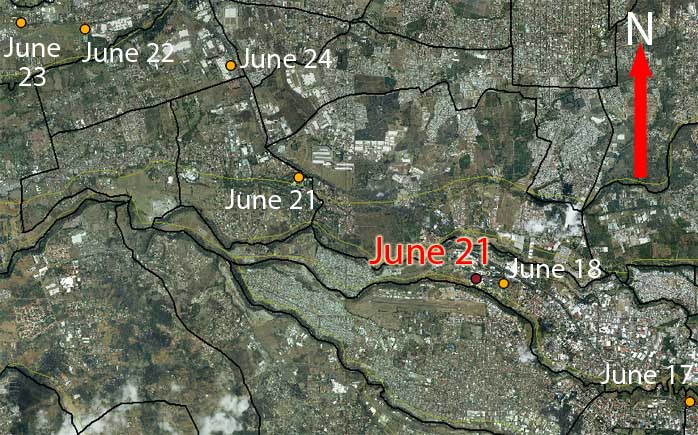 Judicial investigators created this
map of rapes and a murder along the Autopista General Cañas
|
|
| Serial rapist appears to have worked his way east to west |
|
|
By the A.M. Costa Rica staff
The man who committed a string of rapes and a murder appears to have begun his reign of terror June 17 when a woman was accosted and abused sexually in Sabana Norte in a bus stop not far from the Más x Menos supermarket there. The next day a student walking on her way to English classes became a victim but managed to get away from her attacker. That assault took place only a kilometer west of the first attack. June 20, a Sunday, a woman on her way to work a short distance away became a murder victim when a rapist killed her with a knife. Her body was found the next day. On that |
same day a women
reported an attempted rape a little more than a kilometer from the
murder scene. The following day, June 22, a Tuesday, a woman reported
an attempted
rape. Rapes followed the next two days. All the crimes took place along the Autopista General Cañas, and investigators said that the rapist appeared to wait for his victims at sheltered bus stops along the highway. He would pull a knife and demand that the lone woman follow him into the underbrush. Meanwhile, investigators, with the help of some of the victims were working on a sketch. Investigators found the principal suspect in the case sitting at a bus stop Saturday in the la Uruca section highway. |
| Stiff increases are planned for U.S. consular services |
|||||||||||||||||||||
|
By the A.M. Costa Rica staff
Getting a document notarized at the U.S. consulate in Pavas will cost $50 starting July 13, a 66 percent increase over the current $30 fee. That is one of the major increases that the U.S. State Department has published in the Federal Register. Also going up are fees for passports, visa applications and other consular services "The 27 adjusted fees are based on a cost of service study completed by the Bureau of Consular Affairs in June 2009," the State Department said. "The study, which was the most detailed and exhaustive ever conducted by the Department of State, established the true cost of providing these consular services, which by law must be recovered through collection of fees." The revised fees will cover actual operating expenses for the 301 overseas consular posts, 23 domestic passport agencies and other centers that provide these consular services to U.S. and foreign citizens, the State Department added. Based on information published on the State Department Web site adult passports for U.S. citizens go from $75 to $110. a child's passport goes from $60 to $80, and the State Department also is assessing an extra $25 fee on both adult and passports for children. Anyone who does not like the new fees and wishes to renounce U.S. citizenship will find that there is a new charge of $450 to do so. The declaration used to be free. Some of the increases are in the triple digits. Scheduling and arranging a deposition in a legal case used to cost |
$475. On July 13, the fee will be $1,283. The cost of processing letters rogatory under the Foreign Sovereign Immunities Act jumps from $735 to $2,275. Letters rogatory are requests from a court for some kind of judicial assistance by a foreign government. Consular reports of births abroad go from $65 to $100. Non-immigrant visas for non-U.S. citizens show a $9 increase to $140 in the most common categories. However, one class of visa application goes from $131 to $390. Of course this is just the application. There is no guarantee that a visa will be issued. Notary services are important for those selling property elsewhere because services by U.S. notaries are only legal in the state in which they have been appointed. Still, by U.S. standards, the new consular fee is high. New York established a $2 fee for notaries, but there are additional fees allowed if the notary has to travel to the location where a document is to be signed. Maximum fees in California range from between $10 and $30, depending on the services. For simply validating someone's signature the charge is $10. Other states set maximum charges as low as $1. Many U.S. banks will notarize the signature of a customer for free. |
||||||||||||||||||||
| You need to see Costa Rican tourism information HERE! |
| Home |
Tourism |
Place
classified ad |
Classifieds |
Entertainment |
Real
estate |
Rentals |
Sports |
About
us |
|
| What we published this week: | Monday | Tuesday | Wednesday | Thursday | Friday | Earlier |
| The contents of this page and this Web site are copyrighted by Consultantes Río Colorado 2001, 2002, 2003, 2004, 2005, 2006, 2007 and 2008 and may not be reproduced anywhere without permission. Abstracts and fair use are permitted. Check HERE for details | ||||||
| A.M. Costa Rica fourth news page |
|
||||||||
| Home |
Tourism |
Calendar |
Classifieds |
Entertainment |
Real
estate |
Rentals |
Sports |
About
us |
|
| San José, Costa Rica, Tuesday, June 29, 2010, Vol. 10, No. 126 | |||||||||
| International HIV/AIDS group calls for
changes in drug war |
||
|
By the A.M. Costa Rica wire services
The fight against HIV/AIDS may have a better chance of success if the war against drugs were waged differently. That’s according to an official document released Monday, prior to next month’s 18th International AIDS Conference in Vienna. The Vienna Declaration calls for a scientific approach to illicit drug use and questions the effectiveness of the criminalization of injection drug users. The document, written by medical and academic professionals, does not criticize law enforcement personnel, but rather the policies they carry out. It says those policies are helping to spread HIV/AIDS. Dr. Evan Wood is chair of the Vienna Declaration Writing Committee and director of the Urban Health Research Initiative at the British Columbia Center for Excellence in HIV/AIDS in Vancouver, Canada. “The Vienna Declaration is basically a scientific statement from the scientific community about the harms of illegal drugs in our society, and drawing important attention to the fact that many of the policies, which are in place around the world – this notion of sort of a war on drugs and this over emphasis on law enforcement does more harm than good,” he says. Locking up drug users is a failed strategy, says the declaration. “The war on drugs has failed to achieve its stated objectives in terms of reducing drug supply or use. And on the contrary, if you look at all the international surveillance systems, the prices of drugs continue to go down; and the purity of drugs continues to go up. And that’s despite ever increasing numbers of individuals that we’re locking up.” says Wood. What’s more, he says, incarcerating all those arrested on drug use charges is “hemorrhaging taxpayers’ dollars.” He says the economic of principle of supply and demand keeps the drug trade alive. “Even conservative economists like Milton Friedman, who won the Nobel Prize, have long known that this sort of war on drugs approach would not be successful,” he says, adding, “Economists will tell you that no market has ever been controlled by the supply side. And any time that law enforcement has any success at taking out a drug dealer…that has the perverse effect of making it that much more profitable for someone else to get into the market.” Wood says the Vienna Declaration does not criticize law enforcement officers who “risk their lives” to protect communities. But, he says, “The reality of the situation is that trying to control the drug problem through law enforcement does not work and of course it has a number of unintended consequences.” The criminalization of illicit drug users is fueling the HIV epidemic and has resulted in overwhelmingly negative health and social consequences, the declaration said. A full policy reorientation is needed, it added. “We know that illegal drugs are more available to young people today than even alcohol or tobacco. So the starting point for the whole discussion, in terms of an evidence-based, sort of science based discussion about the drug problem and drug policies, needs to be really that things could not get any worse in terms of trying to limit drug supply to young people,” says Wood. |
The declaration
says that outside of sub-Saharan Africa, injection drug
use accounts for approximately one in three new cases of HIV. In
some
areas where HIV is spreading rapidly, such as Eastern Europe and
central Asia, HIV prevalence can be as high as 70 percent among people
who inject drugs, and in some areas more than 80 percent of all HIV
cases are among this group. “We know that around the world the HIV rates among drug users are highest in countries that place the greatest emphasis on law enforcement,” he says, “First of all, those countries tend to not to employ public health approaches to try and prevent the spread of HIV . . . and there’s also the problem with the fact that when you’re chasing drug users around they tend to end up in abandoned buildings or under viaducts or other hidden environments.” As a result, it’s difficult for them to have access to treatment and prevention programs, he said. What’s more, risky behavior is more common in such environments, he added. Wood also says drugs are the source of much violence, whether in communities or in Mexico, where the government is battling drug cartels just across the U.S. border. Wood says in using “evidence based policy making” you use what works and discard what doesn’t. “But when it comes to illegal drug use, we’re in a situation where policymakers continue with a war on drugs approach, even though we certainly know that it doesn’t work.” He says, for example, that methadone maintenance therapy is the “most effective medication” that we have to treat heroin addiction. In many areas of the world, where HIV is spreading most rapidly among heroin users, the drug is severely limited or in some place like Russia it’s illegal.” About five years ago, Portugal weighed the costs of drug user incarceration and decided to take a very different approach. It decriminalized drugs. “People like myself, I’m a physician, I’m a public health researcher, we all kind of held our breath,” he said. He adds, “What’s quite remarkable is that not only has Portugal reduced its drug problem in terms of health issues, like the spread of HIV and the number of overdose fatalities among drug users, but it actually has the lowest rate of marijuana use in the European Union now.” A Web site has been set up to gather public support for the declaration. Some estimates say in the United States alone so far this year, over $25 billion has been spent by the federal and state governments on illegal drugs. The term “war on drugs” is believed first used by President Nixon. Its goal is to halt the production, distribution and use of illegal narcotics. Earlier this year, the Obama administration announced it would boost resources for prevention and treatment of drug abuse in its 2011 National Drug Control Budget. It’s estimated that as many as 1.5 million people in the U.S. are arrested each year on drug charges, with up to a half million sentenced to prison. Authorities have raised concern that drug traffickers could help fund terrorists. Drug routes usually start in South America and the Caribbean, extend through Africa, and then on to Europe, the U.S. and elsewhere. |
|
| Home |
Tourism |
Place
classified ad |
Classifieds |
Entertainment |
Real
estate |
Rentals |
Sports |
About
us |
|
| What we published this week: | Monday | Tuesday | Wednesday | Thursday | Friday | Earlier |
| The contents of this page and this Web site are copyrighted by Consultantes Río Colorado 2001, 2002, 2003, 2004, 2005, 2006, 2007 and 2008 and may not be reproduced anywhere without permission. Abstracts and fair use are permitted. Check HERE for details | ||||||
| A.M. Costa Rica fifth news page |
|||||||||
| Home |
Tourism |
Calendar |
Classifieds |
Entertainment |
Real
estate |
Rentals |
Sports |
About
us |
|
|
|
|||||||||
 |
| iPhone getting good reviews in countries where it is sold By the A.M. Costa Rica wire services
After much anticipation, people are lining up at stores around the world to purchase the latest smartphone by Apple. The iPhone 4 is now available in the United States, Britain, France, Germany and Japan. In the United States, Britain and Japan, Apple's iPhone has reached celebrity status. Customers lined up for hours for Apple's newest phone, the iPhone 4. Alex Lee lives in Dubai, but traveled to London for his phone. "The reason why we want to come to this one is because we really want this phone," he said. The iPhone 4 is faster, thinner, has a longer battery life, and it features video calling. Apple is not the only company that makes so-called smartphones that allow users to access the Internet. But loyal customers say its simplicity makes the iPhone stand out. "The user friendliness on the IPhone is unbelievable. It's like even a layman can use it," said one man. By the end of July, Apple says the iPhone 4 will be available in 18 additional countries. By the end of September, in 88 countries worldwide. But technology expert Rob Atkinson says smartphones will most likely not be widely used in many developing nations because of their cost, and the cost of connected on-line data plans. "So I don't think we're going to see a lot of deployment in a region or continent like Africa. You might see some among the smaller groups of higher income users there but what I do think you will see is growth in countries in places like Latin America," he said. Atkinson says countries with a growing middle class will embrace smartphones much faster. "In developing countries, that's going to be a longer process where you'll have perhaps business people, farmers, small business people, professionals who will be the first adopters - the doctors, government officials - and then it will slowly as you get more apps slowly permeate out probably," he said. Atkinson says Apple's iPhone faces growing competition from other companies, such as Google, that make their own smartphones. With competition, experts expect prices to drop, making smartphones much more accessible to consumers around the world.
|
|
 |
| Home |
Tourism |
Place
classified ad |
Classifieds |
Entertainment |
Real
estate |
Rentals |
Sports |
About
us |
|
| What we published this week: | Monday | Tuesday | Wednesday | Thursday | Friday | Earlier |
| The contents of this page and this Web site are copyrighted by Consultantes Río Colorado 2001, 2002, 2003, 2004, 2005, 2006, 2007 and 2008 and may not be reproduced anywhere without permission. Abstracts and fair use are permitted. Check HERE for details | ||||||
| A.M. Costa
Rica sixth news page |
|||||||||
| Home |
Tourism |
Calendar |
Classifieds |
Entertainment |
Real estate |
Rentals |
Sports |
About us |
|
|
|
|||||||||
Latin American news Please reload page if feed does not appear promptly |
authors from foreign libel By the Reporters Committee for Freedom of
the Press
Two members of the U.S. Senate Judiciary Committee on Tuesday introduced bipartisan legislation aimed at protecting authors and journalists from libel lawsuits filed abroad. The SPEECH -- Securing the Protection of our Enduring and Established Constitutional Heritage -- Act, sponsored by Sens. Patrick Leahy, a Vermont Democrat, and Jeff Sessions, an Alabama Republican, would invalidate libel judgments levied against Americans elsewhere that could not have been obtained in the United States due to First Amendment protections. It does not go as far as other libel tourism bills under consideration in Congress that would allow libel defendants to counter-sue the plaintiffs who bring such claims against them in foreign courts, which makes the bill less controversial and possibly more appealing to members of Congress. The proposed legislation, which was modeled on a law in New York State that was inspired by an author who faced a libel tourism suit over a book on terrorism financing, states that foreign defamation judgments cannot be enforced in the United States if they are inconsistent with American law. It also allows individuals to clear their name by obtaining a declaratory judgment in a United States court. "Journalists writing about issues of national security and safety should not be chilled,” Leahy said in a statement. “These lawsuits are designed to stifle the dissemination of that information in both the United States and the world. Journalists willing to investigate and write about such important issues deserve protection." Brazil meets Dutch Friday By the AM. Costa Rica wire services
Brazil beat South American rival Chile on Monday night, 3-0, to advance to the quarterfinals of the World Cup football tournament in South Africa. It's been a decade of dominance by the Brazilians over the Chileans. Before a crowd of more than 54,000 people, Brazil recorded its eighth consecutive victory over Chile, a winning streak spanning 10 years. Brazil will next play the Netherlands on Friday in Port Elizabeth. The Dutch are through to the quarterfinals after a 2-1 victory over Slovakia earlier Monday in Durban. The field for the World Cup quarterfinals will be complete by the end of Tuesday's matches. In the day's first game, Paraguay will play Japan in Pretoria. That will be followed by a match between Spain and Portugal in Cape Town. |
Latin American news feeds are disabled on
archived pages.
|
|
| Home |
Tourism |
Place
classified ad |
Classifieds |
Entertainment |
Real
estate |
Rentals |
Sports |
About
us |
|
| What we published this week: | Monday | Tuesday | Wednesday | Thursday | Friday | Earlier |
| The contents of this page and this Web site are copyrighted by Consultantes Río Colorado 2001, 2002, 2003, 2004, 2005, 2006, 2007 and 2008 and may not be reproduced anywhere without permission. Abstracts and fair use are permitted. Check HERE for details | ||||||