|
|
|
Your daily |
 |
|
|
|
|
||||||||||||||||
|
|
||||||||||||||||
|
|
|
|
|
|
|
|
| What we published this week: | Monday | Tuesday | Wednesday | Thursday | Friday | Earlier |
|
|
 |
| A.M. Costa Rica Second newspage |
 |
||||||||
| Home |
Tourism |
Calendar |
Classifieds |
Entertainment |
Real
estate |
Rentals |
Sports |
About us |
|
|
|
|||||||||
 |
| Costa Rica Expertise Ltd http://crexpertise.com E-mail info@crexpertise.com Tel:506-256-8585 Fax:506-256-7575 |
 |

Click HERE for
great
hotel discounts
|
|
reflected those pet peeves Dear A.M. Costa Rica: Your article on the Instituto Costarricense de Turismo was excellent and reflected all my pet peeves with ICT. We have operated a bed and breakfast since 1994 and so have had thousands of tourists pass through our doors. Very few of our guests have personally experienced crime while visiting Costa Rica. Neither have we. In fact, we have many return visitors who love this country and eventually move here. Of course crime exists as it does in many other countries. The fundamental problem is the false image ICT and the government broadcast to the rest of the world that Costa Rica is "paradise" and unspoiled. So unsuspecting tourists arrive, let down their guard thinking they are in "paradise" where nothing bad happens. How many times is it the fault of the tourist who is lulled into a false sense of security and is, therefore, less vigilant? That fact is rarely reported in the media. Those unhappy tourists then return to their home countries and tell everyone they meet about their dreadful experience in Costa Rica. No amount of advertising by ICT can beat "word of mouth"! Over the years, we have been frustrated by ICT's exaggerated and inaccurate reporting of the number of tourists visiting this country. Your article did an excellent job of pointing out this fact. I think it's the first time any of the media has ever clearly questioned the statistics. Another source of annoyance is the massive publicity given to the same old tourist destinations (e.g. the beaches, Guanacaste, Arenal, Manuel Antonio, Monteverde etc.) to the exclusion of less well-known, unspoiled, truly Costa Rican places. Of course, that leads to my next peeve — the endless publicity for luxury resorts and large impersonal hotels but relatively little promotion for small hotels and inns. How many times have our visitors come back from visiting the aforementioned places and complained of the commercialism, over-development and too many foreigners? Tourists from the U.S.A. say "we didn't come to Costa Rica to meet a lot of other people from our country!" Generally, owners of small hotels and inns spend time with their guests giving them an insight into real Costa Rican life. Fundamentally, neither ICT nor the government seems to understand their potential markets and what the average tourist to Costa Rica wants? Do they have trained, professional public relations personnel on their staff or are they amateur politicians with no business experience? Judging by the poor results of ICT advertising abroad, it seems likely the latter is the case. We are lucky we chose to live in a rural village in the western Central Valley close to Grecia. Our neighbours are Ticos who still live their traditional way of life. We are surrounded by an abundance of trees, flora and fauna and work hard to preserve, enhance and sustain our environment. We recycle, reuse, compost, use solar energy and organic products, hire local workers and support the community in other ways. Is this what ICT means by "Costa Rica — No Artificial Ingredients?" If so, this image is fast disappearing and now is the time to live up to it before it is too late. Tessa Borner
Posada Mimosa Grecia Where were other media in Herradura attack case? Dear A.M. Costa Rica: I read your lead story "Land theft cases add stress to some expats' lifestyle" with great interest. I had heard a rumor of an attack on a property owner in Herradura where I have an interest. I looked and searched the Costa Rican press everywhere for any report. Absolutely nothing. An attack by 30 or so intruders onto private property merits no news whatsoever? We must ask ourselves what or why is there a blackout on such an phenomenon in the mainstream press. Is it so mundane that it is a non event? Such non-coverage is shocking. Costa Rica is a wonderful country with gentle kind people so what is happening? Is there something going on that we are not supposed to know about? Such attacks are not random and are organized by murky, shadowy manipulators who often as not are "legitimate businessman" taking advantage of antiquated land laws for their own profit. I spoke to some friends who told me they just canceled their trip to look for a property. They said that such activity was a precursor to a breakdown of society and they preferred to invest elsewhere where the rule of law prevails and is not manipulated. Look at what has happened to Mexico and Guatemala. They are now headed for Panamá. Your reporting is a wake up call. I commend you for breaking this story, it's time that we stop being frightened and assert our rights be we Ticos or visitors. We owe you a debt of gratitude for your objective and newsworthy reportage. Thank goodness that there is one news organ that tells us what really is going on. As they say down under: "Good on you, mate!" Patricia Henderson
England, Florida and Costa Rica EDITOR'S NOTE: News gathering is not a precise science. We sense an effort by police administrators to diminish distribution of all bad news. In addition, the Spanish-language press has reduced editorial staffs for financial reasons. A.M. Costa Rica gives a very high priority to attacks against expats or their properties.
|
|||||||||||||||||||||||||||||||||||||
| Home |
Tourism |
Place
classified ad |
Classifieds |
Entertainment |
Real estate |
Rentals |
Sports |
About us |
|
| What we published this week: | Monday | Tuesday | Wednesday | Thursday | Friday | Earlier |
| The contents of this page and this Web site are copyrighted by Consultantes Río Colorado 2001, 2002, 2003, 2004, 2005, 2006, 2007 and 2008 and may not be reproduced anywhere without permission. Abstracts and fair use are permitted. Check HERE for details | ||||||
 |
| A.M. Costa Rica third newspage |
 |
||||||||
| Home |
Tourism |
Calendar |
Classifieds |
Entertainment |
Real
estate |
Rentals |
Sports |
About us |
|
|
|
|||||||||
 |
 |
 |
|
||||
|
Constitution court issues
broad order on pineapple pollution
|
|
|
By the A.M. Costa Rica staff
The Sala IV constitutional court has ordered an inter-institutional response to agricultural chemical pollution in the canton of Siquirres. The court ordered three government agencies to join together to eliminate the pollution and invested the health minister, María Luisa Ávila Agüero, with broad powers to shut down the Del Monte pineapple packing plant and plantation if a solution was not reached or agreed upon. The decision came from two appeals by residents in the communities of El Cairo, Luisiana, La Francia and Milano. In addition to the Ministerio de Salud, the court order names the Ministerio de Ambiente, Energía y Telecomunicaciones and the Instituto Costarricense de Acueductos y Alcantarillados. |
The
Tribunal Ambiental Administrativo, a dependency of the environmental
ministry, already is trying to solve the problem. The Tribunal
closed down the plantation and the packing plant
and then allowed both to reopen with conditions. Del Monte purchased
the property less than a year ago and is trying to build a water
retention system to keep the agricultural chemicals from the ground
water. The court order goes one step further than the actions of the Tribunal in that it orders the ministry to remove the chemicals from the local environment. The court said that the health minister could order the pineapple producer to cease using chemicals. The offending chemicals are mainly insecticides and herbicides. The court said that the chemicals were getting into the ground water and water supplies for the communities. The ruling, released Thursday, said that residents have suffered unspecified injuries. |
| A tale of competing cusines and smoking lifestyles |
|||
| Last
Sunday, on the same TV channel, but different programs, I watched two
segments that were poles apart in their messages. One was about a
café that served, along with french fries cooked in lard, a
four-decker hamburger estimated to have 8,000 calories. The eatery is
fittingly named the Heart Attack Grill. The owner bragged that
there was no lettuce on the burger and all of the cokes had
sugar. The narrator of the segment proudly managed to eat a four-decker, making jokes about blood pressure and his weight gain, and then left the café in a wheelchair. It was supposed to be funny and show defiance to a health food-obsessed world. I had indigestion just watching it. Later that day there was a segment about Alice Waters and her Slow Food campaign. I just recently have heard of this movement although it has been around for a long time. The name, as far as I can guess, is simply to distinguish it from the fast food lifestyle illustrated above. Ms. Waters is stressing eating freshly picked organic food that is locally grown. In other words, going back to the days before pesticides and big agribusinesses and long-distance, refrigerated shipping. People who grew up during that time and survived childhood illnesses are living to be very old – older and healthier than their children will. Simultaneously, the president of the U.S. is trying to get affordable medical coverage for everyone including those with preconditions, like heart problems, diabetes and morbid obesity. For some reason the diners in the Heart Attack Grill reminded me of the time I visited the brain injury section of a hospital in Florida. The ward was filled with young men in wheelchairs with damaged brains and vacant faces resulting from accidents while riding their motorcycles without helmets. I believe this was before helmets were mandatory. They had been free to defy conventional wisdom and statistics. And finally we have the growing debate about whether or not to legalize marijuana, at least for medical use. The discussion seems to settle around “Do sick people use it as a medicine or just to get high?” Claims of deaths, crimes, damage to health, as the result of marijuana use have subsided, either because the research is limited, confusing, or statistics show these are negligible problems. I have to laugh at the fear that maybe a person using pot to alleviate pain may also “get high.” Anyone who has experienced extreme pain and the anxiety that often goes with it, knows that the release from this condition is a natural high. People who argue that the use of marijuana may become addictive obviously dismiss the addictiveness of much researched and prescribed and expensive prescriptions that have some serious side effects. |
Chewing the coca leaf, the natives of mountainous Peru were
able to endure long hours without eating and handle the altitude.
According to historical records and writings, they did not become
addicted. |
||
 |
 |
 |
| You need to see Costa Rican tourism information HERE! |
| Home |
Tourism |
Place
classified ad |
Classifieds |
Entertainment |
Real estate |
Rentals |
Sports |
About us |
|
| What we published this week: | Monday | Tuesday | Wednesday | Thursday | Friday | Earlier |
| The contents of this page and this Web site are copyrighted by Consultantes Río Colorado 2001, 2002, 2003, 2004, 2005, 2006, 2007 and 2008 and may not be reproduced anywhere without permission. Abstracts and fair use are permitted. Check HERE for details | ||||||
| A.M. Costa Rica fourth news page |
 |
||||||||
| Home |
Tourism |
Calendar |
Classifieds |
Entertainment |
Real
estate |
Rentals |
Sports |
About us |
|
|
|
|||||||||
|
Mayans had yuca as a
food staple, too, researchers discover
|
|
|
By the University of Colorado
Office of News Services An anthropology professor and his team have uncovered a manioc field one-third the size of football field buried under 10 feet of ash by the eruption of a volcano about 1,400 years ago that blanketed the Mayan farming village of Ceren in El Salvador. The University of Colorado at Boulder team was expanding on the work of the professor, Payson Sheets, who reported in 2007 that he found evidence of the cultivation. Evidence shows the manioc field — at least one-third the size of a football field — was harvested just days before the eruption of the Loma Caldera volcano near San Salvador in roughly A.D. 600, said Sheets, who is directing excavations at the ancient village of Ceren. The cultivated field of manioc was discovered adjacent to Ceren, which was buried under 17 feet of ash and is considered the best preserved ancient farming village in all of Latin America. Manioc also is called cassava or yuca and is grown commercially today in Costa Rica. The ancient planting beds of the carbohydrate-rich tuber are the first and only evidence of an intensive manioc cultivation system at any New World archaeology site, said Sheets. While two isolated portions of the manioc field were discovered in 2007 following radar work and limited excavation, 18 large test pits -- each measuring about 10 feet by 10 feet -- allowed the archaeologists earlier this year to estimate the size of the field and assess the related agricultural activity that went on there. Sheets said manioc pollen has been found at archaeological sites in Belize, Mexico and Panama, but it is not known whether it was cultivated as a major crop or was just remnants of a few garden plants. "This is the first time we have been able to see how ancient Maya grew and harvested manioc," said Sheets, who discovered Ceren in 1978. Ash hollows in the manioc planting beds at Ceren left by decomposed plant material were cast in dental plaster by the team to preserve their shape and size, said Sheets. Evidence showed the field was harvested and then replanted with manioc stalk cuttings just a few days before the eruption of the volcano. A few anthropologists have suspected that manioc tubers — which can be more than three feet long and as thick as a man's arm — were a dietary salvation for ancient societies living in large cities in tropical Latin America. Corn, beans and squash have long been known to be staples of the ancient Maya, but they are sensitive to drought and require fertile soils, said Sheets. "As high anxiety crops, they received a lot of attention, including major roles in religious and cosmological activities of the Maya," said Sheets. "But manioc, which grows well in poor soils and is highly drought resistant did not. I like to think of manioc like an old Chevy gathering dust in the garage that doesn't get much attention, but it starts right up every time when the need arises." Calculations by Sheets indicate the Ceren planting fields would have produced roughly 10 metric tons of manioc annually for the 100 to 200 villagers believed to have lived there. "The question now is what these people in the village were doing with all that manioc that was harvested all at once," he said. "Even if they were gorging themselves, they could not have consumed that much." The research team also found the shapes and sizes of individual manioc planting ridges and walkways varied widely. "This indicates the individual farmers at Ceren had 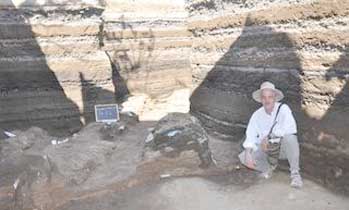 University of Colorado photo
Payson Sheets is seen within one of the excavated structures
at the site |
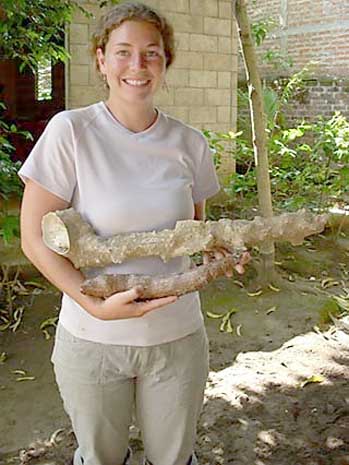 University of Colorado file photo
Graduate student Monica Guerra holds a plaster cast of a
manioc cutting that was placed horizontally in the planting bed by the
ancient farmers just hours before the eruption. She also holds a live
root.control over their families' fields and cultivated them the way they wanted, without an external higher authority telling them what to do and how to do it," Sheets said. The team also found that the manioc fields and adjacent cornfields at Ceren were oriented 30 degrees east of magnetic north — the same orientation as the village buildings and the public town center, said Sheets. "The villagers laid out the agricultural fields and the town structures with the same orientation as the nearby river, showing the importance and reverence the Maya had for water," he said. The volcano at Ceren covered adobe structures, thatched roofs, house beams, woven baskets, sleeping mats, garden tools and grain caches. The height of the corn stalks and other evidence indicate the eruption occurred early on an August evening, he said. Because it is unlikely that the people of Ceren were alone in their intensive cultivation of manioc, Sheets and his colleagues are now investigating chemical and microscopic botanical evidence at other Maya archaeological sites that may be indicators of manioc cultivation and processing. Sheets said Maya villagers living in the region today have a long tradition of cutting manioc roots into small chunks, drying them eight days, then grinding the chunks into a fine, flour-like powder known as almidón. Almidón can be stored almost indefinitely, and traditionally was used by indigenous people in the region for making tamales and tortillas and as a thickening agent for stews, he said. Since indigenous peoples in tropical South America use manioc today to brew alcoholic beverages, including beer, the research team will be testing ceramic vessels recovered from various structures at Ceren for traces of manioc. To date, 12 structures have been excavated, and others detected by ground-penetrating radar remain buried, he said. Sheets is particularly interested in vessels from a religious building at Ceren. The structure contained such items as a deer headdress painted red, blue and white; a large, alligator-shaped painted pot; the bones of butchered deer; and evidence that large quantities of food items like meat, corn, beans and squash were prepared on-site and dispensed to villagers from the structure, said Sheets. Ceren's residents apparently were participating in a spiritual ceremony in the building when the volcano erupted, and did not return to their adobe homes, which excavations showed were void of people and tied shut from the outside. "I think there may have been an emergency evacuation from the ceremonial building when the volcano erupted," he said. To date, no human remains have been found at Ceren. The research team also included University of Costa Rica graduate student George Maloof. |
 |
|
| News from
the BBC up to the minute |
BBC sports news up to the minute |
| BBC news and sports feeds are disabled on archived pages. |
|
| Home |
Tourism |
Place
classified ad |
Classifieds |
Entertainment |
Real estate |
Rentals |
Sports |
About us |
|
| What we published this week: | Monday | Tuesday | Wednesday | Thursday | Friday | Earlier |
| The contents of this page and this Web site are copyrighted by Consultantes Río Colorado 2001, 2002, 2003, 2004, 2005, 2006, 2007 and 2008 and may not be reproduced anywhere without permission. Abstracts and fair use are permitted. Check HERE for details | ||||||
| A.M. Costa Rica fifth news page |
 |
||||||||
| Home |
Tourism |
Calendar |
Classifieds |
Entertainment |
Real
estate |
Rentals |
Sports |
About us |
|
|
|
|||||||||
|
U.N. expert says military
in Colombia kill for profit Special to A.M. Costa Rica
An independent United Nations human rights expert warned Thursday that although guerrilla groups in Colombia commit a significant number of murders, more concerning are the so-called false positive slayings performed by government forces. The killings involve luring innocent victims under false pretences to a remote location, and the murdered bodies are often photographed wearing guerrilla uniforms and holding a gun or grenade to appear as if the individual was legitimately killed in combat. “Victims are often buried anonymously in communal graves, and the killers are rewarded for the results they have achieved in the fight against the guerrillas,” Philip Alston, the U.N. special rapporteur on extrajudicial executions, said in a statement issued at the end of a 10-day fact-finding mission. Alston said that the term false positive provides a “sort of technical aura to describe a practice which is better characterized as cold-blooded, premeditated murder of innocent civilians for profit.” In addition, he said that the focus on the most publicized false positive case last year in Soacha, a suburb of Bogotá, encourages the view that the killings are limited to a geographic area and to a period in time. “But while the Soacha killings were undeniably blatant and obscene, my investigations show that they were but the tip of the iceberg.” Through interviews with witnesses and survivors who described very similar killings in several districts of Colombia, Alston determined that a significant number of military units were involved in killings. The military’s systematic harassment of the survivors is part of a common pattern, said the special rapporteur. “A woman from Soacha described how, in 2008, one of her sons disappeared and was reported killed in combat two days later.” He said that when another of her sons became active in pursuing the case, he received a series of threats and was shot dead earlier this year. Since then, the mother has also received death threats, he said. Alston is encouraged by the steps taken by the government since last year aimed at stopping and addressing the killings, including disciplinary sanctions, better cooperation with the U.N. and other international organizations, more oversight of payments to informers, and requiring deaths in combat to be investigated first by judicial police and modifying award criteria. The expert — who, like all U.N. special rapporteurs, reports to the Geneva-based U.N. Human Rights Council in an unpaid, independent capacity — is expected to recommend a number of reforms, including the removal of all forms of incentives to members of the military for killing, when he presents his report in four or five months time. |
| Home |
Tourism |
Place
classified ad |
Classifieds |
Entertainment |
Real estate |
Rentals |
Sports |
About us |
|
| What we published this week: | Monday | Tuesday | Wednesday | Thursday | Friday | Earlier |
| The contents of this page and this Web site are copyrighted by Consultantes Río Colorado 2001, 2002, 2003, 2004, 2005, 2006, 2007 and 2008 and may not be reproduced anywhere without permission. Abstracts and fair use are permitted. Check HERE for details | ||||||
| A.M. Costa Rica sixth news page |
 |
||||||||
| Home |
Tourism |
Calendar |
Classifieds |
Entertainment |
Real
estate |
Rentals |
Sports |
About us |
|
|
|
|||||||||
| Latin
American news digest |
Suspected spies for Cuba want freedom on bail By the A.M. Costa Rica wire services
An elderly U.S. couple accused of spying for Cuba for nearly 30 years asked a judge Wednesday to release them on bail, under certain conditions. Lawyers for the couple, Walter Kendall Myers, 72 and his wife Gwendolyn, 71, filed a motion in a federal court in Washington, D.C. The attorneys said the Myers' would submit to being placed under house arrest and would pay for an electronic monitoring program. Gwendolyn Myers' son would also ensure someone was with them at all times. The couple have been held without bond since their arrest June 4. They are charged with conspiracy to act as illegal agents of the Cuban government and to communicate classified information to the Communist-led country. They have pleaded innocent to both charges. Walter Myers is a former official at the U.S. State Department. The FBI says from August of 2006 until his retirement in October of 2007, Myers viewed more than 200 sensitive or classified intelligence reports related to Cuba. He and his wife are also accused of meeting with then-Cuban president Fidel Castro in 1995. Castro said he does not recall meeting the couple and that the case against them is ridiculous. A federal magistrate agreed with the FBI's assertions that they pose a flight risk. Agents fear the couple would flee to the Cuba Interests Section, located just minutes from their Washington apartment, to avoid arrest. They also found documents showing the couple planned to go sailing in the Caribbean in November. But attorneys for the couple say they will surrender all travel documents and maps related to sailing in Cuban waters, and stay away from both the Cuba Interests Section in Washington, and their sailboat docked near the port city of Annapolis, Maryland. |
| Latin American news feeds are disabled on archived pages.
|
|
| Home |
Tourism |
Place
classified ad |
Classifieds |
Entertainment |
Real estate |
Rentals |
Sports |
About us |
|
| What we published this week: | Monday | Tuesday | Wednesday | Thursday | Friday | Earlier |
| The contents of this page and this Web site are copyrighted by Consultantes Río Colorado 2001, 2002, 2003, 2004, 2005, 2006, 2007 and 2008 and may not be reproduced anywhere without permission. Abstracts and fair use are permitted. Check HERE for details | ||||||