|
 |
Costa Rica Your daily |
 |
|
|
|
|
||||||||||||||||||||||||||||||
 |
|||||||||||||||||||||||||||||||
|
|
||||||||||||||||||||||||||||||
 |
|
|
|
|
|
|
|
|
| What we published this week: | Monday | Tuesday | Wednesday | Thursday | Friday | Earlier |
|
|
 |
| A.M. Costa Rica Second newspage |
 |
||||||||
| Home |
Tourism |
Calendar |
Classifieds |
Entertainment |
Real
estate |
Rentals |
Sports |
About
us |
|
| San José, Costa Rica, Wednesday, June 16, 2010, Vol. 10, No. 117 | |||||||||
 |
| Costa Rica Expertise Ltd http://crexpertise.com E-mail info@crexpertise.com Tel:506-256-8585 Fax:506-256-7575 |
 |
 Click HERE for
great
hotel discounts
|
|
 Comité de
Campaña Evo Premio Nobel de la Paz 2010
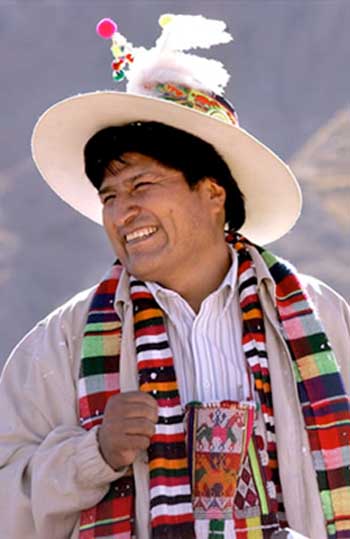
Evo Morales with a dove on his head
Campaign for Evo Morales
has eyes on Nobel Prize By the A.M. Costa Rica staff
Barack Obama got one without even raising a sweat. Now Evo Morales has been nominated for the 2010 Nobel Peace Prize. He's the president of Bolivia, and part of the justification for the award, according to supporters, is that he fought to dignify the original peoples of Bolivia, America and the world. He also defends nature and respects cultural diversity, they said. This is not the first time that Morales has been put forward for the prize. Supporters nominated him last year, too. This is part of a trend to make public the campaign that supporters launch for their Peace Prize favorites. Supporters, including Argentine social activist Adolfo Pérez Esquivel, are urging an e-mail campaign to the Nobel Prize committee. Pérez Esquivel, himself a 1980 Nobel winner, wrote a letter that is posted on an Argentine Web site promoting Morales. The campaign committee already has sent out 15 bulletins this year promoting their choice. Considering the uncertain qualifications employed by the Norwegian politicians who choose the Peace Prize recipient, Morales just might make it. Al Gore did for his controversial climate change film. The Nobel Peace Prize committee has tight rules
on who can make a formal nomination. Pérez Esquivel can because
he is a former winner. Other so-called qualified nominators are members
of national legislatures, international court judges, certain
university professors and individuals associated with the Nobel
Committee and board members of organizations that have been awarded the
prize.
Pérez Esquivel said that the nomination of Morales went to the Nobel committee Jan. 6. But he provides a draft of a letter of support anyone can copy and send. Costa Rica's Óscar Arias Sánchez received the Peace Prize in 1987 for his role in ending the Central American wars. That honor certainly added stature to the former president and the nation. This year's winner will be announced in October. Last year there were more than 200 nominations. The committee notes that Mahatma Gandhi was nominated four times and never won the prize because of his assassination in 1948. Prizes are not awarded posthumously. Joseph Stalin, Adolf Hitler and Benito Mussolini were nominated, the committee said. Winston Churchill was nominated for the Peace Prize but did not make the cut. He won the 1953 Nobel Prize for Literature instead, the committee noted. Other non-winners of the Peace Prize include Leo Tolstoy, the Russian literary giant, Pablo Casals, the Spanish musician, and Juan and Eva Perón.
|
||||||||||||||||||||||||||||||||||||||||||||||||||||||||
 |
|||||||||||||||||||||||||||||||||||||||||||||||||||||||||
| Home |
Tourism |
Place
classified ad |
Classifieds |
Entertainment |
Real
estate |
Rentals |
Sports |
About
us |
|
| What we published this week: | Monday | Tuesday | Wednesday | Thursday | Friday | Earlier |
| The contents of this page and this Web site are copyrighted by Consultantes Río Colorado 2001, 2002, 2003, 2004, 2005, 2006, 2007 and 2008 and may not be reproduced anywhere without permission. Abstracts and fair use are permitted. Check HERE for details | ||||||
 |
| A.M. Costa Rica third newspage |
|||||||||
| Home |
Tourism |
Calendar |
Classifieds |
Entertainment |
Real
estate |
Rentals |
Sports |
About
us |
|
| San José, Costa Rica, Wednesday, June 16, 2010, Vol. 10, No. 117 | |||||||||
 |
 |
 A.M. Costa Rica/Manuel
Avendaño Arce
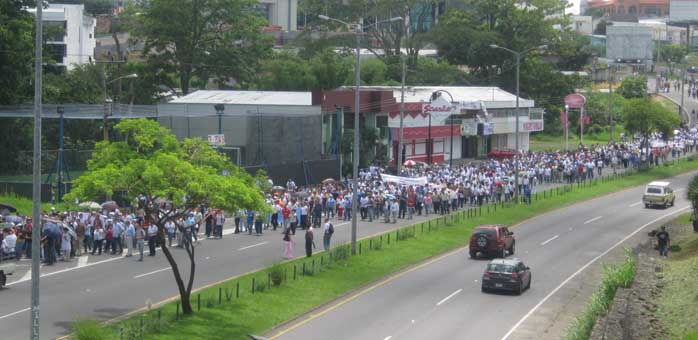
Marchers forced motorists to find another route. |
|
| U.S. students among those seeking bigger university budgets |
|
|
By Manuel Avendaño Arce.
of the A.M. Costa Rica staff American university students joined the march Tuesday as perhaps 2,500 persons demonstrated for more money for public higher education. At least 14 U.S. citizens were in the line of march from the Universidad de Costa Rica to Casa Presidencial. Mary Jane Doodgley is one. She is an anthropology student from Rhode Island and is studying at the university. She said that the government should give more money to the universities so they can develop research and technology, two areas in which the country scores low in a report by the World Economic Forum. Bob Scott said he was from South Carolina and is here for six months studying theater and Spanish at the university. "Costa Rica is a beautiful country," he said, "but apart from this it has a good quality of education, which can decline if the universities do not have money." Yamileth González, rector of the Universidad de Costa Rica, later told a reporter that 34 percent of the students there are foreigners and that the university needs more money to improve the quality of education and get even more foreign students. Foreign students pay more unless |
they are permanent residents and
have completed three years in secondary school here. The marchers left the San Pedro university grounds in the company of two more rectors: Sandra León of the Universidad Nacional in Heredia and Eugenio Trejos of the Instituto Tecnológico de Costa Rica in Cartago. They were joined later by union representatives and students from the Universidad Estatal a Distancia. The marchers did not win many friends on the Circunvalación that was blocked for a time. Some 450 students and professors also blocked the way on Avenida Central near Mall San Pedro as they waited to march. Leonardo Garnier, minister of Educación Pública, said that the rectors had an unreachable dream. They want more than $1 billion. Right now the public universities get less than half that. The budgetary amount is expressed in a percentage of the gross domestic product. Now the universities get 1.23 percent or about 227 billion colons. They want 2.4 percent or 600 billion colons. The government has offered 1.3 percent or 400 billion colons. After lunch, President Laura Chinchilla met with the rectors and other representatives. That was less than an hour after the strong morning sun gave way to a downpour that broke up the march. |
| Acción Ciudadana unhappy with special allocations |
|
|
By the A.M. Costa Rica staff
An agreement among the major parties that gives them control of the legislature is just a device to hand out money, the Partido Acción Ciudadana said Tuesday night. The political party was reacting to approval by legislators of Liberación Nacional, Movimiento Liberatrio, Unidad Social Cristiana and Accesibilidad Sin Exclusión of a supplementary budget. The budget awards 85 million colons to improvements at the Guápiles stadium and 113 million colons to a controversial Boulevar de los Ex-Presidentes in Heredia. 85 million colons is about $158,000. |
Gustavo Arias, an Acción
Ciudadana lawmakers, said the money should
have been used for social purposes. The stadium is being operated by a
private entity, the party statement said. The Boulevar de los Ex-Presidentes in Heredia is generally seen as a tribute to former president Óscar Arias Sánchez, who grew up there. Juan Carlos Mendoza, chief of the Acción Ciudadana delegation, said that lawmakers should not go around with a briefcase full of money handing cash out to special causes. Some of the money should have been used to get rid of slums, the lawmakers said. |
| You need to see Costa Rican tourism information HERE! |
| Home |
Tourism |
Place
classified ad |
Classifieds |
Entertainment |
Real
estate |
Rentals |
Sports |
About
us |
|
| What we published this week: | Monday | Tuesday | Wednesday | Thursday | Friday | Earlier |
| The contents of this page and this Web site are copyrighted by Consultantes Río Colorado 2001, 2002, 2003, 2004, 2005, 2006, 2007 and 2008 and may not be reproduced anywhere without permission. Abstracts and fair use are permitted. Check HERE for details | ||||||
| A.M. Costa Rica fourth news page |
 |
||||||||
| Home |
Tourism |
Calendar |
Classifieds |
Entertainment |
Real
estate |
Rentals |
Sports |
About
us |
|
| San José, Costa Rica, Wednesday, June 16, 2010, Vol. 10, No. 117 | |||||||||
| Scientists report progress in creating
malaria vaccine |
||
|
By The Rockefeller University news service
There is no vaccine for malaria, which sickens almost a quarter of a billion people each year and kills a child every 30 seconds. That could be changing. Researchers at The Rockefeller University have genetically transformed the yellow fever vaccine to prime the immune system to fend off the mosquito borne parasites that cause malaria. The researchers found that the modified vaccine, along with a booster, provided mice with immunity to the deadly disease. Malaria is one of the most pressing health crises of developing countries: in communities stricken by infection, attendance at work and school drops, and poverty deepens. It has been known since the 1960s that one form of the malaria parasite — called the sporozoite — can wake up the immune system and help to protect against future infection. The only way to gather sporozoites, however, is to pluck them one-by-one from the salivary glands of irradiated, malaria-ridden mosquitoes. To provide immunity, the attenuated parasites must then be injected in high doses — or delivered by the bites of hundreds of mosquitoes — a labor intensive approach not feasible for large-scale use. “We needed to come up with another way to get the benefits of sporozoite immunization,” said Charles M. Rice, head of the Laboratory of Virology and Infectious Disease. Along with researchers from Michel C. Nussenzweig’s Laboratory of Molecular Immunology at Rockefeller and colleagues at New York University, Rice and his team considered that fighting infection with infection might be the key. They began experimenting with the attenuated yellow fever strain used in the yellow fever vaccine, known as YF17D, which has been used to successfully vaccinate more than 400 million people since 1937. Previous work in the Rice laboratory and by others had shown that this vaccine strain could be modified to include short sequences from other pathogens, including malaria. In experiments published last month in Vaccine, the researchers inserted the nearly complete sequence of a |
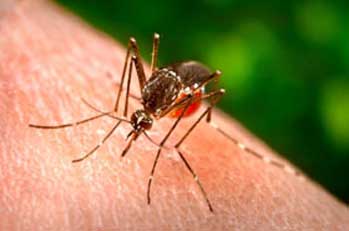 Photo by James Gathany, U.S. Centers
for disease Control
Mosquitoes carry both yellow fever and malariamalaria gene into the YF17D vaccine and found that the gene could produce its protein in cultured cells. The protein they chose, called CSP, covers the surface of the malaria sporozoite and is thought to be the main reason that this form of the parasite stimulates the immune system so effectively. Immunization of mice with the YF17D-CSP vaccine led to a measurable jump in immune activity against the malaria protein, but the single shot was not enough to protect the animals from infection with the mouse form of the malaria parasite. The group therefore added a booster shot to the vaccination regimen. Animals that had been immunized with YF17D-CSP, or with a saline solution control, were given a low dose of irradiated sporozoites. While the saline-sporozoite group was only partially protected from challenge with viable parasites, vaccination with YF17D-CSP plus the sporozoites protected 100 percent of the animals against infection. “These results are exciting because they show the YF17D-CSP vaccine can prime the immune response against a malaria parasite,” says lead author Cristina Stoyanov. Although the utility of this approach for human immunization is not yet clear, the team hopes that further studies might eventually lead to an effective vaccine. |
|
| Coffee gets some good press for
preventing diabetes |
||
|
By the American Chemical Society news
service
Scientists are reporting new evidence that drinking coffee may help prevent diabetes and that caffeine may be the ingredient largely responsible for this effect. Their findings, among the first animal studies to demonstrate this apparent link, appear in theAmerican Chemical Society's bi-weekly Journal of Agricultural and Food Chemistry: “Coffee and Caffeine Ameliorate Hyperglycemia, Fatty Liver, and Inflammatory Adipocytokine Expression in Spontaneously Diabetic KK-Ay Mice.” Fumihiko Horio and colleagues note that past studies have suggested that regular coffee drinking may reduce the risk of type 2 diabetes. The disease affects millions in the |
United
States
and is on the rise worldwide. However, little of that evidence comes
from studies on lab animals used to do research that cannot be done in
humans. The scientists fed either water or coffee to a group of laboratory mice commonly used to study diabetes. Coffee consumption prevented the development of high-blood sugar and also improved insulin sensitivity in the mice, thereby reducing the risk of diabetes. Coffee also caused other beneficial changes in the fatty liver and inflammatory adipocytokines related to a reduced diabetes risk. Additional lab studies showed that caffeine may be “one of the most effective anti-diabetic compounds in coffee,” the scientists said. |
|
| Home |
Tourism |
Place
classified ad |
Classifieds |
Entertainment |
Real
estate |
Rentals |
Sports |
About
us |
|
| What we published this week: | Monday | Tuesday | Wednesday | Thursday | Friday | Earlier |
| The contents of this page and this Web site are copyrighted by Consultantes Río Colorado 2001, 2002, 2003, 2004, 2005, 2006, 2007 and 2008 and may not be reproduced anywhere without permission. Abstracts and fair use are permitted. Check HERE for details | ||||||
| A.M. Costa Rica fifth news page |
 |
||||||||
| Home |
Tourism |
Calendar |
Classifieds |
Entertainment |
Real
estate |
Rentals |
Sports |
About
us |
|
|
|
|||||||||
 |
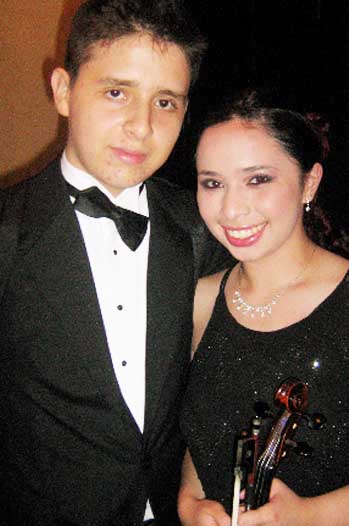 Guillermo Salas and Daniela Arley
Young violinists planning
concert to raise tuition By the A.M. Costa Rica staff
Two violin students from the National Institute of Music have a chance to attend the Green Mountain Chamber Music Festival in Burlington, Vermont. The problem is money, so the pair will be giving a recital Sunday at 3 p.m. in the Mexican cultural center in Los Yoses to raise money for their tuition. They are Daniela Arley and Guillermo Salas, described as two talented young Costa Rican violinists. They will perform music by Mendelssohn, Bach, Vivaldi and others, accompanied by members of the National Symphony Orchestra and the National Youth Symphony, said Catherine Hayes, a violin teacher at the institute. The Green Mountain program begins at the end of the month. Both pair are university level students at the National Institute of Music and perform with the National Youth Symphony and the Advanced Chamber Orchestra of that institution. Miss Arley was concertmaster of the Central American Youth Orchestra for two years, and Salas was selected to perform for the violinist Midori last June. Both also perform with the Costa Rican Filarmónica and the Heredia Symphony Orchestra. The recital will be free of charge, but a voluntary contribution is requested and much appreciated, organizers said.
|
|
 |
| Home |
Tourism |
Place
classified ad |
Classifieds |
Entertainment |
Real
estate |
Rentals |
Sports |
About
us |
|
| What we published this week: | Monday | Tuesday | Wednesday | Thursday | Friday | Earlier |
| The contents of this page and this Web site are copyrighted by Consultantes Río Colorado 2001, 2002, 2003, 2004, 2005, 2006, 2007 and 2008 and may not be reproduced anywhere without permission. Abstracts and fair use are permitted. Check HERE for details | ||||||
| A.M. Costa
Rica sixth news page |
|
|||||||||
| Home |
Tourism |
Calendar |
Classifieds |
Entertainment |
Real estate |
Rentals |
Sports |
About us |
||
|
|
||||||||||
Latin American news Please reload page if feed does not appear promptly |
features auction and lunch Special to A.M. Costa Rica
Animal Shelter Costa Rica will hold its Mutt’s Campaign 2010 fundraiser July 3 at Zamora Estates in Santa Ana. This year’s annual fundraising event is in a new venue for the San Rafael de Heredia Animal Shelter. The Mutt’s Campaign 2010 fundraiser offers a beautiful setting and includes a gourmet lunch. The event starts at 12:30 p.m. Ticket sales will go towards offsetting the cost of the shelter’s operation and its effective neutering project which travels to remote areas throughout Costa Rica, offering low-cost or free neutering and vaccinations. In addition to the luncheon, a live auction will be held offering supporters a chance to bid for prizes. Auctioneer Barry Rein, will help raise more monies for the Animal Shelter. The event has many local sponsors who have donated prizes. Tickets are available by calling 2267-7158 and 2267-6374 or by e-mail to leighjohn2003@yahoo.com. Organizers noted that for several years the shelter benefitted from the efforts of its popular "Rice Table" Asian feast, hosted by board member Penny Santomenno and others. Four Colombians back after years with rebels By the A.M. Costa Rica wire services
Four Colombian men held captive by rebels for nearly 12 years have returned to Bogotá. The four arrived in the Colombian capital Monday, a day after a military operation in the southeastern province of Guaviare rescued them from the Fuerzas Armadas Revolicionarias de Colombia. The former police and military hostages got a hero's welcome on their return. One was found early Monday hiding in the jungle after Sunday's rescue operation scattered the rebels. Authorities said the operation took six months to plan. It was one of the highest-profile rescues since military forces freed former presidential candidate Ingrid Betancourt and three U.S. nationals in 2008. While most of their funding comes from cocaine trafficking and extortion, the leftist rebels are believed to hold at least 20 police and soldiers, and an unknown number of civilians, for ransom or political leverage. The rebels have been at war with the Colombian government for more than 45 years. Colombia, the European Union and the United States have designated the rebel group as a terrorist organization. |
| Latin American news feeds are disabled on
archived pages.
|
|
| Home |
Tourism |
Place
classified ad |
Classifieds |
Entertainment |
Real
estate |
Rentals |
Sports |
About
us |
|
| What we published this week: | Monday | Tuesday | Wednesday | Thursday | Friday | Earlier |
| The contents of this page and this Web site are copyrighted by Consultantes Río Colorado 2001, 2002, 2003, 2004, 2005, 2006, 2007 and 2008 and may not be reproduced anywhere without permission. Abstracts and fair use are permitted. Check HERE for details | ||||||