|
 |
Your daily |
 |
|
|
|
|
|
|
|
|
|
|
|
|
||||||||||||||
|
|
||||||||||||||
 |
 |
| A.M. Costa Rica Second newspage |
|||||||||
| Home |
Tourism |
Calendar |
Classifieds |
Entertainment |
Real
estate |
Rentals |
Sports |
About us |
|
|
|
|||||||||
 |
| Costa Rica Expertise Ltd http://crexpertise.com E-mail info@crexpertise.com Tel:506-256-8585 Fax:506-256-7575 |
 |
|
for not tracking cheap fuel By Helen Thompson
of the A.M. Costa Rica staff The national fishing institute has claimed that it lacks the funding and personnel to make sure that subsidized fuel available to the Costa Rican fishing fleet is not sold on to drug runners after an analysis blamed the organization. It has long been suspected that some of the cheap fuel available to commercial fishermen ends up being sold for a profit to unlicensed boat users. One example was the boat San Mateo, which was detained in January 2007 on suspicion of taking around 9,000 liters of subsidized fuel to narcotrafficking boats in the Pacific. A study carried out by the Contraloría General de la República that lasted almost two years has concluded that the Instituto Costarricense de Pesca y Acuicultura does not carry out enough checks to be sure of the proper use of the fuel. Inspections should be made of the intermediary organizations, boats, service, storage and distribution stations involved in distributing and using the fuel, which is available with little or no added tax, said the Contraloría. To claim the fuel, fishermen must be licensed and belong to an authorized organization, and present documents such as receipts and declarations of how many hours and at what times they were fishing. Irregularities were found with many fishermen's documents, such as one company which lacked authorization to receive the fuel and which wrote in its declaration that for 25 days running the boat left and returned at the same times, regardless of tides, and each day brought back exactly the same amount and type of fish. In some cases it was found that the fuel was sold at preferencial prices to unlicensed fishermen, and that some fishermen received less fuel than their tickets said they should. Authors of the study ordered that the fishing institute work in conjunction with the Refinadora Costarricense de Petroleo to design a system of delivering the subsidized fuel that minimizes risk and cost. Telephone company plans project to recycle cellulars By the A.M. Costa Rica staff
Throwing out cell phones can spread harmful and toxic materials into the environment, and thus the Instituto Costarricense de Electricidad has announced a plan for disposing of the objects safely. After confirming that it is encouraging people to abandon old models for new 3G technology phones, the institute has issued notice of a countermeasure in which it has signed a deal with a Canadian recycling company. Instead of being chucked into landfills, where metals such as cadmium, lead, nickel, mercury and copper from batteries and other components can leak into soils and water courses, clients will be able to dispose of their unwanted handsets in recycling bins. These metals are considered to be persistent, meaning they do not biodegrade, and are bioaccumulative, which means that they build up in the fatty tissue of human and animals, and when they reach high levels they can be toxic. Initially, receptacles will be positioned in 64 of the institute's agencies around the company, with future plans for bins in every institute agency and other agencies related to telecommunications such as Compañía Nacional de Fuerza y Luz. Everything including hands-free kits, chargers and batteries can be left in the recycling bins. Fortech and its subsidiary Global Electric Electronic Processing, which operates from Ontario, Canada, will be in charge of collecting the waste and the recycling of parts, the institute said. Legion again planning Independence Day Picnic By the A.M. Costa Rica staff
American Legion Post 16 will hold its second annual U.S. Independence Day picnic Sunday, July 6, from 9 a.m. to 2 p.m. at La Cueva in Barrio San José, Alajuela. The Legion stepped in to fill the breach last year when the American Colony Committee was not able to put on the traditional picnic. Now the Legion event is becoming an annual one, said Melvin J. Goldberg of the Legion. This year the American Colony Committee says it will be again putting on a picnic for U.S. citizens and dependents at the Cerverceria Costa Rica picnic grounds July 4. But Goldberg said in a release that the Legion picnic will be open to Costa Ricans as well as U.S. citizens and dependents. Admission for adults will be 4,500 colons (about $9). Children 5-12 are charged 3,000 colons or $6. Tickets are available at the entrance and also at 2269-3190 or 2261-6944.
|
 |
 |
| A.M. Costa Rica third newspage |
|||||||||
| Home |
Tourism |
Calendar |
Classifieds |
Entertainment |
Real
estate |
Rentals |
Sports |
About us |
|
|
|
|||||||||
 |
 |
 |
 A.M. Costa
Rica photos/José Pablo Ramírez Vindas
Coffee
museum in Asserí brings back
forgotten past
|
|||
|
By
José Pablo Ramírez Vindas
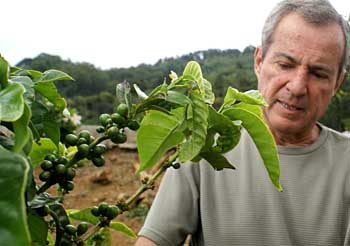
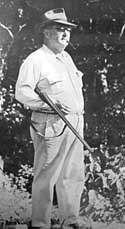
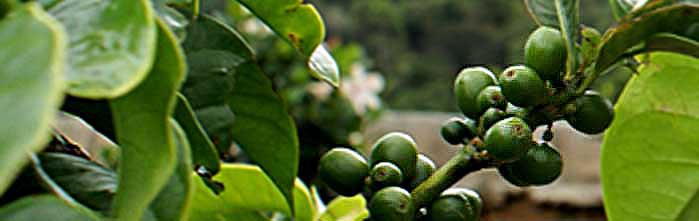
of the A.M. Costa Rica staff Long ago the steep slopes of Aserrí were covered in emerald green coffee plants. The farmers used rudimentary machines to cultivate their “golden” crop. Today, many have forgotten the history, and huge companies have taken over much of the industry. Luis Alfaro Zeledón wants to bring the story back and remind the children of Vuelta de Jorco about the work of their grandparents and great grandparents. Alfaro, who was born in San José and raised in California, is the owner of Haciendo Río Jorco, a 70 hectare plantation in the mountains of Aserrí. He is constructing a museum that features the story of his grandfather, Jorge Zeledón Castro, and the birth of the coffee industry in the area.
The historical room is aimed at students in the area, said Alfaro, who added that the entrance will be free. Alfaro, who helped build a library at a local school already has contacts with educators in the region, he said. If tourists want to come later, that's a possibility, said Alfaro, but that's not really the point. Alfaro, who uses almost all of his labor from the local town and machinery made in Costa Rica for his plantation, said he wants to help the area's economy. “If tourists come here I'd rather they go eat at a local restaurant and put something into the community,” he said when asked if he would open a restaurant. The museum will be dedicated to Alfaro's mother, Claudia Zeledón González, and will open Aug. 23, the 25th anniversary of her death, he said. Alfaro is still thinking of a name. In the 1920's preparing the coffee beans for sale was a week long process. Today with modern machinery, the process takes a little more than 24 hours. A good picker can earn up to $30 a day, said José Ramón Castro, a plantation worker whose experience ranges from the fields to the final packing of the burlap exportation bags. A not-so-good picker might make about $8 a day said Castro, who has worked in coffee for 30 years. A small operation like Hacienda Río Jorco produces about |
300,000 pounds
of coffee a year. A large company can produce twice that much each day,
said Alfaro. “The workers here treat the coffee as if it were something
alive,” said Alfaro, cupping his hands, “in large companies they don't
do that.” A few meters down the hill from the museum is the modern machinery which sifts, peels, dries, and separates the coffee beans to prepare them for exportation and local sale. In an international auction, “Taza de la Excelencia,” May 15, coffee from Hacienda Río Jorco placed 20th out of the top 106 plantations in Costa Rica. Río Jorco does not roast the beans. It sells them to a variety of international companies. Some of the beans are bought by Café Rey, for local consumption, said Alfaro. It would be impossible to taste the Río Jarco flavor though, since the beans are mixed in with those from around the country. Some of the land divided among the other five daughters is still farmed today, said Alfaro, although much of it is not. Aside from Hacienda Jarco, Zeledón also had a plantation near the Panamanian border. In the early 1900s when Zeledón was still a teenager, he went to study tobacco culture in Cuba. The English and German plantation owners at Hacienda Jorca hired the youth upon his return to Aserrí. Zeledón became the chief of the operation at just 18 years of age, said Alfaro. Although the youth had studied tobacco and knew nothing of coffee operations, he excelled in the position. The European owners offered to sell Zeledón the entire operation when he was just 21. The young man who had no money, paid in increments and soon had a flourishing Costa Rican business.  A.M. Costa
Rica/José Pablo Ramírez Vindas
An antique carreta and an original bean
sorting machinefrom London will be part of the museum display |
||
|
Production
of coffee can include a lot of hand work
|
||
| In the early coffee plantations, all
the machinery was made of wood, and
much of it was imported from Europe. From freshly picked to dried and
ready for exportation, the preparation of the beans lasted about a
week. First, Costa Rican workers picked the coffee beans in the period called summer here and brought their crop in metal boxes to be measured for payment. While today the process is the same on most small plantations in Costa Rica, the majority of laborers are from Nicaragua, according to the Ministerio de Trabajo. Coffee picked manually is a better quality because workers only pick the ripe beans and don't damage the plants. Other plantations “strip pick” the product with machines, but this technique is not used often in Costa Rica. In the traditional plantation workers transported their product in carretas or oxcarts pulled sometimes by horses. Each wooden cart made a unique sound with its wheels. “The wives' would know the sound of their husband on his way home from work,” said Lulis Alfaro Zeledón of the coffee museum. Before the industrialization, the separation of coffee beans was manual. At the beginning of the 20th century, machines started to separate the beans, cutting down production time. The selection of different beans is very important to the companies for each target market. For example, in Costa Rica, the “primera” or premium quality is only for exportation, and is
|
 A.M. Costa Rica/José Pablo
Ramírez Vindas
José
Ramón Castro and Luis Alfaro Zeledón show off the
plantation's modern machinery
expensive coffee because of the bean's large size. It is mainly consumed by Europeans. “Segunda,” also used for export, is slightly inferior due to the smaller size. Another type of coffee is the “caracol,” the smallest bean. It has always been expensive because it must be selected by hand. It's popular in Spain and South America. The consumers in Costa Rica drink a coffee that doesn't fall into any of the categories. The “local” bean is basically the leftover product. In the artesian process, beans are spread out and dried under the sun. Sun dried beans are of a higher quality. Now most large commercial coffee companies use a large oven to dry the beans in about 24 hours. After the beans are dried, machines husk the shell. Hacienda Río Jorco uses the husk as fertilizer for its crop. In the old method, farmers peeled the beans by hand. At Hacienda Río Jorco when the coffee is ready, workers pack the beans into plastic bags for local sale, or jute bags if the coffee is for exportation. Finally, the companies that buy the coffee roast the beans, which changes their color to brown and adds the smell and flavor. |
|
| You need to see Costa Rican tourism information HERE! |
 |
| A.M. Costa Rica fourth news page |
|||||||||
| Home |
Tourism |
Calendar |
Classifieds |
Entertainment |
Real
estate |
Rentals |
Sports |
About us |
|
|
|
|||||||||
| Of pantsuits, personal loss and a philosophy of recycling |
|||
| I had no idea so many
people
would respond with such lovely e-mails of condolences to my column
about my mother’s passing. I have to laugh at myself, because
before anyone close to me died, I would wonder why people didn’t just
use the verb to die, or the noun death when referring to
someone they loved who had obviously died. Then, within three
months, both my dear friend Mavis Biesanz and my mother died. My
daughter once said, "She left the planet,” about someone else’s
mother. I liked that concept, because now I am not so sure what
death really is, or where one goes. I still talk to Mavis
just about every day, and sometimes she answers me. As most of my readers know by now, I am a great believer in recycling, transforming things that have been used for one thing into something that will serve another purpose before I think of throwing it away. It is easy to go from that to believing, if not in actual reincarnation, in the transformation or passing of the spirit in a life that has been used up into something else or even someone else. There are a lot of spirits this past week that are looking for other lives. Bo Diddley and Yves Saint-Laurent are two. I never saw Bo Diddley perform, but I have often given my thanks to Yves Saint-Laurent for introducing the pantsuit to every woman. Back in the 60s we could all be like Kathryn Hepburn. I was living in New York when the pantsuit first hit the department stores. I tried on two: one, a velvet evening suit that I called a Georges Sand suit and another, a white and grey herringbone with a longish jacket and straight pant legs. The velvet one was missing a rhinestone button so I didn’t buy it, the other I did. This was the winter of 1966, as I recall. I think I was the first person in New York City to wear a pantsuit to work, which I did the following Monday. After our regular meeting of editors and writers, I stood up to |
After work some friends and I went out for drinks (something
people did
in New York in the 60s) and then on to a new well-known discotec, the
name of which I have forgotten. When the doorman saw my pantsuit
he
wouldn’t let me in. After peeking inside the club, I went back to
our
car, removed my trousers and returned wearing just the jacket, my
pantyhose and my silver boots. He smiled and opened the door for me. |
||
| Environment Day celebrated with eco-friendly fair |
|
|
By Jeremy Arias
of the A.M. Costa Rica staff A multitude of white display stands and exotic bamboo walkways appeared outside the usually plain Antigua Aduana building in downtown San José Thursday, as this year's Feria Ambiental was inaugrated to coincide with Environment Day. The fair, hosted by Grupo Instituto Costarricense de Electricidad, draws a diverse crowd of Costa Ricans, expatriates and tourists interested in the many ways that various government and private companies are seeking to improve and protect the country's fragile environment. Large displays in the center of the building advertise the electricity institute's use of recycled paper in telephone books and advocate the recycling of cell phones. Other environmentally-friendly companies fill the building with informational videos and interactive presentations, and plenty of information is available through pamphlets and displays. During the opening day of the feria, Gabriela Moya presented San José's Super Heroes Ambientes program, aimed at motivating the youth of the municipality to clean up trash. Mateo Villalobos explained the efforts of the Green Hotels initiative to promote energy conservation, |
recycling and wildlife conservation as a means of reducing the negative
effect of Costa Rica's booming tourism from across the building. “It's creative and it's intriguing because there's a lot of green and plants and a lot of access to information,” said Mackenzie Turner, a student at Regis University, Colorado, who is participating in a study abroad program in San Jose and who is interested in starting a sustainable gardening business in Costa Rica. “We're here just talking about sustainable environments and getting background on the field.” Carole Triem, a student from Seattle University, also attended the fair. “I know that Costa Rica has historically been more environmentally aware than many other countries.” she said, saying she had enjoyed the carbon nuetral exhibits at the fair the most so far. Grupo ICE is a conglomeration of the electricity institute, Radiográphica Costarricense S.A. and the Compañia Nacional de Fuerza y Luz. The fair is free to the public and will continue through Sunday, June 8, when a closing concert will be held from 6 to 7 pm. It features a variety of guest speakers, displays and presentations. The Antigua Aduana lies just south of Santa Teresita church in Barrio Aranjuez. |
|
Deep ocean bacteria much more
numerous than thought
|
|
|
Special to A.M. Costa Rica
Sea floor bacteria on ocean-bottom rocks are more abundant and diverse than previously thought, appearing to feed on the planet's oceanic crust, according to results of a study reported in the journal Nature. The findings pose intriguing questions about ocean chemistry and the co-evolution of Earth and life. Once considered a barren plain dotted with hydrothermal vents, the seafloor's rocky regions appear to be teeming with microbial life, say scientists from the Woods Hole Oceanographic Institution in Woods Hole, Massachusetts, University of Southern California in Los Angeles, California, and other institutions. While seafloor microbes have been detected before, this is the first time they have been quantified. Using genetic analyses, Cara Santelli of Woods Hole, Katrina Edwards of the University of Southern California, and colleagues found three to four times more bacteria living on exposed rock than in the waters above. "Initial research predicted that life could, in fact, exist in such a cold, dark, rocky environment," said Ms. Santelli. "But we really didn't expect to find it thriving at the levels we observed." Surprised by this diversity, the scientists tested more than one site and arrived at consistent results, making it likely, according to Ms. Santelli and Ms. Edwards, that rich microbial life extends across the ocean floor. "This may represent the largest surface area on Earth for microbes to colonize," said Edwards. The researchers also found that the higher microbial diversity on ocean-bottom rocks compared favorably with other life-rich places in the oceans, such as hydrothermal vents. |
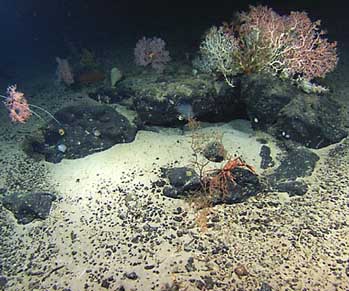 Photo by the National Oceanic and
Atmospheric Administration
Rocks made of basalt on and under the ocean bottom harbor
surprising numbers of deep-sea bacteria.and Woods Hole Oceanographic Institution These findings raise the question of where these bacteria find their energy, Ms. Santelli said. "We scratched our heads about what was supporting this high level of growth," Ms. Edwards said. With evidence that the oceanic crust supports more bacteria than overlying water, the scientists hypothesized that reactions with the rocks themselves might offer fuel for life. Many scientists believe that shallow water, not deep water, is better suited for cradling the planet's first life forms. Up until now, dark, carbon-poor ocean depths appeared to offer little energy, and rich environments like hydrothermal vents were thought to be relatively sparse. But the newfound abundance of seafloor microbes makes it possible that early life thrived — and perhaps began — on the seafloor. |
 |
|
| News from
the BBC up to the minute |
BBC sports news up to the minute |
| BBC news and sports feeds are disabled on archived pages. |
|
| A.M. Costa Rica fifth news page |
Are
you
still
spending 70 percent You need to fill this space ASAP! |
||||||||
| Home |
Tourism |
Calendar |
Classifieds |
Entertainment |
Real
estate |
Rentals |
Sports |
About us |
|
|
|
|||||||||
 |
 |
| Human rights court decision on criminal libel case concerns press advocates |
||
|
Special to A.M. Costa Rica
The Inter American Press Association said Wednesday it plans to take a close look at a recent ruling by the Inter-American Human Rights Court that allows criminal proceedings against journalists in libel cases, a move it claims “goes against major progress made in recent years in favor of free speech and press freedom.” The human rights court decision, handed down May 26 was in
|
favor of the
case of Argentine journalist Eduardo Kimel. He had been given a
suspended sentence, upheld by his country’s supreme court, of one year in prison and payment of damages for authoring a book in November 1989 that criticized a judge’s conduct over an investigation into the murder of five members of a religious order. The Inter-American Court’s unanimous ruling called on the Argentine government to amend the South American country’s Penal Code regarding libel and defamation in a decision that overturned Kimel’s conviction and ordered that his name be removed from criminal records. The decision declared that “opinion is not subject to punishment” when it is about how a public official carries out his or her duties. Earl Maucker, president of the Inter American Press Association said, “We will examine this ruling very closely because while it comes out in favor of freedom of expression and we feel it has done justice in the Kimel case by exonerating him, it is also true that it creates confusion by endorsing criminal proceedings to settle disputes when a conflict arises between free speech and the right to one’s reputation that result from the publication of news or opinions.” Maucker, senior vice president and editor of the Fort Lauderdale, Florida, newspaper Sun-Sentinel, added that “we are concerned with the fact that criminal punishment continues to exist along with laws that encourage it, for example contempt laws, when it has been proved that the criminal law alternative causes self-censorship and restricts the free flow of information.” Gonzalo Marroquín, chairman of the organization's Committee on Freedom of the Press and Information, declared that the ruling “would appear to go against all the recent progress made in the decriminalization of libel such as last April’s criminal law reform at the federal level in Mexico and the previous 2004 reform in El Salvador.” Marroquín, editor of the Guatemala City, Guatemala, newspaper Prensa Libre, said that upholding libel as a criminal offense “creates confusion,” since the Inter-American system, through Article 10 of the Inter-American Commission on Human Rights’ Declaration of Principles on Freedom of Expression, states that civil proceedings should be employed to resolve this kind of conflict: “Privacy laws should not inhibit or restrict investigation and dissemination of information of public interest. The protection of a person’s reputation should only be guaranteed through civil sanctions . . . .” In a separate development, the press organization expressed regret at a Uruguayan court’s decision to hand down a suspended four-month prison sentence to a journalist on a defamation charge. May 22 the editor of the weekly Noticias in the southwestern Uruguay city of Colonia, Norberto Costabel, was sentenced after publishing an article telling his readers that a former distributor of the newspaper was still collecting subscriptions despite no longer belonging to the firm that published it. Although the report was confirmed as true during the court hearing it was not admitted by Judge Gloria Rodríguez, who ordered the case to continue. The conviction was suspended on appeal on the grounds that the journalist had no prior criminal record. Under terms of Uruguayan law defamation, libel, contempt, affront to the reputation of a foreign head of state and vilification of patriotic symbols are considered criminal offenses. Editor's Note: A.M. Costa Rica is a member of the Inter American Press Association. |
|
| A.M. Costa Rica Sports news local and from the wires |
 |
|
|
|
|
|
|
|
|
|
|
||||||
|
||||
|
|
|
|
|
|
|
|
| What we published this week: | Monday | Tuesday | Wednesday | Thursday | Friday | Earlier |
|
|