|
 |
Your daily |
 |
|
|
|
|
|
|
|
|
|
|
|
|
||||||||||||||||
|
|
||||||||||||||||
|
|
|
|
|
|
|
|
| What we published this week: | Monday | Tuesday | Wednesday | Thursday | Friday | Earlier |
|
|
 |
| A.M. Costa Rica Second newspage |
 |
||||||||
| Home |
Tourism |
Calendar |
Classifieds |
Entertainment |
Real
estate |
Rentals |
Sports |
About us |
|
|
|
|||||||||
 |
| Costa Rica Expertise Ltd http://crexpertise.com E-mail info@crexpertise.com Tel:506-256-8585 Fax:506-256-7575 |
 |

Click HERE for
great
hotel discounts
|
|
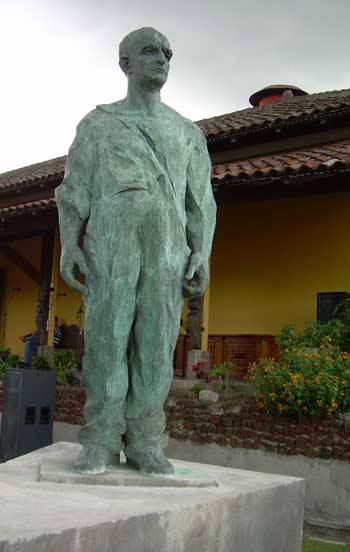 A.M. Costa Rica photo
Pepe Figueres surveys the San José downtown from his
new location in the Museo Nacional, the spot where he abolished the
military. The statue had been below in the Plaza de la Democracia that
was remodeled.Candidate breaks a taboo
and criticizes Figueres By the A.M. Costa Rica staff
The Movimiento Libertario presidential candidate walked into a hornets' nest when he characterized Costa Rica's political hero, José Figueres, as corrupt. The candidate, Otto Guevara Guth, also referred in his television commercial to the relationship Figueres maintained with fugitive U.S. financier Robert Vesco in the early 1970s. Figueres was the man who led the winning forces in the Costa Rican civil war in 1948, and he is the leader who abolished the military. School children are taught to venerate him. Guevara was trying to differentiate himself from the other political leaders and suggested they all were corrupt in his televised commercial. A response was not long in coming. The second wife of Figueres, U.S.-born Karen Olsen Beck, dismissed the allegations at a press conference and said that if Figueres still were alive he would consider Guevara as a misbehaving child. Others were not so gentle. The aging Alberto Cañas, now president of the Partido Acción Ciudadana, said that no one associated with the Figueres administrations (he was president three times) profited personally. In fact, records show that Figueres got a $2.2 million investment from Vesco for a financially troubled company he ran that employed 3,000 Costa Ricans. Figueres, known as Don Pepe, was an astute political leader who balanced the United States against other world powers for the benefit of Costa Rica. He spoke English and said he received most of his education by reading in the Boston Public Library. Members of the Partido Liberación Nacional that Figueres founded have dominated Costa Rican politics. Many, like Cañas, have left to explore other political options. José María Figueres Olsen, his son, was president from 1994 to 1998. Plans proposed for rivers along Caribbean coast By the A.M. Costa Rica staff
Every time heavy rains hit the Provincia de Limón and homes and roads are submerged, the question arises: Why don't they do something. Well, emergency officials have released a $5.25 million plan to try to tame the Banano, Chirripó and Sixaola rivers. Each in their own way sow havoc on adjacent communities. The plans are too late for this rainy season, but officials hope to be able to start to work in December. The board of directors of the Comisión Nacional de Emergencias has to approve the plans. At the Chirripó channelization will protect a number of communities and the important Ruta 32, which frequently is flooded. Along the Río Banano the emergency experts want to construct retaining walls to protect Beverly, la Bomba and Río Banano. The Río Sixaloa, which frequently puts the community of the same name under water, presents a number of engineering challenges that will be met with more retaining walls, reinforcing existing protections and blocking some feeder streams. Sunday is when Liberación picks presidential candidate By the A.M. Costa Rica staff
Sunday is when the Partido Liberación Nacional picks its presidential candidate. The choice appears to be either Laura Chinchilla, the former vice president, or Johnny Araya, the former mayor of San José. Fernando Berrocal, the former security minister, lags in the polls and in spending for advertising. Party members all over the country will cast their ballots in the same way they would in a general election. There are more than 1,000 voting locations manned by party members. Party leaders hope that the turnout is better than the percentage who turned out last Sunday for the Acción Ciudadana nomination vote. That appeared to be about 30 percent. Ms. Chinchilla has been the favorite, based on national opinion polls, but both she and Araya were close. He appears to have picked up more support in the last two weeks. Gasoline going up again By the A.M. Costa Rica staff
Gasoline is going up again. The price regulating agency says the average increase will be 8 percent based on world petroleum price and the devaluation of the colon. Super gasoline goes from 452 to 492 colons (about 86 cents) per liter. Plus goes from 435 to 472 (about 82.6 cents). Diesel takes a 46-colon jump to 400 colons (about 70 cents) per liter. The prices are expected to be published and go into effect a week from today.
|
|||||||||||||||||||||||||||||||||||||||||||||||
| Home |
Tourism |
Place
classified ad |
Classifieds |
Entertainment |
Real estate |
Rentals |
Sports |
About us |
|
| What we published this week: | Monday | Tuesday | Wednesday | Thursday | Friday | Earlier |
| The contents of this page and this Web site are copyrighted by Consultantes Río Colorado 2001, 2002, 2003, 2004, 2005, 2006, 2007 and 2008 and may not be reproduced anywhere without permission. Abstracts and fair use are permitted. Check HERE for details | ||||||
| A.M. Costa Rica third newspage |
 |
||||||||
| Home |
Tourism |
Calendar |
Classifieds |
Entertainment |
Real
estate |
Rentals |
Sports |
About us |
|
|
|
|||||||||
 |
 |
 |
 A.M. Costa Rica/Saray Ramírez
Vindas
|
Dangerous
shortcut Despite the obvious sign, a motorist makes an illegal left turn to drive against the traffic for about 100 feet on Avenida 7 to avoid making a five-block loop. In doing so, he endangers a pedestrian who is not expecting the illegal act. The stop sign forbidding a left turn is on Calle 11, which jogs around the east side of Parque España near the Instituto Nacional de Seguros building. There is a procession of such violations during rush hour. |
|
Canada and Costa Rica plan to
broaden free trade treaty
|
|
|
By the A.M. Costa Rica staff
Costa Rica and Canada will reopen the free trade treaty between the two countries to revise and broaden it, said President Óscar Arias Sánchez Thursday. He spoke after a meeting with Peter Kent, the Canadian minister of state for external relations. Arias suggested that one of the major areas would be the section on services. And Canada is in the process of negotiating treaties with other Central American countries. The Central American free trade treaty with the United |
States that went into force Jan. 1
provides for an extensive exchange of services among the countries that
signed the document. In fact, Arias left the meeting and went to the San José Palacio Hotel where a meeting of Costa Rican business people and foreign buyers was finishing up. Some of what was offered fell into the service category, and the meeting was called the Costa Rican Services Summit organized by Promotora de Comercio Exterior. Costa Rica ratified its agreement with Canada in July 2002. Kent reiterated what Canadian officials have been saying for a number of years, that the agreement with Costa Rica is a model for other pacts elsewhere. |
| Sometimes it is the things that we do not do that bite us |
|||
| Probably
one of the more dismaying enlightenments in life is the realization of
how much we contribute to the annoyances and setbacks, sometimes even
tragedies, that beset our lives from time to time. Thanks to the unspoken suggestion from my friend Doug, I finally looked in my files just in case a copy of my missing carnet existed somewhere. I started with a file labeled “Residency”. There it was, the copy I didn’t think I had and so hadn’t bothered to look for. I took it to Immigration on my fourth visit and showed it to the tall, young man I was getting to know. He smiled broadly and in Spanish said the equivalent of “Great, that is just what you needed!” My next appointment is July 2, and, supposedly, I will get either a replacement or a renewal. However, anything can “happen” in a month’s time. I must deposit some dollars and some colons in the Banco de Costa Rica before I am eligible. But it is a relief to be back on track. Thinking back at some of the little and big annoying times I have experienced, I have to admit that more often than not they were the result of not what I did, but what I didn’t do. Whether it was not checking if the gas tank had gas, not paying a bill on time, not writing an important letter in a timely fashion or not saying something I should have. I wonder if that is what people mean when they say they don’t regret what they did, only what they didn’t do? Well, there is something I am thinking about not doing in the future. And that is riding the bus. I don’t like thinking about the arrival of that day. But boarding a city bus has long been a challenge because the first step can be so high. My friend Lillian once told me how indignant she was when a bus driver told her she should start boarding the bus via the back door. I wouldn’t mind at all if a bus driver told me that. But that wouldn’t be the end of my problems with the bus. It seems more bus drivers are cowboys – actually they give cowboy a bad name. |
She also has chosen to live outside the U.S. – her
choice was Mexico. I found Ann through Google. Some time ago she became
a successful author with her first novel, "Crowfoot Ridge." We
still
talk and talk but now via e-mail. So, doing something doesn’t just
avoid disaster. It can bring positive joy. |
||
 |
 |
 |
| Home |
Tourism |
Place
classified ad |
Classifieds |
Entertainment |
Real estate |
Rentals |
Sports |
About us |
|
| What we published this week: | Monday | Tuesday | Wednesday | Thursday | Friday | Earlier |
| The contents of this page and this Web site are copyrighted by Consultantes Río Colorado 2001, 2002, 2003, 2004, 2005, 2006, 2007 and 2008 and may not be reproduced anywhere without permission. Abstracts and fair use are permitted. Check HERE for details | ||||||
 |
| A.M. Costa Rica fourth news page |
 |
||||||||
| Home |
Tourism |
Calendar |
Classifieds |
Entertainment |
Real
estate |
Rentals |
Sports |
About us |
|
|
|
|||||||||
|
Readers give their opinions
on celebrities, taxes, work rules
|
|
| They're not
celebrities! Get them out of here! Dear A.M. Costa Rica: As a former U.S. advertising executive, now a guest in Costa Rica, I am embarrassed about NBC's "I'm A Celebrity, Get Me Out of Here." I would assure potential visitors and tourists that in my experience, this travesty in no way represents what Costa Rica has to offer nor the great beauty found in this nation's eco-tourism or tourism in general. Even the concept is bad, focusing on the egos of individual, self-declared "celebrities" few have ever heard of rather than on the richness and diversity of this nation. To the Costa Rican authorities, as a former member of the Phoenix, Arizona, Film Board, I caution against giving future carte blanche approval to commercial filming, be it for entertainment, advertising or other reasons without a more thorough understanding of the impact it may have. What I am seeing on this show (which at this point I'm watching only to see if there is any redeeming value) sickens me due to the negative portrait of a country I love. Kent Carthey
Villa Real Giving up U.S. citizenship to avoid taxes not good idea Dear A.M. Costa Rica: Enjoy reading all the reasons for leaving the United States, But to get out of paying taxes is not a good one. Giving up your citizenship to avoid taxes will land you in jail. The law allows you to give up your citizenship for almost any other reason but to avoid paying taxes. It takes up to seven years to receive and answer to your revocation of citizenship, in that time the Internal Revenue Service and other government agency are looking for where your money went. I like the idea of moving out of the country for more mundane reasons like not paying for the dog license, excise tax, property tax, sales tax, fishing license, water and sewer tax, and state income tax, meals tax and on and on. The states are already worried because if I move out of the country only the Federal government will get any money from me. The explanation on money made outside the U.S. only applies to income made as a worker. Money earned from investments or unearned income is still taxed. The income earned up to 87,500.00 is correct but you should have added that the earnings over that amount are taxed at the rate on the total income. So if you earned $150,000, the tax rate would be based on the total amount, not the 62,500.00 difference. That will make a big difference in the tax owed. The number always sounds good but not when you pay the taxes on the smaller amount at the higher rate. How many expats are aware that the cost of living increase for Social Security has been cut. This was done soon after Mr. Obama took office. He signed an order putting a cap of 2 percent on future increases in Social Security. He didn't mention that to the seniors he was willing to screw before he was elected. Oh, that's right, he isn't going to increase taxes on the middle class. Paul Lamarche
Leominster, Massachusettes |
Lawmakers should not
mess with contracts for labor Dear A.M. Costa Rica: They’ve done it again. The diputados of the national assembly have passed another law that supposedly favors victims, but makes no sense to enforce. While the country is awash in crime and destruction of the country's natural resources, where sensible and enforceable laws are sorely needed, the diputados and diputadas play little gods for political reason. Don’t forget the country already has the airs of campaigning in it with elections coming up next February. An eight-hour workday for maid is good stuff to dump in the political hopper. The fundamental argument for the law is that Nicaraguan maids are exploited, and surely some are, so it makes sense to bring down an entire labor relationship created over decades, evolved from needs that have to be satisfied. The wages that maids get and the conditions they work in are determined by these needs. If there are more maids wanting to work than jobs available, the salary is going to be low. It is the law of supply and demand at work. If the salary is but a pittance, conditions intolerable, and the lady or the man of house treats the maid in humiliating ways, the maid can quit: slavery was abolished a long time ago. The smart employer knows if she or he wants to keep a good maid, various things have to be done: a decent salary, a polite and respectable but firm treatment be given, no abusive or excessive work, and show signs that she or he has an awareness of the maid’s problems. That can be done with a day off with pay, a gift that eases the problem, or often the comforting words of “Don’t worry, we’ll help you wherever we can” will suffice. “Well done, Maria” are also comforting and encouraging words for the maid. The dimwits on Cuesta de Mora want the rules spelled out like a soccer game, no room for the natural flow of mutual convenience. For non-live-in maids, your work day begins exactly at 8 A.M. If you are late, you stay over to make up for it. The first two hours will be spent washing and drying last night’s dishes, and sweeping and mopping the kitchen floor... and the rest of the house. At 10 o'clock, you get a 12 minute rest break in the laundry room. You bring your own coffee or "fresco" and soda crackers. I'm not going into the rest of the day's work schedule, but you imagine. Coming departure time, the maid submits to a search. Nothing that belongs in house leaves with the owner's permission. All trust is destroyed: them against us. There are households that need a maid for more than eight hours, a big party coming up, or a delay at the office. What happens now, overtime? And if the maid insists on leaving, you are out of luck, no contract agreement broken. The point of bashing of this stupid law is to point out the certain labor relations are best left alone. Let the natural flow of mutual convenience set the conditions. It will turn out that way anyway. A maid who complains about extra hours and threatens to take you court has just lost her job. She might suggest it would be nice to get a little more for those extra hours, but insistence, backed the law, is counterproductive. The maid loses, and you look for a new maid. Walter Fila
Ciudad Colon |
 |
|
| News from
the BBC up to the minute |
BBC sports news up to the minute |
| BBC news and sports feeds are disabled on archived pages. |
|
| Home |
Tourism |
Place
classified ad |
Classifieds |
Entertainment |
Real estate |
Rentals |
Sports |
About us |
|
| What we published this week: | Monday | Tuesday | Wednesday | Thursday | Friday | Earlier |
| The contents of this page and this Web site are copyrighted by Consultantes Río Colorado 2001, 2002, 2003, 2004, 2005, 2006, 2007 and 2008 and may not be reproduced anywhere without permission. Abstracts and fair use are permitted. Check HERE for details | ||||||
| A.M. Costa Rica fifth news page |
 |
||||||||
| Home |
Tourism |
Calendar |
Classifieds |
Entertainment |
Real
estate |
Rentals |
Sports |
About us |
|
|
|
|||||||||
|
Thanks, but no thanks,
Cuban leader says on ban By the A.M. Costa Rica wire services
Cuba is declining to rejoin the Organization of American States but calls the group's decision to lift a 47-year suspension against it a "major victory." Ricardo Alarcon, Cuban national assembly president, told journalists in Havana Thursday the organization's decision to lift the 1962 suspension does not alter what Cuba thought yesterday or the day before. Before the Organization of American States decision, Cuba said it had no interest in resuming its membership. The Organization of American States said Cuba's re-entry would be the result of a "process of dialogue" under the group's "practices, proposals and principles," an indirect reference to human-rights protections and democracy. Among other things, Cuba would have to release its political prisoners. The 34-member group made its decision on the second and final day of its general assembly in Honduras. Cuba was suspended because of its Communist government and Soviet bloc ties. Former Cuban President Fidel Castro said in an essay published Wednesday that the Organization of American States was an accomplice to crimes committed against his country. Tuesday, before leaving Honduras to join President Barack Obama in Cairo, U.S. Secretary of State Hillary Clinton called on the assembled Organization of American States members to restore Cuba's membership rights only if political prisoners are released and basic human rights are improved. Clinton said Wednesday that she was pleased with the compromise measure, saying the OAS members showed flexibility and openness and reached a decision that focuses on the future instead of the past. She said Cuba can return to the Organization of American States in the future if it decides that its participation meets the purposes and principles of the organization, including democracy and human rights. |
| Home |
Tourism |
Place
classified ad |
Classifieds |
Entertainment |
Real estate |
Rentals |
Sports |
About us |
|
| What we published this week: | Monday | Tuesday | Wednesday | Thursday | Friday | Earlier |
| The contents of this page and this Web site are copyrighted by Consultantes Río Colorado 2001, 2002, 2003, 2004, 2005, 2006, 2007 and 2008 and may not be reproduced anywhere without permission. Abstracts and fair use are permitted. Check HERE for details | ||||||
| A.M. Costa Rica sixth news page |
 |
||||||||
| Home |
Tourism |
Calendar |
Classifieds |
Entertainment |
Real
estate |
Rentals |
Sports |
About us |
|
|
|
|||||||||
| Latin
American news digest |
Undersea heritage stars in kids' TV cartoon series Special to A.M. Costa Rica
The U. N. Educational, Scientific and Cultural Organization has teamed up with a popular animated television show about submarines, “Dive Olly Dive!” to teach children about the world’s underwater cultural heritage. The agency will use characters from the show on its Web site and in printed materials distributed to classrooms worldwide in a continuing campaign to protect underwater archaeological heritage, the agency said in a news release. '“Dive Olly Dive!’ has done a wonderful job introducing children to the importance of caring for the environment and submerged archaeological sites and we look forward to working with them on stories about shipwrecks and the ancient ruins that make up our underwater cultural heritage,” the agency said. “The characters are friendly and engaging, and they will be a great aid in our efforts to reach children in an entertaining and easily understood way in every corner of the globe,” it added. The high-definition, 3D computer-generated animation show follows underwater escapades of two young research submarines-in-training, who live in a deep-sea research center. Its stories educate children on the delicate nature of the ecosystems and submerged archaeological sites beneath the oceans. As part of the agreement, the agency is serving as a consultant to the show, as the series begins production on its second season. “We are honoured that UNESCO has chosen the characters to be an integral part of their educational mission,” said Cynthia Money of the Los Angeles-based Mike Young Productions/MoonScoop Group that produces the show. The show airs on PBS Sprout in the United States, Disney Channel and France 5 in France, KI.KA in Germany, TVE in Spain and dozens more channels worldwide. The UN agency said the agreement was part of its education programme in the framework of UNESCO’s Convention on the Protection of the Underwater Cultural Heritage. The convention was adopted in 2001 to improve the safeguarding of such heritage, which includes ancient shipwrecks, submerged ruins and underwater caves containing archaeological vestiges. |
Latin American news feeds is disabled on archived pages.
|
|
| Home |
Tourism |
Place
classified ad |
Classifieds |
Entertainment |
Real estate |
Rentals |
Sports |
About us |
|
| What we published this week: | Monday | Tuesday | Wednesday | Thursday | Friday | Earlier |
| The contents of this page and this Web site are copyrighted by Consultantes Río Colorado 2001, 2002, 2003, 2004, 2005, 2006, 2007 and 2008 and may not be reproduced anywhere without permission. Abstracts and fair use are permitted. Check HERE for details | ||||||
|
Food, festivals, arts, entertainment, poker |
 |
|
|
|
|
|
|
|
|
|
|
 A.M. Costa Rica/Saray Ramírez
Vindas
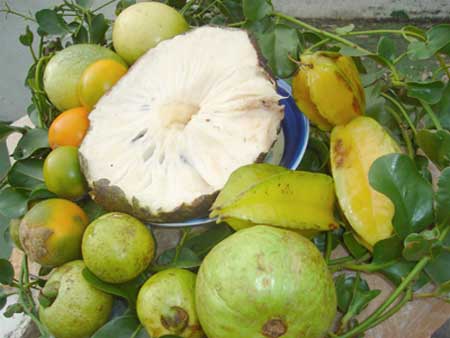
Vitamin on the half shell to eat out of hand or in drinks.From left, a seedy grandilla, a naranjilla with dark interior, a guava,
starfruit and a piece of snowy white guanabana A few thousand colons provides
a bounty of delicious fruits By Saray Ramírez Vindas
of the A.M. Costa Rica staff Delights from star fruit to guavas to the prickly guyabana and the delicate naranjilla are on the market now, and you can get your daily dose of vitamin C with little trouble. In water, milk or cocktails, the fruits give up their delicious tastes. The rainy season brings pure water to revitalize the earth and improve the environment. It also gives a boost for some fruits. And this is a good time to explore fruity options. Costa Rica has a long list of delicious tropical varieties rich in vitamins A, B1, B2, B6, and C. Blending fruits with water to make a refresco is common in Costa Rican homes. Water is preferred for its lower costs, but the daring can try milk and even cream for some of the fruit. Watch out for seeds if a blender is to be used. A reporter went to the Mercado Central with a few thousand colons to seek out fresh fruit. Another option is the ferias del agricultor, but many markets are just one day a week. At the central market there were at least guayabas, maracuyas, carambolas, naranjillas and guanabanas. Here is what they are: The guayabas or guavas are 1,100 colons a kilo, about $1.93. The baseball-size green fruit has five small protrusions on the flower end. Some fruits have up to 500 seeds but they can be eaten. They are Mexican or Central American natives now found all over the world. The carambola is the starfruit now grown locally and available in most North American supermarkets but not at 600 colons a kilo, or a bit more than $1. The whole fruit, including skin, can be eaten. The maracuyá is the passion fruit or what is called grandilla here in Costa Rica. They are available for 850 colons a kilo, about $1.50. The fruit can be several colors, but most here are yellow. There are plenty of seeds. They can be eaten but some folks like to strain them for juice. The naranjillas (1,500 colons per kilo) are like tiny oranges, with lots of seeds and a dark interior. They can be eaten out of hand, and the juice is green. Unripe fruits are sour but can be eaten with sprinklings of salt. The guanabana is the soursop, a giant fruit that frequently is cut up to be sold. It runs 1,200 a kilo ($2.10) at the market. The creamy meat of the plant is eaten out of hand or juiced. The black seeds, about the size of those in a watermelon, are not eaten. Each of these fruits can be the subject of its own monograph. But the wise shopper will try new fruits and in different ways. Some can end up in jam as well as drinks. Others can be reduced to a sweet syrup. Some fruits have a reputation as a medicine or a cure. But that is a whole different article. Pigs with the right genes sought for the best tasting meat By the University of the West of England Press Office How can pigs be produced that provide healthy
and yet good tasting meat?
Meat eating quality and healthiness are closely
related to the amount and type of fat. During the last decade there has
been extensive selection towards leaner genotypes which has resulted in
reduction of not only undesirable subcutaneous fat, but also in a
dramatic decrease in desirable intramuscular fat (commonly known as
“marbling” fat).
Intramuscular fat has the key input in meat tenderness and juiciness and a low level of intramuscular fat is associated with dry and unpalatable pork. The challenge which the pig producing industry is facing now is how to increase intramuscular fat without increasing subcutaneous fat? A project which has recently started at the Institute of Biosensing Technology in collaboration with the Centre for Research in Biomedicine at the University of the West of England (UWE) aims to identify the genes controlling subcutaneous and intramuscular fat deposition. The end-aim of this work is to provide data which could form a basis for developing a genetic test for intramuscular fat and which could assist pig breeders in genetic selection. The project is undertaken by Duncan Marriott, a doctoral student with a amster's degree in meat science and five years experience as a research technician at the University of Bristol's School of Clinical Veterinary Science. “Pigs need to be leaner to produce healthy meat
but to carry
sufficient intramuscular fat to maintain good eating quality," Marriott explaind. "The project will be conducted on a number of commercial pig breeds, which differ in intramuscular fat content. My challenge is to identify the genes controlling both the intramuscular and subcutaneous fat content in different breeds.”  A.M. Costa Rica
photo
The first step is to half the palm nutsEditor's favorite soup is easy
and very much Costa Rican By Jay Brodell
editor of A.M. Costa Rica Here's the lowdown on the editor's favorite soup. One serving is about a zillion calories, so Weight Watchers can tune out now. The beauty of pejibaye soup is that it is easy to make, tastes great and is uniquely Costa Rican. The fruit have been grown here since long before Columbus. Pejibayes are those palm nuts found in the vegetable sauna at the grocery. They range from orange to green and resemble large, bobbing acorns. When they are hot, they are easier to peel. Purdue University in Indiana says that one average pejibaye fruit contains 1,096 calories. They are the perfect junk food: low in protein, high in fat. Of course they're high in fat, they are the product of a palm tree. One palm tree can produce more than 140 pounds of nuts in a year. So they are far from endangered. The biggest challenge in making pejibaye soup is in forcing yourself not to eat the peeled halves. They make a nice hor d'oeuvre topped with mayonnaise. Another challenge might be in getting someone else to peel and halve the fruit. There is a pit that must be removed. (Hey, Honey, can you give me a hand for a minute . . . . ?) The soup is a snap. Drip a little oil in a saucepan and make tender chopped onions, garlic and maybe even jalapeños. Then drop in about a dozen pejibaye halves . Or two dozen. It really makes no difference because you can cut the soup with milk or cream to make it the consistency you desire. Add a cup or two of water and begin breaking up the pejibaye. Or you could run the whole mixture through a blender. Add milk or cream to reach the consistency of soup. Serve hot and season to taste. A little experimentation will show that the pejibaye mixture is perfect for a sauce over traditional foods. And they say fermented pejibaye will knock your socks off.  A.M. Costa Rica
photo
A quick snack of green mango
Time for a sour green fruit
that's loaded with vitamin C By the A.M. Costa Rica staff
Among the more underrated offerings of the Costa Rican produce markets is the green mango. Most expats know about ripe mangos and have enjoyed the drippy, juicy fruit with its unique flavor. They may also have used it in blended drinks or as a flavor for ice cream or soda. Less respected is the green mango. This can be found prepared in the little baggies offered by street vendors. Included in the bag with the strips of mango is a bit of lemon and salt. Nice vendors also will add special ingredients, like chili, upon request. This is street finger food. The long mango strips are bitter and an acquired taste. And that's about all the average Tico sees of green mangos. The inhabitants of India and some Asian countries have a 4,000 to 5,000 year head start on using the fruit. Chutney, the condiment identified with the British Empire and India, has a mango base. Green mangos can hold their own in any taste test, and the addition of sea salt, chili, chilero or black pepper can cater to the desires of the consumer. A real treat is a green mango salad. There are an infinite number of recipes. The basic salad contains either grated or strips of mango. From there on in, the choices are many. One version uses baked coconut and various nuts, bean sprouts and basil. Those who want to add fire to the sour treat can create a mango-jalapeño salad, heavy on lime or lemon and pepper. The fruit is so accommodating that a chef can hardly go wrong. The salad can become a main course with the addition of chicken or shrimp. The mango also contains all sorts of healthful compounds, including vitamin C and fiber. The only downside is the large seed in the middle that sometimes can be a challenge. Freestone versions of the fruit exist, but they are foreign to Costa Rica.
Take the Chinese liquor plunge and drink that mystery elixir By Arron O'Dell
Special to A.M. Costa Rica China is a country known for the Great Wall, temples, big cities, big culture, a billion people and their seeming love to eat anything. If it grows out of the ground, walks, crawls, slithers, swims, flies or does any combination, the people of China have found a way to kill it, cook it, eat it and enjoy it. However, the liquor traditions of China seldom come up in conversation. There are more Chinese than you can shake a stick at around the globe and not one beer that is popular around the world. This is the sort of thing not to be taken lightly. There must be a good reason for it. Most Chinese joints here don't even sell an Asian beer and, if they do, it's almost always Thai or Japanese. You will never here a Chinese expat say something like "Yeah, this Pilsen is okay but you should try this beer I use to drink back home." What the Chinese did bring with them was liquor, high octane, burn-on-the-way-down, glorious liquor. You haven't seen the stuff at Hipermás, any of the big mercados or your local super, because it is not there. You cannot find it in any of the places you frequent for your standard shopping needs. The only way to track down Chinese liquor is to search out the small shops around town with the Chinese characters on the front. These shops are here. You can find them. When you fall into one of these places you hit gold because of the strange and exotic smells. A good shop will have two or three shelves of bottles in a variety of shapes sizes with red and gold labels and writing that means nothing unless you read Mandarin. My friend and I have found the best way to pick the best one is by style. The first bottle we took home was chosen this way and still remains a favorite. It was a short and fat bottle shaped like an oversize pineapple hand grenade with a colorful label. When my friend saw it, he said something like 'I've got to have that bottle. It looks cool!' He was that excited about this new elixir we had found. With bottle in hand we quickly made our way to the closest place to home that sold beer and yanked several six packs off the shelf and darted home at a near run. With two open cans and empty shot glasses in front of us we stared admiring the bottle for a moment. Then with stupid giddy expressions on our faces we poured. After the straight shot, we felt compelled to try it every way we could come up with until there was no more. We sipped it, drank it on ice, with soda, chased it, used it as a chaser for beer. This tasting was was done very scientifically. It was very similar to Jägermeister without the bite on the front, and for 2,000 colons it was a superb deal. Somewhere around around the bottom of the bottle it occurred to us it might be nice to have a name to put to this wonderful concoction. We studied every character that The People's Republic of China felt necessary to put on the ornate paper label on that fine, cheap bottle, and all of it was in some form of Chinese. When we inquired of the proprietor of the local Chinese restaurant, he told us that it was an “export-only” liquor from mainland China. How fortunate for us that they chose to export this fine elixir!
Yes, there is good typical
food
on the Costa Rican menu By Saray Ramírez Vindas
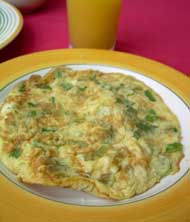
of the A.M. Costa Rica staff When visitors to Costa Rica turn up their nose at the concept of Tico food, its because they have not looked hard enough. Those who come to San José can find a wide assortment of great typical food at a place like the Central Market or Mercado Central. At one time this was where most food transactions took place. The building itself is an historic site. The structure is on the Avenida Central pedestrian mall not far west of the Banco de Costa Rica. Tourists and locals alike will find that gallitos, a typical Tico canape or snack, is available here at the several sodas or inside lunch counters. Around the eating spots, daily commerce takes place. The smell of leather goods, flowers and all kinds of foods and plants fill the air. Inside, the gallito you can get a chile relleno (a filled pepper), an almuerzito de repollo (cabbage), tortas de huevo con cebollin (a scallion omelette) a barbudos (string bean omelette), a canellone ticos rellenos de carne (pasta stuffed with meat) or an enyucada with beef as well as cheese. The last is meat or cheese wrapped in yucca and deep fried. There also are empanadas, pastry stuffed with meat, chicken, beans, potatoes with meat and/or cheese, all good food anytime of the day. The word soda has a unique Costa Rica usage for a luncheon spot or snack bar. The stands are small with some inside tables surrounded by a counter with stools. As you eat, you can see the food being prepared. The Mercado Central is operated by the municipality, so proper food preparation can be expected. One well-known place is the Soda San Bosco at the western part of the Mercado Central. It is run by Luis Garcia Campos and his family. They have had the location for at least 30 years. Even though the place is small, it is very popular with locals. Garcia said the reason for the popularity is the freshness of the food, the friendly and quick service and the prices. You can drink the juice of different kinds of fruits for 350 colons (62 U.S. cents), a coffee for 400 colons (71 cents), a gallito of chile relleno, canelloni or barbudos just for 600 colons ($1.06), the gallo de salchichon (sausage) with salad and tortillas for 500 colons (89 cents) as well the similarly priced empanadas, enyucadas and torta de huevo.  A.M. Costa Rica/Saray Ramírez
Vindas
Luis Garcia Campos at his Soda San Bosco |
 |
||||||
 |
|||||||
| These spaces are reserved for the country's better restaurants |
|||||||
Take your gourmet cooking to the next level! 5234-cb17
World's finest 5-star restaurant secret
recipes
Discover the secret recipes from the world's finest restaurants and
cook 5-star dinners at home for a fraction of the cost! Make your
friends and family go all wild and gaga over your food at the next
bash, party or gathering. HERE!5232-cb15
Top ten candy recipes.
Learn how to cook some of the best tasting candy recipes in less than
an hour. Any recipe can be fixed in less than an hour with no more than
eight ingredients! All of these candy recipes have been perfected to a
point where even people who dislike major ingredients in some candies
can't get enough of our unique taste and flavors! HERE!5233-cb16
Make your own GREAT beer!
Did you know that it REALLY is pretty easy to make a great tasting home
brewed beer in your own kitchen? You might find it hard to
believe
after the bad experiences you might have had or heard about from your
friends. Learn how to brew your own beer with the BeerEasy.com video
training series. Training includes videos on extract brewing, all grain
brewing, original home brewing recipes, Brew your own beer today for a
lot less than what C ervercería Costa Rica charges for Imperial
Visit BeerEasy.com!5235a-cb18
Food- and entertainment-related events and
times are eligible for placement here at the usual classified rates.
See how to place a classified HERE!
|
|||||||
| The
plantain is a fruit that has triple flexibility in kitchen |
|
|
By the A.M. Costa Rica staff
The culinary landscape of pre-conquest America lacked some of the foods taken for granted today. There was no sugar. That was imported by Columbus on his second voyage. The delicious mango did not grow here. And the banana did not come to the Americas until the 16th century. Even the ubiquitous rice plant is a colonial import. Despite being imported, these plants flourished here. And no Costa Rican meal is complete without rice. The plantain, called plátano, also makes up a flexible part of the diet. The flexibility is in the use of green plantains as a starchy potato or rice substitute and the use of the mature fruit in ways to take advantage of its sweetness. The plantain is larger than the typical table banana. Its uses differ depending on the maturity. The green plátano can be cooked like a potato, grated into flour or fried to make chips. The patacone, a double-fried disc of plantain traditionally is decorated with refried beans, mayonnaise and avocado dip. Compared to the rest of the world, Costa Rica is fairly conservative in using the plátano. Asian cooks are far more creative. For most, the mature, almost black-skinned plátano comes fried as one of the regulars in the luncheon casado. They are called maduros and give off their sweetness when fried in hot oil. Nutritional content varies slightly depending on the maturity of the plantain. A green plantain, about 220 grams or about half a pound, is about 360 calories with no calories from fat. A ripe fruit is slightly less, about 340 calories. The 2 gram sugar content of the green fruit increases to about 10 grams in the mature plantain. Both are reported to be a good source of potassium, dietary fiber, vitamin A and vitamin C. The non-fat label is a bit misleading because many of the great plantain recipes call for deep frying. A good source of recipes is the Turbana cooperative Web site. The company features dishes for all three plátano stages. |
 Typical display of green plátanos
Among these are plantain pancakes, mashed green plantains, fried plantains and several desserts. Those who love patacones should know that some gourmet stores sell a press to make uniform discs. Others sell a product to fabricate a small plátano shell into which condiments can be spooned. At home, the once-fried quarters of plantain can be pressed with the bottom of a bottle or some other hard object. They need to be reduced to about a quarter inch before deep frying again. |
| Chemical
seen leaching from polycarbonate bottles to humans |
|
|
By the Harvard School of Public Health
news service
Researchers have found that persons who drink from polycarbonate bottles have a higher level of chemical bisphenol A , which is used in producing the containers. Exposure to bisphenol A, used in the manufacture of polycarbonate and other plastics, has been shown to interfere with reproductive development in animals and has been linked with cardiovascular disease and diabetes in humans. The researchers were led by Jenny Carwile, a doctoral student in the department of epidemiology at Harvard School of Public Health, and Karin B. Michels, an associate professor of epidemiology. Researchers recruited Harvard College students for the study in April 2008. The 77 participants began the study with a seven-day washout phase in which they drank all cold beverages from stainless steel bottles as a control. Participants provided urine samples during the washout period. They were then given two polycarbonate bottles and asked to drink all cold beverages from the bottles during the next week. Urine samples were also provided during that time. The results showed that the participants' urinary bisphenol A concentrations increased 69 percent after drinking from the |
polycarbonate bottles. The study
authors noted that concentrations in
the college population were similar to those reported for the U.S.
general population. Previous studies had found that bisphenol A
could
leach from polycarbonate bottles into their contents. This study is the
first to show a corresponding increase in urinary concentrations in
humans. One of the study's strengths, the authors note, is that the students drank from the bottles in a normal setting. Additionally, the students did not wash their bottles in dishwashers nor put hot liquids in them. Heating has been shown to increase the leaching of Bisphenol A from polycarbonate. Canada banned the use of bisphenol A in polycarbonate baby bottles in 2008 and some polycarbonate bottle manufacturers have voluntarily eliminated the chemical from their products. With increasing evidence of the potential harmful effects of Bisphenol A in humans, the authors believe further research is needed on the effect of Bisphenol A on infants and on reproductive disorders and on breast cancer in adults. In addition to polycarbonate bottles, which are refillable and a popular container among students, campers and others and are also used as baby bottles, bisphenol A is also found in dentistry composites and sealants and in the lining of aluminum food and beverage cans. In bottles, polycarbonate can be identified by the recycling number 7. |
|
|
|
|
|
|
|
|
| What we published this week: | Monday | Tuesday | Wednesday | Thursday | Friday | Earlier |
| The contents of this page and this Web site are copyrighted by Consultantes Río Colorado 2001, 2002, 2003, 2004, 2005, 2006, 2007 and 2008 and may not be reproduced anywhere without permission. Abstracts and fair use are permitted. Check HERE for details | ||||||