|
|
A.M. Costa Rica
Your daily English-language news source Monday through Friday |
||
 |
 |
 |
|
|
 |
|||||||||||||||||||
|

|
||||||||||||||||||
 |
|||||||||||||||||||
|
|
||||||||||||||||||
 |
 |
| What we published this week: | Monday | Tuesday | Wednesday | Thursday | Friday | Earlier |
|
|
|
|
|
|
|
Food |
|
Jo
Stuart |
|
|
| A.M. Costa Rica's Second news page | |||||||||
| San José, Costa Rica, Wednesday, May 23, 2012, Vol. 12, No. 102 | |||||||||
|
|
|
|
|
|
|
Food |
|
Jo
Stuart |
 |
 |
 |
|
Legal system
very far
from purported virtues Dear A.M. Costa Rica: As a frequent reader of A.M. Costa Rica and former resident of Costa Rica, I had to chuckle when I read the Ministerio de Relaciones Exteriores y Culto statement extolling the virtues and ethics of the legal system in Costa Rica. He was talking about Paul Watson and how the court will treat him fairly. Yeah, right. I guess the legal system works for lawyers that scam property transactions or lawyers that draw out court proceedings on property disputes. And the judges that allow it. Also Costa Rica is treading on very thin ice as a country that promotes its self as environmentally friendly but looks the other way when shark fining is going on in plain sight. PERTOMA shined a light on that activity. I think Paul Watson will stay out of Costa Rica as will many more tourists when they learn of the virtues of the Costa Rican legal system. Kevin Burdock
Columbus, Ohio The end does not justify the means used by Watson Dear A.M. Costa Rica: I have been following the escapades of Paul Watson for the past few years and find him an interesting character, but not one without fault. I applaud Costa Rica for demanding he return to Costa Rica in person for a trial to clear his name. They would make the same demand for me and you if we had skipped bail, as they have for former presidents of the country! I am all for protecting whales, dolphins, lions, tigers and bears, oh my. But more importantly I am for protecting the order of law. Costa Rica is a country of peace, and Mr. Watson and his followers regularly state on their TV program " the only way to stop us is to sink us!" Hardly a peaceful bunch. In the 18th and 19th centuries the West Indian Trading Company would have hung them! Mr. Watson feels he can sail his ships around the world with impunity and harass fishermen despite the fact that what they are doing, while perhaps morally against what you or I believe in, is legal in the waters where the whales are hunted and often part of the culture of the people hunting the animals. Regardless of my personal disdain for whaling, I am offended at his self righteousness and the absurd claim that Costa Rica would allow the shark finning mafia to kill him if he was put in prison there. Come on, be realistic, I doubt a man of his celebrity would suffer such a fate, and, indeed, if he would be imprisoned at all, except, of course, he did skip bail the last time. As far as the tape he has showing the conflict with Costa Rican fishermen, I ask who gave him the right to stop a vessel of a sovereign nation from doing anything legal or illegal. Shark finning is a horrible act, but he is not an arm of any law enforcement entity as I know. In fact, his actions and those of his crew are close to piracy and certainly amount to nothing more than vandalism. The right of law is more important. The end does not justify the means. I believe Mr. Paul Watson may have began his crusade with great intention many years ago. Today he is motivated by self importance, and financial gain. He has a TV show after all that must have new adventures to maintain ratings and support his fantasy as a savior of the environment. Don't worry about Mr. Watson. Be concerned about the rights of others and yours as well. Where does it stop if he is not held accountable for his acts. Patrick
Mach
St. Augustine, Florida, and La Uruca
|
|||||||||||||||||||||||||||||||||||||||||
 |
||||||||||||||||||||||||||||||||||||||||||
|
|
|
|
|
|
|
Food |
|
Jo
Stuart |
| What we published this week: | Monday | Tuesday | Wednesday | Thursday | Friday | Earlier |
| The contents of this page and this Web site are copyrighted by Consultantes Río Colorado 2012 and may not be reproduced anywhere without permission. Abstracts and fair use are permitted. Check HERE for details | ||||||
 |
 |
|
| A.M. Costa Rica Third
News Page |
|
| San José, Costa Rica, Wednesday, May 23, 2012, Vol. 12, No. 102 | |
|
|
|
|
|
|
|
Food |
|
Jo Stuart |
| Los Yoses walking tour promises a visit
to the 1950s and 1960s |
|
|
By
the A.M. Costa Rica staff
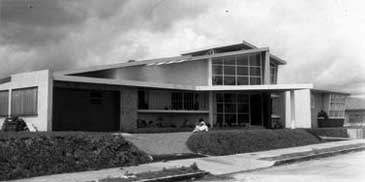
Los Yoses east of San José is best known as the location of the Centro Cultural Costarricense Norteamericano where thousands of Ticos have learned English. The area also is known as the present site of a supermarket and the building called Subaru, although that car dealer has moved operations elsewhere. There is a former coffee plantation divided by Avenida Central. The majority of the area is within the Municipalidad de Montes de Oca. But there is plenty of history here, and Alliance Française is organizing one of its walking tours with architect Andrés Fernández to prove the point. The title of this trek is “La Modernidad Josefina: El Barrio Los Yoses.” The French cultural organization and Fernández have covered San José neoclassical, barrios, the surprisingly historic Barrio México and the churches of the downtown. The excursion into Los Yoses is June 9, starting at 9 a.m. from the Instituto Cultural Mexicano, which is 250 meters south of Subaru. This is by no means a colonial area. Until about 1947 the land was the Los Yoses coffee farm that was the property of Francisco Montealegre. The name comes from the yos tree (Sapium glandulosum), which grew in the area. According to Alliance, it was not until after the 1942 death of Montealegre that his heirs began to develop the area, first along what is now Avenida Central, the four-lane main drag. Young architect Jorge Borbón Zeller and some of his other foreign educated contemporaries found the area perfect for developing their modern style with straight lines and large windows. They designed many fine homes, and the area was an upscale neighborhood. Some sections, such as Barrio Dent, still are. Los Yoses stretches to the south to the Río Ocloro and to the east to the Circunvalación highway. A major structure is the Mall San Pedro and the famous Fuente de Hispanidad at the |
 Photo via Alliance Française
Church of Nuestra
Señora de Fátima Photo
via Alliance Française
Photo of supermarket
appears to be from the 1960s. Thestore still is in operation. mall traffic circle. Alliance says that the barrio contains the biggest accumulation of international style architecture to be found in the Central Valley. Other architectural points of interest include the church of Nuestra Señora de Fátima and a multi-story structure for the Institute Costarricense de Electricidad. Alliance is soliciting reservations for the guided tour. The walk ends back at the Mexican institute for lunch and a discussion. Those interested can contact the organization at its three offices, Barrio Amón, La Sabana and Heredia. |
| Four more held in double murder of
Austrian expats in the Osa |
|
|
By
the A.M. Costa Rica staff
Investigators have detained four more persons in the Christmas 2009 murder of two Austrian expats in Puerto Jiménez on the Osa peninsula. One of those detained is a police officer. The Poder Judicial said Tuesday that genetic tests from the mother and sister of one of the victims was key in identifying his remains. Agents believe the motive was to obtain ownership of the real estate, vehicle and other belongings of the men. In fact, one of the suspects was driving the expats' car shortly after the pair went missing. The victims are Horse Hauser, 67, and Herbert Langmaier, 65. they lived in Dos Brazos de Río Tigre, Puerto Jiménez. Hauser had been living here for at least 20 years. Both come from the same Austrian town. Agents have been on the case since the men disappeared, but there was little they could do without a body. They did find blood in the home the men shared. But it was not until March |
2011 that a bag containing bones
washed up in Playa Ciénaga. The bag
was found by persons collecting rocks at the beach near Puerto
Jiménez. The remains of Hauser were identified shortly thereafter with the help of Austrian authorities, said the Poder Judicial. Langmaier's remains were those that have just been identified. An autopsy showed that both men suffered blows to the head. Agents detained one man, identified by the last names of Rojas Santamaría, last Sept. 25. He has been in preventative detention since. He is believed to be the man who administered the fatal blows. Agents detained a woman with the last name of Rojas, a sister of the man already in custody Monday afternoon in Dos Brazos. She is 29 years old. A 33-year-old man with the last name of Muñoz was detained at the same time by agents of the Judicial Investigating Organization. Also detained was a man with the last name of Murillo. He is 24. The police officer, who has the last name of Obando, was detained at work in the police station in Pital de San Carlos, Alajuela. |
 |
| You need to see Costa Rican tourism information HERE! |
|
|
|
|
|
|
|
Food |
|
Jo
Stuart |
| What we published this week: | Monday | Tuesday | Wednesday | Thursday | Friday | Earlier |
| The contents of this page and this Web site are copyrighted by Consultantes Río Colorado 2012 and may not be reproduced anywhere without permission. Abstracts and fair use are permitted. Check HERE for details | ||||||
 |
 |
||||
| A.M. Costa Rica's Fourth News page | |||||
| San José, Costa Rica, Wednesday, May 23, 2012, Vol. 12, No. 102 | |||||
|
|
|
|
|
|
|
Food |
|
Jo
Stuart |
| Lawmakers move to ban sale or rental of
liquor licenses |
|
|
By
the A.M. Costa Rica staff
Legislators again passed an update of the law regulating the sale of alcohol Tuesday. The bill was one of three given an initial approval during the Asamblea Legislativa's afternoon session. Lawmakers also passed measures addressing online crimes and drugs and money laundering. The big change in the alcohol measure is that those who have alcohol licenses are prohibited from selling, renting or otherwise putting them in the hands of another party. Such activity is usual here, and many popular nightspots run on a rented liquor license. Lawmakers called this a black market. The bill received passage earlier, but the Sala IV constitutional court on review found a number of flaws that have been addressed. The measure also increases what license holders pay to the municipality. Some licensees have been paying as little as 75 colons every three months. The bill retains the E license that allows alcohol sales 24 hours a day in establishments that receive approval from the Instituto |
Costarricense de Turismo, such as
hotels, restaurants and casinos. In all there are five major
categories of licenses. The Internet bill outlines online crimes that are not addressed by other laws and provides a prison term of from three to eight years for corrupting minors with pornography and from four to 10 years for using the Internet to arrange sexual encounters with minors. Another section provides three to six years in prison for intercepting or using online communications, photos or data. These acts are characterized as damage to intimacy or privacy. The money laundering and drug measure provides for the speedy distribution of money and goods that are confiscated during police actions. Now there is a long wait while the criminal case is adjudicated. The new rules provide for the sale with the provision that if the individual is acquitted of the crime, the goods will either be restored or compensation will be made. All of the proposed laws require a second vote, although there does not seem to be any strong opposition. Each probably will be challenged in the Sala IV, too. And the Internet bill may prove to be unenforceable because of the universal nature of online activities. |
|
Discovery of
intact tomb
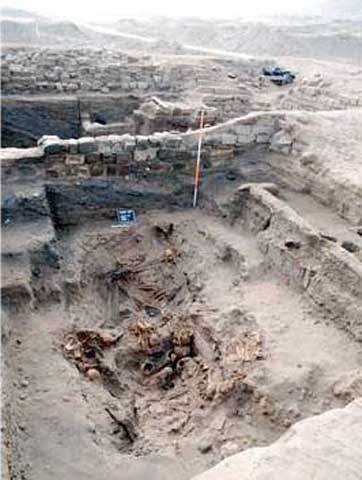
made at famous Peruvian site By the Université libre de Bruxelles news staff European archaeologists have discovered a pre-Columbian tomb in Perú with more than 80 bodies. The tomb is from the year 1000, the researchers said. It is at the famous Pachacamac site about 30 kilometers (19 miles)_ from Lima. Peter Eeckhout, a professor in the Faculté de Philosophie et Lettres, at the Brussels, Belgium, university has been working at the site. The oval tomb is about 20 meters in length, more than 60 feet, and was reported to be intact. There has been no incursions by grave robbers, said the university. The discovery raised a lot of questions that researchers are trying to answer. There were at least a dozen infants in the tomb. Scientists speculated that many might be from the same genetic line or that the individuals were the result of some form of epidemic. There also is the possibility that the tomb was used for a long period. The Pachacamac complex is being studied for inclusion in the U.S. list of world heritage sites. |
 Université libre de Bruxelles photo
This is the site near the
Pachacamac temple. |
| Proposed rules published for compliance
with anti-tobacco law |
|
|
Special
to A.M. Costa Rica
The Ministry de Salud has published proposed rules to enforce the new tobacco control law that was published March 26. If approved by President Laura Chinchilla Miranda, the 79- page document will end any lingering doubts on the part of businesses and individuals as to their rights and obligations under the law. Many were surprised when the ministry issued a sweeping ban on public smoking just weeks after the law was passed, instead of waiting the full six months provided by the law. Proposed rules reaffirm the smoking ban and require in some circumstances larger non-smoking signs. One article explains exactly how visually impaired and blind persons must be informed of the prohibition. The document continually cites the explicit, legal right of non-smokers to enjoy public spaces free of tobacco. There is no mention of any rights for smokers. Implications exist for business owners and employers. Under the law they can be fined for failure to protect the rights of non-smokers. The health ministry also would set up a national registry of unpaid fines. Companies listed there might not be able to renew business licenses and permits. Employers would also have obligations under the proposed rules. The prohibition and sanctions on employees smoking at work would have to be documented in policy manuals, and it would be possible to fire an employee for smoking at work. Employers would also be required to give time off for employees to attend smoking-cessation programs. The national health care system or Caja must pay for and offer these programs, which would be accredited by the health ministry. |
Public schools would also educate
children as to the dangers of tobacco use. The bulk of the proposed rules actually deal with the marketing and sale of tobacco products. Businesses that sell tobacco would essentially be forced to make the product both invisible and inaccessible to customers. For example, grocery stores would have to put opaque covers on the cigarette bins, and a cigar store might comply by installing locks and opaque glass on their humidors. The law effectively ends any kind of tobacco brand recognition, apart from word of mouth promotion. Even cigarette packages would consist of more space for warning labels than brand name. Advertising is prohibited. The proposed time for compliance is between three and 12 months from publication of the final rules. The enforcement of a similar Spanish law has reduced the percentage of smokers from 40.3 percent to 35.3 percent and consumption among the working population, a report said this week. This decline applies to men and women of all ages and occupations. A pioneering study, carried out by the Society of Prevention of Ibermutuamur, an insurance organization, analyzed the consumption of tobacco in the working population during the first months of application of the law. This law extended the smoking ban to all enclosed public spaces, including bars and restaurants. Between 1 July 2009 and 30 June 2011, the development of the percentage of smokers and tobacco consumption in a sample of 413,473 workers of all ages and occupations was assessed. The conclusions are published this month in the journal Revista Española de Salud Pública. |
|
|
|
|
|
|
|
Food |
|
Jo
Stuart |
| What we published this week: | Monday | Tuesday | Wednesday | Thursday | Friday | Earlier |
| The contents of this page and this Web site are copyrighted by Consultantes Río Colorado 2012 and may not be reproduced anywhere without permission. Abstracts and fair use are permitted. Check HERE for details | ||||||
| A.M.
Costa Rica's Fifth news page |
 |
||||||||
| San José, Costa Rica, Wednesday, May 23, 2012, Vol. 12, No. 102 | |||||||||
|
|
|
|
|
|
|
Food |
|
Jo
Stuart |
 |
| Facebook
public offering getting more scrutiny By
the A.M. Costa Rica wire services
Massachusetts' state secretary, the state's top securities regulator, has subpoenaed investment firm Morgan Stanley over allegations it may have withheld information about the future revenue of Facebook. Shares in the world's most popular social network were sold in an initial public offering Friday at $38 each. The price of Facebook stock has since dropped to $31 a share - more than 18 percent. The Reuters news agency reported Tuesday that analysts with Morgan Stanley, the top underwriter of Facebook stock, revised their revenue outlook downward in the days before Facebook went public. The revision was based on a stock prospectus issued by Facebook. Reuters reports the analysts allegedly shared that information with large investors but held it back from small investors who bought Facebook stock at $38, expecting the price to rise. The Securities and Exchange Commission and Financial Industry Regulatory Authority have called for a review of Facebook's public offering. Private rocket into space finally achieves liftoff By
the A.M. Costa Rica wire services
The private U.S. company Space Exploration Technologies, known as SpaceX, successfully launched its Falcon 9 rocket and reusable Dragon space capsule from Cape Canaveral in Florida before dawn Tuesday. "Three, two, one, zero and launch of the SpaceX Falcon 9 rocket, as NASA turns to the private sector to resupply the International Space Station," announced NASA launch commentator George Diller as the rocket, carrying the Dragon space capsule, soared into the dark sky, creating a blaze that made it look like a six-pointed star. The unmanned Dragon capsule is heading to the International Space Station, an orbiting lab that zooms around the Earth at more than 32,000 kilometers per hour. It is the first time a private spacecraft has attempted to catch up to the orbiting lab, a feat that has only been achieved by the United States, Russia, Europe and Japan. NASA Administrator Charlie Bolden grinned as he spoke to journalists at the Kennedy Space Center in Florida after the successful launch. "The significance of this day cannot be overstated," said Bolden. "A private company has launched a spacecraft to the International Space Station that will attempt to dock there for the first time. And, while there is a lot of work ahead to successfully complete this mission, we are certainly off to a good start, and I hope you would all agree on that." SpaceX CEO Elon Musk watched the launch from company headquarters in California, and he spoke to reporters at a post-launch news conference at the Kennedy Space Center via video conference. Musk said his adrenaline was pumping at launch time. "There is so much hope riding on that rocket, so when it worked and Dragon worked and the solar arrays deployed, people saw their handiwork in space and operating as it should. I mean it was tremendous elation," Musk said. "I mean, it is like, I guess, for us, it is like winning the Super Bowl," he added, referring to the championship game of American pro football. If all goes according to plan, the space station crew will use the station's robotic arm to capture the Dragon for docking on Friday. The Dragon is carrying more than 500 kilograms of cargo, including commemorative patches, clothing, meals and student experiments. Nothing is considered critical to the space station's crew. Astronauts will then load up Dragon with items they no longer need and, if all goes well, the space capsule will splash down in the Pacific Ocean, west of California, May 31. NASA has invested more than $380 million in SpaceX's commercial cargo capabilities. SpaceX has a $1.6 billion NASA contract to handle 12 missions to resupply the ISS. SpaceX officials say those flights could begin later this year. Tuesday's successful launch comes three days after a launch attempt was aborted at the last second when the flight computer detected slightly high pressure in an engine combustion chamber. SpaceX engineers later discovered and replaced a faulty check valve. The U.S. space agency is looking to private companies to handle low-Earth orbit transportation so NASA can focus on developing the next generation of spacecraft that can go to destinations beyond, such as asteroids or Mars. |
|
||||
|
|
|
|
|
|
|
Food |
|
Jo
Stuart |
| What we published this week: | Monday | Tuesday | Wednesday | Thursday | Friday | Earlier |
| The contents of this page and this Web site are copyrighted by Consultantes Río Colorado 2012 and may not be reproduced anywhere without permission. Abstracts and fair use are permitted. Check HERE for details | ||||||
| A.M.
Costa
Rica's sixth news page |
|
|||||||||
| San
José,
Costa Rica, Wednesday, May 23, 2012, Vol. 12, No. 102 |
||||||||||
|
|
|
|
|
|
|
Food |
|
Jo
Stuart |
 |
Latin America news |
INBio planning to
count
its variety of wild things Special
to A.M. Costa Rica
The Instituto Nacional de Biodiversidad, known as INBio, is marking international biodiversity day with an activity this weekend at its park in Santo Domingo de Heredia. The so-called “bio-blitz” will catalog as much of the outdoor facility’s animal and plant life as possible in a 24-hour period. With the participation of the public, the institute’s researchers will make identifications. Certain biological classes will be covered with their respective experts in two-hour blocs during the 24-hour run. The schedule is HERE! The nighttime hours are dedicated to insects. The Bioblitz activity starts at noon Saturday and continues overnight to noon Sunday. Entrance for adults is 3,750 colons, children up to 12 years pay 2,600, and seniors pay 3,000. Usual weekend park hours are 9 a.m. to 5:30 p.m. with last admission at 4 p.m. Admission after 3:30 p.m. has a reduced rate. The park is also open to the public Fridays from 8 a.m. to 5 p.m. with last call at 3 p.m. The format is similar to a recreational bird watching activity where a team attempts to see or hear as many species in a day as possible. The record 308 in Costa Rica is the second highest in the world after Perú. Country wants to join group with black list By
the A.M. Costa Rica staff
President Laura Chinchilla Miranda told an international financial organization that Costa Rica was ready to join, according to Casa Presidencial. She was speaking in Paris, France, before the Organization for Co-operation and Economic Development. The organization says that its mission is to promote policies that will improve the economic and social well-being of people around the world. However, it made Costa Rica nervous when it put the country on a black list as a tax haven in 2009. Costa Rica has been working to change that by creating systems so that individual financial information here is more accessible to tax-collecting agencies around the world. The president is on a two-week European tour. She visits Germany today. |
|
Latin
American news feeds are disabled on archvied pages.
|
|
| Costa Rican News |
AMCostaRicaArchives.com |
Retire NOW in Costa Rica |
CostaRicaReport.com |
|
|
|
|
|
|
|
Food |
|
Jo
Stuart |
| What we published this week: | Monday | Tuesday | Wednesday | Thursday | Friday | Earlier |
| The contents of this page and this Web site are copyrighted by Consultantes Río Colorado 2012 and may not be reproduced anywhere without permission. Abstracts and fair use are permitted. Check HERE for details | ||||||